Command Palette
Search for a command to run...
쿼터니언 생성적 적대 신경망
쿼터니언 생성적 적대 신경망
Eleonora Grassucci Edoardo Cicero Danilo Comminiello
딥 컨볼루션 생성적 적대 신경망
초록
최신 생성적 적대 신경망(GANs)은 대규모 학습을 통해 뛰어난 결과를 거두며, 수백만 개의 매개변수로 구성된 모델을 활용하고 있어 광범위한 연산 능력을 요구하고 있습니다. 이러한 거대 모델의 구축은 재현성을 저해하고 학습 불안정성을 증가시킵니다. 또한, 이미지나 오디오와 같은 다채널 데이터는 일반적으로 실수 값 합성곱 신경망을 통해 처리되며, 이때 입력이 평탄화되고 연결되어 채널 내 공간적 관계가 종종 손실됩니다. 이러한 복잡성 및 정보 손실과 관련된 문제들을 해결하기 위해, 우리는 쿼터니온 값 생성적 적대 신경망(QGANs)의 일족을 제안합니다. QGANs는 해밀턴 곱과 같은 쿼터니온 대수의 성질을 활용하여 채널을 단일 엔티티로 처리하고 내부 잠재적 관계를 포착할 수 있으며, 전체 매개변수 수를 4분의 1로 줄입니다. 우리는 QGANs를 설계하는 방법과 제안된 접근법을 고급 모델로 확장하는 방법을 보여줍니다. 제안된 QGANs를 여러 이미지 생성 벤치마크에서 실수 값 대안 모델들과 비교합니다. 결과는 QGANs가 실수 값 GANs보다 더 우수한 FID 점수를 얻고 시각적으로 만족스러운 이미지를 생성할 수 있음을 보여줍니다. 또한, QGANs는 최대 75%의 학습 매개변수를 절약합니다. 이러한 결과들이 성능을 개선하고 연산 자원을 절약할 수 있는 더 접근 가능한 새로운 GANs의 길을 열 것으로 믿습니다.
One-sentence Summary
The authors propose quaternion generative adversarial networks (QGANs), which leverage quaternion algebra to process multi-channel data as unified entities, preserving intra-channel spatial relationships while reducing trainable parameters by up to 75 percent and achieving superior FID scores compared to real-valued counterparts on several image generation benchmarks.
Key Contributions
- The paper introduces a family of quaternion-valued generative adversarial networks (QGANs) that apply quaternion algebra to process multichannel inputs as a unified entity. This formulation captures internal latent relations and reduces the total parameter count by up to 75 percent relative to real-valued architectures.
- A theoretically rigorous quaternion batch normalization (QBN) layer is defined for hypercomplex activations, establishing that prior normalization methods function as mathematical approximations of this exact formulation.
- The architecture integrates quaternion spectral normalization (QSN), which is validated on image generation benchmarks to enhance training stability. Models employing this technique, including the quaternion spectral normalized GAN, achieve improved FID scores and visual quality while utilizing only 25 percent of the parameters required by real-valued baselines.
Introduction
Modern generative adversarial networks have achieved remarkable results in image and audio synthesis, but their practical deployment is constrained by massive parameter counts, steep computational costs, and inherent training instability. Standard real-valued architectures further limit performance by processing multi-channel inputs as independent vectors, which severs critical intra-channel spatial relationships. To overcome these bottlenecks, the authors introduce Quaternion Generative Adversarial Networks (QGANs), a framework that operates entirely within quaternion algebra. By leveraging Hamilton products to treat multi-channel data as a unified entity, QGANs preserve internal structural correlations while reducing parameter counts by up to seventy-five percent. The authors also formally define quaternion batch normalization and spectral normalization, demonstrating that this hypercomplex approach consistently yields superior image generation quality with significantly lower computational overhead than real-valued counterparts.
Method
The framework for quaternion-valued generative models is built upon a foundation of quaternion algebra, which extends complex numbers to four dimensions and introduces a non-commutative multiplication rule known as the Hamilton product. This algebraic structure is leveraged to define the core components of a generative adversarial network (GAN) in the quaternion domain. The overall architecture is designed to process data as a single entity, preserving the intrinsic relationships between its components. The framework diagram illustrates that the input, whether an image or another multidimensional signal, is first represented as a quaternion. For images, this involves encapsulating the red, green, and blue channels into the imaginary components of a pure quaternion, with the scalar part set to zero. This unified representation allows the network to process the data as a cohesive unit, in contrast to traditional real-valued networks that treat channels independently. The processing proceeds through a series of quaternion-valued layers, including fully connected and convolutional layers, which are constructed using the Hamilton product to maintain the quaternion structure. The architecture also incorporates specialized modules such as quaternion batch normalization and quaternion spectral normalization to stabilize training. The generator network produces quaternion-valued samples, which are then evaluated by the discriminator to determine their authenticity. The entire process, from input representation to the final decision, is designed to be consistent with the properties of quaternion algebra.
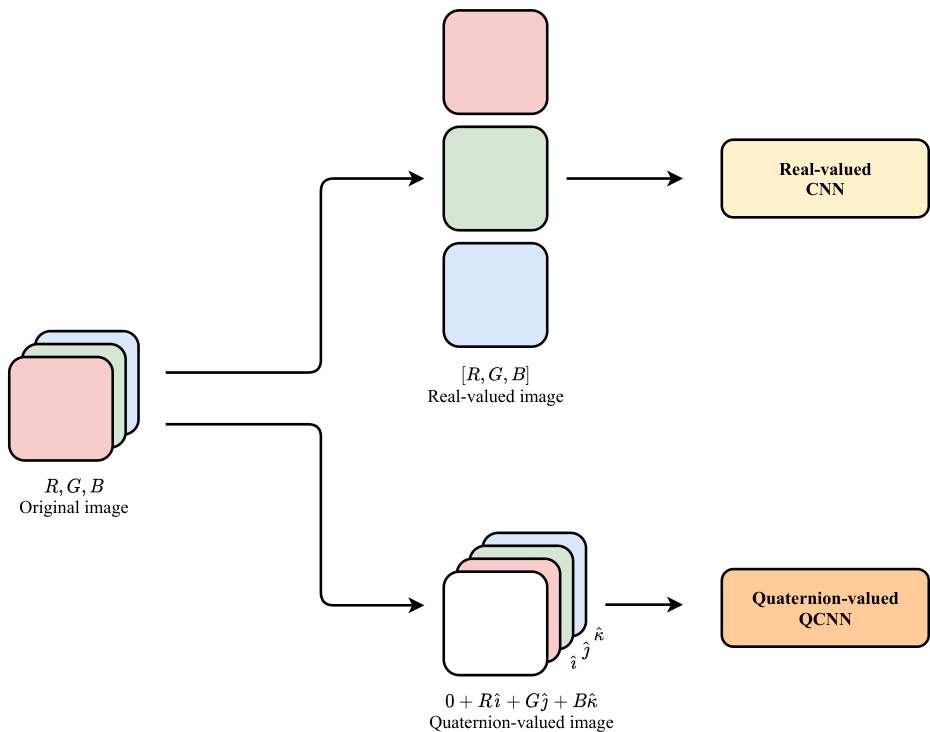
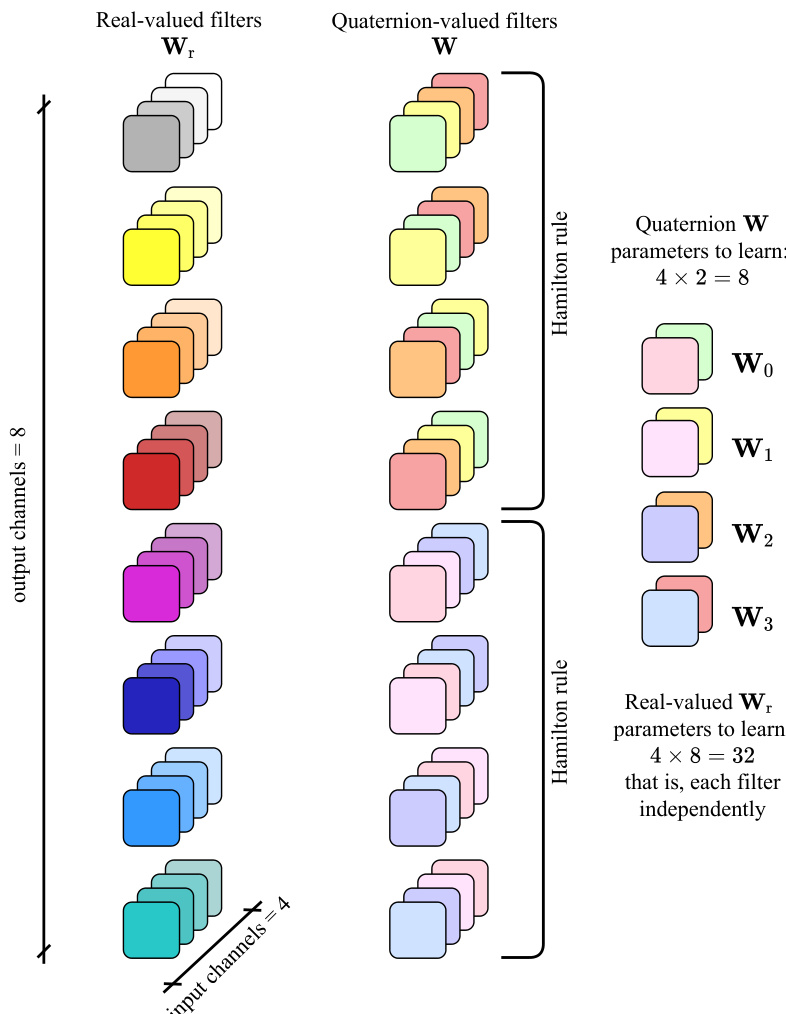
The fundamental building blocks of the network are the quaternion fully connected and convolutional layers. In a quaternion fully connected layer, the input and weight matrices are each represented as quaternions, composed of four real-valued submatrices corresponding to their scalar and three imaginary components. The layer's output is computed by applying the Hamilton product to the input and weight quaternions. This operation is defined as a sum of a scalar part, which is the product of the scalar components minus the dot product of the vector parts, and a vector part, which is the sum of the scalar times the vector, the vector times the scalar, and the cross product of the vectors. The result is a quaternion that is then added to a quaternion bias, also composed of four submatrices. An activation function, such as ReLU, is applied element-wise to each component of the resulting quaternion, a process known as a split activation. This design ensures that the output dimensionality matches that of the corresponding real-valued layer, but with a significant reduction in the number of parameters, as the submatrices are shared across the quaternion components. Similarly, quaternion convolutional layers use the same principle, where the convolution operator is replaced by the Hamilton product. This allows the network to learn both the spatial relationships between pixels and the inter-channel relationships simultaneously, as the filters are shared across the input components. The architecture diagram shows that the generator uses a series of transposed convolutions to upsample the input, while the discriminator uses standard convolutions to downsample the image, both processing the data in a quaternion-valued manner.
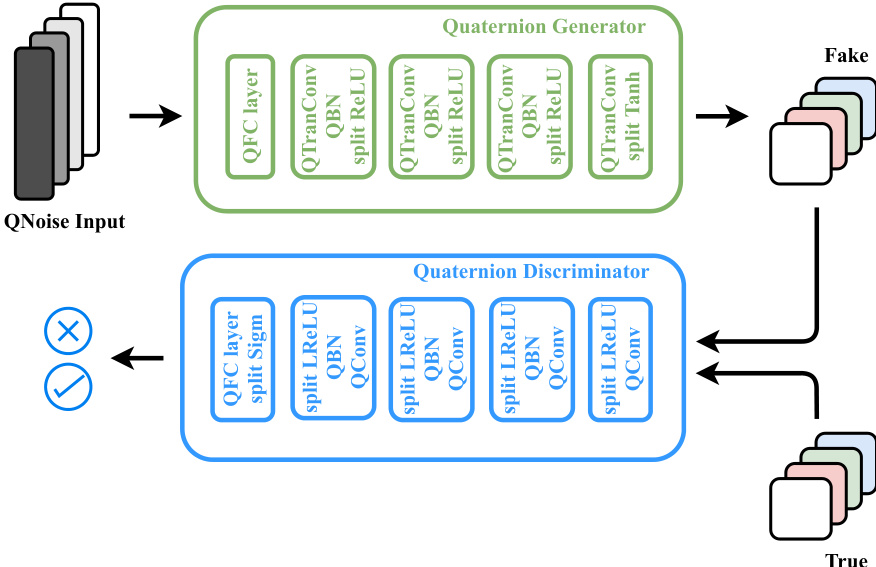
The training process for the quaternion GAN follows the standard adversarial framework, where a generator network learns to produce realistic samples while a discriminator network learns to distinguish between real and fake data. The generator takes a quaternion noise signal as input and generates a batch of quaternion-valued images. The discriminator takes both real and fake samples as input and outputs a decision on their authenticity. The network is trained by optimizing an objective function, such as the cross-entropy or hinge loss, which is redefined for quaternions by applying the function element-wise to each of the four components. The architecture is designed to be efficient, with the generator and discriminator networks being symmetric in structure but with different operations to upsample and downsample the data. The generator uses transposed convolutions and the discriminator uses standard convolutions, both processing the data as quaternions. The network also includes batch normalization and spectral normalization to improve training stability and convergence. The architecture diagram shows that the generator consists of a series of quaternion transposed convolution layers, each followed by a quaternion batch normalization layer and a split ReLU activation function, with the final layer using a split Tanh function to output the generated image. The discriminator has a similar structure, but with standard convolutions and a final fully connected layer that outputs a real/fake decision using a split sigmoid activation.
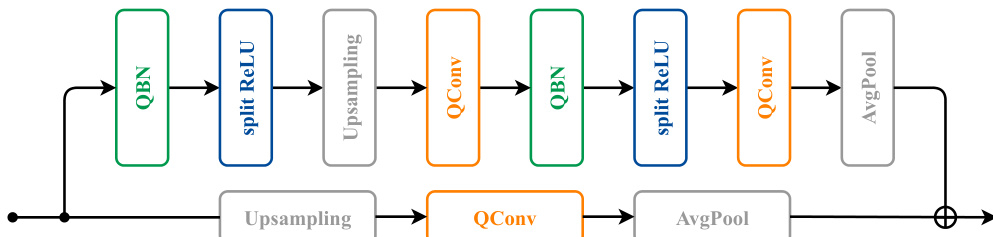
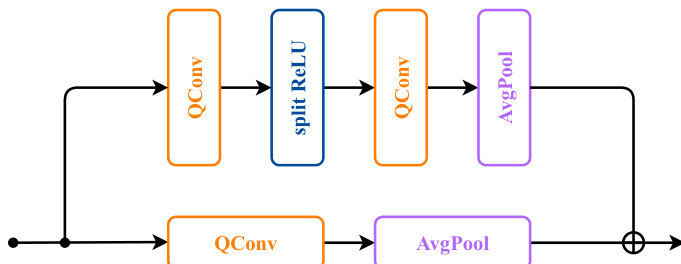
The network incorporates several specialized modules to handle the unique properties of quaternion data. Quaternion batch normalization (QBN) normalizes the inputs to have zero mean and unit variance, which helps to improve the generalization ability of the network and speed up convergence. This is achieved by computing the mean and variance of each component of the quaternion and normalizing the input accordingly. The network also uses quaternion spectral normalization (QSN) to stabilize training by constraining the Lipschitz constant of the discriminator. This is done by normalizing the weight matrices of the network to have a spectral norm of one. The QSN method proposed in the paper normalizes the entire weight matrix together, considering the relations among the quaternion components, which is theoretically more appropriate than normalizing the submatrices independently. The architecture diagram shows that the generator uses QBN in the residual blocks, while the discriminator uses QSN in the discriminator network. The network also uses residual blocks to mitigate the vanishing gradient problem and improve performance. The residual blocks consist of a series of convolutional layers, each followed by a batch normalization layer and an activation function, with a skip connection that adds the input to the output of the block.
The network is trained using backpropagation, where the gradient of the loss function is computed for each component of the quaternion weight matrix and propagated back through the network. The gradient is computed by applying the chain rule to the loss function, which is defined as a sum of the losses for each component of the quaternion. The network is trained by optimizing the objective function using an optimization algorithm, such as stochastic gradient descent. The architecture diagram shows that the forward phase flows from left to right for the generator and from right to left for the discriminator. The network is trained in an adversarial fashion, where the generator and discriminator are trained in a minimax game to improve their performance. The generator learns to produce realistic samples, while the discriminator learns to distinguish between real and fake data. The network is designed to be efficient, with the generator and discriminator networks being symmetric in structure but with different operations to upsample and downsample the data. The network also uses batch normalization and spectral normalization to improve training stability and convergence.
Experiment
The evaluation compares a proposed quaternion-valued generative model against a real-valued baseline across multiple image datasets, while separate tests validate different quaternion spectral normalization strategies. The primary comparison demonstrates that the quaternion framework consistently yields more vivid, diverse, and structurally coherent samples with superior subject-background separation and color fidelity, all while requiring substantially fewer parameters. The normalization experiments confirm that computing norms across the full quaternion matrix effectively stabilizes training, whereas unbounded or component-wise approaches lead to failure. Ultimately, the results validate that quaternion algebra successfully captures inter-channel relationships to enhance generation quality, hyperparameter robustness, and overall training efficiency.
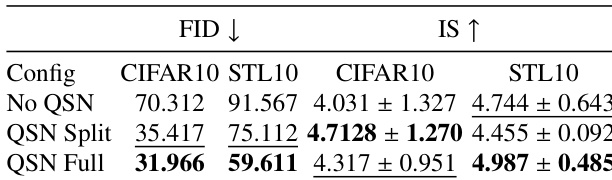
The authors evaluate the performance of quaternion-valued generative models compared to real-valued counterparts using FID and IS metrics. Results show that the proposed QSNGAN achieves lower FID and higher IS values across multiple datasets, indicating superior image quality and diversity. The QSN Full normalization method consistently outperforms other configurations, demonstrating its effectiveness in stabilizing training and improving generation quality. QSNGAN achieves lower FID and higher IS values compared to real-valued baselines across datasets. QSN Full normalization method outperforms QSN Split and No QSN configurations in both CIFAR10 and STL10 experiments. The proposed method generates more visually pleasant and diverse samples with better-defined features and color representation.
The authors compare a real-valued SNGAN with its quaternion-valued counterpart QSNGAN, focusing on parameter efficiency and performance. Results show that the QSNGAN achieves a significant reduction in parameters and disk memory usage while maintaining or improving generative quality, as measured by objective metrics and visual inspection. The QSNGAN model uses substantially fewer parameters and requires less disk memory compared to the SNGAN. The QSNGAN achieves better or comparable performance with reduced model size, indicating improved parameter efficiency. The QSNGAN generates more visually consistent and diverse samples, as supported by both objective metrics and qualitative analysis.

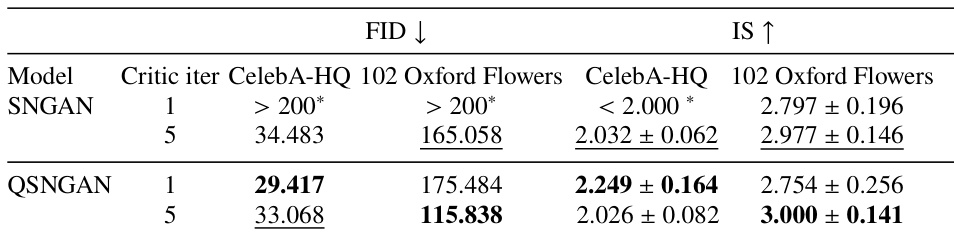
The authors compare a quaternion-valued generative adversarial network (QSNGAN) with a real-valued baseline (SNGAN) on two image datasets, evaluating performance using Fréchet Inception Distance and Inception Score. Results show that QSNGAN achieves lower FID and higher IS values than SNGAN across both datasets, indicating superior sample quality and diversity. The proposed method also demonstrates greater robustness to changes in the number of critic iterations. QSNGAN achieves lower FID and higher IS values than SNGAN on both datasets, indicating better sample quality and diversity. QSNGAN performs better than SNGAN with fewer critic iterations, showing greater robustness to hyperparameter changes. QSNGAN generates more visually coherent images with clearer subject-background separation and more vivid colors compared to SNGAN.
The experiments compare a quaternion-valued generative adversarial network with real-valued baselines across multiple image datasets to validate generative quality, parameter efficiency, and training robustness. Results demonstrate that the quaternion approach consistently produces more visually coherent and diverse samples with sharper features and richer color representation while requiring significantly fewer parameters and less memory. Furthermore, the model exhibits greater stability under varying hyperparameters and benefits from a comprehensive normalization strategy, confirming its overall superiority in both generation quality and computational efficiency.