Command Palette
Search for a command to run...
고델 의미론 하의 퍼지 설명 논리에 대한 시뮬레이션과 시뮬리티
고델 의미론 하의 퍼지 설명 논리에 대한 시뮬레이션과 시뮬리티
Linh Anh Nguyen Quang-Thuy Ha Ngoc-Thanh Nguyen Thi Hong Khanh Nguyen Thanh-Luong Tran
분류 기반 블러 감지
초록
기술 논리(DLs)는 개체가 단순히 속성뿐만 아니라 개체 간의 이항 관계로도 기술되는 도메인에 대한 지식을 표현하는 데 적합한 형식 체계입니다. 이러한 도메인에서 데이터와 관련 지식이 모호하고 부정확할 경우, DLs의 퍼지 확장(Fuzzy extensions)을 활용할 수 있습니다. 또한, 이러한 도메인에서 객체 클래스를 명시하는 하나의 가능한 방법은 퍼지 DLs에서 개념(concepts)을 사용하는 것입니다. DLs는 모달 논리(modal logics)의 변형이므로, DLs에서의 구분 불가능성(indiscernibility)은 이 유사성(bisimilarity)으로 특징지어집니다. 어떤 해석(interpretation)의 이 유사성 관계는 해당 해석의 최대 자가 이 유사성(auto-bisimulation)입니다. DLs와 그 퍼지 확장에서 이러한 동치 관계는 개념 학습(concept learning)에 활용될 수 있습니다.본 논문에서는 고델semantics(Gödel semantics) 하에서 퍼지 DLs에 대한 퍼지 이 유사성(fuzzy bisimulation)과 이 유사성(bisimilarity)을 정의하고 연구하며, 더불어 역부정(involutive negation)을 추가로 확장한 논리들에 대한 명확한 이 유사성(crisp bisimulation)과 강한 이 유사성(strong bisimilarity)도 함께 고찰합니다. 고려 대상이 되는 논리들은 역 역할(inverse roles), 명명형(nominals), (정격 또는 비정격) 수량 제한(number restrictions), 전역 역할(universal role), 역할의 지역적 반사성(local reflexivity), 그리고 역부정(involutive negation)과 같은 추가 기능들을 갖춘 퍼지 DL인 ALC_reg (PDL의 변형)의 퍼지 확장들입니다.우리는 고델 semantics 하에서 역부정이 없는 퍼지 DLs의 경우 퍼지 이 유사성, 그리고 역부정이 있는 경우 명확한 이 유사성에 대해 개념의 불변성(invariance), 이 유사성(또는 강한 이 유사성) 하에서 퍼지 TBoxes/ABoxes의 조건부 불변성(conditional invariance), 그리고 퍼지 DLs의 Hennessy-Milner 성질(Hennessy-Milner property)에 관한 결과를 도출하고 증명합니다. 이러한 근본적인 결과들 외에도, 우리는 퍼지 DLs의 표현력(expressive powers)을 구분하는 데 퍼지 이 유사성을 사용하는 방법과, 퍼지 해석을 최소화하는 데 강한 이 유사성을 사용하는 방법에 관한 결과들도 제시합니다.
One-sentence Summary
This paper defines fuzzy and crisp bisimulation for the fuzzy description logic ALCreg extended with inverse roles, nominals, number restrictions, and involutive negation under Gödel semantics, establishes concept invariance and Hennessy-Milner properties, and demonstrates that fuzzy bisimulation separates the expressive powers of these logics while strong bisimilarity minimizes their interpretations.
Key Contributions
- Define fuzzy bisimulation and bisimilarity for a large class of fuzzy description logics under Gödel semantics, alongside crisp bisimulation and strong bisimilarity for logics extended with involutive negation or the Baaz projection operator. The definitions utilize elementary conditions for number restrictions rather than relational composition.
- Establish invariance of concepts under the introduced bisimulations and prove conditional invariance of fuzzy TBoxes and ABoxes under bisimilarity and strong bisimilarity. Demonstrate the Hennessy-Milner property for witnessed and modally saturated interpretations, generalizing prior theoretical guarantees beyond image-finite domains.
- Apply fuzzy bisimulations to separate the expressive powers of different fuzzy description logics and utilize strong bisimilarity to minimize fuzzy interpretations while preserving the validity of fuzzy axioms and assertions.
Introduction
Description logics formalize knowledge about objects and their relationships, making them essential for relational domains like social networks, while fuzzy extensions handle inherent data vagueness and bisimilarity provides a foundational notion of indiscernibility for concept learning. Prior research has explored bisimulation for fuzzy transition systems and Zadeh-based fuzzy description logics, but extending these concepts to Gödel semantics proves difficult because standard relational composition techniques fail when handling number restrictions. The authors resolve this by introducing novel fuzzy and crisp bisimulation definitions that use elementary conditions to properly accommodate number restrictions, rigorously proving fundamental properties like concept invariance and the Hennessy-Milner property while demonstrating practical applications in separating logical expressive power and minimizing interpretations.
Dataset
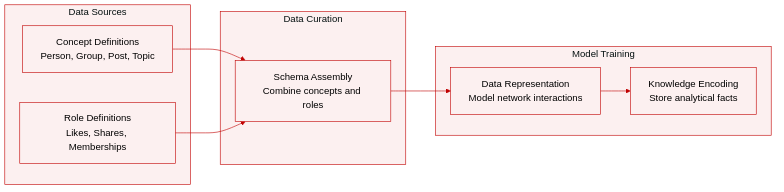
- Dataset Composition and Sources: The authors present a knowledge representation schema rather than a traditional empirical dataset. It is constructed from structured concept and role definitions designed to model social network analytics.
- Subset Details: The framework consists of two primary components. Concept names include Person, Male, Female, Group, Post, Hobby, and Topic. Role names define relational predicates such as hasCloseFriend, posts, postedBy, likes, likedBy, shares, sharedBy, relatedTo, interestedIn, isMemberOf, and hasMember.
- Data Usage: The authors employ this ontology to represent analytical data and encode domain knowledge about social network interactions. The excerpt does not specify training splits, mixture ratios, or empirical scaling procedures.
- Processing and Metadata: The provided text focuses on ontological construction rather than data preprocessing. No cropping strategies, filtering rules, or automated metadata generation steps are described.
Method
The framework of the proposed method centers on the formalization and analysis of bisimulation relations within the context of fuzzy description logics (DLs) under the Gödel semantics. The core of the approach lies in defining and characterizing fuzzy bisimulations between fuzzy interpretations, which are functions mapping pairs of elements from two domains to truth values in the interval [0,1]. These bisimulations are designed to preserve the semantic equivalence of concepts and roles across interpretations, ensuring that related elements exhibit the same behavior with respect to the logic's constructs.
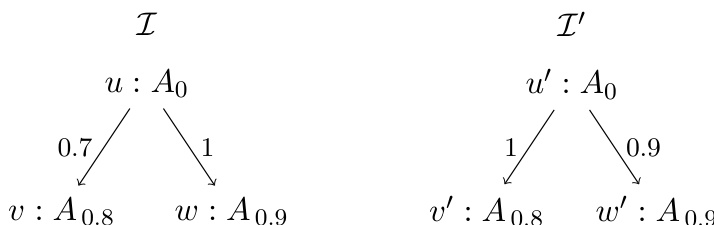
The framework diagram illustrates two fuzzy interpretations, I and I′, which are the primary structures under analysis. In I, the domain contains elements u, v, and w, with u associated with concept A at a truth value of 0.7, and v and w associated with A at values of 0.8 and 0.9, respectively. The diagram for I′ shows a similar structure, with elements u′, v′, and w′, where u′ has a truth value of 1 for A, v′ has a value of 0.8, and w′ has a value of 0.9. The arrows represent roles connecting these elements, with the associated values indicating the strength of the relationship. The authors leverage these interpretations to define the conditions for a fuzzy Φ-bisimulation Z, which must satisfy specific properties to ensure that the interpretations are related in a semantically meaningful way. For instance, the function Z must preserve the truth values of concepts and the structure of roles, ensuring that for any concept C, the value of C in I at x is equivalent to the value of C in I′ at x′, as captured by the inequality Z(x,x′)≤(CI(x)⇔CI′(x′)). This property, known as invariance of concepts, is a fundamental result that establishes the robustness of the bisimulation relation.
The method further extends to the notion of crisp bisimulation, which is a special case where the bisimulation function Z takes values only in {0,1}. This allows for the definition of strong bisimilarity, where two interpretations are considered equivalent if there exists a crisp bisimulation that relates all named individuals. The authors prove that under certain conditions, such as being witnessed and modally saturated, the greatest crisp bisimulation can be explicitly constructed by comparing the truth values of all concepts in a sublanguage L(Phi,triangle)0, which excludes certain constructors and uses the Baaz projection operator. This leads to a Hennessy-Milner property, which states that if two interpretations are indistinguishable by concepts in this sublanguage, then they are strongly bisimilar. The framework also includes results on the invariance of fuzzy TBoxes and ABoxes under bisimilarity, demonstrating that certain logical constructs are preserved across bisimilar interpretations. The overall architecture is designed to provide a rigorous foundation for reasoning about the expressive power of fuzzy DLs and to enable the minimization of interpretations by quotienting them with respect to strong bisimilarity.
Experiment
The provided text does not contain empirical experiments but rather formal proofs that validate the theoretical framework. Lemma 3.7 establishes that fuzzy bisimulation preserves logical equivalence across complex constructs, ensuring structural consistency. Theorem 3.15 characterizes the greatest fuzzy bisimulation by aligning it with the infimum of concept equivalences under witnessed and modally saturated interpretations. Theorem 4.11 extends these results to crisp settings, collectively confirming the logical soundness and robustness of the system.