Command Palette
Search for a command to run...
객체 감지 API를 위한 사용자 친화적인 그래픽 프레임워크를 사용한 TensorFlow
객체 감지 API를 위한 사용자 친화적인 그래픽 프레임워크를 사용한 TensorFlow
Heemoon Yoon Sang-Hee Lee Mira Park
TensorFlow 로BERTa 시작하기
초록
TensorFlow는 딥러닝 데이터플로우를 위한 오픈소스 프레임워크이며, 음성 분석, 자연어 처리, 컴퓨터 비전 분야의 응용 프로그래밍 인터페이스(API)를 포함하고 있습니다. 특히, 컴퓨터 비전 분야의 TensorFlow 객체 감지 API는 농업, 공학, 의학 분야의 기술에 널리 적용되었으나, 정보기술(IT) 분야의 비전문가 및 초보자에게는 명령줄 인터페이스(CLI)와 코드를 통한 프레임워크 사용 장벽이 여전히 높습니다. 따라서 본 연구의 목적은 TensorFlow 기반 객체 감지 API를 위한 사용자 친화적인 그래픽 프레임워크인 TensorFlow Graphical Framework(TF-GraF)를 개발하는 것입니다. TF-GraF는 서버 측에서 사용자 계정별로 독립적인 가상 환경을 제공하며, 클라이언트 측에서는 CLI 없이 데이터 전처리, 학습, 평가의 실행을 지원합니다. 또한, TF-GraF를 통해 하이퍼파라미터 설정, 학습 과정의 실시간 관찰, 테스트 이미지의 객체 시각화, 테스트 데이터의 지표 평가도 수행할 수 있습니다. 특히, TF-GraF는 GUI 환경을 통해 SSD, Faster-RCNN, RFCN, Mask-RCNN을 포함한 합성곱 신경망(Inceptions 및 ResNets)에 대한 유연한 모델 선택을 지원합니다.
One-sentence Summary
The authors introduce the TensorFlow Graphical Framework (TF-GraF), a graphical interface that replaces the command-line object detection API with an intuitive GUI enabling non-experts to configure models including SSD, Faster-RCNN, RFCN, Mask-RCNN, Inception, and ResNet architectures, manage server-side virtual environments, and execute data preprocessing, training, and metric evaluation without coding.
Key Contributions
- The paper introduces TF-GraF, a graphical framework that exposes the TensorFlow object detection API through an intuitive interface, eliminating the command-line dependencies and high technical barriers that hinder non-IT users.
- The system employs a server-client architecture to provision isolated virtual environments per user account and automates data preprocessing, hyperparameter configuration, real-time training monitoring, and metric evaluation without requiring programming expertise.
- The framework supports flexible selection of SSD, Faster-RCNN, RFCN, Mask-RCNN, Inceptions, and ResNets, enabling direct model training, testing, and visualization through a graphical interface.
Introduction
Deep learning has rapidly advanced computer vision, positioning object detection as a vital capability for applications spanning healthcare, agriculture, and engineering. Despite the power of mainstream frameworks like TensorFlow, their practical deployment remains hindered by complex installation procedures, dependency management, and heavy reliance on command-line interfaces that demand specialized programming expertise. Existing visual programming tools also fall short due to unintuitive designs and steep learning curves. To bridge this gap, the authors leverage the TensorFlow object detection API to develop TF-GraF, a graphical framework that translates model configuration, training, and evaluation into an accessible interface. This approach enables researchers to build and analyze object detection models without writing code, significantly lowering the technical barrier to entry for deep learning workflows.
Dataset
- Dataset Composition and Sources: The authors source their images and annotations from the Common Objects in Context (COCO) dataset, retrieved directly from the official COCO repository.
- Subset Details: The complete dataset is partitioned into an 80 percent training subset and a 20 percent testing subset. The provided text does not specify additional filtering rules, class distributions, or exact image counts for either subset.
- Data Usage and Processing: The authors convert the raw COCO data into TFRecord format and generate labelmap files to prepare the data for the TensorFlow Object Detection API. Fifty percent of the training subset undergoes data augmentation, which includes random horizontal flips, brightness, contrast, and saturation adjustments, and 90 degree rotations. The processed training data is used to train object detection models, with performance evaluated using Pascal VOC metrics and mean average precision (mAP). Final model checkpoints are converted into inference graph files to enable real time detection.
- Additional Processing Workflow: All preprocessing, augmentation, and model configuration steps are managed through the TF GraF graphical framework. The pipeline supports architecture selection, hyperparameter tuning, and automated checkpoint management to streamline the transition from training to deployment.
Method
The TF-GraF framework is structured as a client-server architecture designed to abstract the complexities of TensorFlow's command-line interface into a user-friendly graphical environment. The system enables users to perform object detection tasks without writing code by replacing command-line interactions with intuitive GUI operations. The overall workflow begins with user access to the client-side interface, which communicates with the server-side to execute deep learning tasks. The client-side, implemented using Java Swing, provides a visual interface that guides users through a step-by-step process, allowing them to control operations via button clicks instead of direct command-line input.
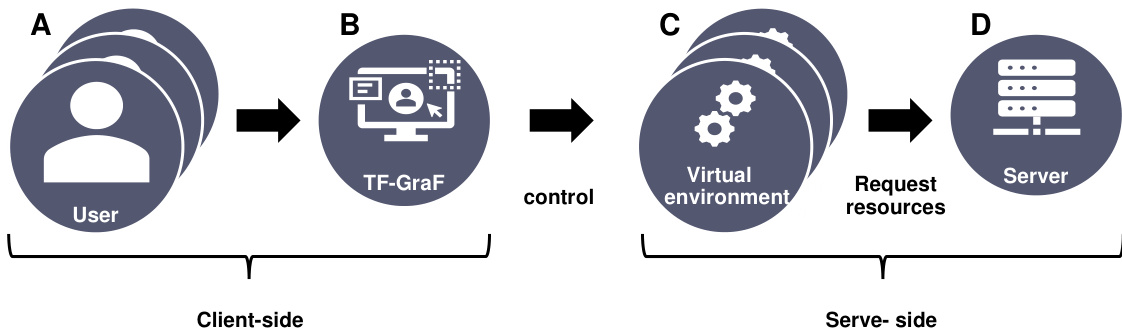
As shown in the figure below, the framework consists of two primary components: the client-side and the server-side. The client-side serves as the user interface where users interact with the system through a graphical environment. It includes six distinct modules: a toolbar for file management, a directory and file display view, a training control panel, a command-line interface for advanced operations, an image preview window, and a view displaying the current directory path and active environment. These components allow users to upload and manage datasets, configure training parameters, and monitor results without engaging with raw code. The client-side's main function is to translate user actions into commands that are sent to the server-side for execution.
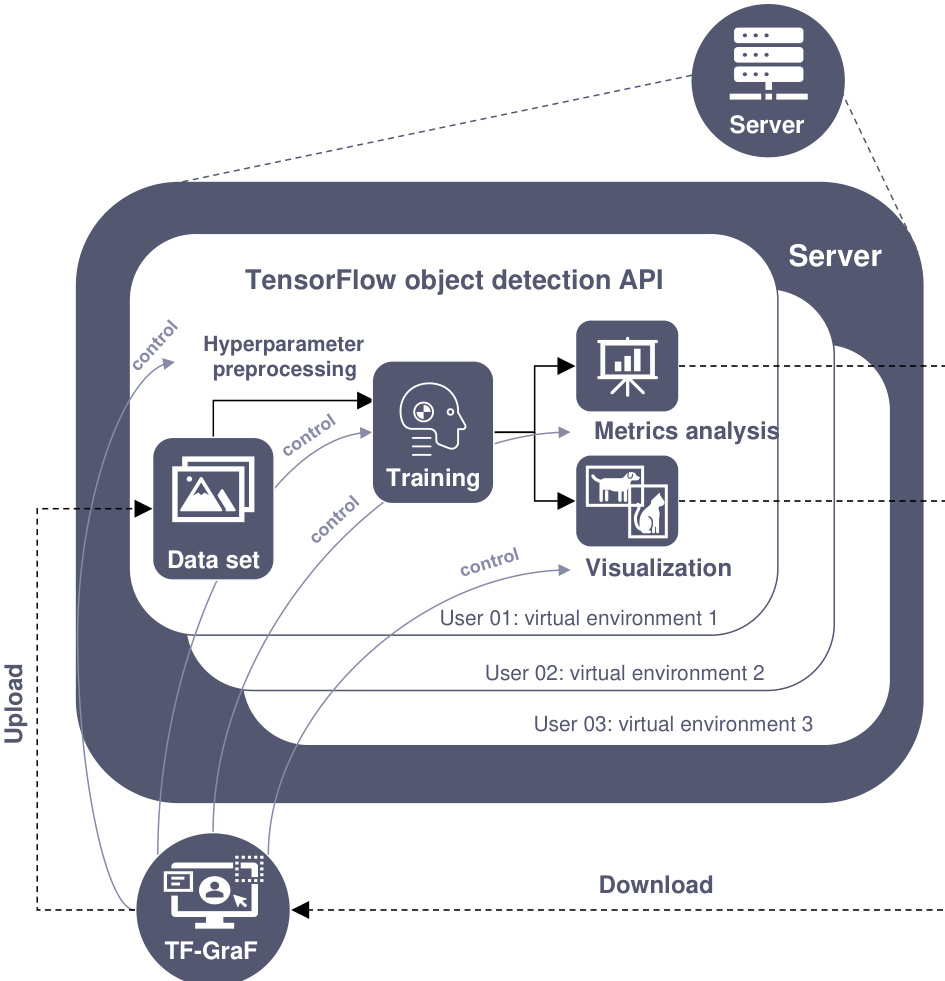
The server-side hosts the TensorFlow object detection API environment and manages all computational tasks. Each user is assigned an independent virtual environment, ensuring isolation and security of data and configurations. These virtual environments are preconfigured with the necessary dependencies and TensorFlow APIs, allowing users to avoid the complexities of software installation and environment setup. Within each virtual environment, the framework supports a variety of object detection architectures—such as SSD, Faster-RCNN, RFCN, and Mask-RCNN—and backbones including MobileNets, Inceptions, and ResNets. The server-side also handles data preprocessing, model training, evaluation, and visualization, with results being returned to the client-side for display. The separation of user environments enhances maintainability, as administrators can manage individual configurations without affecting other users.
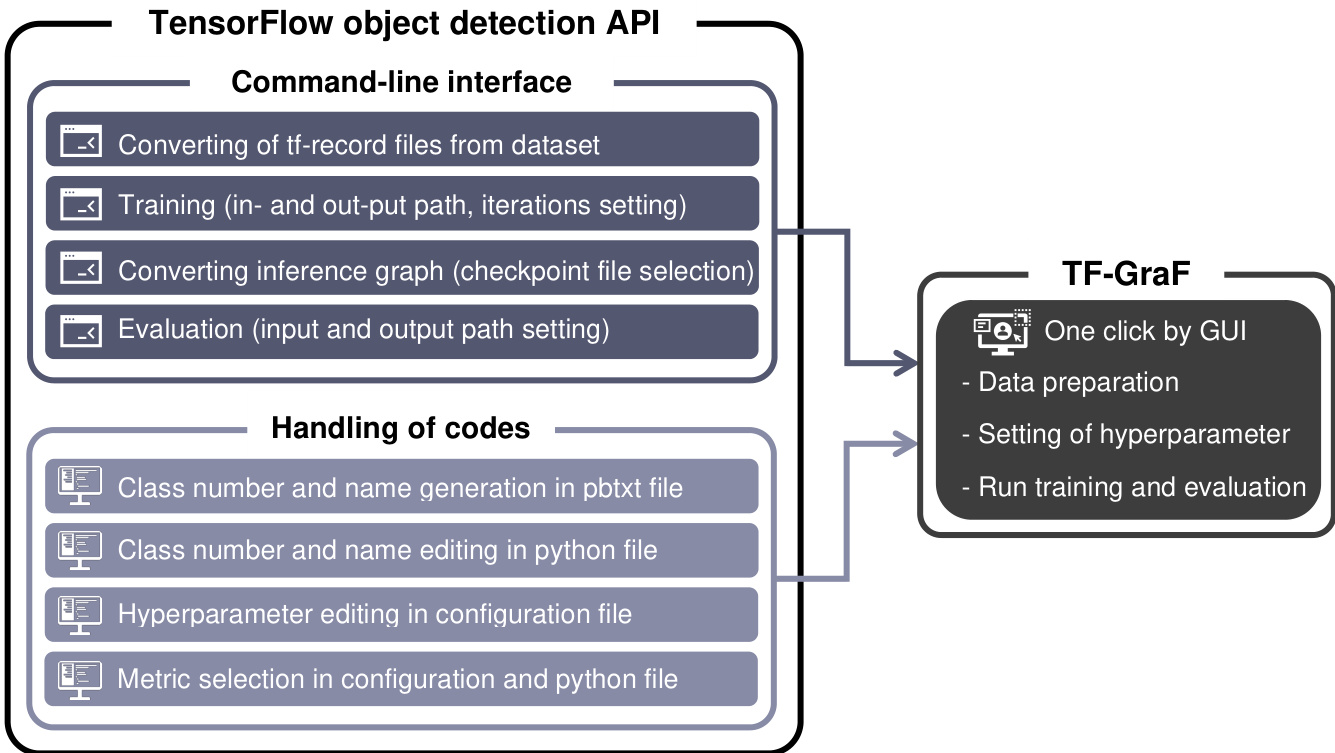
The framework's architecture allows for seamless integration of high-level functionalities such as data preprocessing, hyperparameter tuning, and model evaluation. Data preparation involves converting annotation files (in XML or CSV format) into tfrecord files and generating labelmap files, which are essential for training. Users can select model architectures and backbones through the GUI, set the number of training steps, and configure hyperparameters. Once the training process is initiated, the server-side executes the training, computes metrics, and generates visualizations of detected objects in test images. The results, including trained models, evaluation metrics, and visual outputs, are then downloaded to the client-side for review. This end-to-end process enables users to design, train, and deploy object detection models efficiently, without requiring prior knowledge of deep learning frameworks or programming.
Experiment
The experiments utilized the TF-GraF platform to train and evaluate four object detection architectures, validating its capacity to manage the complete deep learning workflow from model training and real-time monitoring to performance assessment and visual inference. By successfully processing checkpoints, calculating evaluation metrics, and generating segmentation outputs, the framework demonstrates robust integration capabilities for standard detection models. However, the requirement for externally generated annotated datasets introduces additional dependencies that may complicate the user experience and reduce accessibility for non-technical researchers.