Command Palette
Search for a command to run...
바이저인 내성 분산 최적화를 위한 데이터 인코딩
바이저인 내성 분산 최적화를 위한 데이터 인코딩
Deepesh Data Linqi Song Suhas Diggavi
타이타닉 데이터 과학 솔루션
초록
우리는 비잔틴 적대자가 존재하는 환경에서 분산 최적화 문제를 연구한다. 여기서 데이터와 계산은 m개의 작업자 머신에 분산되어 있으며, 그 중 t개는 손상될 수 있다. 손상된 노드들은 사전에 지정된 프로그램에서 협력적으로 그리고 임의적으로 이탈할 수 있으며, 지정된 (마스터) 노드는 일반화 선형 모델에 대한 모델/매개변수 벡터를 반복적으로 계산한다. 본 연구에서는 주로 두 가지 반복 알고리즘인 근사 경사 하강법(Proximal Gradient Descent, PGD)과 좌표 하강법(Coordinate Descent, CD)에 초점을 맞춘다. 경사 하강법(Gradient Descent, GD)은 이러한 알고리즘들의 특수한 경우이다. PGD는 일반적으로 데이터가 서로 다른 샘플 간에 분할되는 데이터 병렬 처리 환경에서 사용되며, 반면 CD는 데이터가 매개변수 공간 간에 분할되는 모델 병렬 처리 환경에서 사용된다. 두 알고리즘에 대한 우리의 해결책의 핵심은 비잔틴 내성 행렬-벡터(MV) 곱셈 방법이며, 이를 위해 우리는 적대적 공격에 대응하기 위해 실수 상에서의 데이터 인코딩 및 오류 정정을 기반으로 한 방법을 제안한다. 우리는 정보이론적으로 최적인 최대 t≤⌊2m−1⌋개의 손상된 작업자 노드를 허용할 수 있다. 우리는 결정론적 보장을 제공하며, 우리의 방법은 데이터에 대한 확률 분포를 가정하지 않는다. 우리는 계산적으로 효율적인 데이터 인코딩 및 디코딩을 가능하게 하는 희소 인코딩_scheme를 개발한다.
One-sentence Summary
The authors propose a Byzantine-resilient distributed optimization framework for Proximal Gradient Descent and Coordinate Descent that employs data encoding and error correction over real numbers to enable Byzantine-resilient matrix-vector multiplication, achieving information-theoretically optimal tolerance for corrupt nodes with deterministic guarantees without assuming data distributions via a computationally efficient sparse encoding scheme.
Key Contributions
- The paper introduces a Byzantine-resilient matrix-vector multiplication method based on data encoding and error correction over real numbers. This approach tolerates up to half of the worker nodes being corrupt with information-theoretically optimal guarantees without assuming any probability distribution on the data.
- This work presents the first efficient solution for distributed Coordinate Descent under Byzantine attacks by utilizing a specific regular structure for the encoding matrix. The method enables partial coordinate updates in each iteration, distinguishing it from general-purpose codes used in gradient descent.
- A sparse encoding scheme is developed to enable computationally efficient data encoding and decoding while preserving the sparsity of the underlying matrix. This design ensures that Byzantine resiliency is achieved without compromising the computational efficiency typically gained from sparse matrix operations.
Introduction
Distributed learning frameworks often operate across partially trusted worker nodes that may act as Byzantine adversaries. Prior solutions typically rely on statistical assumptions about data or employ robust aggregation techniques that incur significant computational overhead and approximation errors. Most existing research also focuses on Gradient Descent, leaving the model-parallel Coordinate Descent algorithm largely unsecured against such attacks. The authors leverage a sparse data encoding scheme rooted in error correction over real numbers to achieve Byzantine-resilient matrix-vector multiplication. This approach offers deterministic guarantees without requiring probabilistic data assumptions while tolerating up to half of the worker nodes being corrupt. Notably, the team is the first to connect matrix-vector multiplication with Coordinate Descent to design an efficient, adversarial-secure optimization method.
Method
The authors propose Byzantine-resilient distributed optimization algorithms for Proximal Gradient Descent (PGD) and Coordinate Descent (CD) based on data encoding and real-error correction. The core methodology involves encoding the data matrix and parameter vectors to tolerate a constant fraction of malicious worker nodes without relying on statistical assumptions about the data or attack patterns.
For gradient computation in PGD, the process is structured as a two-round matrix-vector multiplication scheme. Refer to the framework diagram for the 2-round approach to the Byzantine-resilient distributed gradient descent.
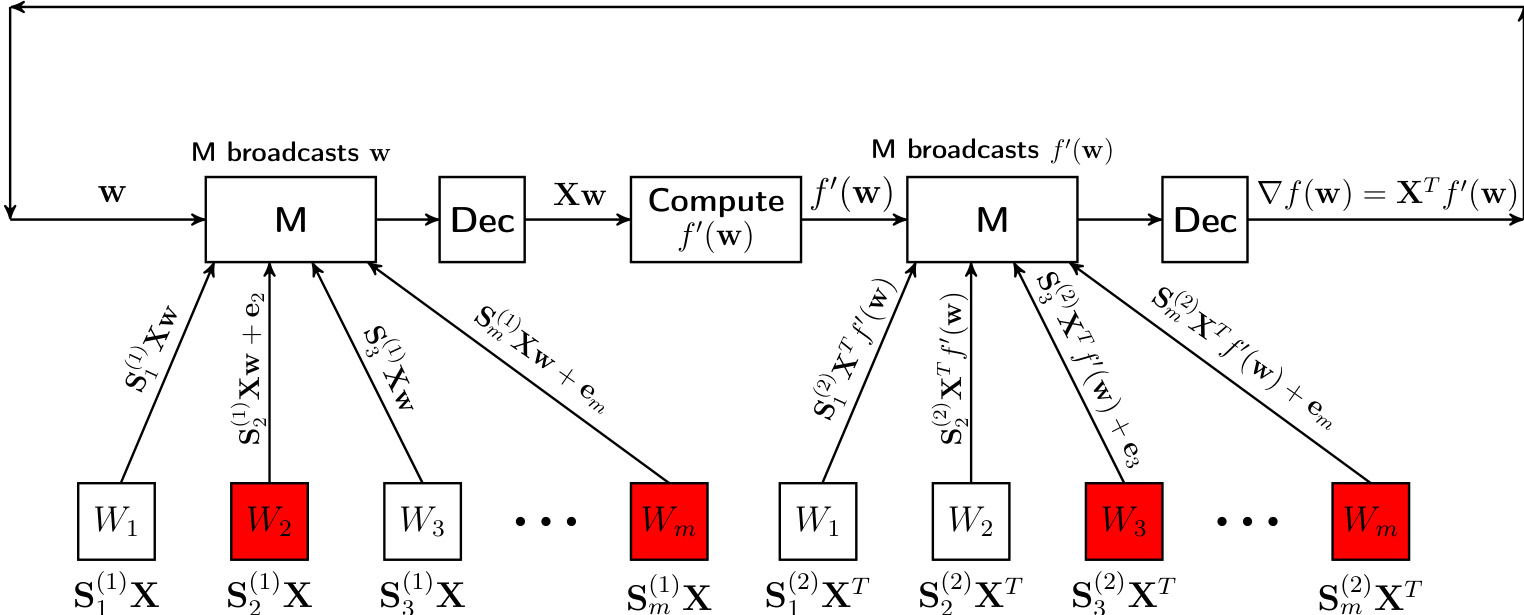 The gradient ∇f(w)=XTf′(w) is computed in two stages. In the first round, the master broadcasts the parameter vector w to the workers. Each worker i holds an encoded version of the data matrix, Si(1)X, and computes the product Si(1)Xw. The master collects these responses, applies an error-correction decoding procedure to recover the true vector Xw, and locally computes f′(w). In the second round, the master broadcasts f′(w). Workers use a second encoding matrix S(2) applied to XT to compute Si(2)XTf′(w). The master decodes these results to obtain the final gradient ∇f(w). The encoding matrices are designed to be sparse with a regular structure, which facilitates efficient decoding using sparse reconstruction techniques over real numbers.
For Coordinate Descent, the approach is adapted to handle updates on subsets of coordinates while maintaining Byzantine resilience. As illustrated in the figure below, the method extends the encoding strategy to handle parameter updates on subsets of coordinates.
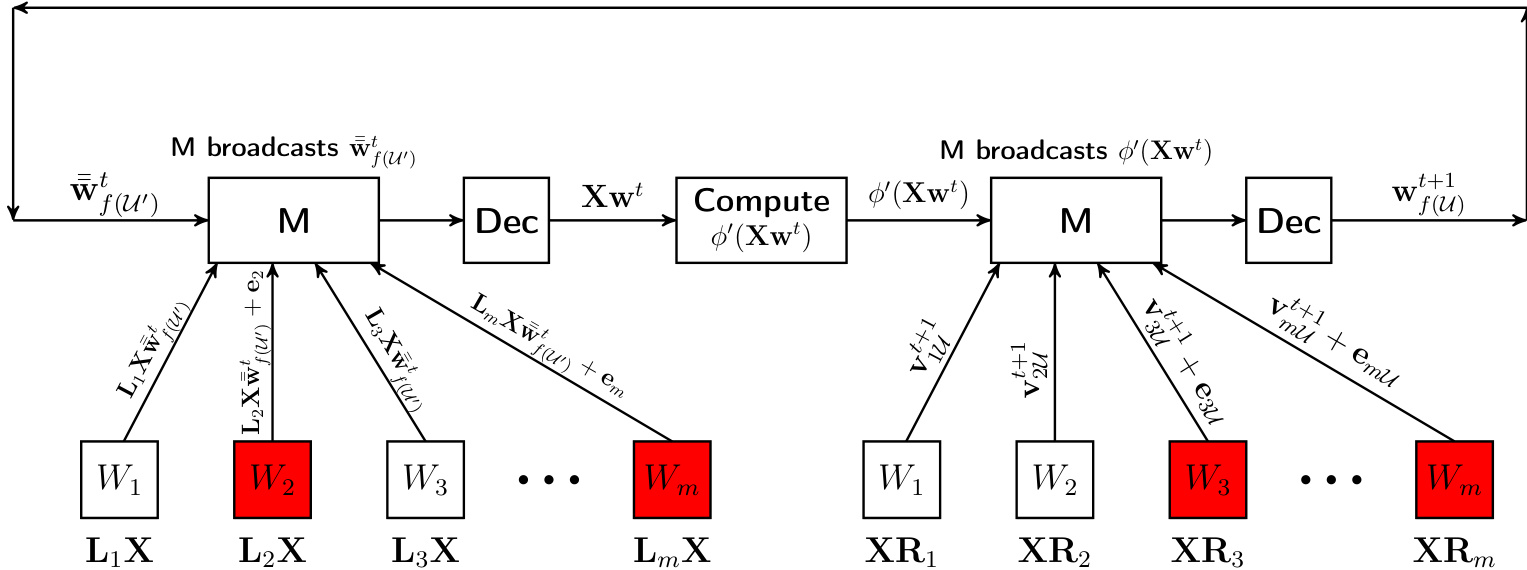 The authors enlarge the parameter space by encoding the original parameter vector w into a higher-dimensional vector v using an encoding matrix R, such that v=R+w. Workers store encoded data XRi and update specific coordinates of their local vi. To facilitate these updates, the master must compute Xw (or its updates) robustly. This is achieved using another encoding matrix L on the data matrix X. In each iteration, the master broadcasts the relevant updates to w, workers compute local matrix-vector products involving LiX, and the master decodes the results to update the global state. This design ensures that updating a small subset of coordinates in v corresponds to updating a specific subset of coordinates in w, allowing the algorithm to proceed correctly even if some workers provide erroneous updates.
The decoding mechanism relies on an error locator matrix F, typically a Vandermonde matrix, to identify the set of corrupt workers. By constructing the encoding matrices such that their null space relates to F, the master can isolate the error support through random linear combinations of received vectors. Once the corrupt nodes are identified, their contributions are discarded, and the remaining honest responses are used to recover the exact matrix-vector products via least-squares or similar recovery methods. This allows the system to tolerate up to t<m/2 corrupt nodes with constant overhead in storage and computation compared to the non-resilient baseline.
Experiment
The evaluation compares the proposed coding scheme against DRACO and Lagrange coded computing to validate resource efficiency, followed by numerical experiments on distributed gradient descent and coordinate descent to test performance under Byzantine adversaries. Results indicate the proposed method achieves lower storage and computation redundancy at worker nodes than DRACO while offering superior communication efficiency compared to Lagrange coded computing. Numerical experiments further confirm the approach effectively handles corrupt workers with significant time savings for partial coordinate descent updates and negligible master node overhead.
The experiment evaluates the computational time for Coordinate Descent (CD) with varying fractions of updated coordinates and full Gradient Descent (GD) in the presence of Byzantine adversaries. Results demonstrate that updating fewer coordinates significantly reduces execution time for both worker and master nodes compared to full gradient updates. Additionally, the time required for both computation and decoding increases as the number of corrupt worker nodes rises. Partial coordinate updates (CD) consistently require less time than full gradient descent (GD) for both workers and the master node. Worker computation time for CD with a small fraction of coordinates is drastically lower than that for full GD. Increasing the number of corrupt workers leads to a steady increase in processing time across all algorithm configurations.
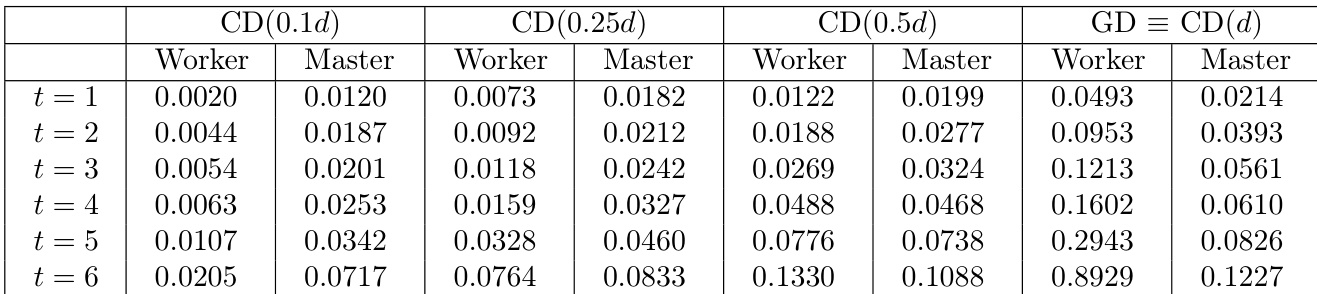
The experiment evaluates the computational time of Coordinate Descent with varying coordinate update fractions against full Gradient Descent in the presence of Byzantine adversaries. Findings show that partial coordinate updates consistently reduce execution time for both worker and master nodes compared to full gradient descent, especially when updating a small fraction of coordinates. Furthermore, processing times for computation and decoding increase steadily as the number of corrupt worker nodes rises across all configurations.