Command Palette
Search for a command to run...
희소한 학습 데이터를 가진 도메인에서 세분화된 객체 인식을 위한 중요도
희소한 학습 데이터를 가진 도메인에서 세분화된 객체 인식을 위한 중요도
Carola Figueroa Flores Abel Gonzalez-Garcia Joost van de Weijer Bogdan Raducanu
케라스를 사용한 꽃 인식 CNN
초록
본 논문은 제한된 학습 데이터가 제공되는 경우, 합성곱 신경망(CNN)의 분류 정확도를 향상시키기 위해 유의미성(saliency)의 역할을 조사한다. 본 접근법은 기존 CNN 아키텍처에 유의미성 분기(branch)를 추가하여, 원래 이미지 입력으로부터의 표준 하향식(bottom-up) 시각적 특징을 조절하는 방식으로, 특징 추출 과정을 안내하는 주의 메커니즘(attentional mechanism)으로 작용한다. 제안된 접근법의 주요 목적은 제한된 학습 샘플로 세분화된 인식 모델을 효과적으로 학습시키고 해당 작업에서의 성능을 향상시켜 대규모 데이터셋의 주석이 필요함을 완화하는 것이다. 대부분의 유의미성 방법은 완전한 비전 파이프라인 내에서의 기능성보다는 유의미성 지도(saliency map) 생성 능력에 대해 평가된다. 본 연구에서 제안하는 파이프라인은 객체 인식이라는 고수준 작업을 위해 유의미성 방법을 평가할 수 있게 한다. 우리는 다양한 조건 하에서 여러 세분화된 데이터셋(꽃, 새, 자동차, 개)에 대해 광범위한 실험을 수행하였으며, 유의미성이 특히 학습 데이터가 부족한 경우에 네트워크 성능을 현저히 향상시킬 수 있음을 보여준다.
One-sentence Summary
By integrating a saliency branch that modulates bottom-up visual features as an attentional mechanism, the proposed CNN considerably improves fine-grained object recognition accuracy on the Flowers, Birds, Cars, and Dogs datasets, particularly when training samples are scarce, thereby validating saliency methods within complete vision pipelines rather than restricting evaluation to map generation alone.
Key Contributions
- Introduces a convolutional neural network architecture that integrates a dedicated saliency branch to modulate standard bottom-up visual features as an attentional mechanism.
- Establishes a complete vision pipeline that evaluates saliency generation methods by measuring their direct impact on high-level object recognition performance rather than relying solely on traditional saliency map quality metrics.
- Demonstrates through extensive experiments on the Flowers, Birds, Cars, and Dogs datasets that the proposed architecture significantly improves classification accuracy, particularly under limited training data conditions.
Introduction
Fine-grained object recognition requires distinguishing highly similar subclasses, a task that traditionally demands expensive expert annotations and large labeled datasets to capture subtle visual differences. While computational saliency methods effectively highlight visually prominent regions, prior work primarily optimizes these models for map accuracy or human gaze prediction rather than measuring their actual impact on downstream classification. Additionally, existing attention-based neural networks typically require learning new parameters from scratch, making them unstable and prone to overfitting when labeled examples are scarce. The authors leverage a pretrained saliency network as a fixed attention module that modulates standard visual features within a dual-branch architecture. By guiding the recognition model to focus on discriminative regions without requiring explicit part annotations, this approach significantly boosts classification accuracy under data-scarce conditions and reduces the need for costly dataset collection.
Dataset
- Dataset Composition and Sources: The authors evaluate their framework on four standard fine-grained classification benchmarks sourced from established academic repositories.
- Subset Specifications:
- Oxford Flower 102 provides 8,189 images across 102 classes, with 40 to 258 samples per category.
- The Birds dataset contains 11,788 images spanning 200 species, originally equipped with bounding boxes and 15 keypoints, though the authors process the full uncropped images.
- The Cars dataset offers 16,185 images across 196 classes, already partitioned into roughly equal training and testing portions.
- Stanford Dogs includes 20,580 images across 120 breeds, with a preprocessing step that removes any images overlapping with ImageNet.
- Training Protocol and Data Utilization: For each class, the authors enforce a fixed split of five test images, five validation images, and the remainder for training. To measure performance under limited data conditions, they train models on subsets of k images per class, where k takes values from 1 to 30 and includes the complete available training set. The base AlexNet architecture is pretrained on ImageNet and fine-tuned for 70 epochs using a learning rate of 0.01 and weight decay of 0.003. The authors also validate the pipeline with ResNet-50 and ResNet-152, reporting classification accuracy averaged over five independent random initializations.
- Processing and Input Engineering: The workflow avoids explicit cropping, operating directly on full images. Although the Birds dataset includes bounding box and keypoint metadata, these annotations are intentionally ignored. Instead, the authors construct an additional saliency input channel by generating attention maps through five established algorithms (iSEEL, SALICON, Itti and Koch, GBVS, and BMS) and two geometric baselines (uniform white and centered Gaussian distributions) to determine whether learned visual attention enhances recognition beyond standard pixel features.
Method
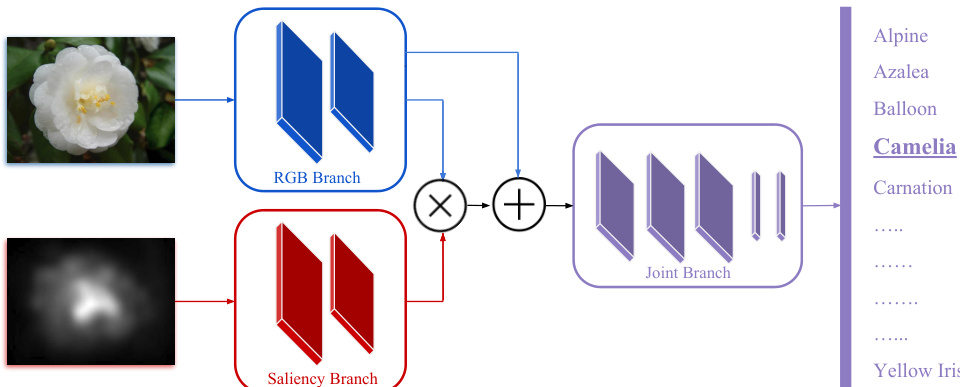
The authors leverage a dual-branch architecture to integrate saliency information into a convolutional neural network (CNN) for fine-grained object classification under conditions of scarce training data. The framework consists of two primary pathways: an RGB branch that processes the original color image and a saliency branch that operates on a precomputed saliency map derived from the same image. These two streams are designed to interact through a modulation mechanism that dynamically adjusts the importance of visual features during feature extraction. The RGB branch follows a standard CNN processing pipeline, while the saliency branch transforms the input saliency map into a modulation image of matching spatial dimensions. This modulation image is then used to scale the feature maps of an intermediate layer in the RGB branch, effectively emphasizing salient regions and de-emphasizing less relevant background areas. The modulated features are subsequently combined with the original features via a skip connection and fed into a shared joint branch, which continues processing through additional layers before reaching the final classification layer. The architecture is designed to be modular and compatible with various base networks, such as AlexNet, ResNet-50, and ResNet-152, and is trained end-to-end to jointly optimize both the classification and modulation components.