Command Palette
Search for a command to run...
SAMI 은하 탐색: 첫 1000개 은하
SAMI 은하 탐색: 첫 1000개 은하
J. T. Allen The SAMI Galaxy Survey Team
초록
시드니-AAO 다중 객체 적분장 분광기(SAMI) 은하 탐사는 2016년 중반까지 약 3,400개의 은하에 대한 적분장 분광 관측을 수행하는 진행 중인 프로젝트입니다. 파일럿 탐사를 포함하여 지금까지 약 1,000개의 은하가 관측되었으며, 이로 인해 SAMI 은하 탐사는 해당 분야에서는 최대 규모의 조사로 자리매김하고 있습니다. 이 독특한 데이터셋은 은하 진화의 다양한 측면에 대한 폭넓은 연구를 가능하게 합니다. 이제 전체 샘플에서 추려진 107개의 은하로 구성된 SAMI 은하 탐사의 첫 번째 공개 데이터가 출시되었습니다. 전 연구 커뮤니티에 SAMI 데이터에 대한 조기 접근을 제공함으로써, 우리는 은하 진화에 관한 광범위한 주제를 넘어선 연구를 촉진하고자 합니다. 샘플이 계속 확대됨에 따라 이 탐사는 은하 진화 연구에 새롭고 독특한 매개변수 공간을 열어갈 것입니다.
One-sentence Summary
The SAMI Galaxy Survey team releases the first public dataset of 107 galaxies observed with the Sydney-AAO Multi-object Integral field spectrograph, establishing the largest integral field survey of its kind and providing early community access to stimulate research across diverse aspects of galaxy evolution.
Key Contributions
- The paper releases the first public dataset from the Sydney–AAO Multi-object Integral field spectrograph (SAMI) Galaxy Survey, providing calibrated integral field spectroscopic observations for 107 galaxies.
- This dataset establishes the SAMI Galaxy Survey as the largest active integral field spectroscopic galaxy survey, with approximately 1000 galaxies observed to date and a target sample of roughly 3400 galaxies.
- Early public access to these observations expands the measurable parameter space for galaxy evolution studies and enables the broader research community to conduct diverse astrophysical investigations.
Introduction
The provided excerpt contains only funding acknowledgements and lacks the technical context, prior limitations, and core contributions required for a research summary. To generate the requested overview, please share the abstract or introductory sections. Once available, I will clearly outline the application domain, identify gaps in existing methods, and explain how the authors leverage novel approaches to advance the field.
Dataset

-
Dataset composition and sources: The authors compile integral field spectroscopic observations from the Sydney and AAO Multi-object Integral field spectrograph mounted on the Anglo-Australian Telescope. Targets are drawn from two primary environments: a field and group sample covering the GAMA survey fields, and a dedicated cluster sample spanning eight galaxy clusters to capture higher environmental densities. The dataset is further supported by multiband ancillary data ranging from UV to radio observations.
-
Key details for each subset: The overarching survey targets approximately 3400 galaxies, with roughly 1000 already observed. The Early Data Release subset contains fully calibrated datacubes for 107 galaxies selected from the GAMA regions using a tiered volume limited filtering strategy.
-
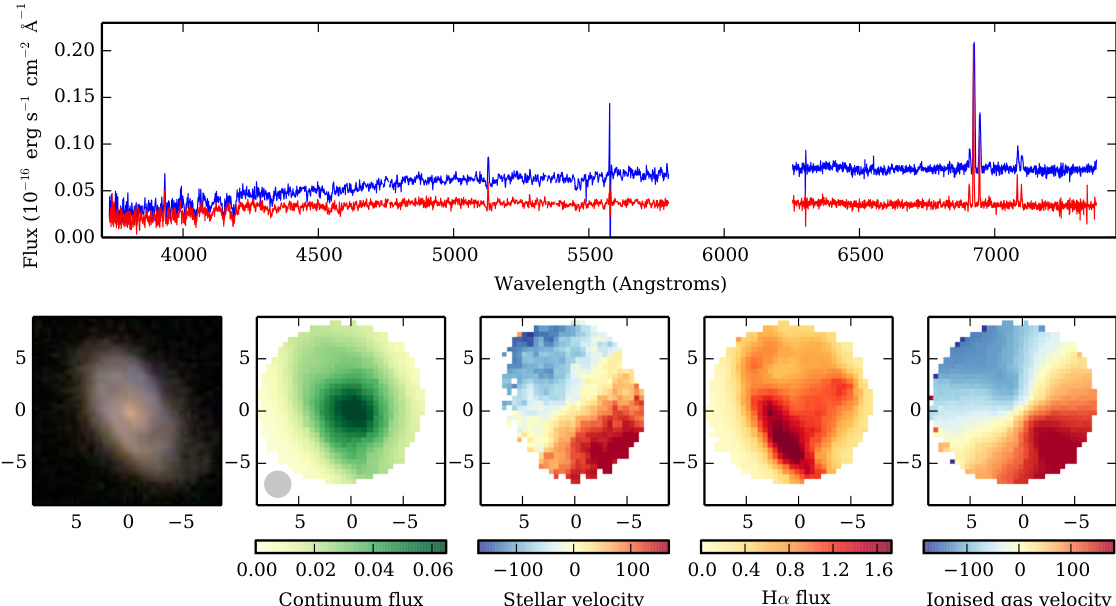
Data processing and usage: Raw exposures are initially reduced using the 2DFDR software to produce row stacked spectra. A dedicated pipeline then applies flux calibration using spectrophotometric standards and corrects for telluric absorption. The authors combine approximately seven dithered frames per galaxy, resampling them onto a regular grid to generate paired blue and red datacubes. This spatially resolved dataset supports direct scientific analysis of galactic winds, star formation distributions, and stellar kinematics rather than machine learning training splits.
-
Cropping strategy, metadata, and quality control: Velocity field maps are masked to retain only spaxels with a continuum signal to noise ratio exceeding five. The authors construct metadata tables listing stellar mass, effective radius, and surface brightness for each object. Rigorous quality control maintains flat field accuracy between 0.3 and 1 percent, wavelength calibration within 0.1 pixels, and a median point spread function full width at half maximum of 2.1 arcseconds.