Command Palette
Search for a command to run...
영상 추출을 위한 특징 기반 퍼지 규칙 기반 설계
영상 추출을 위한 특징 기반 퍼지 규칙 기반 설계
Koushik Mondal Paramartha Dutta Siddhartha Bhattacharyya
이미지 특징 추출
초록
최근 멀티미디어 기술의 발전으로 이미지 처리 분야에서 시각적 주의 영역(detected visual attention regions)을 탐지하는 것은 주요 관심사가 되었다. 멀티미디어 기술의 이종 환경에서 단말기 장치의 보편화는 이미지 시각화의 개선을 위한 충분한 가능성을 제공한다. 수많은 방법이 존재하지만, 그중에서도 특징 기반의 이미지 추출(feature based image extraction)은 이미지 처리 분야에서 널리 사용되는 기법이다. 이미지 분할(image segmentation)의 목표는 회색조(grey level), 텍스처(texture), 색상(color)과 같은 특정 속성에 대해 시각적으로 뚜렷하고 일관된 여러 영역으로 이미지를 도메인 독립적으로 분할하는 것이다. 분할 및 그 후속 추출 과정은 객체 인식(object recognition), 장면 이해(scene understanding), 이미지 분석(image analysis)의 첫 단계이자 핵심 과제이다. 이 기술의 응용 분야는 모바일 기기, 산업용 품질 관리, 의료 기기, 로봇 항법, 지구물리 탐사, 군사 응용 등 광범위하다. 이러한 모든 분야에서 최종 결과의 품질은 전처리 작업(preprocessing work)의 품질에 크게 좌우된다. 일반적으로 잡음 없는(spurious-free) 전처리 데이터를 획득하려면 막대한 양의 응용 및 수학적 배경 연구가 필요하다.본 논문에서는 실행 과정에서 외부 개입이 필요 없는 기능적으로 독립적인 특징 기반 퍼지 규칙 가이드(feature based fuzzy rule guided)의 새로운 기법을 제안한다. 실험 결과, 본 접근법이 문헌에서 광범위하게 논의된 다른 다양한 기법에 비해 효율적임이 밝혀졌다. 제안된 기법의 성능 우위를 입증하기 위해, 평균 제곱 오차(Mean Squared Error, MSE), 평균 절대 오차(Mean Absolute Error, MAE), 그리고 피크 신호 대 잡음비(Peak Signal to Noise Ratio, PSNR)와 같은 효과적인 지표(metrics)를 활용하여 경쟁 기법들과 비교 분석하였다.
One-sentence Summary
The authors propose a feature-based fuzzy rule-guided technique for image extraction that operates without external intervention and demonstrates superior efficiency compared to existing methods, as validated by mean squared error, mean absolute error, and peak signal-to-noise ratio metrics.
Key Contributions
- The paper introduces a feature-based fuzzy rule-guided segmentation technique that autonomously partitions images without requiring external intervention or domain-specific preprocessing.
- The method integrates red, green, blue, mean intensity, and standard deviation values as inputs to a Fuzzy Rule Base System that generates interpretable membership functions to handle noisy data and intensity variations.
- Experimental evaluations demonstrate that the proposed framework outperforms conventional segmentation approaches, as validated by superior performance across Mean Squared Error, Mean Absolute Error, and Peak Signal to Noise Ratio metrics.
Introduction
Image segmentation and feature extraction serve as foundational steps for critical applications ranging from medical imaging to autonomous navigation, where reliable preprocessing directly determines downstream accuracy. Traditional thresholding and histogram-based methods, while computationally simple, struggle with intensity variations and noise, often requiring extensive manual tuning or heavy mathematical preprocessing. To address these limitations, the authors leverage a feature-driven fuzzy rule base system that automatically constructs membership functions from standard image statistics like RGB values, mean, and standard deviation. This approach eliminates the need for external intervention, effectively handling uncertain or noisy data while maintaining high interpretability and outperforming conventional techniques across standard error and quality metrics.
Method
The authors leverage a fuzzy image processing framework designed to enhance segmentation robustness by integrating multiple thresholding techniques through a rule-based system. The overall architecture begins with an input image, which is processed by a feature extractor to derive pixel-level attributes such as color components, mean, and standard deviation. These features are then fed into an inference engine that operates on a fuzzy rule base. The inference engine applies fuzzy logic reasoning to determine segmentation decisions based on the extracted features and predefined rules. The output of the inference process is a fuzzy representation of the image, which is subsequently defuzzified to produce a segmented image.
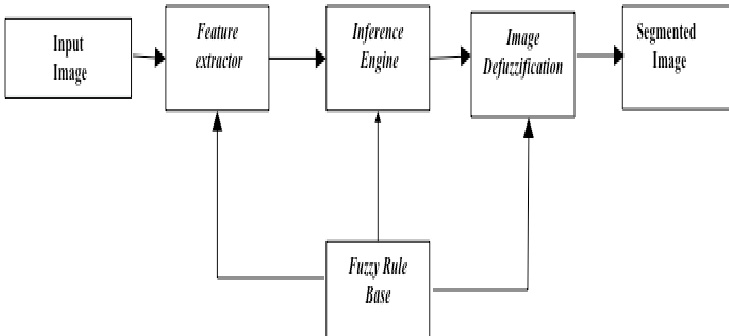
As shown in the figure below, the system incorporates a feedback loop from the fuzzy rule base to the feature extractor, enabling adaptive refinement of feature representation based on the rule base's knowledge. This feedback mechanism supports the integration of multiple thresholding methods by allowing the system to dynamically adjust feature evaluation based on the combined results of different thresholding algorithms. The fuzzy rule base is constructed by mapping threshold values obtained from various methods into corresponding fuzzy regions, forming a combined rule base that governs the inference process. The defuzzification step converts the fuzzy output into a crisp segmented image, effectively translating the fuzzy logic decisions into a final segmentation result. This design emphasizes the integration of numerical data from diverse thresholding techniques into a unified fuzzy framework, enabling a robust and adaptive segmentation approach without requiring iterative training.