Command Palette
Search for a command to run...
自己教師あり強化学習のための1000層ネットワーク:深さのスケーリングが新たな目標到達能力を可能にする
自己教師あり強化学習のための1000層ネットワーク:深さのスケーリングが新たな目標到達能力を可能にする
Kevin Wang Ishaan Javali Michał Bortkiewicz Tomasz Trzciński Benjamin Eysenbach
概要
自己教師あり学習のスケーリングは言語や視覚分野においてブレークスルーを牽引してきたが、強化学習(RL)では同等の進展が得られていない。本論文では、スケーラビリティにおける大幅な改善を可能にする自己教師あり強化学習の構成要素を研究し、ネットワークの深さが重要な因子であることを示す。近年の多くの強化学習論文が浅いアーキテクチャ(約2〜5層)に依存してきたのに対し、深さを1024層まで増加させることで性能が大幅に向上することを示す。本実験は教師なしの目標条件付き設定で実施されており、実演や報酬が一切与えられない環境において、エージェントはゼロから探索を行い、命令された目標に到達する尤度を最大化する方法を学習しなければならない。シミュレーション上の移動操作およびマニピュレーションタスクでの評価において、本アプローチは自己教師あり対照強化学習アルゴリズムの性能を2〜50倍向上させ、他の目標条件付きベースラインを上回る。モデルの深さの増加は成功率の向上だけでなく、学習される行動の質的変化をもたらし、プロジェクトのウェブページおよびコードは https://wang-kevin3290.github.io/scaling-crl/ で公開されている。
One-sentence Summary
Princeton University and Warsaw University of Technology et al. demonstrate that scaling network depth to 1024 layers in self-supervised contrastive RL, far beyond the typical 2–5 layers, improves goal-reaching performance by 2×−50× on unsupervised locomotion and manipulation tasks while qualitatively changing the behaviors the agent learns.
Key Contributions
- The paper introduces building blocks for self-supervised reinforcement learning in an unsupervised goal-conditioned setting, where an agent explores from scratch and learns to maximize the likelihood of reaching commanded goals without demonstrations or rewards.
- The approach combines an InfoNCE-trained contrastive critic whose output is the l2 norm between state-action and goal embeddings, a policy trained to maximize this critic, and residual connections that help stabilize training of networks with up to 1024 layers.
- Simulated locomotion and manipulation experiments show that increasing depth improves success rates by 2x to 50x over self-supervised contrastive RL and other goal-conditioned baselines, while producing qualitatively richer goal-reaching behaviors.
Introduction
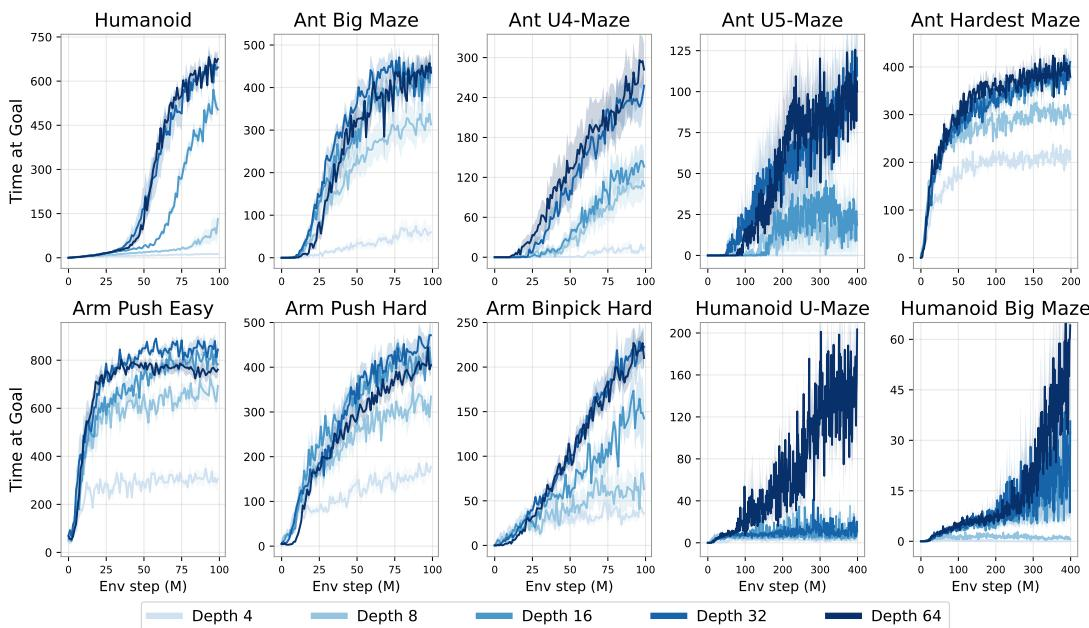
Scaling large models has produced emergent capabilities in vision and language, yet in reinforcement learning the payoff from scale remains uncertain because agents receive sparse reward signals and usually use small MLP policies of 2 to 5 layers. Prior work has struggled to match these gains, often seeing only marginal improvements, training instability, or limited and sometimes negative returns when increasing depth, while commonly treating self supervised pretraining as the main path to scale. The authors leverage contrastive reinforcement learning as a self supervised actor critic method, increase online data availability through GPU accelerated RL training, and build networks up to about 100 times deeper using residual connections, layer normalization, and Swish activations. They show that this combination enables strong RL scalability, with more than 20 times performance gains in half the environments, better results than goal conditioned baselines, and qualitatively distinct policies emerging as depth and scale increase.
Experiment
The experiments evaluate goal-conditioned contrastive RL on JaxGCRL locomotion, navigation, and manipulation tasks with sparse rewards, comparing residual actor and critic networks of increasing depth against standard shallow baselines. The results show that depth scaling yields substantial gains, especially in long-horizon and humanoid tasks, and leads to emergent navigational and locomotion skills once critical depths are reached. Ablations and mechanistic analyses indicate that depth is more useful than width, joint actor-critic scaling can help, and larger depths unlock larger batches while improving representation quality, exploration, and limited generalization, though offline results do not show the same benefit.