Command Palette
Search for a command to run...
強化学習はLLMにおいて基底モデルを超える推論能力を本当に促進するのか?
強化学習はLLMにおいて基底モデルを超える推論能力を本当に促進するのか?
Yang Yue Zhiqi Chen Rui Lu Andrew Zhao Zhaokai Wang Shiji Song Gao Huang
概要
検証可能な報酬を用いた強化学習(Reinforcement Learning with Verifiable Rewards; RLVR)は、近年、大規模言語モデル(LLM)の推論性能、特に数学・プログラミングタスクにおける性能向上において顕著な成功を収めている。従来の強化学習がエージェントに探索と新戦略の学習を促すのと同様に、RLVRもLLMが継続的に自己改善を行い、対応する基底モデルの能力を超える新たな推論能力を獲得すると広く考えられている。本研究では、RLVRの現状を批判的に検証するため、複数のモデルファミリー、強化学習アルゴリズム、数学・コーディング・視覚推論ベンチマークにわたり、RLVRで学習したLLMの推論能力の境界を体系的に探る。評価指標には大きなk値におけるpass@kを用いる。RLVRが正しい経路へのサンプリング効率を改善することは確認されたが、驚くべきことに、現在の訓練では根本的に新たな推論パターンは獲得されていないことが判明した。具体的には、RLVRで学習したモデルは小さいk値(例:k=1)では基底モデルを上回るものの、kが大きい場合、基底モデルの方がより高いpass@kスコアを達成する。さらに、RLVRの訓練が進むにつれてLLMの推論能力の境界がむしろ狭まる傾向も観察された。カバレッジおよびパープレキシティの分析から、RLVRモデルが生成する推論経路は基底モデルのサンプリング分布に既に含まれていることが示され、それらの推論能力は基底モデルに由来し、基底モデルによって規定されていることが示唆される。この観点から基底モデルを上限として捉えると、6つの主要なRLVRアルゴリズムはいずれも同様の性能にとどまり、基底モデルの潜在力を十分に活用するには程遠いことが定量分析により明らかになった。対照的に、蒸留(distillation)は教師モデルから新たな推論パターンを導入し、モデルの推論能力を実質的に拡張できることが確認された。以上の結果から、現在のRLVR手法は、LLMに真に新規な推論能力を喚起するという強化学習の潜在力を十分に実現していないことが示唆される。この潜在力を解き放つためには、継続的なスケーリングやマルチターンでのエージェントと環境のインタラクションなど、改良された強化学習パラダイムの必要性が強調される。
One-sentence Summary
Researchers from LeapLab at Tsinghua University and Shanghai Jiao Tong University use pass@k at large k to systematically probe RLVR-trained LLMs and find that RLVR narrows rather than expands reasoning capability boundaries, with all tested reasoning paths originating from the base model's sampling distribution, whereas distillation genuinely introduces novel reasoning patterns.
Key Contributions
-
This paper provides a systematic framework for evaluating reasoning capability boundaries of RLVR-trained large language models across model families, reinforcement learning algorithms, and math, coding, and visual reasoning benchmarks, using pass@k at large k values.
-
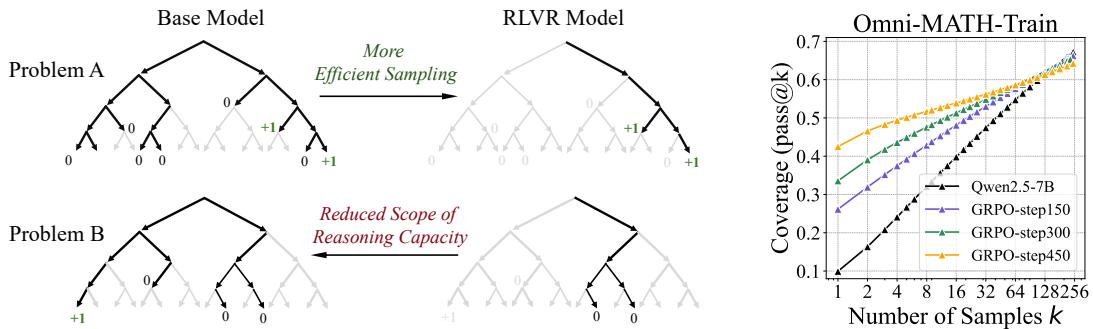
Empirical results indicate that current RLVR training improves sampling efficiency toward correct paths already present in base models, while base models can achieve higher pass@k scores at large k and RLVR-trained models often show narrowed reasoning boundaries.
-
A comparison of six popular RLVR algorithms against distillation shows that the RLVR algorithms perform similarly and remain far from fully leveraging the base model, whereas distillation introduces new reasoning patterns and expands reasoning capability.
Introduction
The authors study reinforcement learning with verifiable rewards, or RLVR, which has become important for improving large language models on reasoning-heavy tasks such as math and coding. In this setting, models are optimized using automatically verifiable feedback, such as final-answer correctness or passing unit tests, without relying on costly human annotations. Prior work has shown strong empirical gains, but it remained unclear whether RLVR genuinely teaches new reasoning strategies or merely makes better use of the base model’s existing capabilities. Previous analyses were often limited in scope and typically evaluated average-case performance, which can obscure a model’s true reasoning potential. The authors contribute a rigorous boundary evaluation using pass@k across multiple model families, sizes, tasks, and RLVR algorithms. They show that current RLVR improves sampling efficiency but does not fundamentally expand reasoning capacity, and that the successful reasoning paths found by RLVR models largely already exist in the base model.
Dataset
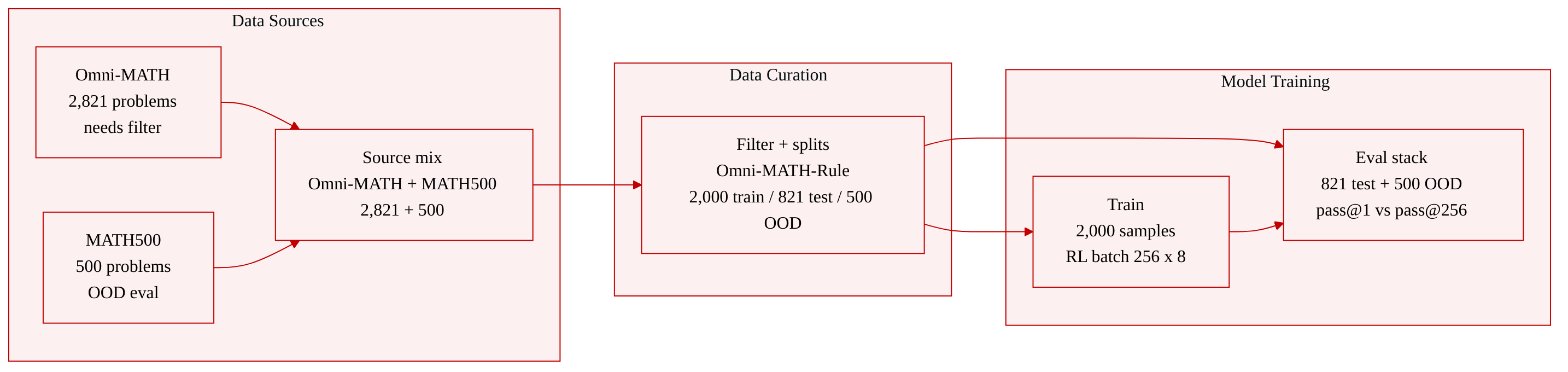
- The dataset is Omni-MATH-Rule, a subset of Omni-MATH selected to include math problems with verifiable answers.
- The authors split Omni-MATH-Rule into a 2,000-sample training set and an 821-sample in-domain test set.
- They use MATH500 as a separate out-of-domain benchmark for evaluating generalization.
- The data is used to study how different RL algorithms affect sampling efficiency, especially by comparing pass@1 with base-model pass@256.
- During evaluation, prompts are handled in batches of 256, with 8 candidate responses generated per prompt, under a maximum generation length of 8,192 tokens.
Method
The authors formulate reinforcement learning with verifiable rewards as an optimization problem over an LLM policy. Let πθ denote a language model with parameters θ that generates a token sequence y=(y1,…,yT) conditioned on a prompt x. A deterministic verifier V evaluates the generated output and returns a binary reward
r=V(x,y)∈{0,1},where r=1 if and only if the model’s final answer is exactly correct. In some settings, an additional format reward is used to encourage the model to separate its reasoning process from the final answer. The training objective is to maximize the expected reward over the prompt distribution D:
J(θ)=Ex∼D[Ey∼πθ(⋅∣x)[r]].The overall RLVR workflow, including prompt sampling, model generation, verifier scoring, and policy optimization, is summarized in the accompanying figure.
For policy optimization, the paper adopts Proximal Policy Optimization and its variants. PPO maximizes a clipped surrogate objective:
LCLIP=E[min(rt(θ)At,clip(rt(θ),1−ϵ,1+ϵ)At)],where
rt(θ)=πθold(yt∣x,y<t)πθ(yt∣x,y<t),and At is the advantage estimated by a value network Vϕ. The probability ratio rt(θ) measures how much the updated policy deviates from the old policy at each token position. The clipping operation limits the magnitude of this deviation, improving training stability compared with unbounded policy updates. An optional KL divergence term can also be added to constrain the optimized policy from drifting too far from the initial model.
PPO belongs to the broader policy gradient family of RL methods. These algorithms learn from on-policy samples, meaning the training data are generated by the current policy or an older version of it. In the verifiable-reward setting, the training signal is especially clean: samples whose final answers are correct receive positive feedback, while incorrect samples receive negative or zero feedback. Consequently, the policy gradient process increases the log likelihood of successful continuations and decreases the likelihood of unsuccessful ones.
The training protocol distinguishes between math tasks and coding or visual reasoning tasks. For math, the authors follow a zero RL setting, where RL is applied directly to a pretrained base model without prior supervised fine tuning. This setting is useful for isolating the effect of RLVR itself. For coding and visual reasoning, instruction-tuned models are typically used as starting points because zero RL from a pure pretrained model can be less stable. In those cases, the paper compares a supervised fine tuned model against its RLVR-trained counterpart to examine the incremental impact of reinforcement learning with verifiable rewards.
Experiment
The experiments evaluate reasoning capacity boundaries across mathematical, coding, and visual reasoning benchmarks using pass@k with extensive sampling and consistent zero-shot prompts, comparing base, RLVR-trained, and distilled models. The results show that RLVR mainly improves sampling efficiency at small k, while base models often cover more solvable problems at larger k, indicating a narrower reasoning boundary after RL training. Analyses of coverage, perplexity, training settings, entropy, algorithm choice, and a near-frontier model suggest that current RLVR sharpens existing base-model reasoning paths rather than expanding them, whereas distillation can introduce new reasoning capabilities.
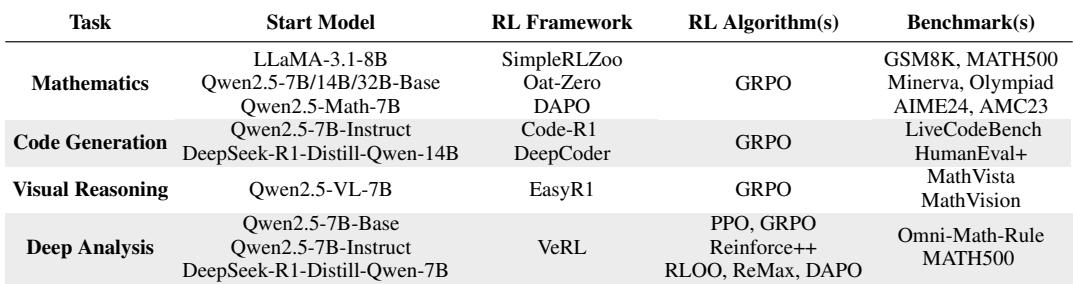
The experiments compare base and RLVR models across mathematics, code generation, and visual reasoning using matched zero-shot sampling settings. RLVR consistently improves low-budget pass performance, but its advantage narrows as the sampling budget increases, and larger near-frontier models show a similar boundary-limited pattern. The evaluation spans multiple model families, RL frameworks, and task domains, including mathematics, coding, and visual reasoning. Base and RLVR models use the same zero-shot prompt style to avoid confounding from few-shot examples. RLVR provides clear gains at low pass budgets, while base models catch up or outperform RLVR at higher pass budgets. KL regularization and entropy-matched generation do not remove the apparent narrowing of the RLVR reasoning boundary.
The base model and RLVR-trained model mostly solve the same problems, but the base model still solves many problems that the RLVR-trained model misses. The reverse case is rare, especially on AIME24, so the RLVR model's gains mainly reflect more reliable sampling on problems the base model can already solve. Both models fail on a notable fraction of AIME24 problems, while shared failures are much less common on MATH500. Most problems solved by the RLVR-trained model are also solvable by the base model. The base model covers a broader set of solvable problems than the RLVR-trained model. RLVR-trained models rarely solve problems that the base model cannot.
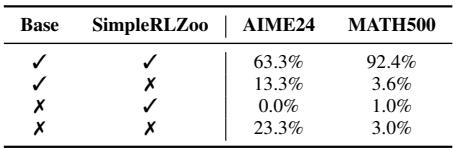
The experiments compare base and RLVR-trained models on mathematics, coding, and visual reasoning under matched zero-shot sampling across multiple model families and RL frameworks. They show that RLVR mainly increases reliability on problems the base model can already solve, yielding larger gains at low sampling budgets that narrow as budgets grow. The base model generally covers a broader set of solvable problems, while RLVR models rarely solve tasks beyond the base model's reach, suggesting reasoning boundary limitations rather than expanded capability.