Command Palette
Search for a command to run...
Claudeによる自律的なde novoタンパク質バインダー設計
Claudeによる自律的なde novoタンパク質バインダー設計
Amir Shanehsazzadeh
概要
タンパク質構造生成、配列設計、構造予測のための深層学習手法により、現在ではわずか数十の設計候補を用いて多くの標的に対するde novoバインダー設計が可能になっている。それでもなお、設計キャンペーンには、標的生物学、構造モデリング、急速に変化する計算ツール群にまたがる専門知識と、ソフトウェアと計算資源を数日間にわたって統合運用する労力が必要とされる。我々は、この専門知識と労力のどの程度をAIエージェントが担えるかを問うた。バインダー設計キャンペーンの実務知識を単一のプロトコルプロンプトにまとめ、いかなる標的についてもエピトープ、スキャフォールド、配列を指定しないものとした。このプロンプトに基づき、またいかなる設計判断にも人間の入力を介さずに、Claude Opus 4.8とMythos Previewは16の標的に対して24〜48時間のキャンペーンを実施した。各標的について調査を行い、エピトープを選択し、オープンソースのタンパク質設計・構造予測モデルをインストールして実行し、候補をin silicoで最適化し、標的ごとにランク付けされた30の設計を納品した。2つの独立した受託研究機関が、納品されたすべての設計をそのまま合成して結合を測定し、16標的のうち15標的について解釈可能な測定結果が得られた。Claudeはそのうち14標的に対してバインダーを設計し、1,320設計中354設計が結合し、ヒット率は27%であった。各キャンペーンで各標的の第1位にランクされた設計のうち49%が結合した。単一の48時間セッションで全標的を同時に設計した場合、Mythos PreviewとOpus 4.8はそれぞれ26.7%と22.6%のヒット率を達成し、24時間セッションで一度に1標的ずつ設計した場合、Mythos Previewのヒット率は35.1%であった。E3リガーゼサブユニットRBX1については、最近開催された公開設計コンペティションで245のde novo設計のうち9つが結合したが、Claudeの90設計のうち28設計が結合した。最も強く結合したものはKDが3.9 nMであり、同じプレート上で再合成・測定されたコンペティション優勝作品の45 nMを上回った。種間交差反応性はプロンプトの副次的な目的に過ぎなかったが、標的のマウスオルソログに対して試験された233バインダーのうち130がそれにも結合した。Claudeが使用したすべてのモデルはオープンソースであり、この種のキャンペーンはあらゆる研究室の手の届くものとなる。我々は、プロンプト、全1,440設計の計算モデル、および信頼性の高い測定が得られた1,320設計の結合データを、自律的バインダー設計の再現可能なプロトコルとして、また当該分野のためのベンチマークデータセットとして公開する。
One-sentence Summary
Anthropic researchers demonstrate that Claude Opus 4.8 and Mythos Preview, guided by a single protocol prompt with no human input into any design decision, autonomously performed de novo binder design campaigns against 16 targets using open-source protein design and structure-prediction models, achieving a 27% hit rate (354 of 1,320 designs) and 49% binding among top-ranked designs, including a KD of 3.9 nM on RBX1, and released the prompts, computational models of all 1,440 designs, and binding data for the 1,320 designs with reliable measurements.
Key Contributions
- The paper introduces an autonomous protein binder design protocol based on a single frozen prompt specifying no epitope, scaffold, or sequence, in which Claude Opus 4.8 and Mythos Preview researched targets, chose epitopes, ran open-source design and structure-prediction tools, and delivered ranked de novo binders without human input into any design decision.
- Experimental validation by two independent contract research organizations across 15 interpretable targets identified binders for 14 targets, with 354 of 1,320 synthesized designs binding (27% hit rate) and 49% of first-ranked designs binding; on RBX1, 28 of 90 designs bound and the tightest KD was 3.9 nM versus 45 nM for the competition's winning entry.
- The study releases the prompts, computational models of all 1,440 designs, per-design provenance, and binding measurements for 1,320 designs, establishing a reproducible protocol and benchmark dataset for autonomous binder design.
Introduction
The design of de novo protein binders is important for therapeutics and diagnostics, but typical campaigns depend on expert scientists to choose targets, select epitopes, run design tools, and rank candidates. Prior AI-assisted pipelines and agent systems have supported parts of this workflow, yet they still rely on substantial human intervention and are rarely tested at scale with complete experimental reporting. The authors address this gap by showing that Claude, given only a written protocol and open-source tools, can autonomously carry out binder design campaigns across 16 targets, making every design decision from target construct to final ranking and producing experimentally validated binders on most targets.
Method
The authors leverage a single, comprehensive protocol prompt to guide an AI agent through autonomous protein binder design campaigns. This prompt, approximately 16,000 words in length, is loaded as the system prompt for every agent instance. It encapsulates the knowledge of an expert designer, defining the campaign stages, available tools, and selection criteria while leaving specific decisions to the agent. The agent autonomously researches target biology, selects modeling regions and epitopes, and chooses from a pre-cleared menu of open-source backbone generation and sequence design tools. It filters candidates for novelty and sequence composition before committing compute to scoring.
Refer to the framework diagram for the detailed anatomy of this protocol.
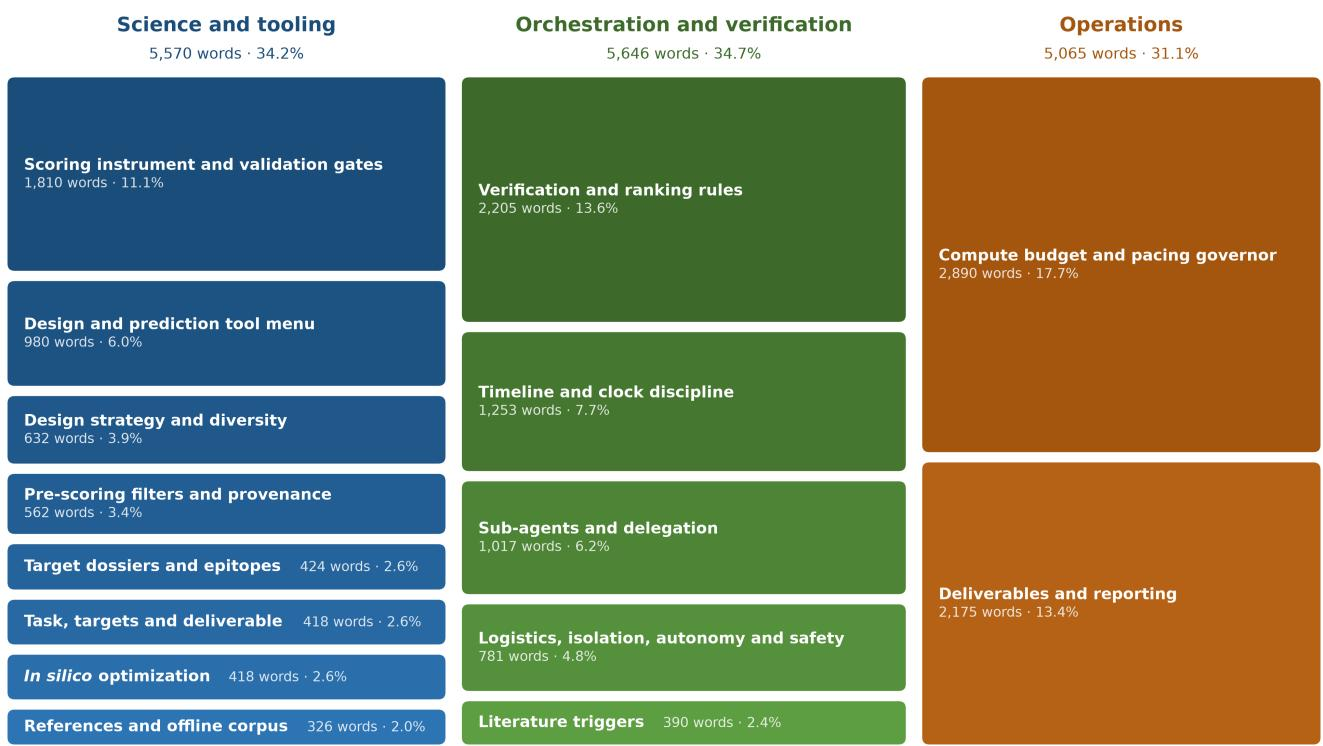
The prompt is structured into three primary thematic blocks. The "Science and tooling" block (34.2%) provides the working knowledge for design, including target dossiers, epitope selection, design tool menus, pre-scoring filters, and the specific ranking score. The "Orchestration and verification" block (34.7%) enables sustained autonomy over 24 to 48 hours by defining sub-agent delegation, timeline discipline, and verification rules. The "Operations" block (31.1%) manages the compute budget, pacing governor, and final reporting deliverables.
To evaluate and select the top 30 designs per target, the agent employs a specific ranking score based on an ensemble of structure predictors.
As shown in the figure below, the authors determined that ensembling scores from Protenix v2, ESMFold2, and ESMFold2-Fast yielded the highest macro-averaged precision for distinguishing binders from non-binders.
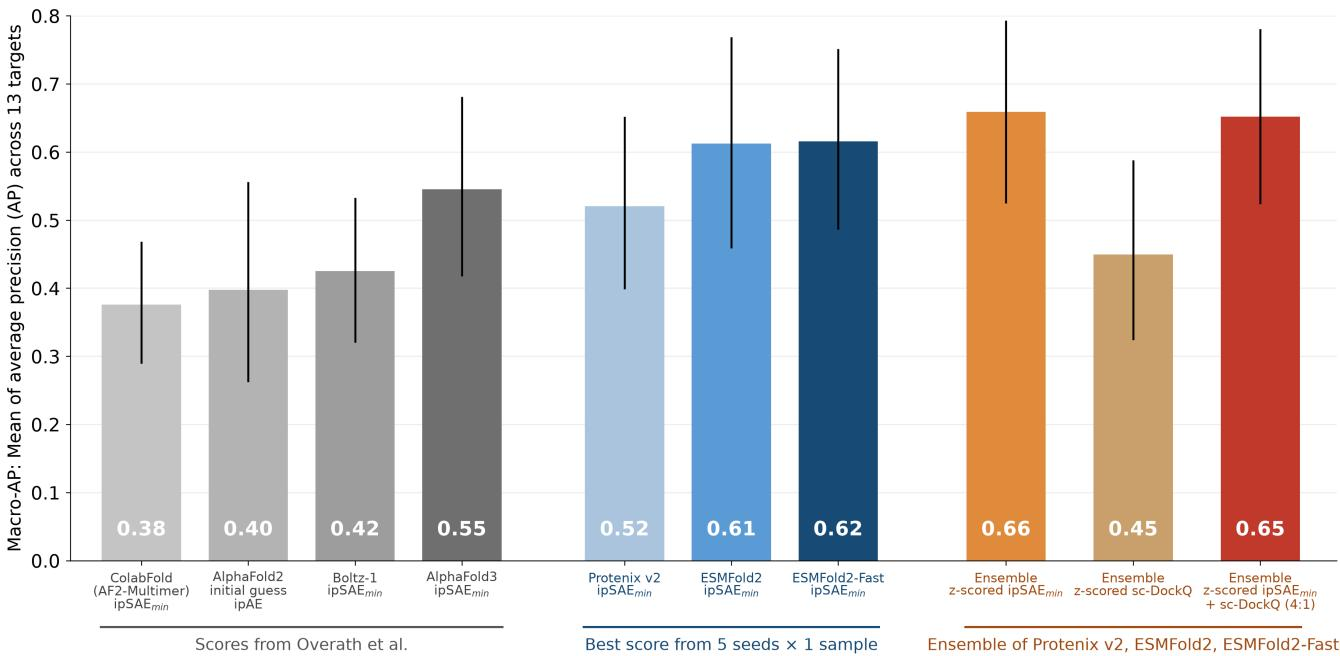
The ranking score combines the z-scored ipSAEmin (interaction predicted Structural Alignment Error) from these three predictors with self-consistency DockQ (sc-DockQ) terms added at one-quarter weight. The sc-DockQ terms serve as a check to ensure the predicted pose matches the designed complex, although they do not significantly change discrimination.
Following the autonomous campaigns, the authors applied a standardized re-scoring protocol independent of the wet lab work. Every ordered design was evaluated using ten publicly available co-folding predictors under uniform settings. The maximum ipSAEmin from five seeds per predictor was recorded.
The calibration of these re-scored confidence values against experimental binding hit rates is presented in the figure below.
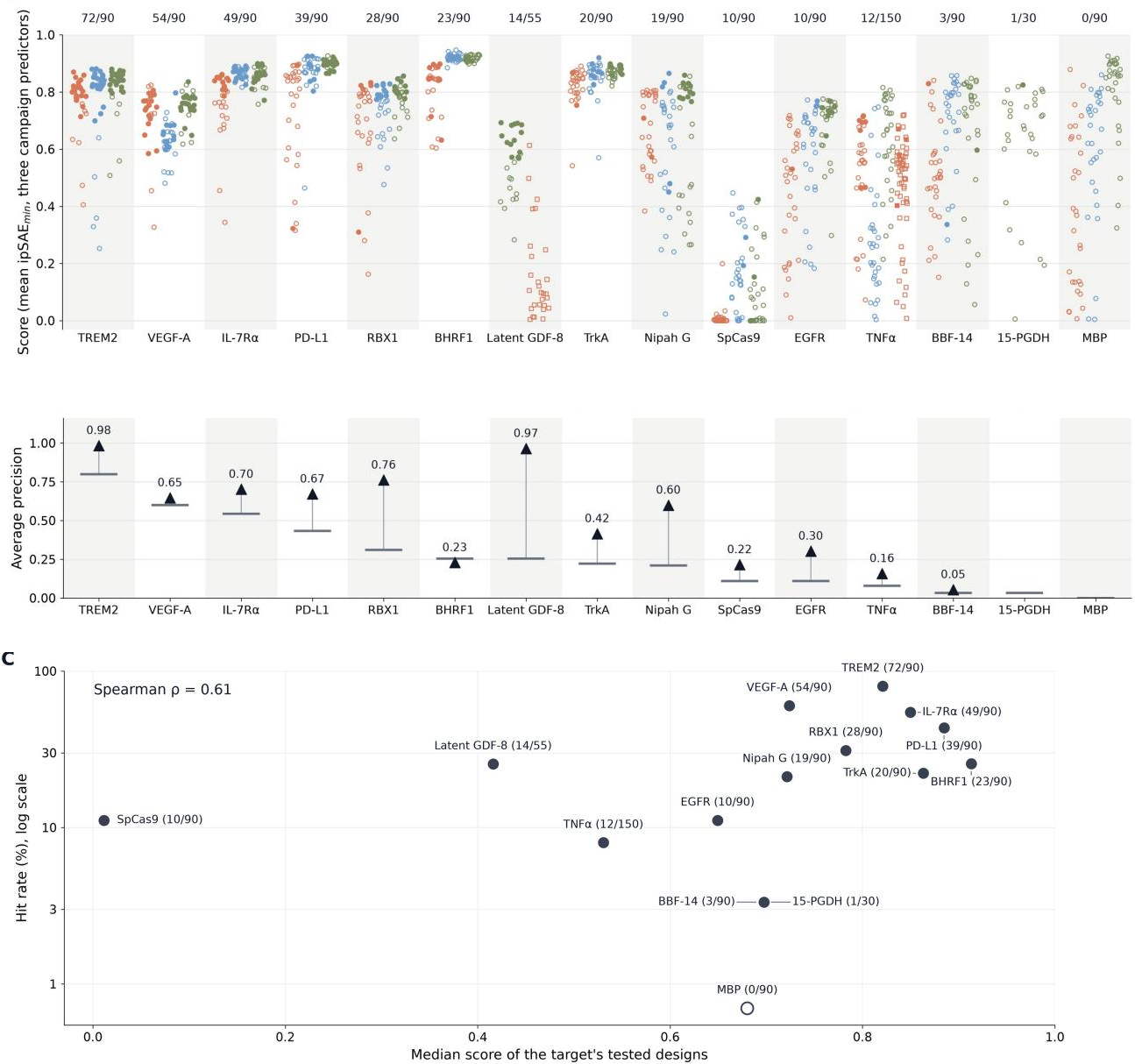
The mean ipSAEmin across the three campaign predictors shows a strong correlation with hit rates across targets. To validate the designs experimentally, the authors utilized two independent contract research organizations (CROs), Adaptyv Bio and Twist Bioscience. Adaptyv Bio expressed designs via cell-free synthesis and measured binding using surface plasmon resonance (SPR) or bio-layer interferometry (BLI). Twist Bioscience expressed designs as Fc fusions in HEK293 cells and used high-throughput SPR arrays. The authors developed an automated labeling rule to integrate the distinct readouts from both CROs. A design was classified as a binder if it met specific criteria in the Adaptyv Bio traces, or if both blind trace grades were positive, or if the Twist Bioscience label was positive and Adaptyv Bio data was uninformative. This rigorous dual-validation pipeline ensured robust classification of the tested designs.
Experiment
The study tested whether an autonomous AI agent could run complete protein-binder design campaigns, from target research to a ranked set of designs, by synthesizing and measuring 1,320 designs across 15 interpretable targets with two independent CROs and assigning each design an integrated binder call. The experiments showed that the agent produced binders for most targets, that its top-ranked designs were enriched for binding, and that co-folding scores separated binders from nonbinders within targets but gave little warning of the least successful targets. Further validations found the agent's designs were competitive with open protein-design competition entries on shared targets, included species cross-reactive and beta-sheet-containing binders, and identified clear failures such as no binders against MBP and only rare weak binders against BBF-14 and 15-PGDH, while the overall evidence remains limited to binding and ranking rather than structure or function.
Design rank was calibrated with binding: considering more of the highest-ranked designs per target increased the number of targets with at least one binder. The single-target campaign reached its maximum shown coverage early, while multi-target campaigns improved more gradually as more designs were included. The top-ranked design per target already yielded binders for roughly half of targets in each campaign. Coverage increased with additional top designs, reaching 10 of 13 targets for the multi-target campaigns and 11 of 15 for the single-target campaign by the top 15 designs. MBP did not produce a binder in any shown campaign, and TNFα did not produce a binder in either Mythos Preview campaign.
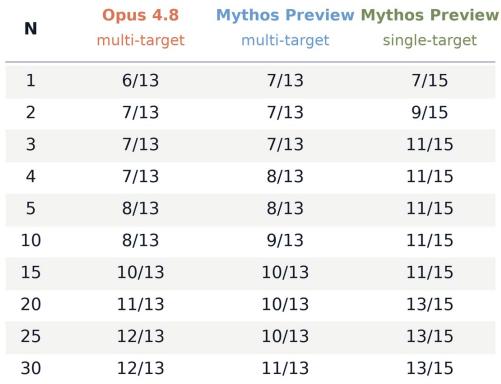
This experiment examined how design ranking relates to binding by tracking target coverage as more top-ranked designs were included. The highest-ranked design per target yielded binders for roughly half of targets, and coverage increased with additional top designs, reaching 10 of 13 targets for multi-target campaigns and 11 of 15 for the single-target campaign by the top 15 designs. The single-target campaign reached its maximum coverage early, while multi-target campaigns improved more gradually. MBP produced no binders in any shown campaign, and TNFα produced no binders in either Mythos Preview campaign.