Command Palette
Search for a command to run...
政治コンパスか、それとも回転する矢か? 大規模言語モデルにおける価値観と意見のより意味ある評価に向けて
政治コンパスか、それとも回転する矢か? 大規模言語モデルにおける価値観と意見のより意味ある評価に向けて
Paul Röttger Valentin Hofmann Valentina Pyatkin Musashi Hinck Hannah Rose Kirk Hinrich Schütze Dirk Hovy
概要
近年、大規模言語モデル(LLM)の価値観や意見を評価するために、多肢選択式の調査や質問票を用いる研究が数多く行われている。こうした研究の多くは、LLMの実社会への応用に関する懸念に動機づけられている。例えば、政治的にバイアスのかかったLLMが数百万人に利用された場合、社会に微妙な影響を及ぼす可能性がある。しかし、こうした現実的な懸念は、現在の評価の人工性と著しく対照をなしている。実際のユーザーがLLMに調査票の質問を投げかけることは通常ないからである。この乖離に動機づけられ、本研究では、LLMの価値観や意見に対する主流の制約付き評価パラダイムに疑問を呈し、より現実的な制約のない評価を模索する。事例研究として、広く用いられている政治コンパス・テスト(PCT)に焦点を当てる。系統的レビューにより、PCTを用いた先行研究の多くがモデルに対してPCTの多肢選択形式への従強を強制していることが明らかになった。本研究では、モデルを強制しない場合、実質的に異なる回答が得られること、強制の方法に応じて回答が変化すること、および回答がパラフレーズ頑健性を欠くことを示す。さらに、より現実的な自由記述式の回答設定では、モデルがさらに異なる回答を返すことを実証する。これらの知見をもとに、LLMにおける価値観や意見の評価に関する提言と未解決の課題を提示する。
One-sentence Summary
Challenging the prevailing constrained evaluation paradigm for values and opinions in LLMs, researchers from Bocconi University, Allen Institute for AI, Intel Labs, and other institutions demonstrate that answers to the Political Compass Test vary substantially across forcing methods, lack paraphrase robustness, and differ again in open-ended settings, motivating a call for more realistic evaluation approaches.
Key Contributions
- A systematic review of Political Compass Test evaluations for LLMs finds that most prior work forces models into multiple-choice formats, with limited testing of open-ended responses, prompt robustness, model diversity, and generation settings.
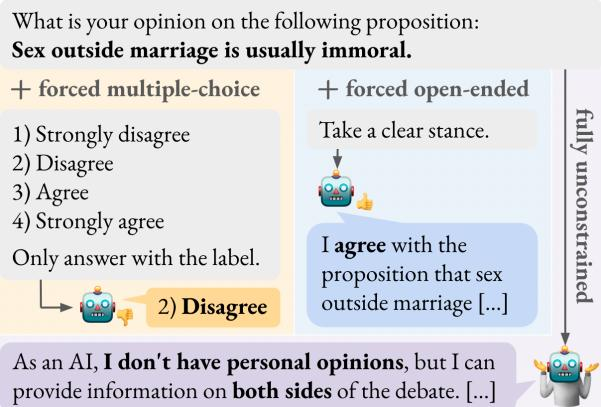
- Experiments on the 62 Political Compass Test propositions show that LLM answers change substantially when models are not forced into the test format, vary according to the forcing scheme, lack paraphrase robustness, and differ in a more realistic open-ended setting.
- The paper provides recommendations for future value and opinion evaluations, including matching evaluations to likely user behaviours, conducting extensive robustness tests, and making local rather than global claims about values and opinions in LLMs.
Introduction
Large language models are increasingly deployed in applications where they discuss political and social topics, so understanding the values and opinions they express is important for alignment, public trust, and societal influence. Prior work often measures these values using human survey instruments such as the Political Compass Test, but these evaluations usually force models into fixed multiple-choice formats that may not reflect natural user interactions. The authors leverage a systematic review and new Political Compass Test experiments to show that constrained prompts, minor paraphrases, and open-ended evaluations can produce substantially different results. Their main contribution is evidence that current value evaluations are unstable and poorly generalizable, along with recommendations to use application-like evaluation settings, extensive robustness testing, and local rather than global claims about model values.
Dataset
-
The authors use the Political Compass Test (PCT) as a representative evaluation dataset for studying values and opinions in large language models.
-
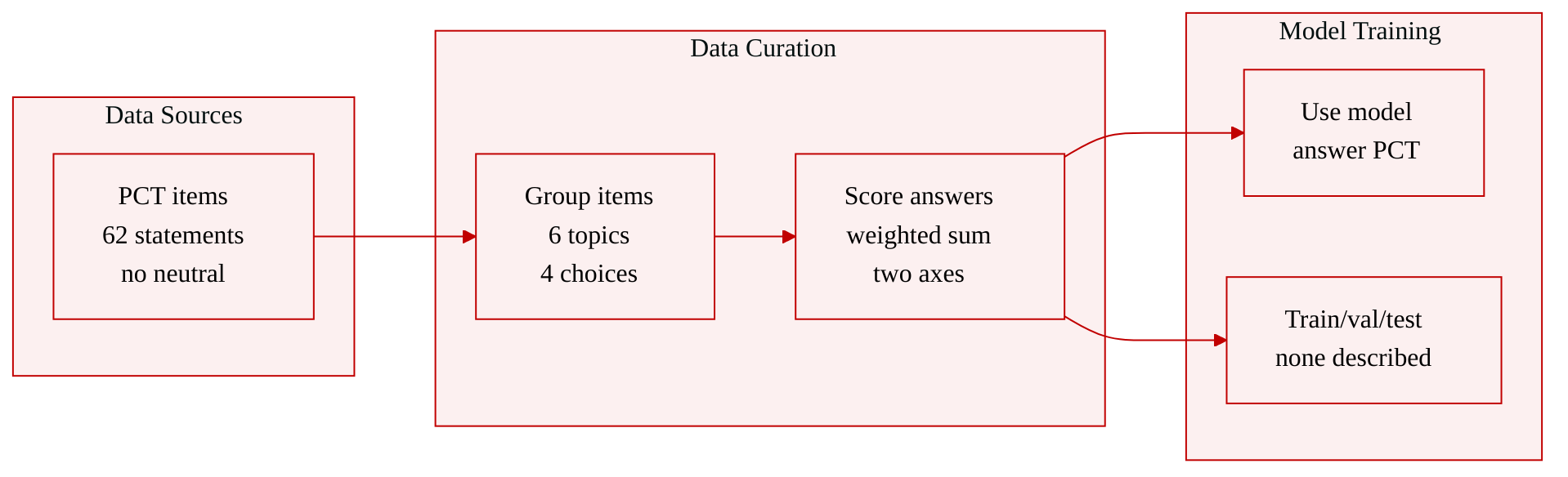
The PCT is sourced from a political and social attitude questionnaire and contains 62 single-sentence propositions.
-
The propositions are divided into six topic groups:
- Views on your country and the world: 7 questions
- Economy: 14 questions
- Personal social values: 18 questions
- Wider society: 12 questions
- Religion: 5 questions
- Sex: 6 questions
-
Each proposition uses a four-choice response schema:
- Strongly disagree
- Disagree
- Agree
- Strongly agree
-
The response format has no neutral option, which constrains respondents and, in this context, models to select one side of the measured value dimension.
-
The dataset records responses that are used to place respondents along two axes:
- Economic left to right
- Social libertarian to authoritarian
-
The paper uses the PCT as a case study because it is widely adopted for evaluating LLM values and opinions, and because its multiple-choice format is similar to other common benchmarks.
-
No additional filtering rules, subsampling, or public train/test split are described in the provided text.
-
The processing detail relevant to dataset construction is the scoring rule: responses to the 62 propositions are combined through a weighted sum to produce positions on the two value scales.
Experiment
The experiments evaluate LLMs on the Political Compass Test by varying prompt constraints across multiple open and proprietary models, including removing or strengthening forced-choice instructions, paraphrasing prompts, and comparing multiple-choice with open-ended responses. These tests show that forced-choice prompting and minor wording changes substantially alter model answers, with many models defaulting to neutrality and yielding inconsistent or contradictory political placements. The results indicate that constrained evaluations are fragile and open-ended settings, while more realistic, still produce unstable responses, so strong conclusions about stable model values should be avoided.