Command Palette
Search for a command to run...
怠惰なエージェントは自らの信念に反して回答する:検証可能な信念を用いた強化学習が信念に基づく行動を教える
怠惰なエージェントは自らの信念に反して回答する:検証可能な信念を用いた強化学習が信念に基づく行動を教える
Richmond Sin Jing Xuan Peilin Feng Wenbin Wang Soujanya Poria
概要
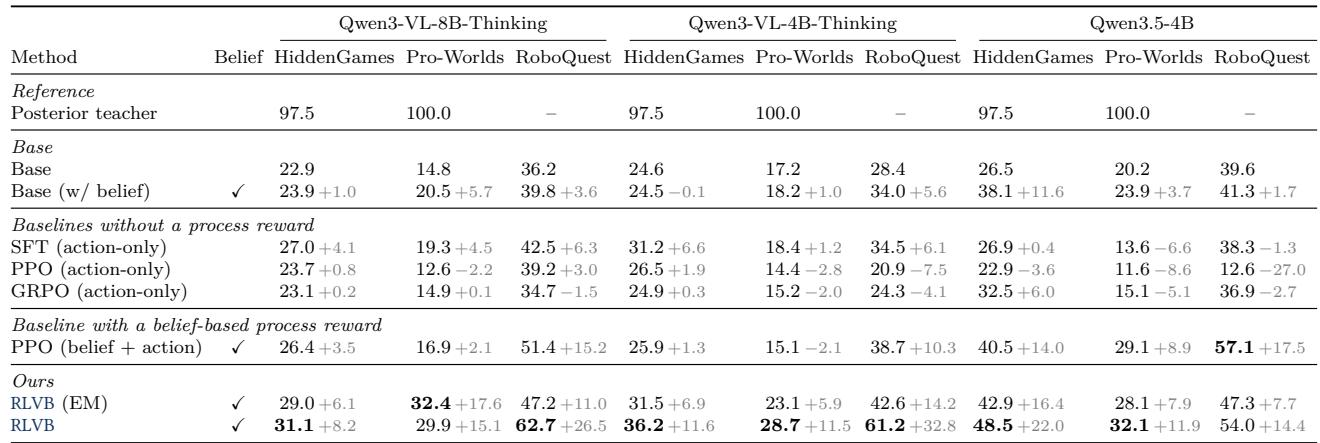
長いタスクに取り組むAIエージェントは、十分な証拠を集める前に早まって回答を確定してしまうことが多く、これはしばしば怠惰と呼ばれる。我々の評価では、エージェントは自身の表明する信念が依然として複数の可能な回答を挙げているにもかかわらず、回答を確定することが頻繁にあった。各ターンでエージェントは、さらにステップを進めるか、回答を確定するかを決定する。エピソード終了時の結果報酬は最終回答のみを評価する。それはどのターンが役立ったかを示さず、エージェントにいつ確定すべきかを教えることもできない。なぜなら、幸運な推測も証拠に裏付けられた回答と同じ報酬を受け取るからである。しかし、訓練中はシミュレータが隠れた回答と証拠を結びつける規則を知っているため、各ステップで回答に関する正確な事後分布を計算し、証拠がすでに十分かどうかを判定できる。我々は、この事後分布を証拠に裏付けられた信念として用いる「検証可能な信念を用いた強化学習(RLVB)」を提案する。RLVBは、この信念が依然として複数の回答を許容する間はさらにステップを進めることに対して、また証拠が十分になった時点で確定することに対してエージェントに報酬を与える。この報酬はエージェントが収集した証拠のみに依存し、判定者、批評家、報酬モデルを必要としない。更新によってこの信念行が行動と共に訓練されるにもかかわらず、報酬はエージェントが各行動の前に書く信念行を決して読まない。また、エージェントが小さな窓を通して広い世界を見て、確定するのに十分な視覚的証拠がいつ得られたかを判断しなければならない視覚パズルのベンチマーク「Pro-Worlds」を導入する。3つの視覚言語モデルを3つのベンチマークで評価し、そのうち2つは訓練では見られないものである。RLVBは9つの設定すべてでベースモデルを改善し、平均17.1%、期待値最大化(EM)を学習器として用いた場合は10.4%改善した。結果報酬の下では、GRPOとPPOは平均でベースモデルを下回った。RLVBはまた、LLM判定者によるプロセス報酬を用いたPPOを平均9.3%上回り、GPU時間は1.6分の1で済んだ。この改善の源泉を特定するため、エージェントが回答した時点で持っている証拠によって回答をグループ化した。訓練されたエージェントは、3つのベンチマークでそれぞれエピソードの51%、12%、74%において十分な証拠を持って回答したのに対し、ベースモデルは8%、0.4%、36%であった。すべての手法において、十分な証拠を持ってなされた回答の66〜92%が正しかった。したがって、訓練されたエージェントの精度向上は、高い証拠レベルでより頻繁に回答することに由来し、同じ証拠レベルではその回答はベースモデルより正確ではない。信念行は、訓練されたエージェントがこの証拠にどう到達するかを示している。すなわち、自らの信念に基づいて行動するのである。証拠が不十分で信念行が依然として複数の回答を挙げているターンで確定するのはわずか0.1〜2.2%であり、同じ信念行を持つベースモデルの3〜68%と対照的である。全ターンを通じて、その信念行はベースモデルより一貫して正確というわけではなく、各ステップで追加される証拠量もベースモデルのステップとほぼ同程度である。訓練されたエージェントは自らの信念に基づいて行動するため、証拠の読み取りが改善されれば、より良い回答につながることが期待される。
One-sentence Summary
Researchers from DeCLaRe Lab, Nanyang Technological University propose Reinforcement Learning with Verifiable Beliefs (RLVB), which uses simulator-derived posterior beliefs to reward evidence gathering and timely commitment without a judge, critic, or reward model, and introduce Pro-Worlds, a benchmark of visual puzzles where an agent views a large world through a small window; RLVB improves three vision-language models on three benchmarks by 17.1% on average and by 10.4% with expectation maximization (EM) as the learner, outperforms PPO with an LLM-judge process reward by 9.3% on average while using 1.6 times fewer GPU-hours, and leaves GRPO and PPO under outcome reward below the base model on average.
Key Contributions
- Reinforcement Learning with Verifiable Beliefs (RLVB) uses the simulator's exact posterior over hidden answers as a verifiable belief and assigns turn-level rewards for continuing while evidence still supports multiple answers and for committing once evidence is sufficient, requiring no judge, critic, or reward model.
- Pro-Worlds is introduced as a benchmark of visual puzzles in which an agent views a large world through a small window and must decide when it has enough visual evidence to commit.
- Across three vision-language models and three benchmarks, two of which are unseen during training, RLVB improves the base model in all nine settings, by 17.1% on average and by 10.4% with expectation maximization as the learner; it also outperforms PPO with an LLM-judge process reward by 9.3% on average while using 1.6 times fewer GPU-hours, with gains attributed to answering more often with sufficient evidence and acting on the stated belief.
Introduction
Long-horizon agents in games, embodied settings, and interactive environments must gather sufficient evidence before answering, but current models often stop too early and guess even when their own stated belief still leaves several answers open. This matters because users usually cannot check how an agent reached its answer, so reliability requires answers to be both correct and backed by sufficient evidence. Outcome-based reinforcement learning struggles here because a final answer reward cannot credit individual steps, and it can reinforce lucky guesses while penalizing careful but unsuccessful search. Process reward models and LLM judges can provide step-level credit, but they are expensive and may still reward lucky guesses. The authors introduce Reinforcement Learning with Verifiable Beliefs, or RLVB, which uses the simulator's privileged information to compute the exact posterior belief after every step and converts that belief into a process reward, requiring no judge, critic, or reward model.
Dataset
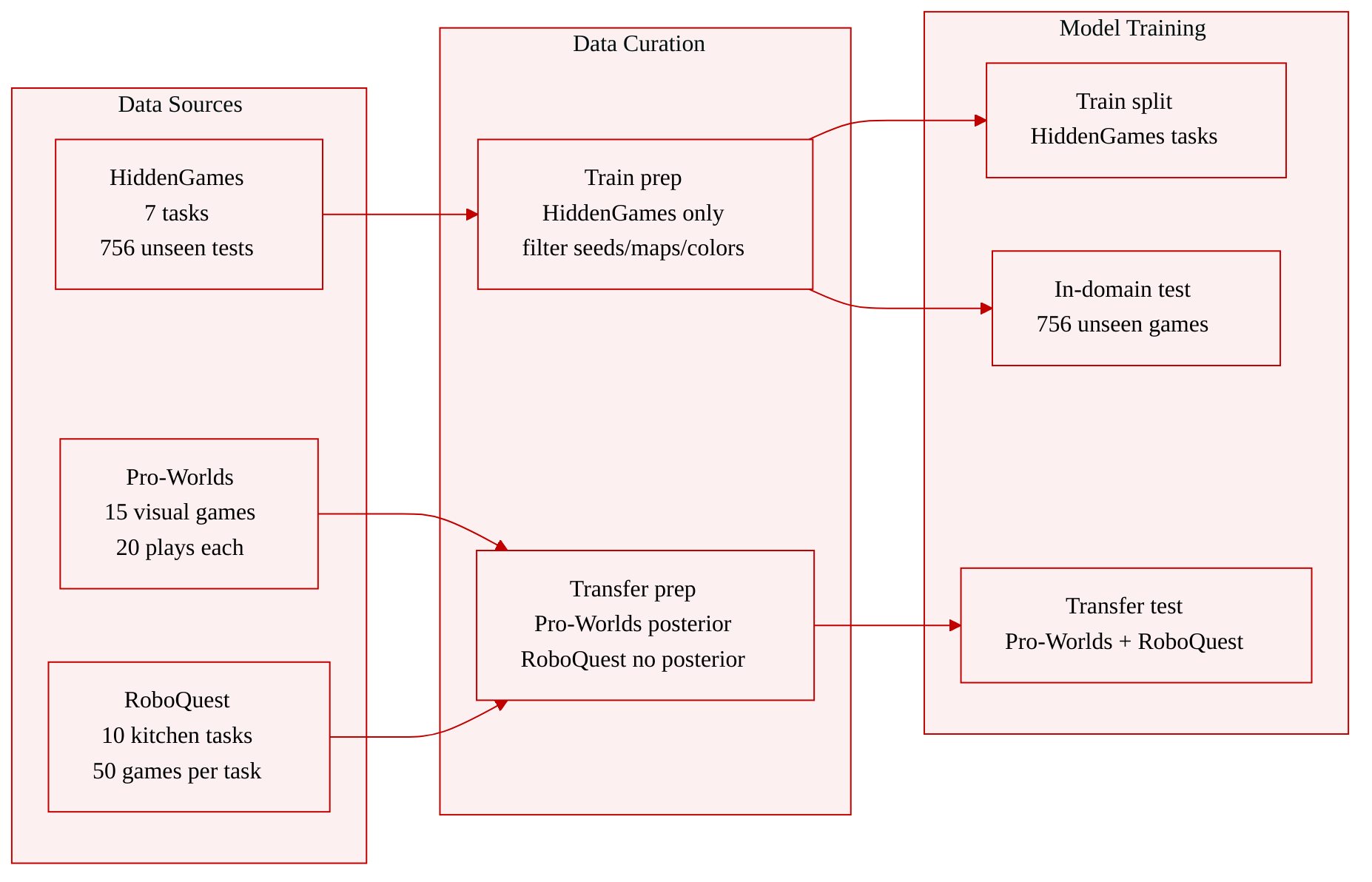
The authors use three benchmark suites, all with hidden answers that require the agent to collect evidence and decide when to answer.
- HiddenGames: combines seven tasks from existing agent benchmarks: MineSweeper, MiniGrid KeyCorridor, FrozenLake, Sokoban, and three Tabletop tasks rendered in ManiSkill3. The authors train on these tasks and test on 756 games with seeds, maps, and colors never seen in training.
- Pro-Worlds: a new out-of-domain visual benchmark with 15 games, 20 plays each: Face, Jigsaw, Kaleido, Bird, Fish, Recipe, Turtle, Balloon, Rocket, Bell, Bee, Candle, Sailboat, Barn, and Lantern. In each game, the agent sees a larger world through a small movable window, can make at most 35 moves, and then selects one of eight candidates, except Jigsaw which has ten candidates. Exact posterior distributions are computed from the game engine; a teacher using this posterior solves every game in 14.7 moves on average.
- RoboQuest: ten mobile manipulation tasks in simulated kitchens. It includes search, inspection, and interactive testing, such as finding an odd parcel by weighing. The authors test on 50 games per task.
Usage: HiddenGames provides the training and in-domain test data. Pro-Worlds and RoboQuest are used as transfer benchmarks to test visual evidence gathering and tasks without an exact posterior. Mixture ratios and additional filtering rules are not reported.
Method
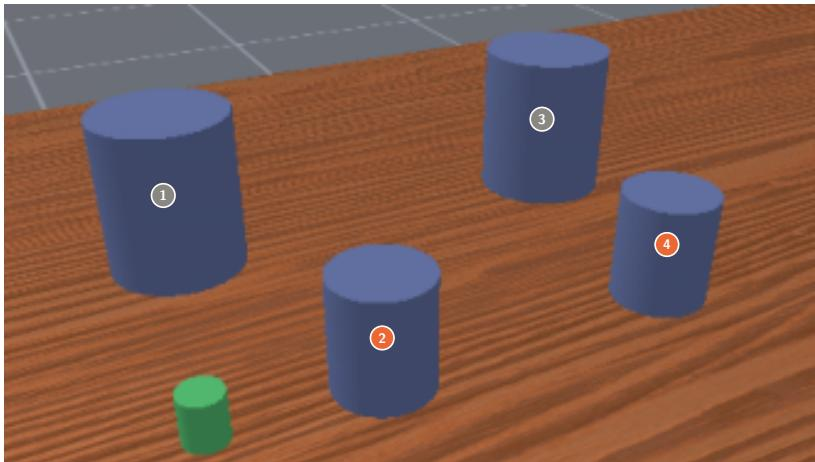
The authors propose RLVB, a reinforcement learning framework that trains vision-language agents to act based on verifiable beliefs in partially observable environments. The environment, such as the cups task shown below, involves a hidden target and evidence-gathering actions.
In this setup, the simulator computes an exact posterior over the hidden target based on the evidence gathered so far. The agent is a vision-language model that generates a turn consisting of reasoning, a belief line stating the set of possible answers, and an action. The objective is formulated as a partially observable Markov decision process where the agent must decide when to commit to an answer.
To guide the agent, the authors design a posterior teacher that operates on the exact posterior. This teacher values each action by computing the expected value of the posterior after the action, defining an optimal teacher policy. The teacher's stopping rule adapts to the agent's accuracy, encouraging more evidence gathering when the agent is unreliable.
The core of the method is the posterior process reward, which evaluates each turn at a given history. The reward function consists of an action term and a belief term. The action term scores the agent's action against the teacher policy based on the exact posterior, heavily penalizing premature answers while lightly discounting extra steps. This teaches the agent to commit only when the evidence is sufficient. The belief term directly checks the agent's stated belief line against the exact posterior, combining a log score, a penalty for overly wide beliefs, and a decision score. The full reward is expressed as R(h,x)=logπ∗(u∣b)+Sdec+η(S+W).
Refer to the framework diagram for a comparison of RLVB with other reinforcement learning approaches.
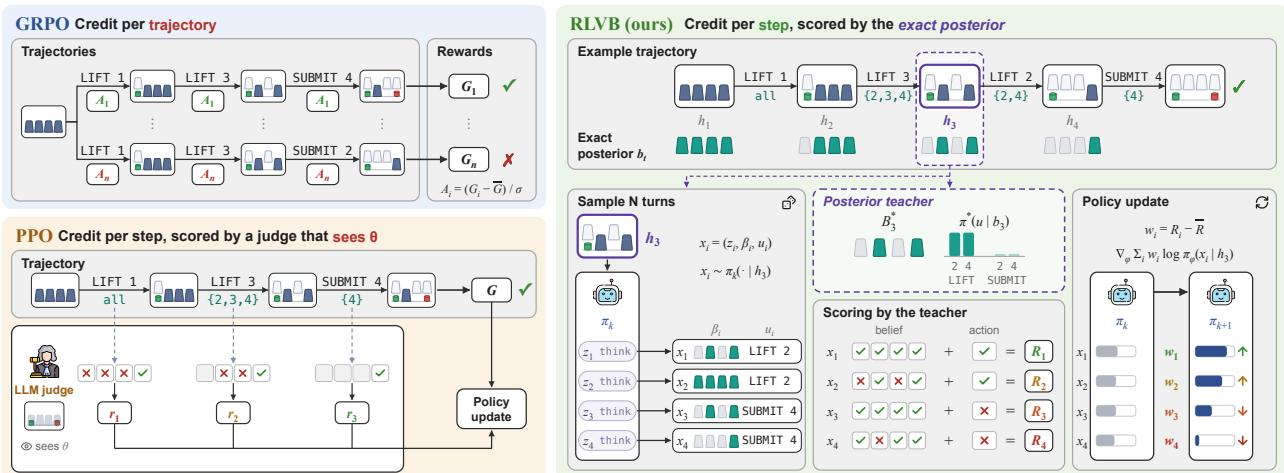
The policy update is performed step-by-step rather than over entire trajectories. Training occurs in phases where a fixed policy generates episodes, and at each history, multiple turns are sampled and scored. The update uses a group-relative weighting scheme similar to GRPO, but the group consists of the sampled turns at a single history. The weights are proportional to the reward minus the mean reward of the group. This ensures that each decision is credited only against alternatives under the exact same evidence, avoiding the credit assignment issues of trajectory-based methods. The model is updated via gradient steps on the weighted log likelihood, moving toward an improved policy while keeping the KL divergence within a threshold.
Experiment
The experiments evaluate agents on HiddenGames, Pro-Worlds, and RoboQuest, where answers are hidden and models must gather evidence before committing. They train open vision-language models with baselines using outcome rewards, belief-augmented PPO, and the proposed RLVB, which rewards turns against an exact posterior. RLVB achieves the highest accuracy and transfers to unseen benchmarks mainly by acting on its own belief line, committing less often when that line still names multiple answers and therefore gathering more evidence, even though its belief reading is not consistently better. Ablations show the posterior-based action term, rather than belief-line rewards, drives the gain, while limitations include relying on known rules and still performing below the posterior teacher.
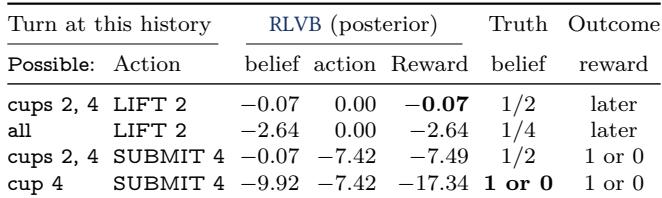
After the agent has lifted two cups, the target is equally likely under one of the two remaining cups. RLVB scores the next decision by combining a belief term and an action term, and it treats further evidence gathering as lower cost while heavily penalizing premature guesses, especially when the guessed cup is not confirmed. The pattern shows RLVB prefers further observation over premature commitment in this state. Lifting an unresolved cup can receive a zero action component and a relatively small belief penalty compared with submitting a guess. Submitting a guess under uncertainty is penalized more heavily than lifting, and the penalty grows further when the candidate cup is not confirmed. Exact posterior truth assigns equal probability to the two remaining cups, while final outcomes for submitted guesses are binary depending on whether the guessed cup hides the target.
Three vision-language models were evaluated on three benchmarks spanning training tasks and unseen environments. Stating a belief before actions improves accuracy without training, but the main and most transferable gains come from the posterior process reward used by RLVB. RLVB and RLVB (EM) outperform outcome-reward, imitation, and judged process-reward baselines in nearly all settings and reduce premature answers by acting on the belief line. Stating a belief improves accuracy in eight of nine settings without training, but it does not prevent early answers; RLVB’s posterior reward yields the strongest gains and reduces premature answers. Outcome rewards provide little or negative average improvement, while posterior process rewards transfer to unseen benchmarks and make RLVB or RLVB (EM) the best method in eight of nine settings.
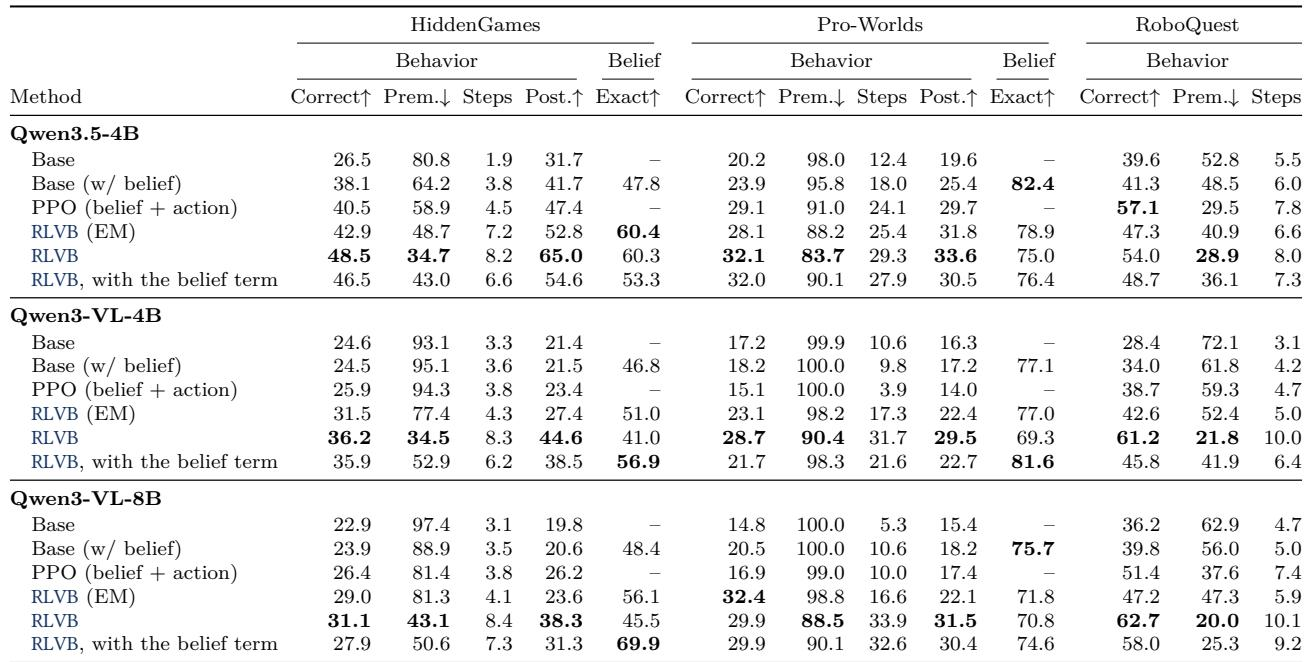
RLVB shows the most metacognitively consistent behavior among the evaluated agents, producing the fewest premature answers and taking the most evidence-gathering steps across all nine settings. On HiddenGames its premature answer rate is much lower than for PPO with belief and action or the base model with belief, even though its belief line is not the most often exactly aligned with the exact posterior. The improvement appears to come from acting on the stated belief, since the agent rarely commits while its belief line still names several answers. Across all nine settings, RLVB records the fewest premature answers and the highest number of evidence-gathering steps per episode. On HiddenGames, RLVB answers prematurely less often than PPO with belief and action or the base model with a belief line. RLVB rarely commits while its belief line still names multiple possible answers, linking its gain to acting on belief. Stating a belief alone does not prevent early answers, as base models with a belief line still commit on 3 to 68% of insufficient-evidence turns where their belief names several answers.
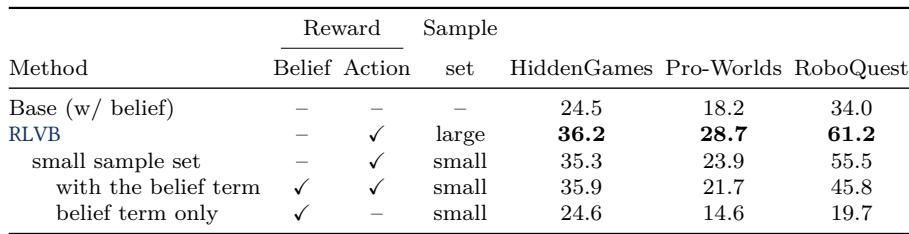
An ablation on Qwen3-VL-4B-Thinking shows that RLVB's gains are driven mainly by the action reward rather than the belief reward. Reducing the sample set from large to small leaves HiddenGames nearly unchanged but lowers accuracy on Pro-Worlds and RoboQuest, indicating the larger sample helps on benchmarks not seen in training. Adding the belief term to the action reward does not improve performance, and a belief-only reward performs at or below the base model. The action reward is the main source of RLVB gains; belief-only training matches or underperforms the base model across all three benchmarks. Using a large sample set mainly helps Pro-Worlds and RoboQuest, where the small sample set reduces accuracy. Adding the belief term to the action reward with a small sample set leaves HiddenGames nearly unchanged but lowers accuracy on Pro-Worlds and RoboQuest. Removing the action term causes performance to fall below the base model on Pro-Worlds and RoboQuest and to match the base model on HiddenGames.
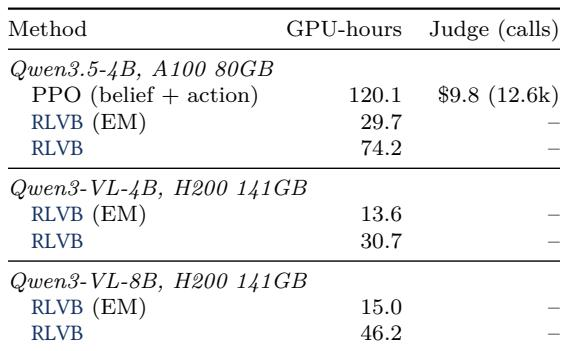
Training cost differs sharply by method. On the same model and GPU, PPO with belief and action is the most expensive setting and the only one with reported LLM judge calls, while RLVB runs are cheaper and RLVB EM runs are cheaper still. RLVB runs also stopped early after 20 to 35 updates because of a step KL limit, which contributes to their lower cost. Within Qwen3.5-4B runs, RLVB uses less GPU time than PPO, and the EM variant uses roughly a quarter of PPO's GPU time. The table reports no judge calls for RLVB variants, whereas PPO includes 12.6k judge calls costing $9.8. RLVB runs end before the planned 50 updates due to a step KL limit, reducing their compute cost.
The experiments evaluate RLVB in a sequential cup-search setting and across three vision-language benchmarks spanning training and unseen environments. RLVB's posterior process reward favors further evidence gathering over premature guessing, yielding the fewest premature answers and the most evidence-gathering steps, while belief statements alone improve accuracy but do not prevent early commitment. Ablations show the action reward, not the belief term, drives RLVB gains, larger sample sets help unseen benchmarks, and training cost is lower than PPO, especially for the EM variant.