Command Palette
Search for a command to run...
ACAP: 効率的なロボット制御のための非同期コーディングエージェント
ACAP: 効率的なロボット制御のための非同期コーディングエージェント
Zexin He Rui Li Yushi Lan Chengkai Jin Zhi Hou Xingang Pan
概要
コーディングエージェントは実行中にロボットの行動を構築・修正できるが、ロボット全体に単一のエージェントを用いると、本来独立に進められる作業が遅延する可能性がある。本論文では、1台のロボットを持続的なエージェントのチームとして組織化する非同期フレームワーク「Asynchronous Coding Agents as Policy(ACAP)」を提案する。各メンバーは、グリッパ付きアームや胴体とシャーシなど、設定可能な制御グループに対して推論と行動を行い、非同期な推論と実行を可能にする。しかし、ロボットの異なる構成要素間には物理的な依存関係が存在することが多く、協調が必要となる。この課題に対処するため、ACAPはタスクを割り当て、依存関係を調整し、リードエージェントとメンバーエージェントの間で制御を動的に配分するハイパーエージェントを導入する。これにより、独立した作業を並行して進めつつ、必要に応じて密に連携したマニピュレーションを支援する。25のタスク/プラットフォーム設定を対象とした72回の実世界ロールアウトにおいて、ACAPは単一エージェントのDirect Policyと比較してタスク均衡時間コストを28.2%削減し、完全並列、並列-逐次、協調の各タスクで改善が見られた。8つの協調設定すべてにおいて、ACAPはメンバーエージェントのみが割り当てられたグループを制御できるFixed Delegationよりも低い平均時間コストを達成した。さらに90回のロールアウトによる追加実験では、6つのタスクすべてにおいて、30分上限付きの平均時間コストがDirectよりも低いことが示された。また、シャーシと胴体の制御に同じメンバーインターフェースを用いた移動マニピュレーションも実証した。本論文では、フレームワークと、観測、生成されたプログラム、行動、フィードバックを含む実世界ロールアウトデータセットを提示し、コーディングエージェントが物理世界でどのように推論し行動するかに関する研究を支援する。
One-sentence Summary
Researchers from S-Lab, Nanyang Technological University, University of Oxford, and ACE Robotics propose ACAP, an asynchronous coding-agent framework that organizes a robot as persistent agents coordinated by a hyper-agent to assign tasks and allocate control, and report that it reduces task-balanced time cost by 28.2% compared with a single-agent Direct Policy across 72 real-world rollouts and 25 task/platform settings.
Key Contributions
- Introduces ACAP, an asynchronous framework that organizes a single robot as a team of persistent coding agents assigned to configurable control groups, enabling concurrent reasoning and execution across robot components.
- Presents a hyper-agent coordination mechanism that assigns tasks, coordinates physical dependencies, and dynamically allocates control between lead and member agents, supporting independent execution and tightly coupled manipulation.
- Evaluates ACAP across 72 real-world rollouts covering 25 task/platform settings, showing a 28.2% reduction in task-balanced time cost compared with a single-agent Direct Policy and improvements across Fully Parallel, Parallel-Sequential, and Collaborative tasks; an additional 90-rollout study shows lower mean 30-minute-capped time cost than Direct on all six tasks. A rollout dataset is also provided with observations, generated programs, agent interactions, actions, and physical feedback.
Introduction
Recent coding-agent policies can inspect a scene, build numerical models, and write and revise robot control programs during execution, extending the Code as Policies interface into sustained interaction with physical feedback. This matters for robotic manipulation because coding agents can create task-specific procedures, but prior systems usually rely on a single agent to reason about the entire robot, so decisions about different components pass through the same serial reasoning process and independent actions can be delayed. Fixed delegation to separate agents can enable parallel work, yet tightly coupled tasks such as folding cloth or opening a bottle require close coordination that introduces communication overhead and can invalidate another agent’s plan after a recovery action. The authors introduce ACAP, an asynchronous framework that organizes one robot as a team of persistent coding agents assigned to control groups, and uses a hyper-agent to coordinate physical dependencies and dynamically shift between member control and direct lead control. This enables parallel reasoning and execution while adapting the division of control to the task’s physical coupling.
Dataset

The authors use a dataset of real-world coding-agent rollouts.
- Sources: real-world agent rollouts involving physical robot tasks; supplementary material describes the release contents.
- Composition: each rollout links observations, generated programs, numerical results, agent communication, actions, feedback, and outcomes.
- Processing: the examples capture a recurring process: build a local analytical model, derive an action, and check the object’s response. For example, a fitted bottle axis determines a corrective wrist rotation, and during carton lifting, one member tracks printed features to correct a mistaken slip diagnosis while the lead controls the robot.
- Use: the dataset is intended for systematic study of how mathematical reasoning connects to physical decisions. The given excerpt does not specify exact dataset size, filtering rules, training split, or mixture ratios.
Method
The authors introduce Asynchronous Coding Agents as Policy (ACAP), a framework that organizes a single robot as a team of persistent coding agents to achieve efficient robotic manipulation. The system separates two core challenges: enabling independent reasoning and execution across different robot components, and coordinating their physical actions when dependencies arise.
Refer to the framework diagram:
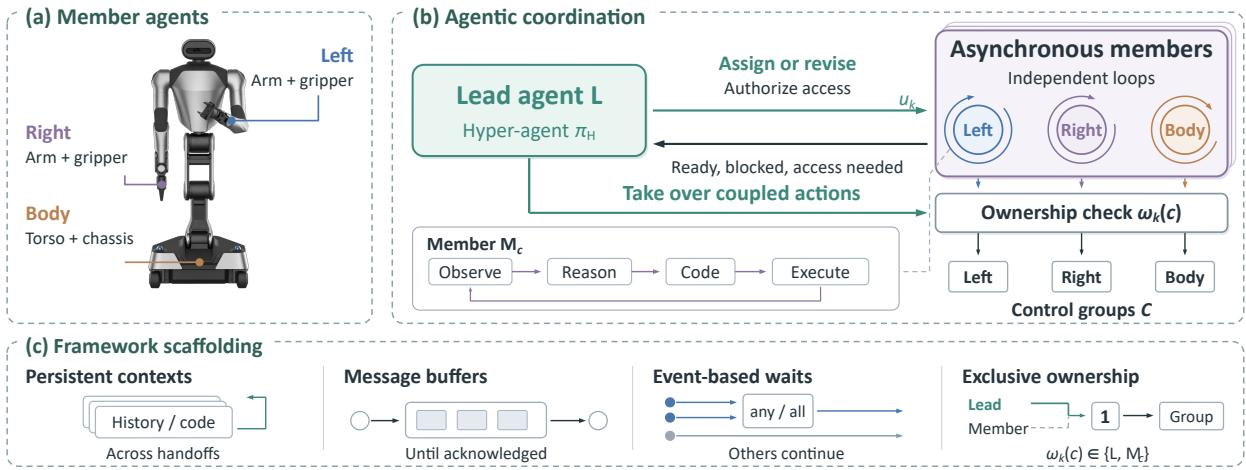
The robot's configured control groups, such as an arm with a gripper or a torso with a chassis, are served by persistent member agents. A lead agent, or hyper-agent, can directly control multiple groups. Each active member agent repeatedly observes, reasons, and acts at its own pace. This asynchronous design allows one member to diagnose a grasp while another plans a placement, without waiting for the other to finish a reasoning turn. Low-level controllers track commanded motions, allowing reasoning and physical execution to overlap. Members can also use lighter reasoning configurations for subtask execution, keeping the computational budget manageable while the hyper-agent considers the overall task.
To manage physical dependencies, the hyper-agent reasons about and coordinates the work of the member agents. Instead of relying on traditional handcrafted coordination rules, the hyper-agent makes task-dependent coordination decisions based on observations, interaction history, and member feedback. At decision step k, the hyper-agent policy πH selects an action uk using the interaction history hk and current command owners ωk:
uk∼πH(⋅∣hk,ωk),ωk(c)∈{L,Mc},c∈C.The action uk can assign or revise work, request evidence, specify a dependency, authorize access to a shared workspace, or arrange direct lead execution. The hyper-agent delegates objectives and scopes of action to members, allowing them to handle local planning and recovery. As dependencies change, the coordinating agent can keep work independent, sequence member actions at a shared workspace, or return control of coupled groups to the lead for joint action.
The framework relies on four scaffolding mechanisms to support concurrent work and control transfers. First, persistent contexts allow each member to maintain observations, conversation history, and generated programs across assignments and control transfers, enabling continuous analysis without rebuilding local context. Second, message buffers store instructions and reports until the receiving agent confirms receipt, accommodating agents working at different speeds. Third, event-based waits establish synchronization points where agents wait for specific evidence before proceeding, while other work continues. For example, during flower insertion, one member prepares a flower while another inserts it, with the clearance report acting as the synchronization event for the next insertion. Finally, exclusive control ownership ensures that command ownership is separate from workspace access permissions. The framework accepts commands for each control group only from its current owner, and ownership transfers preserve controller targets to prevent stopping motion or releasing held objects.
As shown in the figure below:
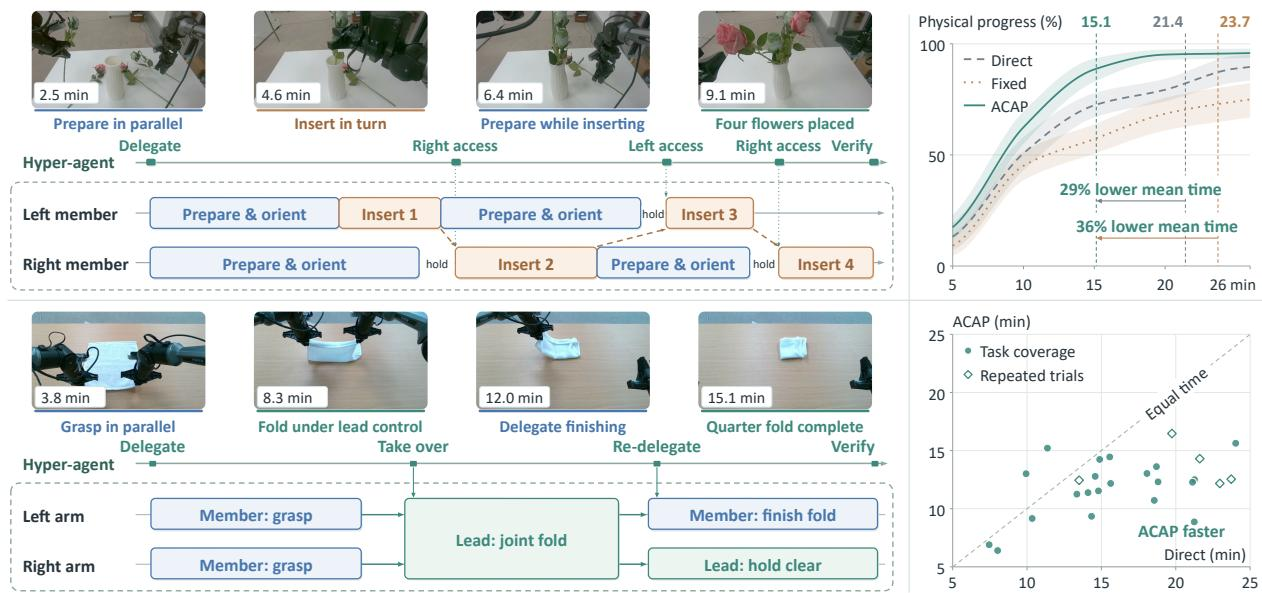
This asynchronous reasoning and agent-directed coordination significantly improves task efficiency. The timelines illustrate how parallel preparation with ordered vase access allows members to prepare and orient flowers while another inserts them, reducing overall time cost. Similarly, for tasks like towel folding, the system can execute a lead takeover for coupled actions followed by delegated finishing, demonstrating the flexibility of the hyper-agent in adapting coordination strategies to evolving physical situations.
Experiment
The evaluation uses real robots across fully parallel, parallel-sequential, and collaborative bimanual tasks, comparing a single direct policy, fixed delegation, and asynchronous coding agents as policy. Across task coverage and repeated trials, asynchronous coding agents consistently complete tasks faster and with higher physical progress than direct control, and outperform fixed delegation on collaborative tasks where adaptive assignment and direct coordination reduce costly synchronization failures. Timing analysis indicates that the gains come mainly from overlapping reasoning with robot execution and from effective coordination rather than from simultaneous robot motion alone. The framework also transfers to mobile manipulation by coordinating arm members and a body member.
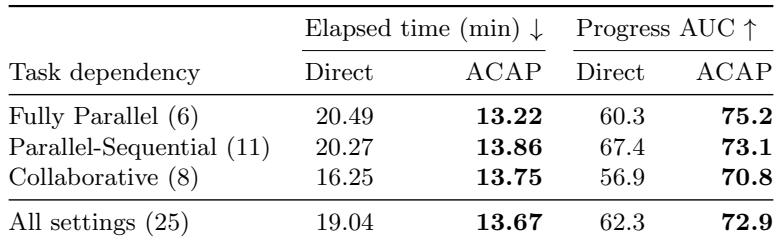
Across 25 task/platform settings, ACAP achieves lower task-balanced elapsed time and higher human-assessed physical-progress AUC than Direct in every dependency category. The advantage appears in fully parallel, parallel-sequential, and collaborative settings, indicating asynchronous execution helps agents complete tasks sooner and make earlier physical progress. The gains hold even when tasks require ordered access or coupled manipulation. ACAP improves elapsed time and physical-progress AUC relative to Direct across all dependency categories and overall across the 25 settings. The largest absolute time reduction occurs in fully parallel tasks, while collaborative tasks also show a notable physical-progress increase. Asynchronous execution yields earlier physical progress even in collaborative settings with ordered access and shared resources.
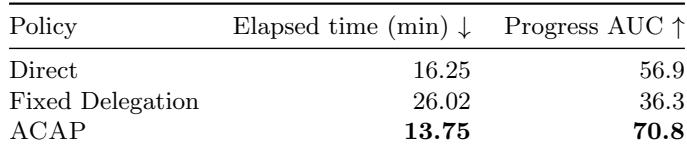
Averaged across eight Collaborative settings, ACAP achieved the lowest elapsed time and the highest physical-progress AUC, outperforming both Direct and Fixed Delegation. Fixed Delegation had the longest elapsed time and the lowest progress AUC despite supporting multiple agents and asynchronous execution. These results indicate that deciding when to act directly, rather than relying only on delegation, improves collaborative task efficiency. ACAP lowered mean elapsed time compared with both Direct and Fixed Delegation while attaining the highest progress AUC. Fixed Delegation was slower than ACAP in every Collaborative setting and posted the lowest progress AUC despite supporting asynchronous multi-agent work.
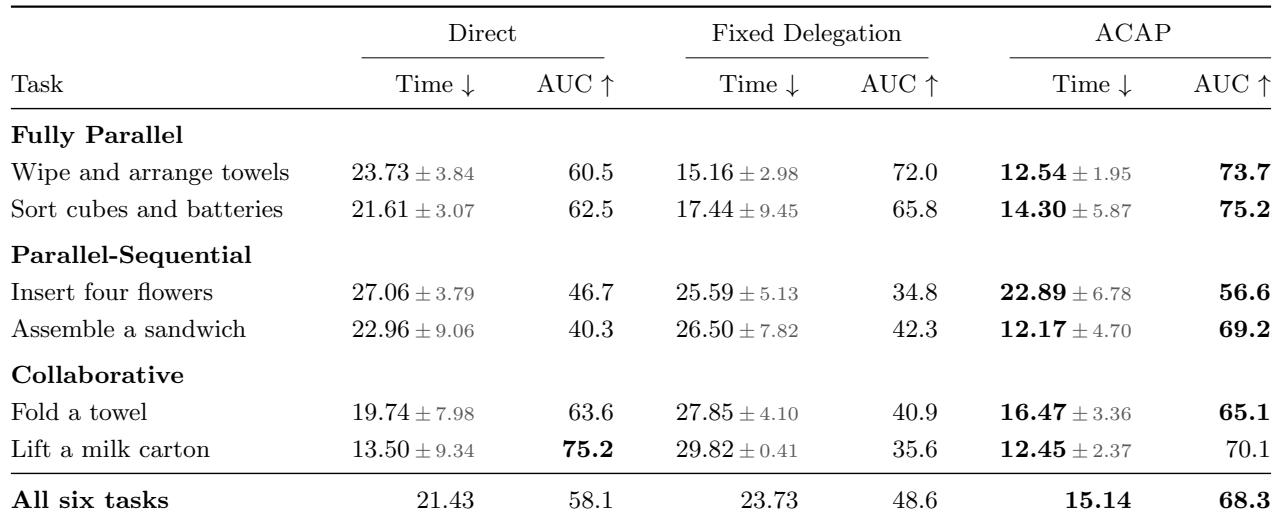
Across repeated executions, ACAP completes the same physical workload faster than Direct, with lower mean capped time on all six tasks and better physical-progress AUC on five of six. It also completes all ten repeated runs, while Direct completes eight and Fixed only three, indicating more reliable task completion. Fixed delegation succeeds on independent wiping work but struggles on coupled joint movements, so asynchronous work alone does not guarantee effective collaboration. ACAP shows a consistent time advantage over Direct, with lower mean capped time on all six tasks, stronger physical-progress AUC on five of six, and completion of all ten repeated runs. Wiping and towel arrangement gives the clearest repeated-trial separation, while Fixed delegation completes all wiping trials but struggles when joints must fold or support an object together.
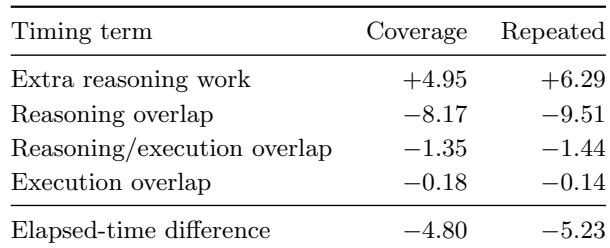
Across the evaluated task settings, ACAP has higher summed reasoning work but finishes sooner than Direct because concurrent reasoning and reasoning-execution overlap dominate the elapsed-time savings while execution overlap remains small. The comparison with Fixed indicates that simply enabling asynchronous work is not enough; adaptive coordination is associated with less reasoning work and coordination waiting. ACAP adds extra reasoning work yet still achieves a negative elapsed-time difference relative to Direct. Reasoning overlap and reasoning-execution overlap provide the largest timing offsets, whereas execution overlap contributes comparatively little. Fixed and ACAP both support asynchronous work, but Fixed spends more time reasoning concurrently and takes longer overall, while ACAP incurs less reasoning work and coordination waiting.
The experiments evaluate ACAP against Direct and Fixed Delegation across 25 task and platform settings spanning fully parallel, parallel-sequential, and collaborative dependencies, along with repeated execution and timing breakdown analyses. ACAP consistently achieves lower elapsed time and higher physical progress than baselines, even under ordered access and coupled manipulation, with the largest time reductions in fully parallel tasks and notable progress gains in collaborative settings. Repeated trials show ACAP completes all runs while baselines miss some, and Fixed Delegation reveals that asynchronous execution alone does not ensure effective collaboration without adaptive coordination. Timing analyses indicate ACAP finishes sooner despite extra reasoning work because concurrent reasoning and reasoning-execution overlap provide the main savings.