Command Palette
Search for a command to run...
Motion Mamba 2.0: 長時間ヒューマノイド制御のための自己回帰拡散Mamba
Motion Mamba 2.0: 長時間ヒューマノイド制御のための自己回帰拡散Mamba
Yue Huang Tianshan Zhang Zeyu Zhang Jayeon Kang Akide Liu Sungjoon Choi Dacheng Tao Hao Tang
概要
長時間にわたるリアルタイム制御可能なモーション生成は、インタラクティブアニメーションやヒューマノイドロボティクスにおいて不可欠であり、エージェントは移動しながら変化する指示や空間目標に応答する必要がある。既存の自己回帰拡散手法はモーションを逐次的に生成するが、有界なアテンションキャッシュにより遠方の履歴へのアクセスが制限され、反復的なデノイジングが大きな推論オーバーヘッドをもたらす。本論文では、長時間の制御可能なモーション生成のために、局所アテンション、再開可能なリカレント状態、および永続的コンテンツメモリ(PCM)を統合したMambaベースのルート・ボディ拡散アーキテクチャであるMotion Mamba 2.0を提案する。PCMは、Mambaのリカレント状態から圧縮されたモーション履歴を、状態変化およびテキスト条件付き特徴とともに、局所アテンションからアクセス可能な動的に更新されるコンテンツスロットへと変換する。効率的な推論を実現するために、本アーキテクチャに特化した実行方式をさらに開発し、CUDA Graphの再生、融合カーネル、実行フローの簡素化を組み合わせつつ、正規の履歴更新を保持する。リターゲットされたHiPHIでの評価では、最大39.52秒のロールアウトにわたって正確な終端制御が実証され、BONES SeedおよびリターゲットされたHumanML3Dでの短時間比較では、モデルが強力な空間制御とテキスト・モーション整合性も保持することが示された。RTX 4090上では、最適化された実行により完全ウィンドウ遅延の中央値が1685.35msから276.14msに低減され、テストされたロールアウトにおいて同一の出力とコミット済み状態を保持しながら、中央値で6.138倍の高速化を達成した。さらに、Unitree G1を用いた広範な実世界評価を実施し、逐次的なテキスト誘導による動作合成、表現豊かなモーション、キーボードおよびマウス制御によるインタラクティブな移動を実証した。
One-sentence Summary
The authors present Motion Mamba 2.0, a Mamba-based root–body diffusion architecture that integrates local attention, resumable recurrent states, and persistent content memory for long-horizon controllable motion generation, while CUDA Graph replay and fused kernels reduce median latency from 1685.35 ms to 276.14 ms and enable real-time text-guided humanoid control on Unitree G1.
Key Contributions
- Motion Mamba 2.0 introduces a Mamba-based root-body diffusion architecture that combines local attention, resumable recurrent states, and persistent content memory for long-horizon controllable motion generation. The persistent content memory converts compressed recurrent motion history, state changes, and text-conditioned features into dynamically updated content slots for bounded local attention.
- The paper introduces an optimized execution scheme tailored to this architecture, using CUDA Graph replay, fused kernels, and execution-flow simplification while preserving the canonical history update. On an RTX 4090, this scheme reduces median complete-window latency from 1685.35 ms to 276.14 ms and achieves a median paired speedup of 6.138x with identical outputs and committed states in tested rollouts.
- Evaluations demonstrate long-horizon control and real-world applicability: on retargeted HiPHI, the model reaches Root CE of 7.55 cm and End CE of 13.64 cm at 39.52 s, the lowest among evaluated methods, and on Unitree G1 hardware it completes 94 of 100 trials with multi-stage text-guided action composition and interactive locomotion.
Introduction
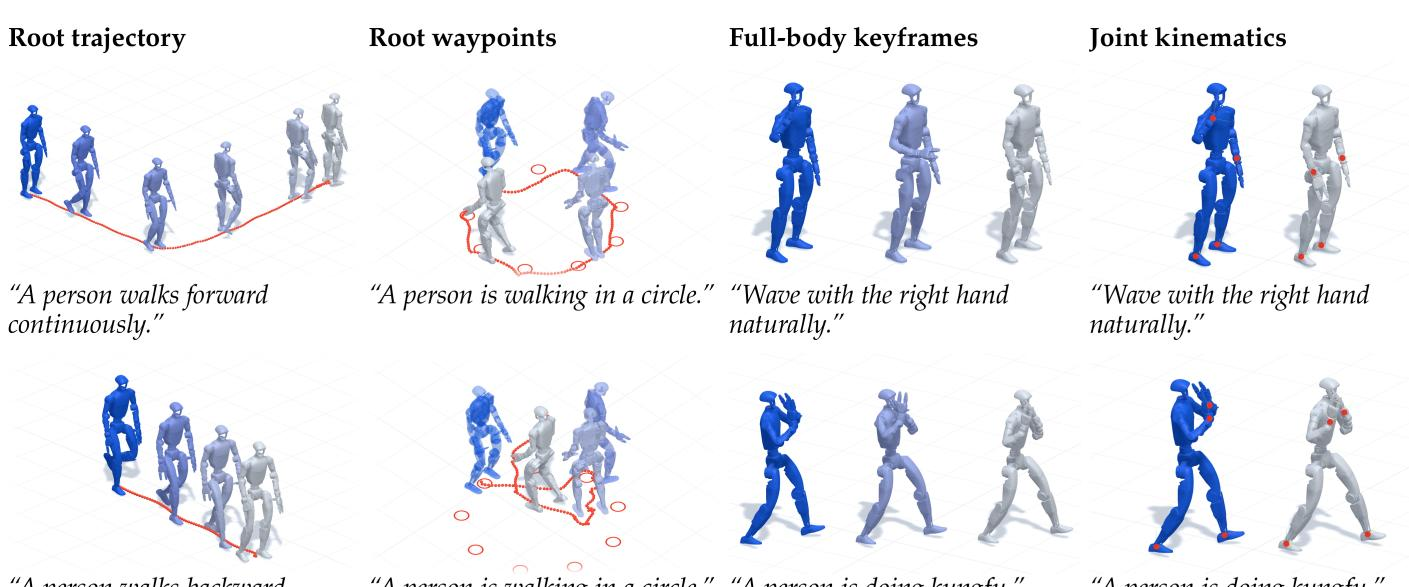
Interactive humanoid motion generation requires models that can follow changing text commands and spatial targets while continuing from already produced motion, with latency low enough for real-time control. Prior diffusion and autoregressive approaches either retain only a bounded cache of recent motion features, discarding older context, or allow memory and compute to grow with sequence length; recurrent state-space summaries are compact but not directly accessible to attention, and repeated short-window denoising adds execution overhead. The authors propose Motion Mamba 2.0, an autoregressive root-body diffusion model that combines local attention with a resumable Mamba branch and a persistent content memory. This memory maps accepted recurrent-state summaries, state changes, and text-conditioned features into dynamically updated slots that local attention can access, while an accepted-only history commit separates denoising iterations from physical motion time. The optimized inference reaches 276.14 ms per 52-frame window on an RTX 4090 with a 6.138x median speedup, and a physical Unitree G1 completes 94 of 100 interactive trials without falls.
Dataset
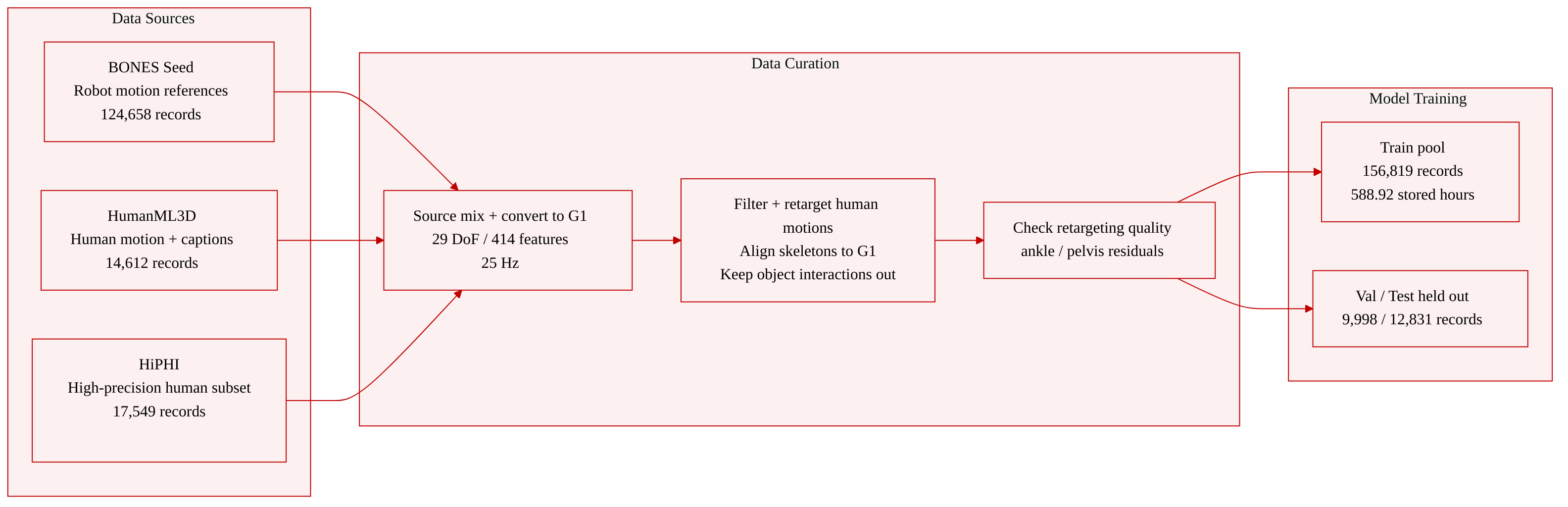
The authors build a unified motion dataset by converting robot and human recordings into a common G1 robot representation with 29 degrees of freedom and 414 physical features at 25 Hz.
Sources and composition
- BONES Seed provides robot motion references.
- HumanML3D provides human motion recordings and captions.
- HiPHI contributes only the high-precision human-motion subset; the object-interaction subset is excluded.
- The training pool contains 156,819 motion records and 588.92 stored hours:
- BONES Seed: 124,658 records
- HumanML3D: 14,612 records
- HiPHI: 17,549 records
- This gives roughly 79.5% BONES Seed, 9.3% HumanML3D, and 11.2% HiPHI records.
- Validation and test manifests contain 9,998 and 12,831 additional records, respectively, and are excluded from training.
- Counts include mirrored records; duration is measured from stored frames.
Filtering and processing
- For HiPHI, the authors keep only the high-precision human-motion subset and exclude object trajectories and object-interaction supervision.
- HumanML3D motions are reconstructed from AMASS parameters using the SMPL-H body-and-hand model.
- HiPHI motions are reconstructed using BVH forward kinematics.
- Rest-pose transforms and pelvis-height scaling align the human skeletons with the common G1 robot asset.
- Root translations and local rotations are resampled to 25 Hz before retargeting.
- BONES Seed motions retain their official G1 trajectories through resampling and representation conversion.
- Human motions are retargeted using source-specific adapters built on General Motion Retargeting, with position and orientation objectives, joint limits, temporal refinement, and bounded ground and rate corrections.
Metadata and quality
- Exported records retain source captions, mirror identities, and transformation provenance.
- Retargeting quality is assessed over all admitted human-source records: 18,525 HumanML3D and 19,503 HiPHI records across training, validation, and test splits.
- Median ankle retargeting residual:
- HumanML3D: 1.49 cm
- HiPHI: 0.93 cm
- Cross-clip 95th percentile ankle residual:
- HumanML3D: 3.37 cm
- HiPHI: 2.39 cm
- Median pelvis residual:
- HumanML3D: 0.99 cm
- HiPHI: 0.56 cm
- Round-trip conversion between stored motion formats and the 414-D representation has a maximum position discrepancy of 1.31e-6 m.
How the data is used
- The unified training pool is used to learn a common motion generator from human and robot recordings.
- Human and robot data share the same embodiment, temporal resolution, and feature representation.
- Validation and test records are held out from training.
Method
The authors propose Motion Mamba 2.0, a framework that combines autoregressive root-body diffusion with local attention, resumable Mamba-3 states, and persistent content memory (PCM).
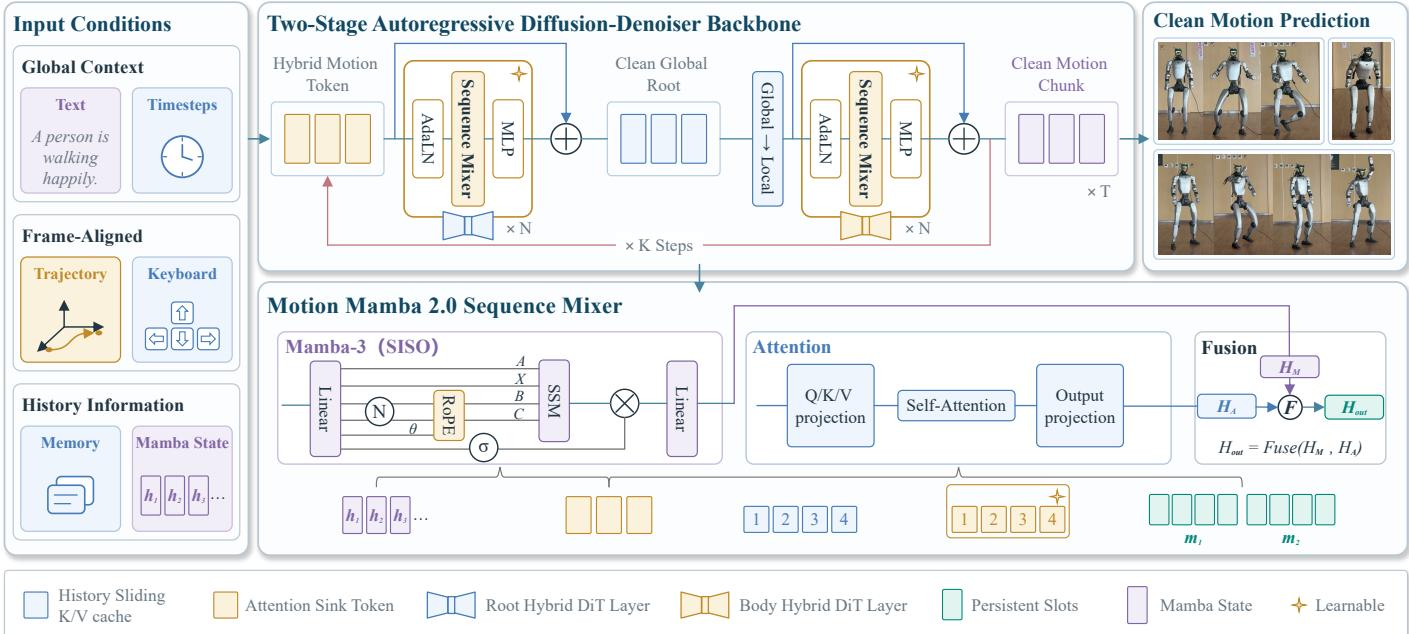
As illustrated in the framework diagram, the system generates motion autoregressively through a two-stage diffusion denoiser conditioned on text, spatial controls, and accepted motion history. The output is divided into windows of tokens, where each token represents a sequence of consecutive frames. At each window, the conditions comprise a text instruction, spatial targets, and a validity mask, while the memory is constructed from the accepted motion prefix. The conditional distribution is factorized over these windows. The authors adopt a hybrid representation that retains an explicit root trajectory and compresses articulation with a causal motion codec. At each frame, the root comprises position and heading, while body features include joint rotations, positions, velocities, and contact indicators. A token concatenates a root patch with a body latent. The encoder maps explicit motion to body latents, and the decoder reconstructs articulation from these latents and local root features. This representation exposes the trajectory directly to spatial control while reducing the dimensionality of articulated motion.
Recurrent Root-Body Denoising
Following the root-body decomposition, each diffusion evaluation first predicts the global root and then predicts articulation conditioned on that root. The conditioning vector combines text, diffusion time, and the available initial heading. The root input contains noisy hybrid features and temporally aligned controls, where valid root observations replace the corresponding noisy coordinates. The body input concatenates local features of the predicted root, noisy body latents, and aligned observations. The root and body networks operate as separate stacks with distinct parameters and layer-specific memories. The sampler consumes the concatenated clean prediction, ensuring that root prediction is refreshed before body prediction at every diffusion step. This decomposition exposes global translation and heading for direct spatial conditioning while allowing articulated motion to adapt to the predicted root trajectory.
Each stack consists of diffusion transformer layers with adaptive normalization and a gated residual multilayer perceptron. Inside the sequence mixer, attention and Mamba process the same normalized, condition-modulated features. Attention retrieves recent features, whereas Mamba resumes its state from the accepted prefix. Their outputs are combined by a learned layerwise gate. The authors adopt the resumable SISO Mamba-3 scan for the recurrent branch. The recurrence combines adjacent state inputs through a trapezoidal update and represents relative phase through accumulated rotations, providing a mechanism for retaining evolving dynamics. The carried state includes the recurrent matrix, accumulated phase, and previous state-input and value vectors required to resume the scan, with a size independent of the accepted sequence length.
Persistent Content Memory
The recurrent state and attention cache play complementary roles. The bounded cache directly exposes recent keys and values but evicts older features, while Mamba carries a fixed-size compressed representation of accepted motion history. PCM learns a state-to-attention mapping from recurrent summaries, their changes, and text conditions to content slots, making the accumulated motion context available to subsequent windows.
In each layer, the cache stores projected keys, values, and validity masks from the latest accepted windows. Learned sink tokens are included to remain available when the cache is short or empty. Current-window attention is bidirectional because the noisy window is denoised jointly. PCM maintains memory slots initialized to zero. A projector pools the accepted recurrent matrix to compute a state summary and its difference from the previous accepted window. The write path projects the pooled text embedding into a layer-specific representation and predicts featurewise modulation parameters to condition the normalized state difference on the active instruction. The state summary, text-modulated difference, and projected text embedding are concatenated to construct the candidate slot content. A gate computed from the joint representation and the previous memory controls the write rate, bounding the contribution of candidate content to each update. Text conditions both candidate-content generation and write gating, allowing the same state transition to produce different memory updates under different instructions.
The current window reads the memory slots without modifying them. Augmented keys and values insert projected slots immediately after the sinks. Base and augmented attention use the same query. A learned scalar controls the attention difference, and another controls the Mamba contribution. Initializing the attention difference scalar to zero recovers the native mixer output exactly. Each denoising evaluation reads an immutable snapshot. After sampling, the accepted window is recentered and materialized as clean history in a canonical pass at diffusion time zero, which updates only accepted motion tokens. Layerwise cache append, recurrent-state replacement, and PCM writing are committed together across the root and body stacks.
State-Preserving Efficient Inference
To address overhead from repeated diffusion denoising, the authors implement state-preserving execution optimizations. During denoising, they avoid materializing state proposals and diagnostics that are not consumed by the prediction or a later commit, ensuring all recurrent computation contributing to predicted motion is retained. They fuse Mamba transition preprocessing, including decay activation, decay floor, step-size transformation, and product calculations, into a single traversal. Intermediate values remain in FP32 registers before outputs are written in the required layout. Compatible scale-shift and gated-residual operations are also fused. Furthermore, the root and body sequence stacks use separate CUDA Graphs. Within each stack, the text-conditioned, spatially conditioned, and unconditional branches execute serially and are captured together. Stable input and state buffers are refreshed before replay.
Learning Objective
The authors optimize clean-window prediction with four terms. The hybrid term applies Smooth L1 to explicit root patches and body latents. The decoded-body term applies L1 to reconstructed articulation. The goal term applies L1 only to observed coordinates inside the generated window, while later goals remain conditioning inputs until their target frames enter the output window. The consistency term measures Euclidean disagreement between joint positions obtained from decoded rotations through forward kinematics and those represented directly by decoded position features. Each term is normalized over its applicable elements, and the codec is frozen during denoiser training. Histories, generation regions, and future observations use explicit validity masks, excluding outputs outside the generation region from the supervised reduction.
Experiment
The experiments evaluate Motion Mamba 2.0 on short- and long-horizon motion generation, architectural ablations, inference efficiency, and physical deployment. The model consistently achieves strong spatial constraint control across HiPHI, BONES Seed, and HumanML3D, with recurrent modeling and persistent content memory contributing most clearly to long-horizon accuracy and command matching. Execution-flow simplification, kernel fusion, and CUDA graph replay substantially reduce latency while preserving generated outputs and committed states. Real-world tests on the Unitree G1 robot further show high success rates for sequential action composition and interactive locomotion, supporting the system's ability to transfer generated motion references into responsive physical execution.
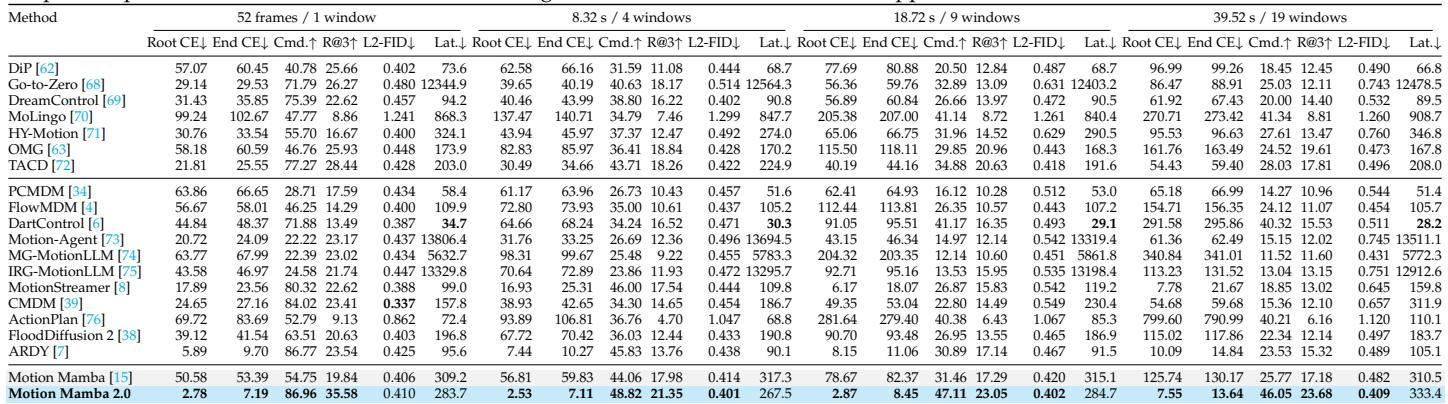
Motion Mamba 2.0 achieves the lowest root error at every evaluated horizon and the lowest or tied-lowest end error, including multi-window rollouts up to 39.52 seconds. It also records the highest command matching and retrieval scores across all four horizons and the lowest L2-FID at most durations. The results show stronger terminal control and text-motion alignment over long horizons relative to the compared methods. Motion Mamba 2.0 reduces root error at the longest horizon by 3.0% relative to MotionStreamer and improves end error by 8.1% over the best competing method. Command matching and retrieval are highest for Motion Mamba 2.0 across all evaluated horizons. L2-FID is lowest at 8.32, 18.72, and 39.52 seconds, while CMDM leads only at the shortest horizon.
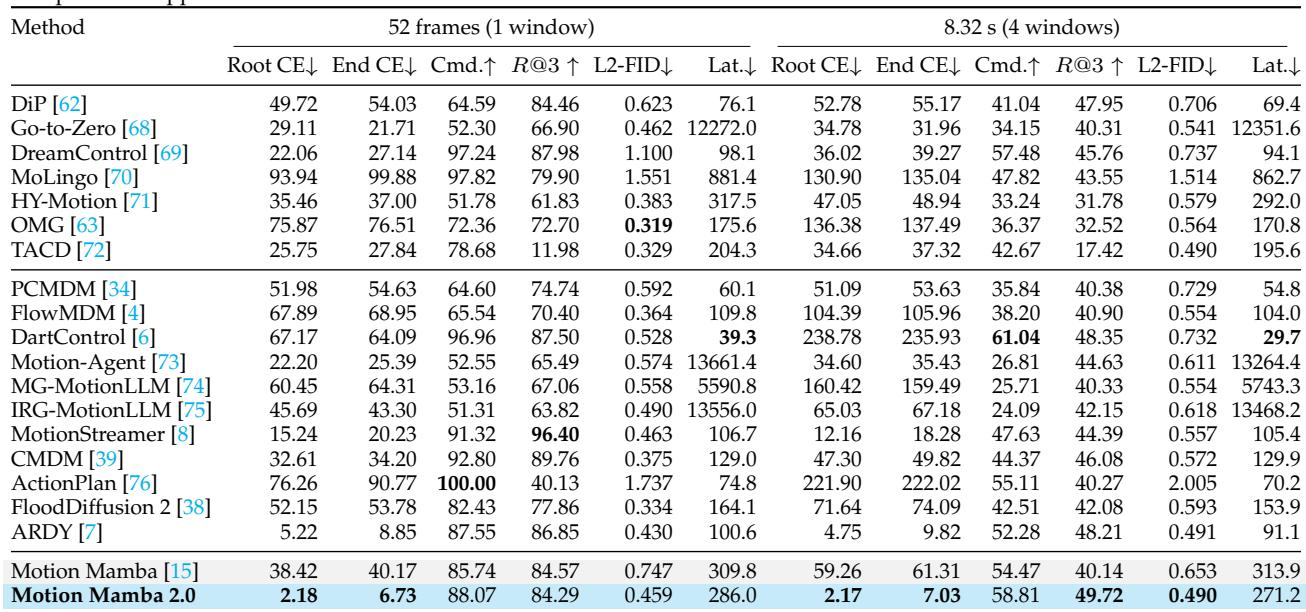
Motion Mamba 2.0 achieves the lowest Root CE and End CE at both short-horizon durations on BONES Seed, along with the highest R@3, indicating accurate spatial control and retrieval alignment for native G1 trajectories. At 8.32 s it reduces Root CE by 62.5% relative to ARDY, while its command matching is not the highest among compared methods. Baselines show wide variation in accuracy and latency, with several strong command-matching methods incurring higher position error. Motion Mamba 2.0 reports the lowest root and end position errors at both evaluated durations on BONES Seed. At 8.32 s, the root error is reduced by 62.5% relative to ARDY, and retrieval recall is highest even though command matching does not lead. Among baselines, MoLingo attains high command matching but also much higher position and distributional errors than other methods. Latency varies widely across methods, from under 100 ms to more than 12 seconds per accepted window.
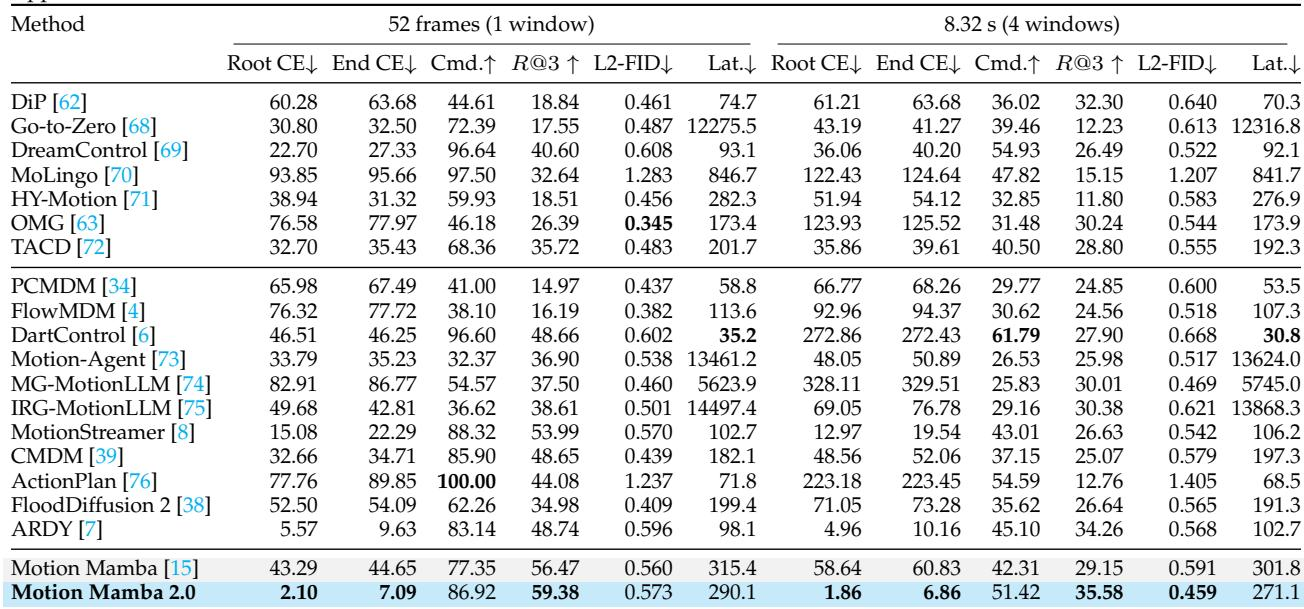
This table compares short-horizon motion generation on retargeted HumanML3D at a single 52-frame window and an 8.32-second rollout. Across the compared methods, spatial error, command agreement, and retrieval all degrade as the horizon lengthens, with DreamControl retaining strong command accuracy and Go-to-Zero achieving the lowest spatial errors at 8.32 seconds. Latency and distributional realism vary widely, and no method dominates every criterion. At the 52-frame horizon, DreamControl has the lowest root error among compared methods, while MoLingo and DreamControl are close for the highest command accuracy. At the 8.32-second horizon, Go-to-Zero achieves the lowest root and end errors, DreamControl achieves the highest command accuracy, and DiP achieves the highest retrieval and lowest latency. Every listed method shows worse root/end error, command agreement, and retrieval at 8.32 seconds than at 52 frames, indicating a consistent short-horizon degradation trend.
This ablation isolates recurrent Mamba modeling and persistent content memory on retargeted HiPHI. Recurrent modeling produces large long-horizon reductions in root and end constraint errors, and the complete Motion Mamba 2.0 with PCM adds further long-horizon gains in command matching and retrieval. Improvements are not uniform, as some short-horizon metrics favor simpler or partial configurations. At the longest evaluated horizon, adding recurrent Mamba to the minimal model yields much lower Root CE and End CE, while the single-window difference is comparatively small. Adding PCM to the native recurrent model at the longest horizon reduces Root CE by roughly one-fifth and lifts command matching from about one-third to nearly half. Both partial PCM variants retain better long-horizon Root CE and End CE than Native, but they trail the complete model on command matching at 18.72 s. Short-horizon results are mixed, with some Cmd., R@3, and L2-FID scores favoring other variants.

This architectural ablation on BONES Seed shows that recurrent modeling and persistent content memory both improve long-horizon constraint accuracy, with the complete Motion Mamba 2.0 achieving the lowest root and end constraint errors and L2-FID at the 8.32 s horizon. Partial PCM variants reduce constraint errors relative to Native but perform less well on command matching, while short-horizon command and retrieval metrics sometimes favor other configurations. Overall, the results support complementary roles for text-conditioned writing and explicit state-difference features in long-horizon generation. Recurrent modeling provides the largest gains in root and end constraint errors at the multi-window 8.32 s horizon. The complete model achieves the best long-horizon Root CE, End CE, and L2-FID among all ablated configurations, while partial PCM variants trail on longer-horizon command matching.

The experiments evaluate Motion Mamba 2.0 on long-horizon text-to-motion benchmarks including BONES Seed, retargeted HumanML3D, and HiPHI, using baseline comparisons and ablations to isolate recurrent Mamba modeling and persistent content memory. The method generally achieves the strongest terminal spatial control and text-motion alignment across extended multi-window rollouts, while short-horizon comparisons show more mixed rankings and no baseline dominates every criterion. Ablations indicate that recurrent modeling and persistent content memory contribute complementary long-horizon improvements in constraint accuracy, command matching, and distributional realism.