Command Palette
Search for a command to run...
ZONOS3-Mini 技術報告
ZONOS3-Mini 技術報告
Gabriel Clark Sofian Mejjoute George Close Beren Millidge
ZONOS3-Mini:多言語リアルタイム音声合成と音声クローン
概要
ZONOS3-Miniは、超コンパクトかつ超高速なゼロショット音声クローニングTTSモデルである。本モデルはノートPCやスマートフォン上でリアルタイムに動作可能である。そのレイテンシとサイズに対して、最先端の精度とクローニング忠実度を達成している。これを実現するため、総パラメータ数わずか886M(トークンあたりのアクティブパラメータは100M)の潜在MoEバックボーンと、44.1kHzの音声を15Hzのフレームレートで表現する新しいオーディオコーデック「Zyphra Audio Codec 1(ZAC-1)」を提案する。新しいZTTS2-Evalベンチマークにおいて、ZONOS3-Miniは55の言語セット(クリーン35、実環境20)でマクロ平均WER 6.71%を達成し、より大規模で低速な最先端モデルに匹敵する性能を示す。モデル重み、推論コード、および学習コードを公開する。
One-sentence Summary
Zyphra introduces ZONOS3-Mini, an ultra-compact zero-shot voice-cloning TTS model that runs in real time on laptops and smartphones, combines an 886M-parameter latent MoE backbone (100M active per token) with the Zyphra Audio Codec 1 (ZAC-1), which represents 44.1 kHz audio at a 15 Hz frame rate, achieves 6.71% macro-average WER on the ZTTS2-Eval benchmark across 55 language sets, and releases model weights, inference, and training code.
Key Contributions
- ZONOS3-Mini is an ultra-compact, zero-shot voice-cloning TTS model with a latent mixture-of-experts backbone using 886M total parameters and 100M active parameters per token, enabling real-time operation on laptops and smartphones.
- The Zyphra Audio Codec 1 (ZAC-1) encodes 44.1 kHz audio at a 15 Hz frame rate and 1.80 kbit/s using a dual-encoding quantizer, semantic distillation from frozen self-supervised speech representations, and causal inverse Short-Time Fourier Transform heads, reducing audio sequence length by 5.7× relative to ZONOS2 and supporting low-latency streaming.
- The released ZTTS2-Eval benchmark covers 55 language sets totaling 74,041 utterances across 35 clean and 20 in-the-wild subsets, and ZONOS3-Mini reaches a 6.71% macro-average word error rate on it, competitive with larger and slower state-of-the-art models, while model weights, inference code, and training code are open-sourced.
Introduction
Current on-device text-to-speech systems typically sacrifice voice cloning quality, controllability, and multilingual coverage to run in real time on constrained hardware. The authors address this gap by introducing ZONOS3-Mini, positioned as a new Pareto-optimal point between synthesis quality and inference performance for smartphones and laptops. Their main contributions include a new audio tokenizer, ZAC-1, which compresses audio sequences by 5.7x at 15 Hz and 1.80 kbit/s while supporting low-latency streaming, a much smaller backbone with higher speaker similarity, and the release of ZTTS2-Eval, a multilingual evaluation framework covering 35 clean and 20 in-the-wild languages.
Dataset
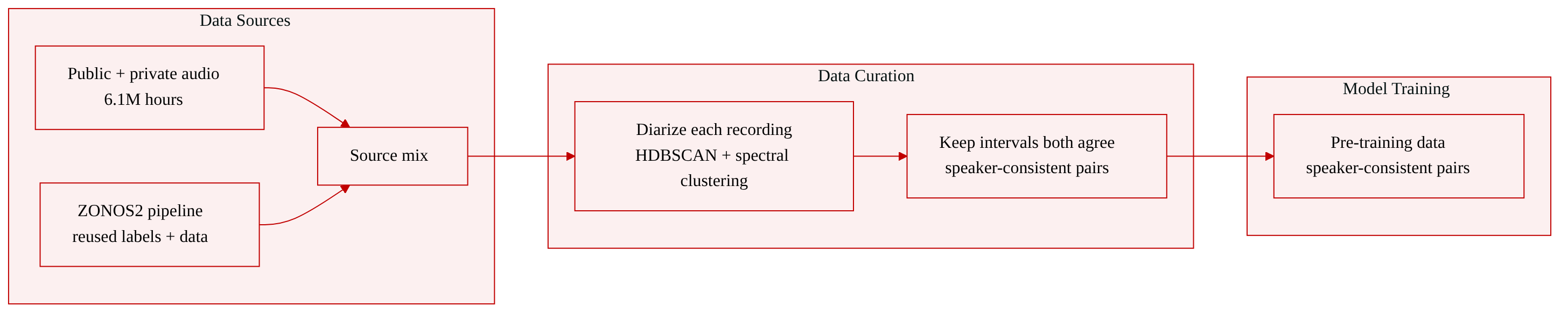
- Sources and scale: The authors use a pre-training corpus of 6.1M hours of naturalistic speech audio, drawn from a mixture of public and private corpora.
- Composition and reuse: The dataset reuses all labels and data from the ZONOS2 data pipeline.
- Processing and filtering: To build speaker-consistent utterance pairs, each recording is diarized using both HDBSCAN and spectral clustering over speaker-embedding windows. The authors keep only intervals where both methods agree on the same speaker.
- Usage: The resulting corpus is used as the pre-training data for the model.
Method
The authors leverage an 8,192 entry SuperBPE tokenizer trained on a spoken language focused data mix, departing from raw byte text representations. The text span is bracketed by beginning of text (BOS) and end of text (EOS) tokens, while the audio stream ends with an end of audio (EOA) token, and a pad row fills unused positions. The backbone architecture combines recurrent Gated DeltaNet (GDN) layers with two global attention layers for efficient long context inference across 11 layers. Layers 4 and 8 utilize global causal attention with Grouped Query Attention (GQA), QK normalization, Rotary Position Embedding (RoPE), and a learned output gate per head. The remaining nine layers employ GDN mixers. To optimize efficiency, the model uses a latent Mixture of Experts (MoE), reducing the 1,024 dimensional model width to 256 inside the experts, and utilizes full attention residuals.
ZONOS3 Mini supports cloning from both raw audio codec references and speaker embeddings. Raw references capture prosody and recording conditions alongside speaker identity, while embeddings occupy a single sequence position and score higher on speaker similarity. The authors train a speaker embedding encoder using the MECT B2 architecture, comprising a convolutional encoder followed by a MoE transformer with an attentive statistics pooling stage, trained independently with the SphereFace2 loss to produce a 192 dimensional vector mapped to the model hidden dimension. During pre training, codec codes of a 1 to 60 second reference clip serve as a loss masked prefix before the text, omitted in 10 percent of examples to enable unconditioned generation and speaker Classifier Free Guidance (CFG). Fine tuning introduces the embedding path alongside quality and speaking rate controls.
The authors design ZAC 1 to be fast to decode and easy for the TTS backbone to model in a delay pattern without compromising acoustic quality. Operating at 15 Hz and 1.80 kbit/s, the 1.99 billion parameter encoder decoder structure utilizes DualCodec style dual encoding with frozen layer 16 w2v BERT 2.0 features as the semantic representation to improve multilingual modelability. Each frame carries ten codes from 4,096 entry codebooks: one semantic code and nine Residual Vector Quantization (RVQ) residual codes.
As shown in the figure below:
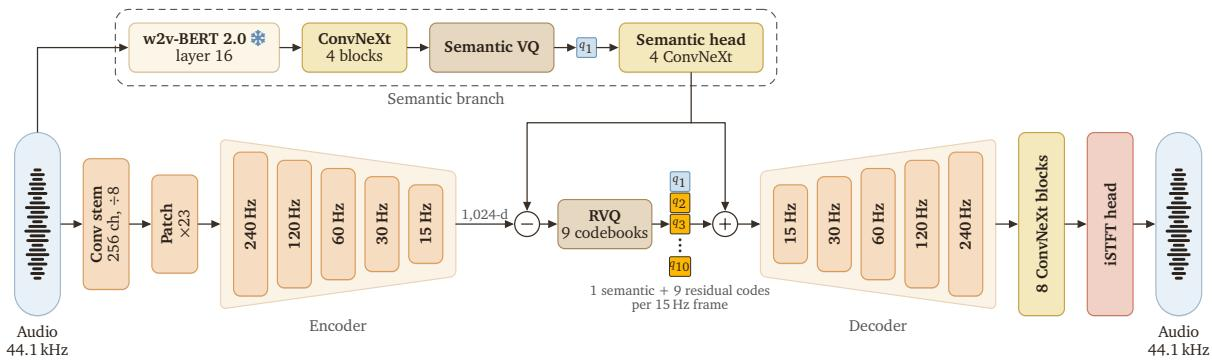
The encoder and decoder comprise a symmetric cascade of causal local attention transformer stages at 15, 30, 60, 120, and 240 Hz. The encoder converts audio into patches using DAC like residual units. The decoder avoids running attention at the 44.1 kHz sample rate by using eight ConvNeXt blocks and two iSTFT heads to generate audio. To accommodate different inference scenarios, two decoders are released: a full decoder that replaces the last layer with ConvNeXt blocks and an iSTFT head to remove large batch memory bottlenecks, and a pruned 144M parameter keep 2 decoder that removes transformer blocks to avoid batch size 1 FLOP bottlenecks for on device inference.
The training pipeline consists of pre training, fine tuning, and post training stages.
Pre training runs for 375k steps on H100 GPUs, covering 4.5T positions or ten epochs over the full corpus. Training sample lengths reach up to 600 seconds, with audio reference clips for voice cloning up to 60 seconds. The authors use the Muon optimizer for 2 D weights and AdamW for the rest. By adopting Quantile Balancing (QB), router entropy stays within 5 percent of uniform in every MoE layer throughout training.
Fine tuning continues from the 375k checkpoint for 60k steps with fresh optimizer states. The model learns to clone from both codec encoded reference clips and MECT B2 based speaker embeddings. On 45 percent of samples, the embedding is provided; on 45 percent, codec encoded reference clips are used; and on the remainder, no voice cloning reference is provided. A second fine tuning stage of 20k steps refines speaking rate control by splitting ten speaking rate buckets into three finer grained buckets each, initialized from their parent representations.
Post training involves two stages using 5,089 training utterances in English, Chinese, Spanish, and Japanese. The first stage targets early stopping and runaway generation failures using direct preference optimization (DPO). Eleven candidates per prompt are generated, and failures (no speech, reaching token cap, incorrect duration, or high WER) are paired with the most similar complete candidate. The loss is the DPO objective on the mean log probability of the audio tokens plus 0.05 times the negative log likelihood of the chosen sequence.
The second post training stage applies group relative policy optimization (GRPO) to directly optimize speaker similarity (SIM) and WER. The reward of a candidate is calculated as:
0.9max(0,1−2WER)+0.1100SIMThe advantage is the reward standardized within the prompt group, minus 0.5 times a duration cost. The cost is defined as:
max(0,log(1.35r))where r is the duration ratio of the generation to the original recording. The loss is the clipped token level surrogate with ϵ=0.2 plus a Kullback Leibler Divergence (KLD) penalty of weight 0.04 to the first stage model.
As shown in the figure below:
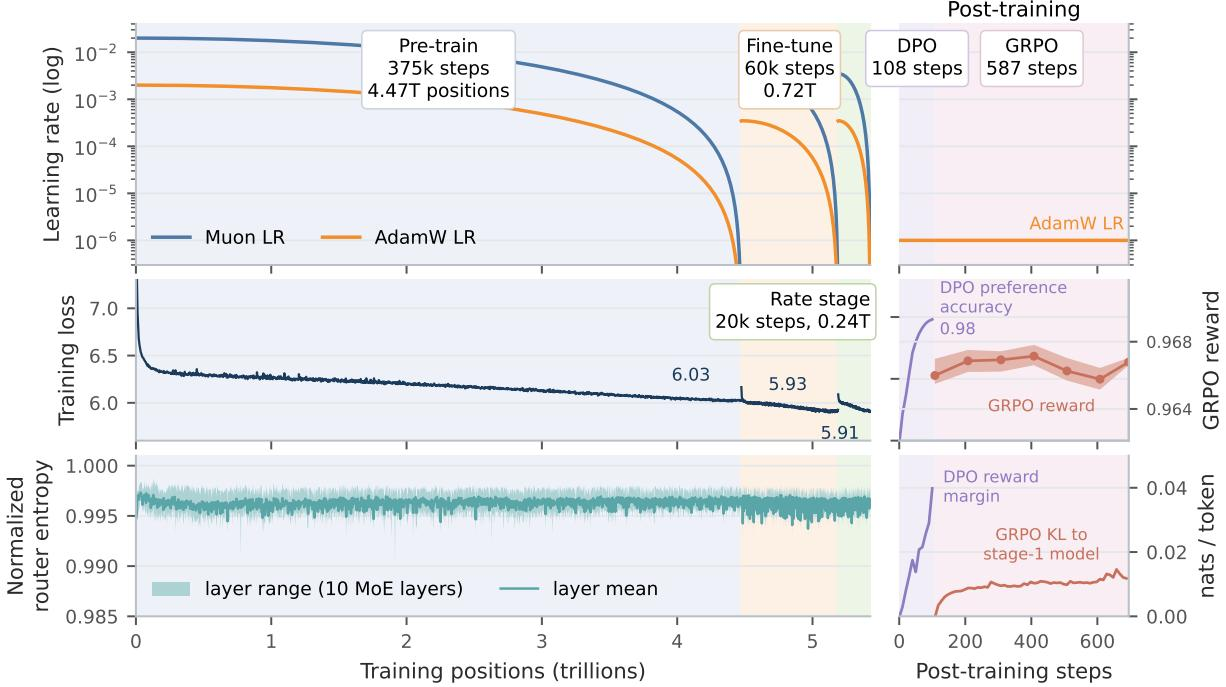
The training dynamics illustrate the learning rate, training loss, and normalized router entropy across pre training, fine tuning, the speaking rate stage, and post training. The fine tune loss starts higher due to the addition of speaker projection and control row tables and a change to the data mix. During post training, the DPO preference accuracy and GRPO reward are tracked alongside the GRPO KL divergence to the stage 1 model.
Experiment
The experiments evaluate ZONOS3-Mini and its components using multilingual clean and in-the-wild benchmarks, with quality, speaker similarity, and error rates as the main criteria. The ZAC-1 codec is validated as a competitive low-bitrate codec with efficient decoding, while fine-tuning with speaker embeddings is shown to improve robustness, especially for in-the-wild audio, compared with raw reference clips. Ablations justify the chosen backbone modifications, codec design, and text tokenizer size, and inference tests demonstrate real-time streaming, low latency, and effective low-bit quantization; the results also indicate that training loss alone is not a reliable predictor of speech quality.
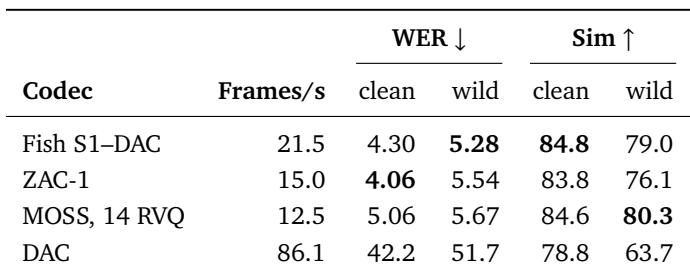
ZAC-1 delivers clean-set word error rate comparable to or slightly better than Fish S1-DAC while operating at a lower frame rate, though its speaker similarity is somewhat lower. The MOSS tokenizer achieves the strongest wild-set speaker similarity and the lowest frame rate but has higher word error rates. The Descript Audio Codec runs at a much higher frame rate and trails the other codecs on both intelligibility and similarity. ZAC-1 improves clean-set WER over Fish S1-DAC and MOSS while reducing frame rate relative to Fish S1-DAC. Wild-set speaker similarity is highest for MOSS, followed by Fish S1-DAC and ZAC-1, with DAC substantially lower. DAC shows markedly higher WER and lower similarity than the lower-frame-rate codecs.
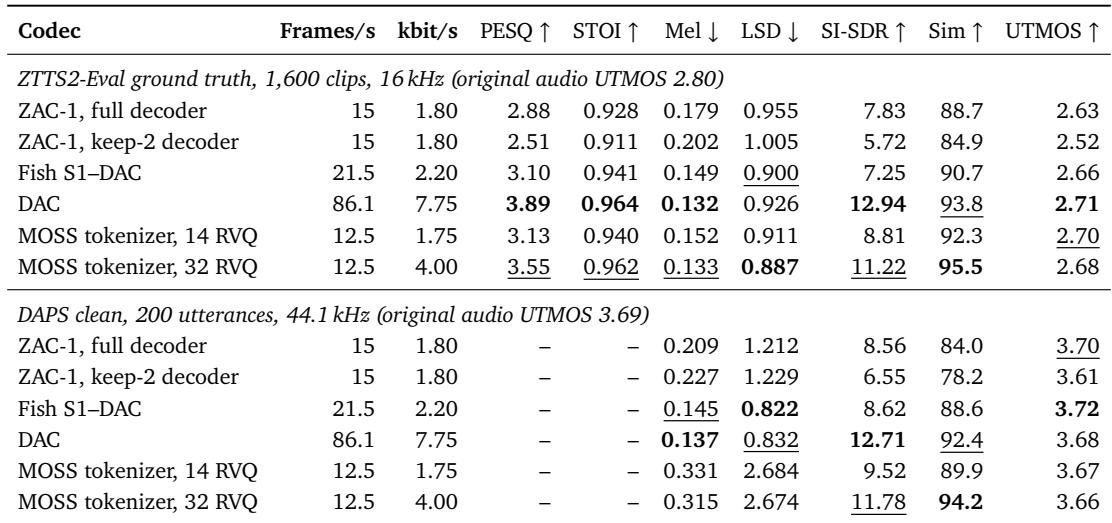
The comparison measures reconstruction quality for ZAC-1 decoders and several public codecs on held-out ZTTS2-Eval and DAPS clean audio. ZAC-1 operates at a lower bitrate and frame rate than Fish S1-DAC and DAC, and its full decoder scores competitively, though it trails those baselines on most objective quality and similarity metrics. The keep-2 decoder trades off reconstruction quality relative to the full decoder, while higher-bitrate or higher-RVQ baselines such as DAC and the MOSS 32-RVQ configuration reach the strongest overall results. The full ZAC-1 decoder outperforms the keep-2 decoder on all reported reconstruction metrics, with the largest relative gaps in PESQ, SI-SDR, and speaker similarity. At 1.80 kbit/s and 15 frames per second, ZAC-1 uses a lower bitrate and frame rate than Fish S1-DAC and DAC but does not match Fish S1-DAC on most quality metrics. Among the tested codecs, DAC attains the best PESQ, STOI, SI-SDR, and UTMOS, while the MOSS 32-RVQ setting attains the best speaker similarity and spectral distance.
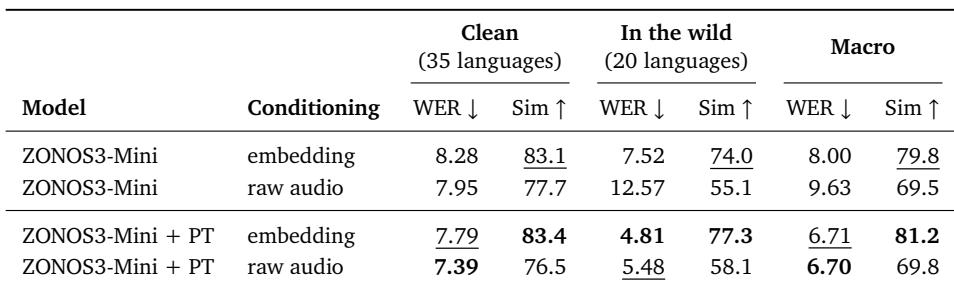
Post-training improves ZONOS3-Mini for both conditioning modes, with the embedding path achieving the best overall speaker similarity and a macro WER close to the raw-audio path. The raw-audio path reaches similar overall intelligibility after post-training but retains lower speaker similarity, especially on in-the-wild data. Most WER gains come from in-the-wild sets rather than clean sets. Embedding conditioning consistently preserves higher speaker similarity than raw audio, with the largest advantage on in-the-wild recordings. Post-training sharply reduces in-the-wild WER for both prompt types and slightly improves clean-set WER. After post-training, the raw-audio path matches the embedding path in macro WER but remains far behind in speaker similarity.
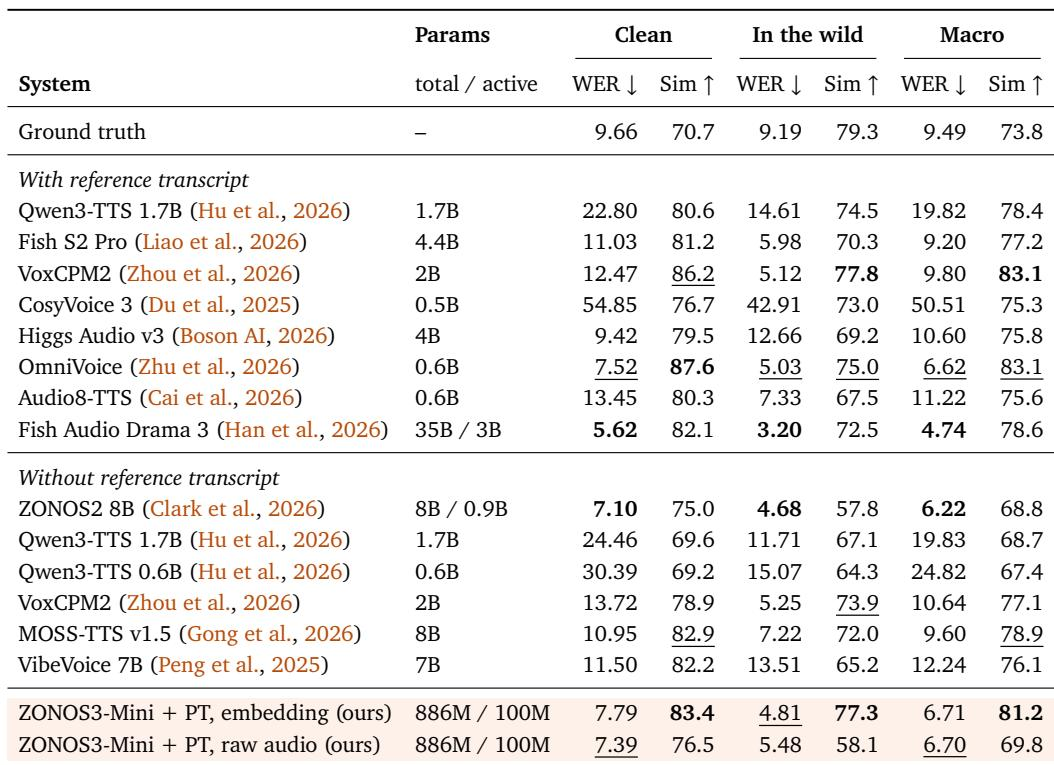
Within the reference-transcript group, VoxCPM2 leads speaker similarity and in-the-wild word error rate, while Fish S2 Pro has the best macro word error rate. Qwen3-TTS and CosyVoice 3 show much higher word error rates, which the text attributes partly to smaller officially supported language sets. In the broader comparison, ZONOS3-Mini is the strongest similarity performer among systems without reference transcripts and ranks second-lowest on macro word error rate after ZONOS2. VoxCPM2 leads the reference-transcript systems in macro similarity and in-the-wild similarity, while Fish S2 Pro has the best macro word error rate in that group. ZONOS3-Mini achieves the highest similarity among systems without reference transcripts and is second only to ZONOS2 on macro word error rate.
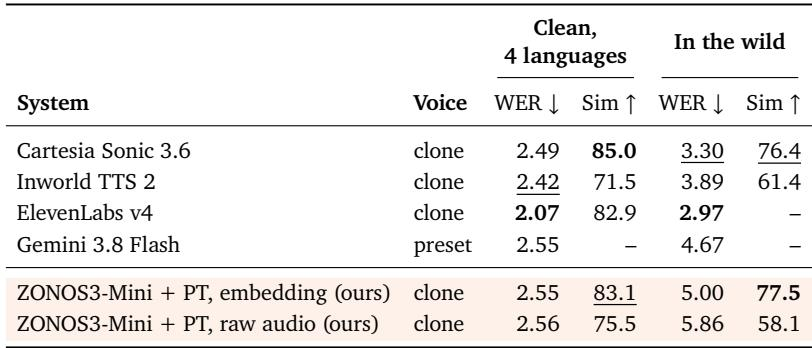
On a multilingual subset covering German, English, Spanish, and Chinese, the post-trained ZONOS3-Mini with embedding prompts is competitive with closed-source voice cloning systems. It achieves the highest speaker similarity on in-the-wild audio and the second-highest similarity on clean audio. Its word error rate is close to the leading closed-source systems on clean speech but somewhat higher on in-the-wild audio. The embedding-prompt ZONOS3-Mini achieves the highest in-the-wild speaker similarity among the compared systems. On clean speech, its speaker similarity is second only to Cartesia Sonic 3.6 and edges above ElevenLabs v4. Word error rates for ZONOS3-Mini are competitive with closed-source systems on clean speech but trail the strongest systems on in-the-wild audio.
The experiments assess codec reconstruction quality, post-training effects, and zero-shot voice cloning across clean and in-the-wild benchmarks. Codec comparisons show ZAC-1 provides lower bitrate and frame rate with competitive clean intelligibility but lower speaker similarity than Fish S1-DAC and MOSS, while DAC trails on both intelligibility and similarity. Post-training improves ZONOS3-Mini mainly on in-the-wild word error rates, and embedding conditioning consistently preserves higher speaker similarity than raw audio. In system and multilingual comparisons, ZONOS3-Mini with embedding prompts achieves the best similarity among systems without reference transcripts and is competitive with closed-source systems, although in-the-wild word error rates remain behind the strongest baselines.