Command Palette
Search for a command to run...
読めないものを読む:テキスト認識型画像超解像には推論が必要である
読めないものを読む:テキスト認識型画像超解像には推論が必要である
Jaeseong Lee Jinwoo Kim Jinho Jeong Seon Joo Kim
概要
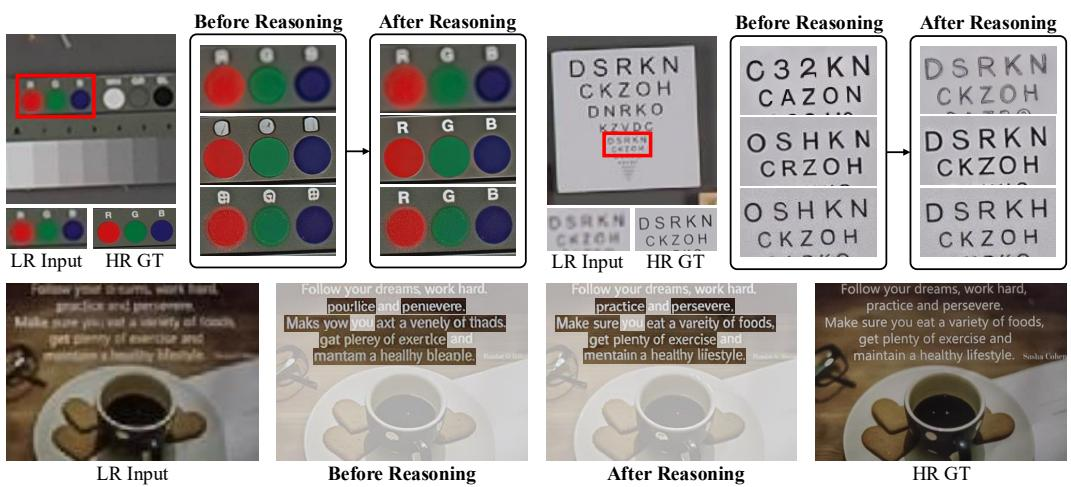
テキスト認識型画像超解像(TAISR)は、低解像度入力から高解像度画像を復元しつつ、テキスト内容を保持することを目的とする。既存手法はこれを視覚的復元問題として扱っているが、著しく劣化したテキストは局所的な視覚的手がかりだけでは読めないことが多い。人間はむしろ、画像の文脈、論理的パターン、事前知識に基づく推論によってそれを読む。このことは根本的な問いを提起する:TAISRに推論は必要なのか。この問いに答えるため、我々は2つの診断ツールを導入する。1つ目はReasonTextであり、人間がキュレーションしたベンチマークで、推論を要するテキストと局所的に復元可能なテキストを分離する。2つ目はGround-Truth Text-Crop Accuracy(GTTCA)であり、テキスト検出誤りの影響を受けずにテキスト復元品質を測定する認識ベースの指標である。12の最近の超解像(SR)モデルを評価したところ、推論を要するテキストにおいて一貫して大幅な性能低下が見られ、系統的な盲点が明らかになった。2つの観察が改善策を示唆する。1つは、テキスト条件付きSRモデルは、正解テキストが与えられるとテキストを大幅に良好に復元することである。もう1つは、マルチモーダル大規模言語モデル(MLLM)が推論を通じて低解像度画像内の劣化テキストを読めることである。そこで我々は、Reasoning Transfer via Captioning(RTC)を提案する。これは学習不要のプラグインであり、外部MLLMを用いて劣化テキストを推論し、得られたキャプションをテキスト条件付きSRモデルに供給する。RTCは、評価した6つのテキスト条件付きSRモデルすべてを一貫して改善し、特に推論を要するテキストにおいて顕著である。驚くべきことに、RTCを備えた実世界SRモデルは、RTCを備えたTAISRモデルを上回ることさえあり、推論が将来のTAISRにおける中核的な設計軸となるべきであることを示唆している。
One-sentence Summary
Researchers from CIPLAB, Yonsei University introduce ReasonText and GTTCA, which diagnose text-aware image super-resolution by revealing a systematic drop on reasoning-required text, and propose Reasoning Transfer via Captioning (RTC), a training-free plug-in that uses an external MLLM to infer degraded text and feed captions to text-conditioned SR models, improving all six evaluated models and indicating reasoning as a core design axis.
Key Contributions
- Introduces ReasonText, a human-curated benchmark that separates reasoning-required text from locally recoverable text, and Ground-Truth Text-Crop Accuracy (GTTCA), a recognition-based metric that measures text restoration quality directly at ground-truth locations without text detection errors.
- Evaluation of twelve recent super-resolution models with ReasonText and GTTCA reveals a consistent and substantial performance drop on reasoning-required text, identifying a systematic blind spot in existing real-world SR and text-aware SR approaches.
- Proposes Reasoning Transfer via Captioning (RTC), a training-free plug-in that uses an external multimodal large language model to infer degraded text and feeds the resulting caption to a text-conditioned SR model; RTC consistently improves all six evaluated text-conditioned SR models, especially on reasoning-required text, and enables a real-world SR model with RTC to outperform a TAISR model with RTC.
Introduction
Real-world image super-resolution recovers high-resolution images from low-resolution inputs affected by unknown degradations, and recent text-to-image generative backbones produce visually plausible details but often hallucinate or corrupt text. Text-aware image super-resolution (TAISR) methods add text detection, segmentation, or spotting modules, yet these remain centered on local visual evidence and lack the contextual reasoning humans use to read degraded text. Existing benchmarks also do not separate reasoning-required text from locally recoverable text, and their metrics depend on text spotting, which can contaminate quality measurement. The authors introduce ReasonText, a human-curated benchmark with perception-grounded difficulty levels, and Ground-Truth Text-Crop Accuracy (GTTCA), a detection-free text restoration metric, then show that twelve recent SR and TAISR models fail sharply on reasoning-required text. They also propose Reasoning Transfer via Captioning (RTC), a training-free plug-in that uses a frozen multimodal large language model to infer degraded text into captions for frozen text-conditioned SR models.
Dataset

The authors introduce ReasonText as an evaluation benchmark for reasoning-required text restoration in super-resolution, built on RealSRv3 and DRealSR real-world LR-HR pairs.
-
Sources and composition: Existing benchmarks such as SA-Text-test and RealText lack per-instance reasoning labels, contain automatic annotation errors, and crop text without surrounding context. ReasonText instead uses manual annotations and context-preserving crops. After filtering, it contains 513 LR-HR pairs and 2,463 text instances: 1,754 Level 1 and 709 Level 2.
-
Annotation and processing: Trained annotators label word-level polygons, transcripts, and orientations in full HR images, with multiple rounds of verification. The authors crop a square HR patch around each text instance while keeping related context, then resize HR patches to 512×512 and aligned LR patches to 128×128 for the ×4 SR setting.
-
Difficulty labeling and filtering: Stage 1 shows a cropped LR text region without context. Instances readable from the text alone are Level 1, treated as locally recoverable text. Stage 2 shows remaining instances in the full LR patch with the text region highlighted. Instances readable only with context are Level 2, treated as reasoning-required text. The rest are Level 3, treated as unrecoverable text. Level 3 instances are excluded from evaluation, and LR-HR pairs containing only Level 3 instances are discarded.
-
Use in the paper: The paper does not describe a training split or mixture ratio for ReasonText; it is used as an evaluation benchmark to test whether SR models can recover reasoning-required text. For evaluation, the authors propose GTTCA, which crops each predicted text instance using the ground-truth polygon with padding, rotates and flips it by ground-truth orientation, recognizes it with PaddleOCR-VL-1.5 OCR, normalizes the result, and checks exact match with the ground-truth transcript. GTTCA is reported separately for Level 1, Level 2, and Overall.
Method
The authors propose an external approach to equip super-resolution (SR) models with reasoning capabilities, termed Reasoning Transfer via Captioning (RTC). Since conventional quality criteria and text-specific objectives fail to provide training signals for inferring locally illegible text, the authors bypass internal reasoning and instead extract reasoning-aware representations from an external model to inject into the SR model.
The design of RTC is grounded in two empirical observations. First, the authors observe that passing ground-truth transcripts through the existing text-conditioning channel of SR models significantly improves the restoration of reasoning-required text. By replacing the default caption with a natural-language caption listing the transcripts, the SR models can accurately render the text, settling the injection mechanism.
Second, to generate these transcripts from low-resolution (LR) images where ground-truth is unavailable, the authors evaluate various models. They find that while standard OCR models struggle with reasoning-required text, Multimodal Large Language Models (MLLMs) can successfully infer it. Specifically, Gemma 4, when prompted to use image context and logical patterns, achieves high text recall. To verify that this performance stems from genuine reasoning rather than memorization or exceptional local recognition, the authors conduct ablation studies on visible regions.
Refer to the framework diagram below:
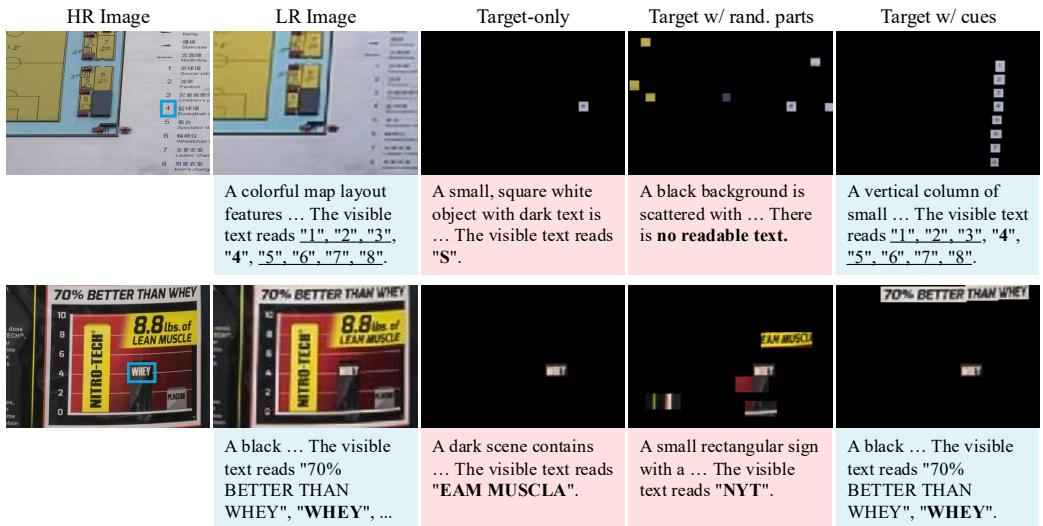
As illustrated, when only the locally illegible target region is visible, the MLLM fails to read the text. Adding random unrelated patches does not improve performance. However, when the relevant contextual cues are provided, the MLLM correctly infers the missing text, confirming its reliance on surrounding context for reasoning.
Building on these observations, the RTC pipeline operates in two training-free steps. First, in the caption by reasoning step, the authors query an MLLM with the LR image xLR and a reasoning prompt. The model returns a two-sentence caption c comprising a scene description followed by the inferred transcripts. Second, in the restore by conditioning step, this generated caption and the LR image are passed to a text-conditioned SR model, which replaces its default caption with the reasoning-aware caption to produce the final high-resolution output x^HR. This modular interface allows RTC to attach to any text-conditioned SR model without requiring additional training.
Experiment
The paper introduces ReasonText, a benchmark with human-annotated text instances labeled as locally recoverable, reasoning-required, or unrecoverable, and uses the GTTCA metric to evaluate restoration quality. Experiments on twelve real-world SR and text-aware SR models show that all models suffer a large accuracy drop on reasoning-required text, and that existing text-aware designs only help locally recoverable text. The authors then propose Reasoning Transfer via Captioning, which injects captions produced by a reasoning-prompted MLLM into text-conditioned SR models, substantially improving restoration of reasoning-required text without training and generalizing across benchmarks.
Across twelve real-world super-resolution and text-aware super-resolution models on ReasonText, text restoration quality drops sharply from Level 1 to Level 2 for every model, and the score ranges of the two levels do not overlap. The HR oracle remains far above all SR models on Level 2, indicating the gap is a model limitation. Text-aware design and conventional image quality metrics do not close or track this reasoning-required text gap. All twelve SR and TAISR models have non-overlapping GTTCA score ranges between Level 1 and Level 2, and the HR oracle remains far above every SR model on Level 2. The text-aware model UniT gains over DiT4SR only on Level 1, while PSNR, SSIM, LPIPS, DISTS, and NR-IQA metrics do not positively track overall text restoration.
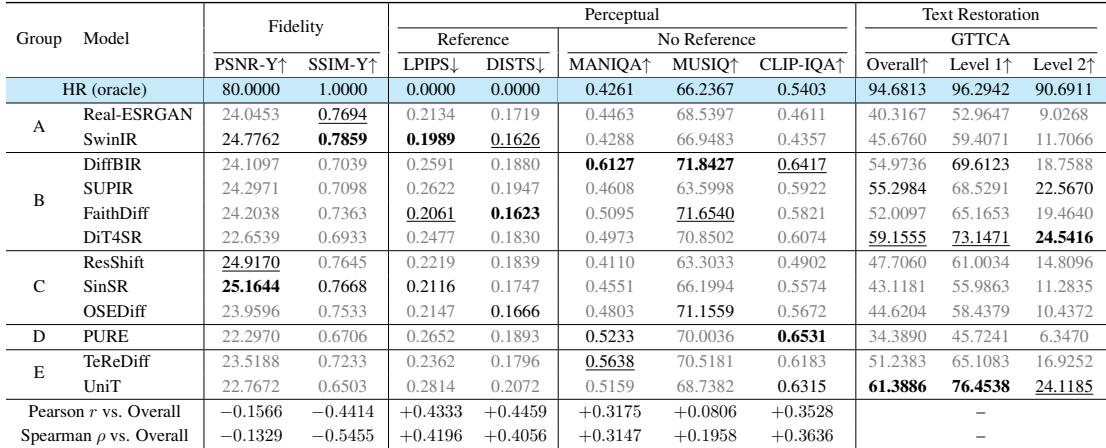
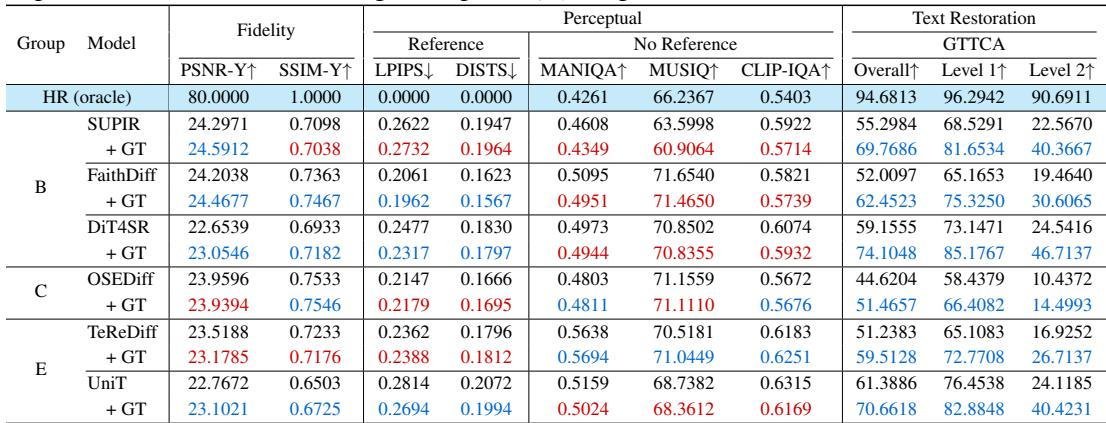
Injecting ground-truth transcripts into the caption input improves GTTCA for all evaluated text-conditioned super-resolution models, with especially large gains on Level 2 reasoning-required text. The improvement is accompanied by declines in several no-reference perceptual quality scores, indicating a trade-off between restoring reasoning-required text and preserving generic image quality. Ground-truth transcripts improve text restoration on both Level 1 and Level 2 for every model, with Level 2 improvements being most pronounced. SUPIR and FaithDiff show clear gains in overall GTTCA and Level 2 accuracy when ground-truth captions replace their original captions. Several models show lower MANIQA, MUSIQ, and CLIP-IQA scores under ground-truth captions, suggesting a perceptual quality cost. The existing text conditioning channel can carry reasoning-aware information, enabling better restoration of reasoning-required text without architectural changes.
Dedicated OCR models read ordinary text relatively well but their recall drops sharply on reasoning-required Level 2 text. MLLMs under a no-reasoning prompt also lag on Level 2, while adding a reasoning prompt improves every evaluated MLLM at both levels, with larger Level 2 gains. Gemma 4 with the reasoning prompt achieves the strongest Level 2 recall and exceeds the best OCR model by a substantial margin. The best OCR result on Level 2 is only 44.43%, while OCR Level 1 scores are considerably higher, showing a sharp drop on reasoning-required text. Reasoning prompts improve all three MLLMs on both text levels, and the Level 2 improvements are consistently larger than the Level 1 improvements. Gemma 4 with reasoning reaches 70.38% Level 2 recall, surpassing the best OCR model by 25.95 points and substantially narrowing the Level 2 gap.

RTC improves GTTCA on both reasoning levels for every text-conditioned SR model, with larger gains on Level 2 than Level 1 for most models. The approach keeps fidelity and reference-based perceptual scores stable and largely avoids the no-reference quality drop observed with transcript-only captions. It also reverses the ranking between a real-world SR model and a text-aware SR model, suggesting text-aware design may need to be rethought around reasoning. RTC improves GTTCA for every model on both Level 1 and Level 2, with larger gains on Level 2 for most models. With RTC, DiT4SR surpasses UniT on both levels despite sharing the same backbone and lacking a text-aware module.
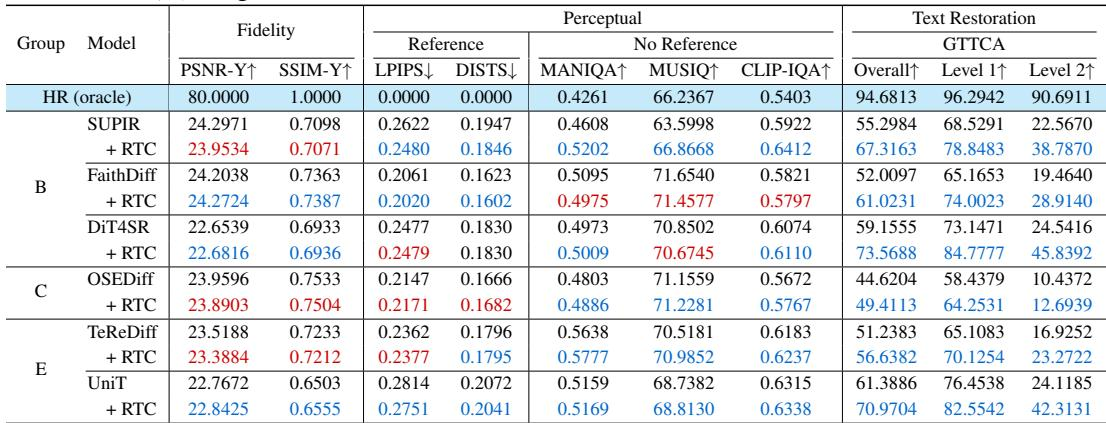
The experiments evaluate twelve real-world and text-aware super-resolution models on ReasonText, examine ground-truth transcript conditioning, compare OCR and MLLM recognition, and test the proposed RTC approach. All SR models show a sharp non-overlapping drop from Level 1 to Level 2 reasoning-required text, and conventional metrics fail to track this gap, while ground-truth transcripts improve restoration but reduce several no-reference perceptual scores. Dedicated OCR models also lose recall on Level 2, whereas MLLMs with reasoning prompts improve markedly, with Gemma 4 achieving the strongest recall. RTC improves GTTCA on both levels for every text-conditioned SR model, with larger Level 2 gains, preserves fidelity and reference-based perceptual quality, and can reverse the ranking between a real-world SR model and a text-aware SR model.