Command Palette
Search for a command to run...
現実世界へのラストマイル:実世界タスクを解決するための再利用可能な構成要素としてのエージェントネイティブ・プリミティブ
現実世界へのラストマイル:実世界タスクを解決するための再利用可能な構成要素としてのエージェントネイティブ・プリミティブ
概要
エージェントは実世界のタスクをどのようにして端から端まで処理できるだろうか。LLMエージェントの最近の進歩にもかかわらず、フロンティアモデルとそれら向けに構築されたハーネスを組み合わせても、実世界タスクの公開ベンチマークでは依然として不十分である。最大の推論努力設定では、Terminal-Bench 4.0において、GPT-5.6 Sol with Codexはタスクの37.3%、Claude Opus 5 with Claude Codeは51.8%を解決するにとどまる。これらのタスクは、リソースに到達することからそれを適用することへの段階で失敗する。我々はこれを現実世界へのラストマイルと呼ぶ。すなわち、ツール呼び出しはその引数を、しばしば先行する呼び出しの出力にグラウンディングしなければならず、各結果はそれを消費するステップに届けられなければならず、失敗はそれが関わる作業まで遡って追跡されなければならない。既存のアプローチはリソースを手の届く範囲に置くが、それを適用する能力は呼び出し側に委ねるため、各ハーネスがその能力を再構築することになる。このギャップに対処するため、我々はエージェントネイティブ・プリミティブ、すなわちリソースに常駐LLMを付与し、そのLLMが文脈に応じてそのリソースを適用し他のプリミティブと通信する、再利用可能な単位と、HEELO(Harness Engineering around Evolving Agent-Native Primitives for the Last Mile to Real-WOrld Tasks:実世界タスクへのラストマイルに向けた進化するエージェントネイティブ・プリミティブ群に関するハーネス工学)を導入する。HEELOは、タスクが必要とするプリミティブをタスク固有のグラフに構成し、タスク環境からの証拠に照らして結果を検証し、失敗が関係するプリミティブを改訂し、検証後に新規または改良されたプリミティブをライブラリに受け入れるハーネス工学フレームワークである。我々の併載研究で証明された結果によれば、ライブラリの規模にかかわらず活性化はタスクの要求によって制限され、タスクごとの構成が最良の固定ハーネスを上回る場合が特定される。しかし、各タスク領域はラストマイルに固有の要求を課すため、我々はHEELOを8つのプリミティブファミリで具体化し、それぞれを1つの種類の実世界タスクに対する解決策として構築し、20を超えるベンチマークで評価する。Dev-Primitivesは、各比較対象のバックボーン上でTerminal-Bench 4.0の解決率をCodex使用時の37.3%から55.5%へ引き上げる。mini-SWE-agentシードハーネス上では、タスクごとに構成されたHarness Primitivesが、100件のSWE-bench VerifiedタスクでPass@1を73.0%から80.5%へ、45件のTerminal-Bench 2.0タスクで60.0%から72.2%へ引き上げ、Codexの79.0%および56.7%を上回る。Tool PrimitivesはToolBenchの合格率を55.8%から75.1%へ、Code Primitivesはrepository deliveryを0.3180から0.5134へ、Agent Primitivesは8つの数学・コード・QAベンチマークにおける平均精度を単一エージェントの58.8%から75.3%へ、Navigation PrimitivesはGAIA-Text-103の精度を45.6%から58.3%へ引き上げる。形式定理証明では、Math Primitivesは注釈付き参照手法を、ホールドアウトされたPutnam問題の95.0%で上位5位以内に入れるのに対し、最強のリランカでは84.2%である。さらなる分析により、利得は各リソースをそのプリミティブの内部で適用することから生じること、そしてどのプリミティブを実行するかはタスクが決まることが示される。これらのベンチマークに加えて、我々は実世界の行動のためのエージェントネイティブ・プリミティブのプラットフォームであるheelo.devを構築した。その46件の実世界タスクでは、Claude Opus 5.5 with Claude CodeとGPT-6.1 Sol with Codexは単独ではそれぞれ9件を完了するが、我々のMCPサーバーを通じてHEELOに接続するとそれぞれ39件と35件を完了し、完了タスクあたりの時間が1.9倍および2.3倍短縮され、コストが1.55倍低くなる。HEELOは、実世界タスクを端から端まで処理するエージェントを構築するための統合フレームワークを提供する。
One-sentence Summary
Researchers at the University of Illinois Urbana-Champaign, Georgia Institute of Technology, and heelo.dev introduce agent-native primitives and the HEELO framework, reusable LLM-equipped units composed into task-specific graphs with evidence-based verification and library revision, improving real-world task benchmarks including Terminal-Bench 4.0, SWE-bench Verified, ToolBench, and heelo.dev tasks.
Key Contributions
- Introduces agent-native primitives, reusable units that equip a resource with a resident LLM so the resource can be applied in context and communicate with other primitives, along with the HEELO framework, which composes primitives into task-specific graphs, verifies results against environment evidence, revises implicated primitives, and publishes validated primitives.
- Instantiates HEELO with eight primitive families and evaluates them on more than twenty benchmarks; for example, Dev-Primitives raise Terminal-Bench 4.0 resolution from 37.3% under Codex to 55.5%, Tool Primitives raise ToolBench pass rate from 55.8% to 75.1%, and Agent Primitives raise mean accuracy over eight math, code, and QA benchmarks from 58.8% to 75.3%.
- Demonstrates real-world deployment via heelo.dev and an MCP server on 46 real-world tasks, where Claude Opus 5.5 with Claude Code and GPT-6.1 Sol with Codex improve from 9 completed tasks each alone to 39 and 35 with HEELO, with 1.9× and 2.3× less time and 1.55× lower cost per completed task. Companion analyses show activation is bounded by task demand and benefits stem from applying resources inside primitives.
Introduction
Large language model agents aim to complete real-world tasks end to end by acting through tools, code repositories, proofs, documents, and other agents. Although harnesses such as Codex and Claude Code make these resources reachable, frontier agents still fall short on practical benchmarks, with failures often occurring at the last mile where a resource must be applied in context, composed with other steps, and revised from observed evidence. Prior work tends to keep resources passive while leaving the competence to apply them with a central caller or a monolithic agent, so that competence is rebuilt per task and becomes harder to verify as libraries grow. The authors address this by introducing agent-native primitives, reusable resources that carry a resident LLM to apply the resource and communicate with other primitives, and by proposing HEELO, a harness engineering framework that composes a task-specific graph from an evolving primitive library, revises only the primitives implicated by task evidence, and admits new or improved primitives through a separate validation path.
Method
The authors leverage a library of reusable, agent-native primitives to construct task-specific harnesses for real-world problems. A real-world task q arrives with a context cq, encompassing its inputs, environment, constraints, and acceptance criteria. An agent acts on the task through a harness H, which serves as the control program deciding which operations run, in what order, and when the execution stops. Rather than relying on a fixed harness for every task, the framework builds a task-specific harness from a library L of reusable units, aiming to maximize the expected score R(q,H)=Eτ[Rq(τ)∣H].
The core building blocks of this system are agent-native primitives. An agent-native primitive Pi equips a reusable resource ai (such as a tool schema, code component, or proof method) with a resident LLM M and exposes an interface di. When invoked with a natural-language request xi in a context ci, the resident LLM applies the resource and returns a result ri along with messages mi directed to other primitives:
(ri,mi)=Pi(xi;ci)=M([ai;ci;xi])This design allows the primitive to assess its own relevance before selection, judging whether it applies to a request and proposing how it would be used. It also performs carried validation, applying the resource's own validation mechanisms, such as tests or schemas, before returning a result.
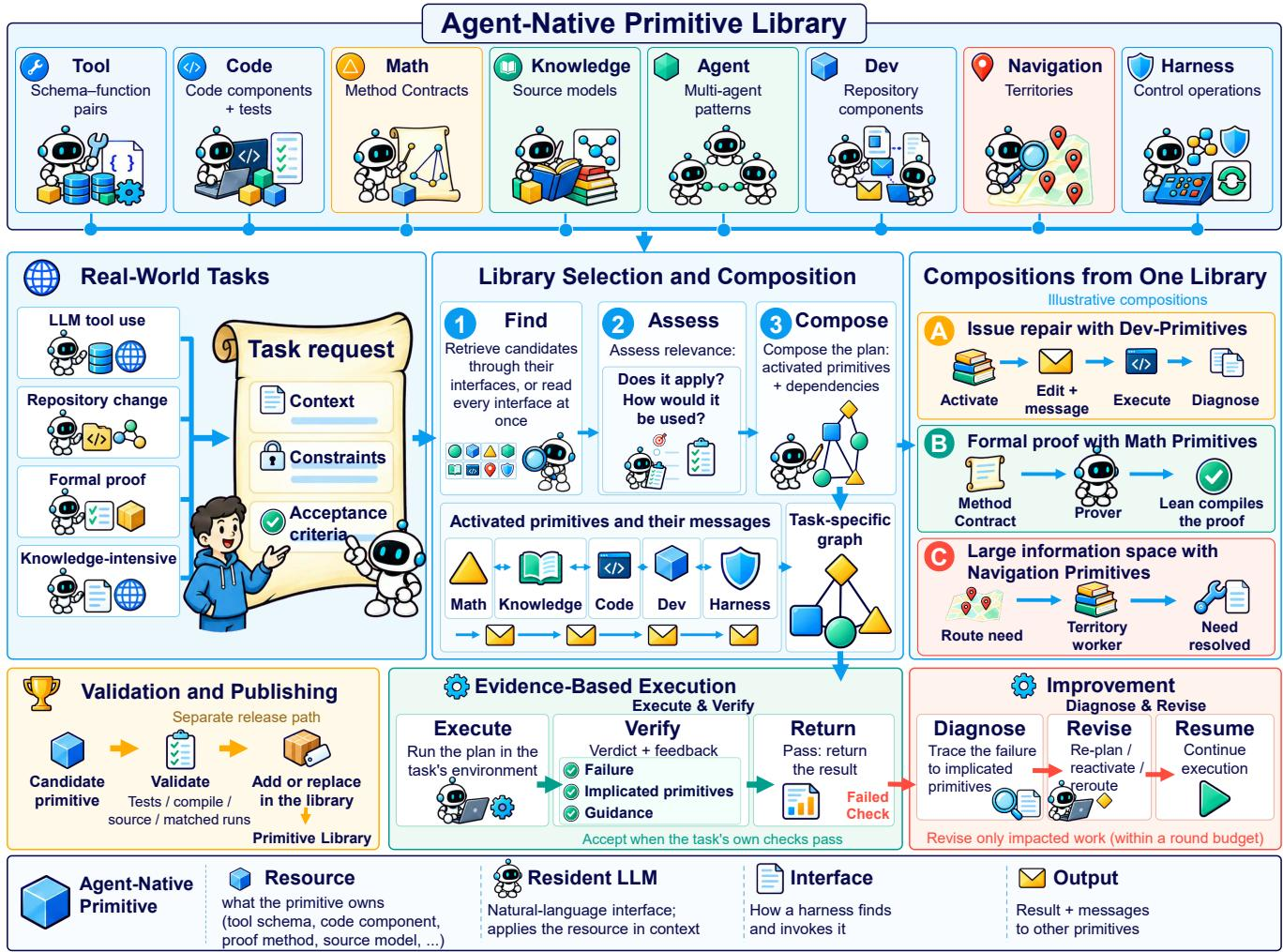
The framework realizes the harness construction and execution through three primary mechanisms. First, Library Selection and Composition (COMPOSE) builds the harness. Since a library typically holds more primitives than a single task requires, COMPOSE finds candidates through their interfaces, reads their relevance assessments, and constructs a task-specific plan Πt=COMPOSE(q,Ct;L). This plan defines an activation set At and a dependency graph Et dictating how results and messages flow between the activated primitives.
Second, Evidence-Based Execution and Improvement runs and revises the plan. In each round t, the activated primitives act, and their results are integrated into the task state St. The system executes the plan in the task environment to gather evidence ot, such as build status or test outcomes. A verification step yields a verdict vt∈{PASS,FAIL} and structured feedback ϕt, which names observed failures, implicates specific primitives, and provides revision guidance. If the task fails, the context is enriched with this feedback, and COMPOSE revises the plan, changing only the implicated work:
Ct+1=Ct∪{ϕt},Πt+1=COMPOSE(q,Ct+1;L,Πt,ϕt)This loop continues until the task passes or a revision budget is exhausted.
Third, Validation and Publishing improves the library between tasks. New or improved primitives, mined from artifacts or harvested from verified runs, enter the library only after passing a separate validation path:
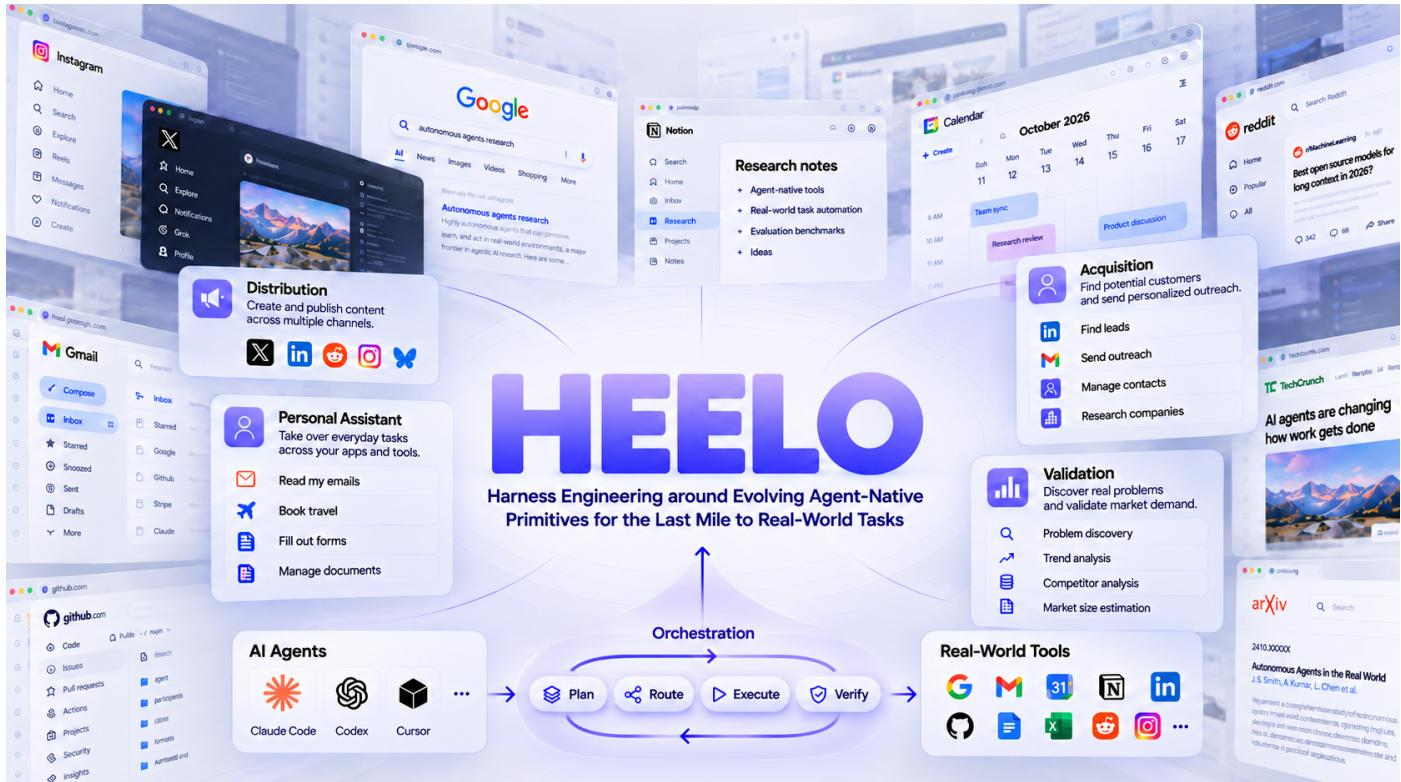
Lk+1=Lk⊕{P~∈P~k:VALIDATE(P~)=PASS}The method is instantiated across eight primitive families, including Tool, Code, Math, Knowledge, Agent, Dev, Navigation, and Harness primitives, each tailored to specific real-world task domains. To evaluate this approach in live environments, the authors built the heelo.dev platform, which exposes third-party actions as agent-native primitives and orchestrates them through planning, routing, execution, and verification loops for tasks like content distribution, customer acquisition, and personal assistance.
Experiment
Across eight primitive families and a real-world platform, the experiments evaluate HEELO against task-specific baselines and ablations, showing consistent gains from applying resources inside their owning primitives, preserving structured communication channels, and activating or revising primitives according to task needs. The results indicate that the benefit comes from the primitives themselves, their carried fields, validation and diagnosis mechanisms, and task-conditioned composition rather than from extra inference or mere retrieval access. In the real-world heelo.dev evaluation, connecting Claude Code and Codex to HEELO enables account-based and service-based tasks that the agents cannot complete alone, while reducing time and cost per completed task.
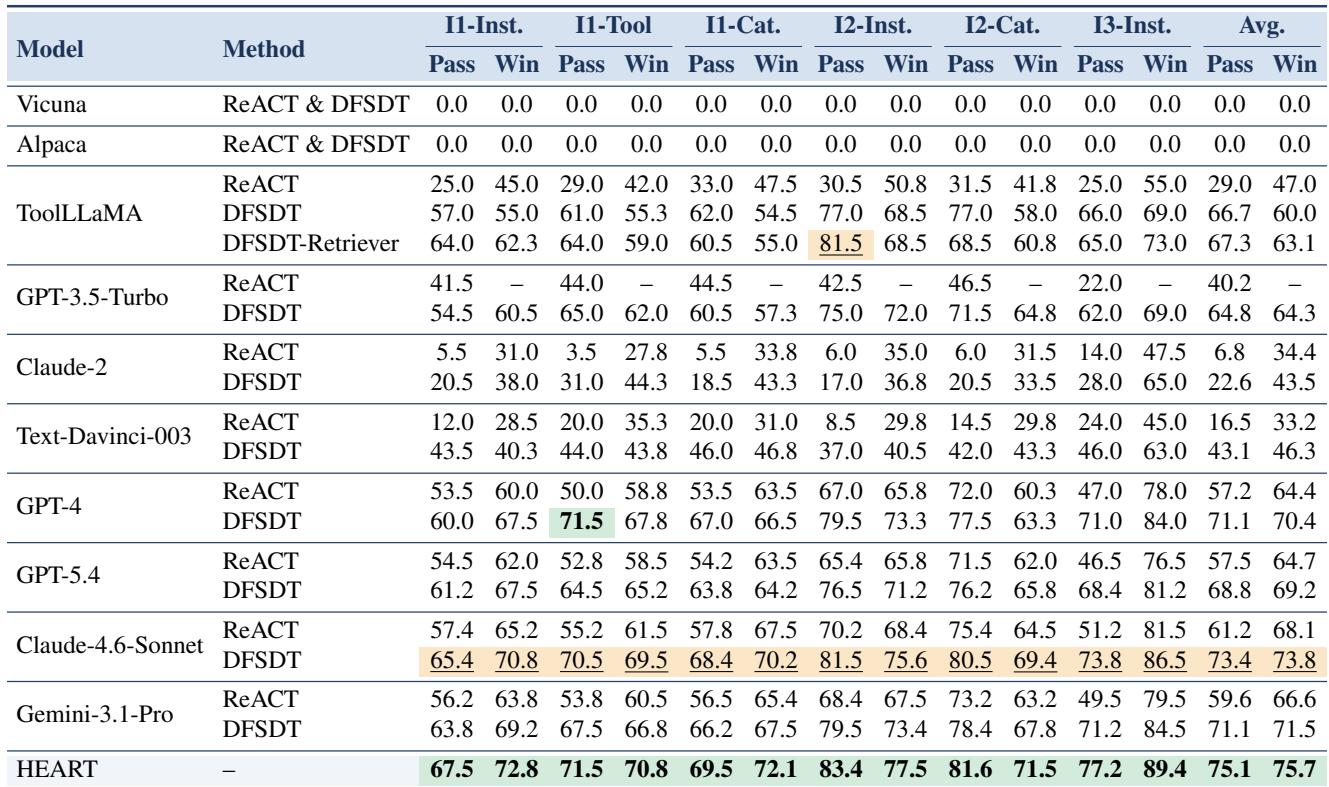
On the six ToolBench splits, HEART with Qwen3-8B achieves the best average pass and win rates among reported systems, outperforming both commercial and fine-tuned references. Its lead is largest on the hardest split where multi-tool instructions require cross-API dependencies. Vicuna and Alpaca fail across all splits, whereas ToolLLaMA improves with DFSDT and retriever augmentation but remains below HEART. HEART leads all reported reference systems on average pass and win rates across the six ToolBench splits. The largest performance gap appears on the hardest split with multi-tool instructions and cross-API dependencies, where HEART posts its strongest win rate. ToolLLaMA with DFSDT and retriever is the strongest fine-tuned reference but still trails HEART on both average pass and win rate. Vicuna and Alpaca score zero pass and win rates on every split, highlighting the difficulty of the benchmark.
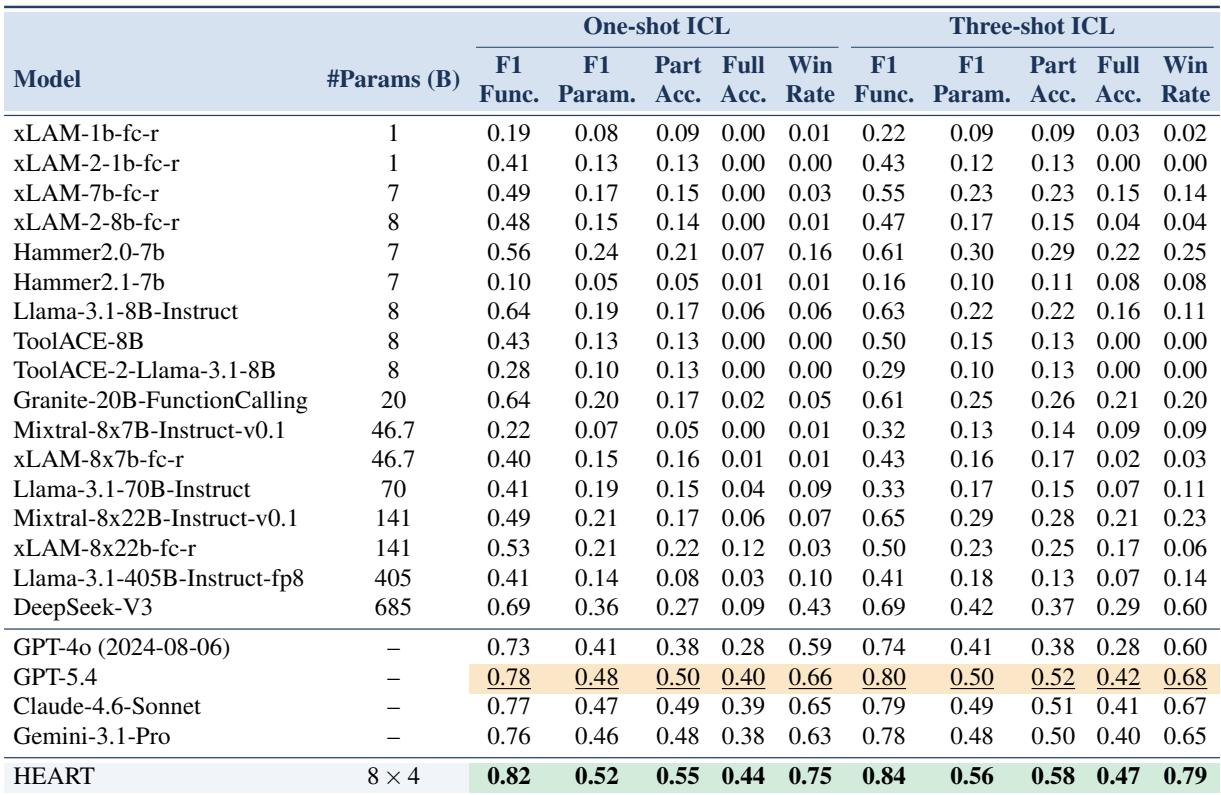
On NESTFUL nested call sequences, HEART leads reference models across function and parameter F1, partial and full sequence accuracy, and win rate under both one-shot and three-shot settings. Its full-sequence accuracy is higher than the strongest baseline, GPT-5.4, in both settings. Smaller fine-tuned function-calling models such as xLAM variants and Hammer2.0 remain much weaker on nested sequences, often near zero full-sequence accuracy. HEART is best on all five NESTFUL metrics in both one-shot and three-shot demonstrations. HEART's full-sequence accuracy reaches 0.44 one-shot and 0.47 three-shot, above GPT-5.4's 0.40 and 0.42. HEART's win rate is 0.75 one-shot and 0.79 three-shot, compared with 0.66 and 0.68 for GPT-5.4. Fine-tuned xLAM models show near zero full-sequence accuracy in one-shot, underscoring the difficulty of nested tool calls.
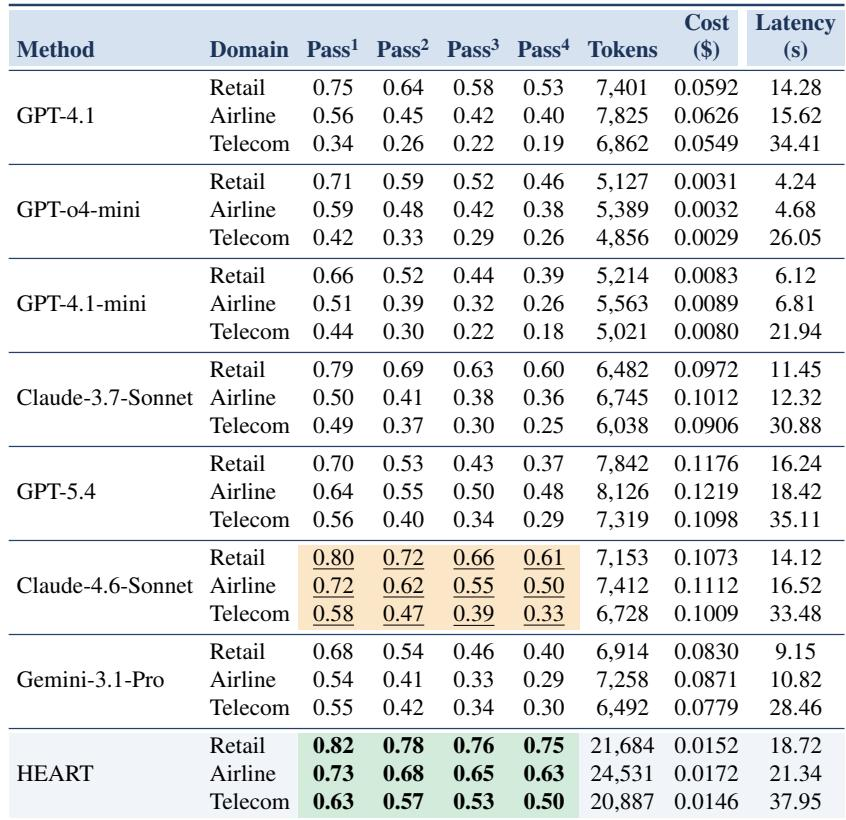
Across the reported reference models, success rates are highest in retail and lowest in telecom, and all models decline as the pass criterion requires more independent successful trials. GPT-4.1 leads in retail, while GPT-o4-mini is more competitive in airline and telecom and operates with much lower token use, cost, and latency. Pass rates fall from Pass^1 to Pass^4 in every reported model and domain, showing that stricter repeated-trial success requirements reduce reliability. GPT-o4-mini undercuts GPT-4.1 on tokens, cost, and latency while posting the strongest reported telecom pass rates, though GPT-4.1 remains strongest in retail.
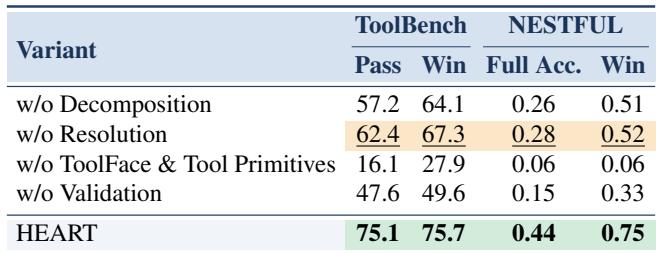
The full HEART configuration performs best on both ToolBench and NESTFUL. Removing any single harness mechanism lowers results, with the largest decline occurring when ToolFace and its Tool Primitives are removed. Result validation is the next most critical component, while removing request decomposition or value resolution causes smaller but still notable drops. Removing ToolFace and Tool Primitives causes the steepest drop across all metrics, reducing ToolBench pass rate to about one fifth of the full configuration and nearly eliminating NESTFUL accuracy. Removing result validation is the second most damaging ablation, with larger losses than removing request decomposition or value resolution. The full configuration leads every column, and ablation of decomposition or resolution preserves moderate performance, confirming that all components contribute but some are more essential.
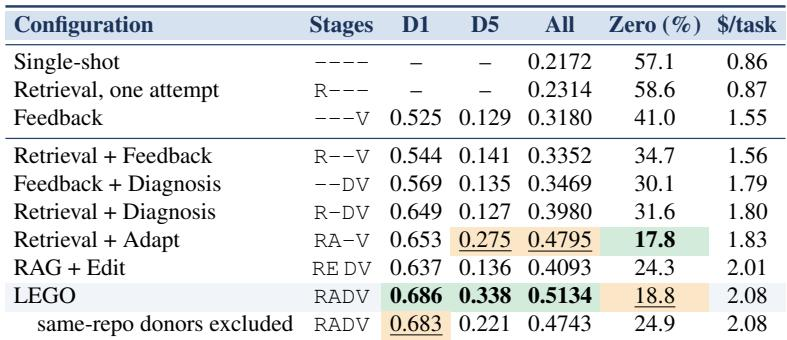
On a 522-repository construction benchmark, adding execution feedback and diagnosis improves delivery scores and lowers zero-score rates relative to single-shot and retrieval-only baselines. The strongest configuration, retrieval plus adaptation, achieves the highest delivery scores on small, large, and all task sets and the lowest zero-score rate, while increasing recorded-call cost above the one-attempt baselines. Large tasks remain substantially harder than small tasks across all configurations. Single-shot and retrieval-only one-attempt runs have the lowest overall delivery scores and the highest zero-score rates, near 57-59%. Retrieval plus adaptation leads on D1, D5, and overall delivery scores and cuts the zero-score rate to 17.8%. Adding diagnosis to feedback yields the second-lowest zero-score rate among the compared configurations. Recorded-call cost rises with added stages, from under 1forone−attemptbaselinestoabout1.83 for retrieval plus adaptation. Even the best configuration scores much lower on the largest tasks than on the smallest tasks, indicating a persistent difficulty gap.
The experiments evaluate HEART on the ToolBench and NESTFUL function-calling benchmarks, domain-specific reliability tests, ablations, and a repository construction benchmark. HEART with Qwen3-8B outperforms reference systems on average ToolBench pass and win rates, with the largest advantage on multi-tool cross-API tasks, and it also leads NESTFUL nested-call metrics under one-shot and three-shot settings. Ablations show that ToolFace with Tool Primitives and result validation are the most critical components, while domain tests reveal that repeated-trial pass criteria reduce reliability and model strengths vary by domain. In repository construction, adding execution feedback and retrieval plus adaptation substantially improves delivery scores and lowers zero-score rates at higher recorded-call cost.