Command Palette
Search for a command to run...
LONGBANANA: 専門家検証済みの長文脈・多参照画像合成ベンチマーク
LONGBANANA: 専門家検証済みの長文脈・多参照画像合成ベンチマーク
概要
我々はLONGBANANAを導入する。これは、我々の知る限り、エージェント駆動型画像生成の時代における長文脈・多参照画像合成のための、専門家が設計し専門家が検証した初のベンチマークである。このタスクは、分散した視覚的証拠の検索、妨害要素の排除、エンティティと関係の結合、および複数の参照から1枚の一貫した最終画像を構成することを必要とする。LONGBANANAは、3×3の分類体系に従って構成された90件の注意深く設計されたタスクを含む。各タスクには約32枚の参照画像、20個の制約、50個の評価項目が含まれ、合計4,670個の専門家が規定した原子的評価項目が得られる。本ベンチマークのグラフに基づく評価設計では、各タスクを参照画像とエンティティ・関係グラフによって具体化し、ノード、エッジ、グラフ全体に関する要件を、内容忠実性(Content Fidelity)、関係結合(Relational Binding)、大域的制約充足(Global Constraint Satisfaction)のチェックリスト項目へ変換する。レビュー済み専門家ラベルには15%の二重ラベル付きサブセットが含まれ、89.4%の完全一致率と0.83の二次重み付きカッパ係数を示した。さらに我々は、長期画像生成のためのエージェントハーネスフレームワークであるLONGBANANA-Genを導入する。実験では、最小限のエージェントハーネスが直接生成を上回ることが示され、一方でReAct–Plan–Exec–Reflect(RPR)ワークフローは、証拠のグラウンディングと修復を強化することでハーネス依存の利得をもたらす。以上により、LONGBANANAは、密な視覚的証拠の利用を測定するための監査可能なテストベッド、およびより強力なエージェント駆動型画像生成システムを開発するための共通目標を提供する。コードとデータはプロジェクトページ(https://long-banana.com/)で公開されている。
One-sentence Summary
Researchers from South China Normal University, University of British Columbia, and other institutions introduce LONGBANANA, the first expert-designed and expert-verified benchmark for long-context multi-reference image synthesis, comprising 90 tasks organized by a 3-by-3 taxonomy with about 32 reference images, 20 constraints, and 50 evaluation items per task for 4,670 expert-specified atomic evaluation items, using graph-grounded evaluation that converts node, edge, and whole-graph obligations into checklist items for Content Fidelity, Relational Binding, and Global Constraint Satisfaction, with reviewed labels showing 89.4% exact agreement and 0.83 quadratic weighted kappa on a 15% double-labeled subset, and also introduce LONGBANANA-Gen, an agent-harness framework in which minimal agent harnesses improve over direct generation and a ReAct–Plan–Exec–Reflect (RPR) workflow yields harness-dependent gains by strengthening evidence grounding and repair, providing an auditable testbed and shared target for agent-driven image-generation systems, with code and data available at https://long-banana.com/.
Key Contributions
- Introduces LONGBANANA-Bench, the first expert-designed and expert-verified benchmark for long-context multi-reference image synthesis, with 90 tasks across a 3-by-3 taxonomy, about 32 reference images and 20 constraints per task, and 4,670 expert-specified atomic evaluation items.
- Presents LONGBANANA-Eval, a graph-grounded checklist evaluation pipeline that maps entity-relation graphs to atomic checklist items for Content Fidelity, Relational Binding, and Global Constraint Satisfaction, routing items to rubric-guided critics and deterministic tools; it is validated against expert labels with 89.4% exact agreement and 0.83 quadratic weighted kappa on the double-labeled subset.
- Introduces LONGBANANA-Gen, an agent-harness framework for long-horizon image generation, and shows that minimal agent harnesses improve over direct generation while a ReAct-Plan-Exec-Reflect workflow yields harness-dependent gains by strengthening evidence grounding and repair.
Introduction
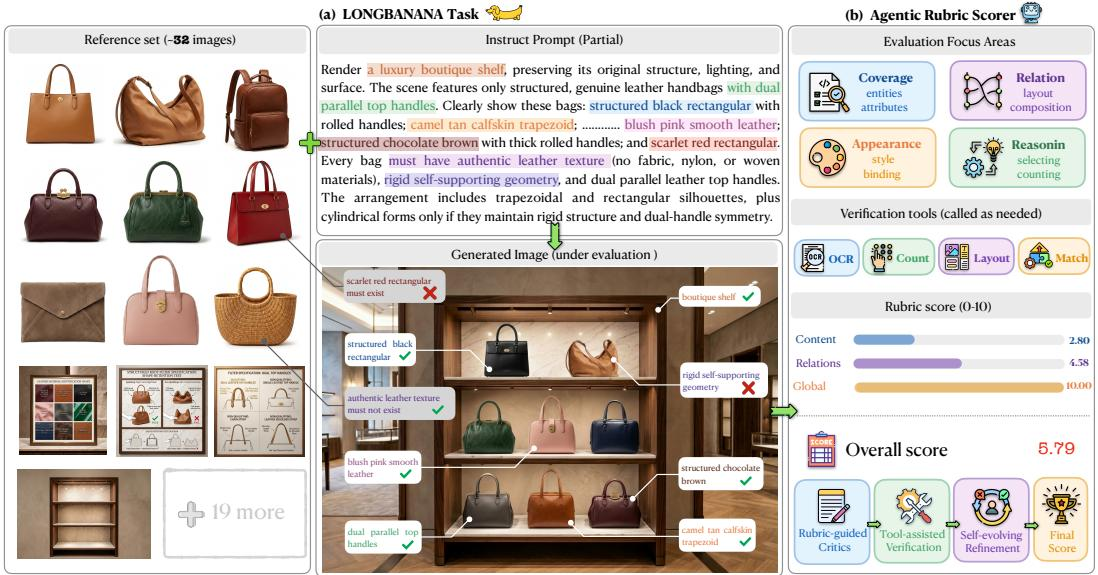
The authors address long-context, multi-reference image synthesis, where a model must generate an image from evidence spread across many reference images and instructions. This matters because realistic outputs can still be wrong if the model selects the wrong reference, copies appearance from a distractor, binds attributes or relations to the wrong entity, or adds unsupported content. Prior benchmarks cover editing, personalization, prompt following, and some reference-based synthesis, but they under-specify dense evidence use and often rely on holistic scoring rather than localizing provenance errors. To close this gap, the authors introduce LONGBANANA-Bench and LONGBANANA-Eval, modeling each task as an entity-relation graph and scoring atomic checklist items across Content Fidelity, Relational Binding, and Global Constraint Satisfaction.
Dataset
The authors use LONGBANANA as an evaluation benchmark for long-horizon multi-reference image synthesis, not as a training set. A generation system receives a heterogeneous reference set and a structured instruction, then must produce one coherent image that satisfies the case’s entity-relation graph.
Dataset composition and scale
- 90 total cases.
- 10 cases per subclass in a 3 × 3 taxonomy.
- Roughly 32 reference images per typical case.
- More than 20 cross-reference constraints per typical case.
- 4,670 atomic checklist items across the benchmark.
Subsets and task taxonomy
- Scene Composition: tests semantic coverage, relational graph consistency, and layout arrangement.
- Visual Appearance: tests global appearance conditioning, local appearance binding, and appearance harmonization.
- Reference Reasoning: tests selection and retrieval, temporal/state reasoning, and counting/aggregation.
Sources and reference construction
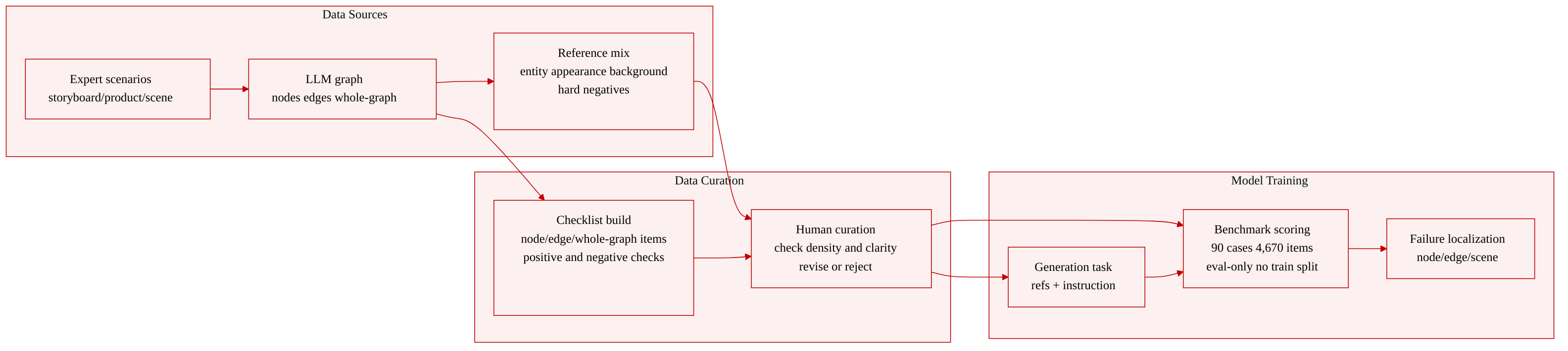
- Expert authors design scenarios based on storyboard, product, and scene-composition use cases.
- An LLM structures each scenario into an entity-relation graph.
- Reference images include entity, appearance, and optional background references.
- At least 30 cases include two or more hard-negative references that are visually plausible but irrelevant to the requested output.
Graph, metadata, and checklist construction
- Graph nodes represent entities and attributes.
- Graph edges encode spatial relations, interactions, and local appearance bindings such as texture, material, color, pose, or state.
- Whole-graph constraints encode composition, layout, counts, and scene-level requirements.
- Checklist items derive from graph constraints at node level, edge level, and whole-graph level.
- Each item records the observable condition, the graph unit being evaluated, relevant reference images, and scoring criteria.
- Positive items check required conditions; negative items check that distractor or unsupported content is absent.
- Human curators review the instruction, references, and checklist together. They reject or revise requirements that cannot be judged, and they check reference density, constraint coverage, and ambiguous or overlapping items.
- The provided text does not report a specific image-cropping strategy.
How the benchmark is used
- LONGBANANA is used to evaluate image generation systems.
- Correctness is measured by the graph-derived checklist rather than by a single holistic quality score.
- Because each checklist item is tied to a graph unit, failures are localized to specific content, relations, or scene-level obligations.
- No training split or mixture ratio is reported, since LONGBANANA is designed as an evaluation benchmark.
Method
The authors construct each case around a shared entity-relation graph that connects the synthesis instruction, reference images, and evaluation checklist. The construction pipeline proceeds from a scenario description to structured constraints, then to visual references and instructions, and finally to the checklist used for evaluation, as shown in the figure below:
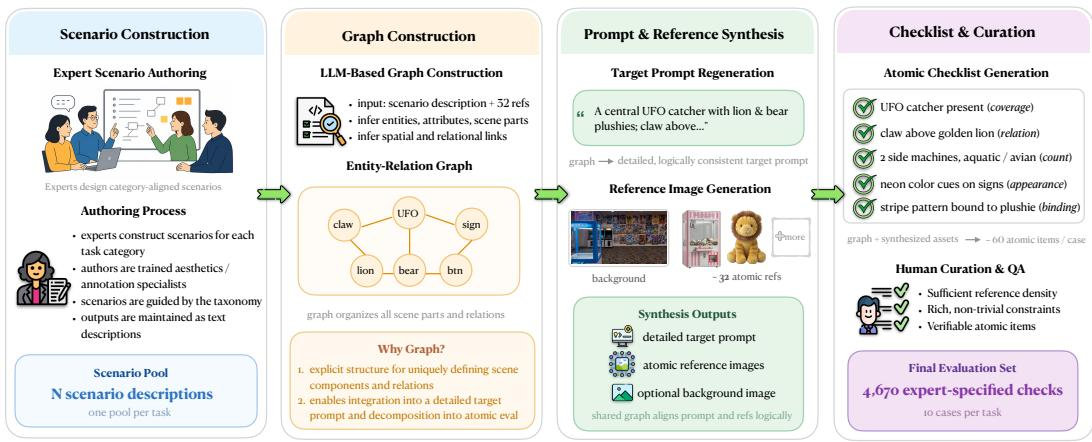
Expert authors first design scenarios aligned with the task taxonomy, specifying what the final image should depict and which entities, visual attributes, and interactions must be preserved. An LLM then structures the scenario into an entity-relation graph. Nodes represent entities and their attributes, edges encode spatial relations, interactions, and local appearance bindings, and whole-graph constraints specify requirements such as composition and counts. This representation makes dependencies explicit, guiding both task synthesis and checklist derivation.
The graph subsequently guides the creation of the target instruction and reference images, including entity, appearance, and optional background references. The instruction expresses the requested composition and relationships, while the references supply visual identities, local details, and appearance cues. Discriminative visual attributes are retained in the references and omitted from text where possible. To assess distractor leakage, at least 30 cases include hard-negative references that are visually plausible but irrelevant to the requested output.
Graph constraints are then translated into atomic checklist items. Node-level items check required entities and attributes, edge-level items check relations and appearance bindings, and whole-graph items check scene-wide requirements like layout and counts. Each item records an observable condition, the graph unit it evaluates, relevant reference images, and scoring criteria. Positive items test whether a required condition is satisfied, while negative items check for the absence of distractor content. Human curators review the instruction, reference images, and checklist together to ensure correspondence to the task graph, visual feasibility, and verifiability before inclusion.
For evaluation, the authors introduce LONGBANANA-Eval, which assesses a generated image against the graph-derived checklist. The agentic checklist judge prepares item-specific reference evidence, routes each check to a dimension-specific critic, and combines the judgments into dimension-level and overall scores, as shown in the figure below:
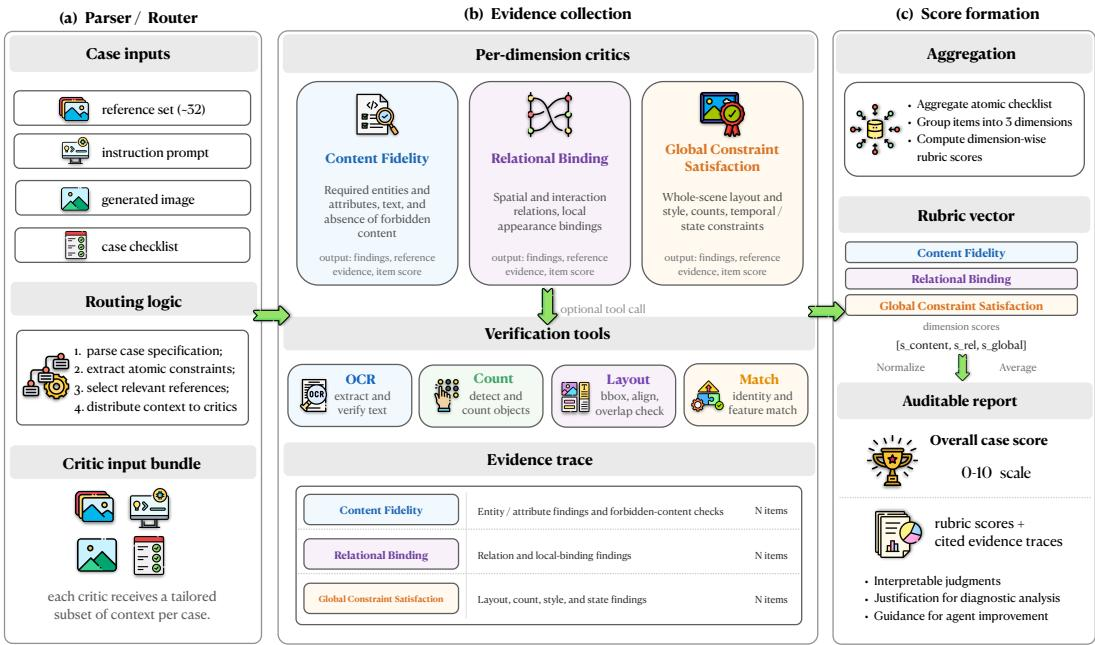
The evaluation pipeline begins with a parser that reads the condition to verify, its rubric dimension, reference identifiers, and scoring criteria. It assembles the generated image and relevant reference images into an evidence packet, with optional crops to localize the region under inspection. Negative-content checks additionally receive identifiers and roles of applicable hard-negative references. A router assigns the packet to the critic corresponding to the item's rubric dimension.
Three dimension-specific critics perform the checks. The Content Fidelity critic checks required entities, attributes, and text, along with the absence of forbidden content. The Relational Binding critic checks spatial and interaction relations and the assignment of local appearance cues. The Global Constraint Satisfaction critic checks scene-wide requirements, including layout, global style, counts, and temporal or state constraints. Each critic compares the output with the item's reference evidence and may invoke verification tools such as OCR for readable text, detection or counting for multiplicity, layout routines for spatial constraints, and identity or feature matching for consistency.
Each check produces a label sj∈{0,1,2}, where 2 indicates a satisfied requirement, 1 indicates partial satisfaction or uncertain evidence, and 0 indicates an unsatisfied requirement. For negative items, complete absence of forbidden content scores 2, ambiguous leakage scores 1, and clear erroneous appearance scores 0. The evidence trace associates the label with relevant references, critic findings, and tool observations.
Finally, the scores are aggregated. For a generated image with N checklist items, the overall score is the mean item label scaled to 0-10. Dimension scores apply the same calculation to the item set Jd assigned to dimension d:
Soverall=N5j=1∑Nsj,Sd=∣Jd∣5j∈Jd∑sj.The dimension scores provide a diagnostic profile, while the overall score summarizes the full checklist.
Experiment
The experiments evaluate long-horizon multi-reference image synthesis using LONGBANANA, a 90-case benchmark with graph-derived checklists, and first validate an agentic checklist judge against reviewed human labels across 900 outputs. The agentic judge tracks expert scores and item-level decisions better than a single-pass VLM judge. Generation results show that a graph-informed direct baseline is competitive, but adaptive agentic workflows produce broader gains, with retrieval, planning, and reflection combined yielding the strongest overall configuration and Nano Banana 2 leading across image backends. The findings suggest that static task structure helps, while inspecting intermediate images and revising evidence use is central to reliable reference-grounded synthesis.
An agentic checklist judge aligns more closely with reviewed human overall scores than a single-pass VLM-as-judge on the fully covered audit pool. It improves all reported output-level correlation measures and also strengthens item-level decisions. These results support its use for machine-scored evaluation and diagnostic reporting. The agentic checklist judge outperforms the single-pass VLM-as-judge across Pearson, Spearman, and Kendall correlations with reviewed human overall scores. Item-level agreement improves as well, with higher exact ternary agreement and fewer opposite-end errors than the baseline judge.

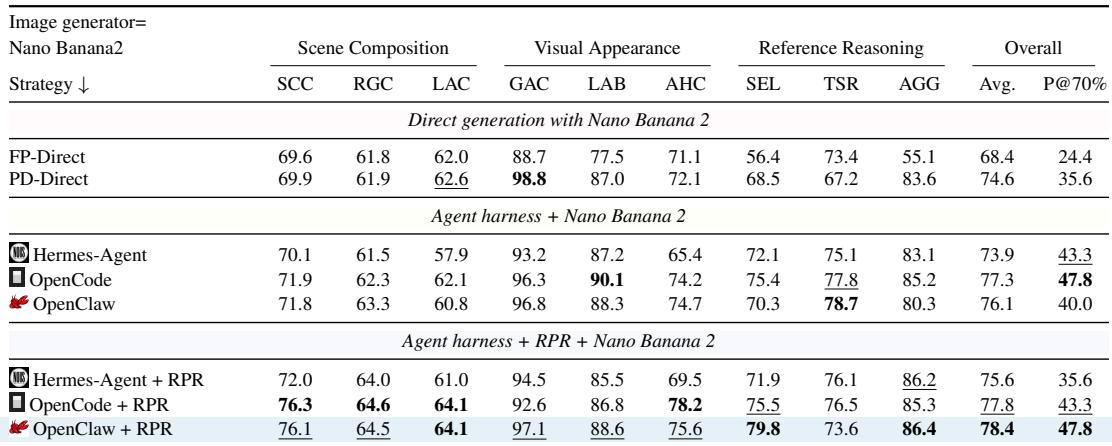
With Nano Banana 2 fixed, PD-Direct is a strong non-agentic baseline that improves on FP-Direct in overall average and most subclasses, recording the best global appearance conditioning and second-best layout arrangement consistency among compared systems. Agentic workflows generally exceed PD-Direct in overall average, and OpenClaw + RPR is stronger on eight of nine subclasses, with the strongest overall average and a joint-best task pass rate. RPR also raises average scores for OpenCode and Hermes-Agent, though their task pass rates decline. PD-Direct substantially improves over FP-Direct in overall average and most subclasses, with the best global appearance conditioning and second-best layout arrangement consistency across compared systems. OpenClaw + RPR surpasses PD-Direct on eight of nine subclasses and leads agentic configurations in overall average and joint-best task pass rate. RPR gives OpenClaw clearest gains in scene composition, reference selection, and aggregation, while the minimal OpenClaw harness remains stronger on temporal and state reasoning. OpenCode and Hermes-Agent improve their average scores with RPR but show lower task pass rates.
With the OpenClaw + RPR workflow fixed, Nano Banana 2 is the strongest image backend on the LONGBANANA benchmark, achieving the best overall average, task pass rate, and every reported subclass metric. Seedream 4 and GPT Image 1 score substantially lower overall and on task pass rate, and they show different secondary strengths, but neither approaches the leading model's breadth. Nano Banana 2 leads all reported metrics, including scene composition, visual appearance, reference reasoning, overall average, and task pass rate. Seedream 4 and GPT Image 1 perform closer to each other, with GPT Image 1 relatively stronger on global appearance and Seedream 4 relatively stronger on temporal state reasoning and aggregation. The image backend choice creates a large gap in task pass rate, with Nano Banana 2 far ahead of both alternatives under the same workflow.

The experiments evaluate three components of the evaluation and generation pipeline. First, an agentic checklist judge aligns more closely with reviewed human scores than a single-pass VLM-as-judge, improving both output-level correlations and item-level agreement. Second, with the Nano Banana 2 image backend fixed, agentic workflows generally outperform the strong non-agentic PD-Direct baseline, and OpenClaw with RPR achieves the best overall average and task pass rate, while RPR also raises average scores for other agents despite lower task pass rates. Third, with the OpenClaw plus RPR workflow fixed, Nano Banana 2 is the strongest image backend across all metrics, far ahead of Seedream 4 and GPT Image 1, which show different secondary strengths but lower overall performance.