Command Palette
Search for a command to run...
CoworkOS: 実世界自動化のためのエージェントコワーカーのスケーリング
CoworkOS: 実世界自動化のためのエージェントコワーカーのスケーリング
概要
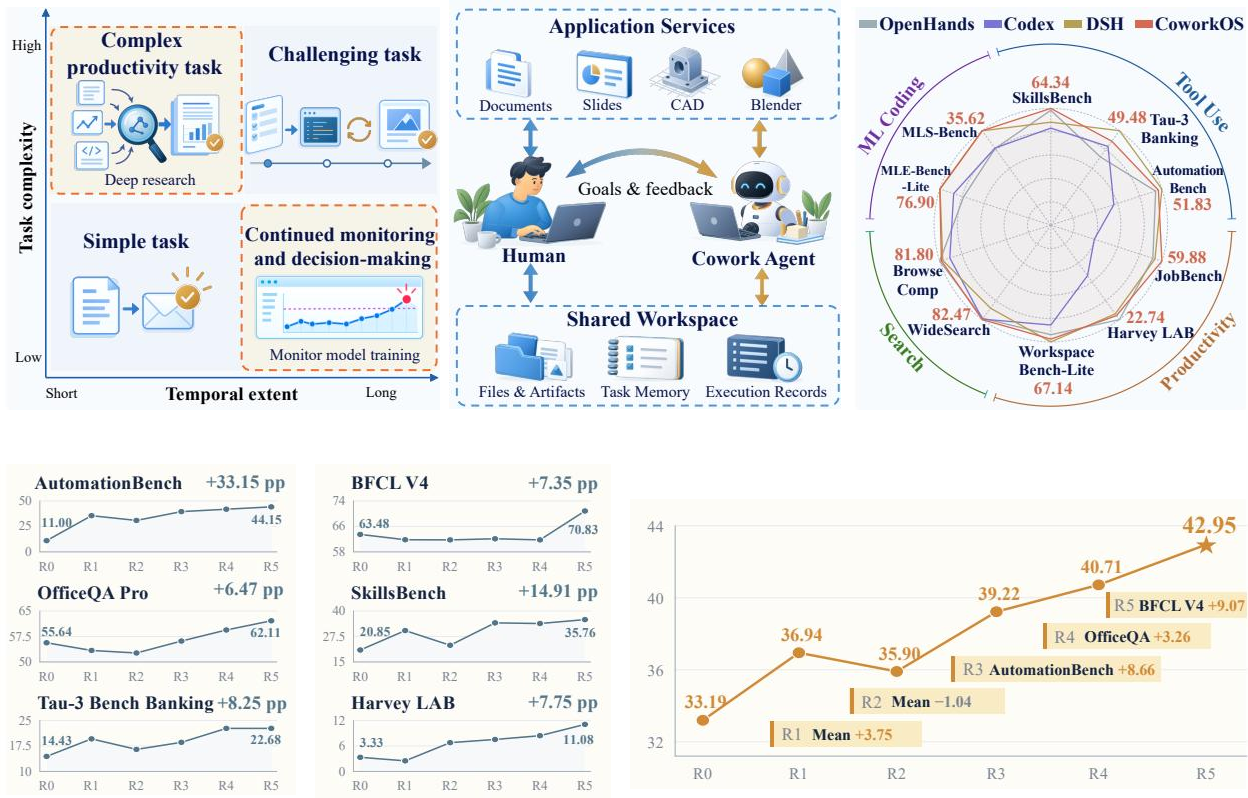
コワークエージェントの急速な進歩により、人間とAIの協働は、ソフトウェア、設計、その他の成果物を生み出す実世界の自動化へと移行しつつある。しかし、こうした生産性業務では、複雑な生産性タスクにおける高品質な成果物の納品と、長期間にわたる継続的な監視・意思決定の両方が求められ、その両立は依然として未解決の課題である。我々は、長期間の作業向け汎用実行基盤(ハーネス)であるCOWORKOSを提案する。COWORKOSはタスク戦略と実行管理を分離し、モデルが行動・委任・承認を決定し、ランタイムが状態とフィードバックを維持する。その3層アーキテクチャは、安定した責任分担の下で、直接実行またはサブエージェントへの委任を同期・非同期のいずれでも可能にする。共有アプリケーションレイヤを通じて、人間とエージェントは同じ進化するドキュメント、プレゼンテーション、CADモデル、Blenderシーンを検査・修正できるため、ヒューマン・イン・ザ・ループの参加は会話を通じても作業そのものの直接修正を通じても可能となる。エージェントやセッションをまたぐ継続性を維持するため、COWORKOSはさらに階層的ワークスペースと永続的意味記憶を導入し、作業ファイル、重要な決定、長時間実行されるジョブログが中断後も共有・再利用・再開可能となるようにする。実世界アプリケーションの6カテゴリ・12のベンチマークにわたり、COWORKOSはCodexやDeepSeek Harnessといった最先端のエージェントアプリケーションと比較して高い競争力を示す。持続的作業の事例研究として、COWORKOSはGLM-5.3をバックボーンに用い、Qwen3.6-35B-A3Bに対してRSI駆動の自動ポストトレーニングを実施する。5ラウンドにわたり、8つのベンチマークにおけるモデルの平均スコアは33.19から42.95へ向上した(+9.76)。今後を見据え、我々はCOWORKOSが汎用コワークエージェント知能への有意義な道を開くと考えている。
One-sentence Summary
Renmin University of China, Fudan University, Peking University, et al. introduce COWORKOS, a general-purpose long-horizon agent harness that separates task strategy from execution management through a three-layer architecture, hierarchical workspaces, and persistent semantic memory, enabling humans and agents to inspect and revise the same evolving documents, presentations, CAD models, and Blender scenes; it proves highly competitive with Codex and DeepSeek Harness across 12 benchmarks and, with GLM-5.3 as its backbone, conducts RSI-driven automated post-training on Qwen3.6-35B-A3B, raising the model’s average score across eight benchmarks from 33.19 to 42.95 (+9.76) over five rounds.
Key Contributions
- COWORKOS is a general-purpose harness for long-horizon human-agent work that separates task strategy from execution management: the model decides actions, delegation, and acceptance while the runtime maintains state and feedback.
- Its shared application layer lets humans and agents inspect and revise the same evolving documents, presentations, CAD models, and Blender scenes, while hierarchical workspaces and persistent semantic memory keep working files, decisions, and job logs shareable, reusable, and resumable after interruption.
- Across 12 benchmarks and six categories of real-world applications, COWORKOS achieves competitive performance relative to OpenHands, Codex, and DeepSeek Harness; in an RSI-driven post-training case study, it raises Qwen3.6-35B-A3B's average score from 33.19 to 42.95 over five rounds across eight benchmarks.
Introduction
Agent systems are moving toward lifelong autonomy, where runtime harnesses are as important as model capability because they determine how models invoke tools, manage state, interpret feedback, and act on available resources. Recent agent frameworks have progressed from workflow-level reasoning and tool use, through assistant-style persistent interaction, to cowork agents that collaborate with humans on evolving artifacts. However, existing systems tend to address either complex productivity tasks or long-running monitoring and decision-making, rather than providing a unified design that keeps humans in the loop across both demands. The authors introduce COWORKOS, a cowork harness that separates model-driven task strategy from runtime execution management through a three-layer framework comprising a Main Agent, a Coordinator Runtime, and Subagents. It adds a human-in-the-loop application ecosystem with shared artifacts, persistent hierarchical workspaces, semantic memory, and long-running Jobs, and it is evaluated across general benchmarks and real-world cowork scenarios.
Method
The authors introduce COWORKOS, a cowork harness designed for long-horizon and human-in-the-loop task execution. The framework is composed of three primary components: a hierarchical agent runtime architecture, scalable application ecosystems for human-agent collaboration, and state management for persistent agent workspaces.
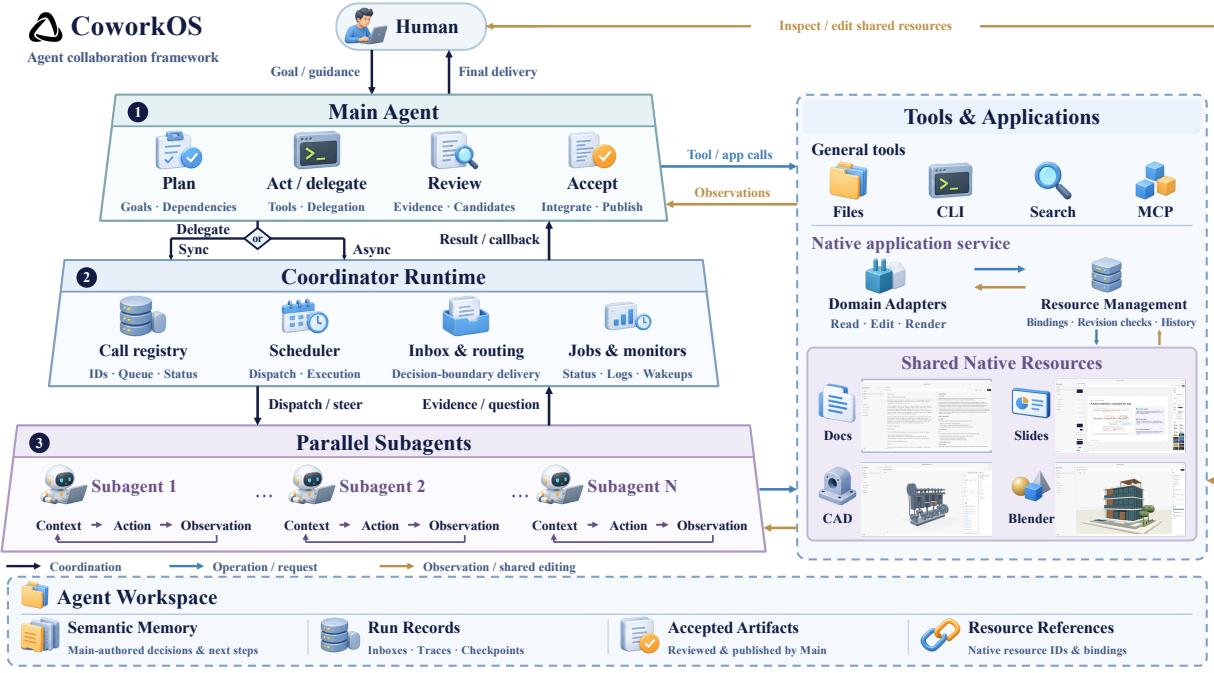
The hierarchical agent runtime architecture resolves the tension between global coherence and local execution by separating authority from execution. The Main agent serves as the user-facing interface and overall planner. At decision step t, it selects an action according to atM∼πM(⋅∣g,htM,Ft), where g is the user's objective, htM is the interaction history, and Ft contains newly available feedback. Main can delegate scoped work to Subagents. For assignment di, a Subagent's initial context is constructed as ci,0=ΦS(di,b(htiM),Γi,Si), where the extraction function retrieves bounded recent background, Γi specifies granted tools, and Si is a catalog of available skills. The Coordinator Runtime acts as the control-plane boundary, maintaining assignments and execution state in persistent program state ξk+1=FC(ξk,ek+1), where ek+1 represents a delegation request, execution update, message, or terminal result.
Information flows through three directional paths in the hierarchy: Main-to-Subagent, Subagent-to-Subagent, and Subagent-to-Main, represented as a communication graph Gt=(Vt,Ethier∪Etpeer). The workspace exposes selected references and accepted artifacts without granting workers unrestricted write access.
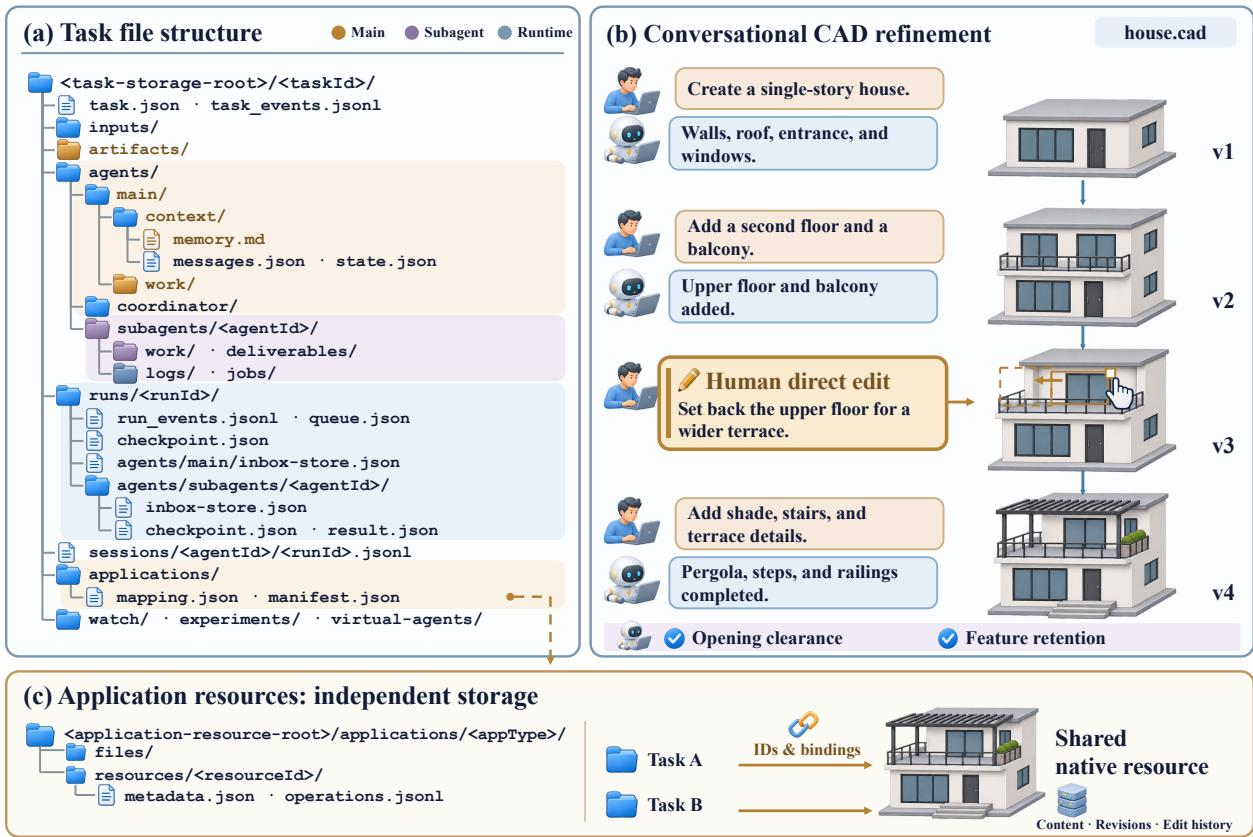
To support long-horizon coworking across multiple applications, the authors build an application ecosystem around a common resource protocol. A platform-managed resource is represented as r=(ι,κ,x,ν), where ι is its identity, κ its kind, x its application-owned content, and ν its committed revision. For a new operation α that passes domain validation, the commit rule is defined as:
Commit(r,u,v^,α)={(ι,κ,Tκ(x,u,α),v+1),conflict,v^=v,v^=v,where v^ is the operation's base revision and u identifies the human or agent actor. Native applications keep the resource under platform control, allowing direct human editing to participate in the same coordination loop as agent actions. The agent's application context includes the current resource and unacknowledged changes: ct,appa=Φκ(rt,st,Δνa:νt¬a), where νt is the current revision, νa is the agent's last acknowledged revision, and st is the saved selection.
State management ensures that a long-horizon Task retains progress across executions. The retained Task state is represented as zk=(Wk,Pk,Rk), where Wk contains working objects, Pk records progress and evidence, and Rk records ongoing executions and pending feedback. The agent uses persistent Task state and available history hk within a bounded decision context: ck=Φ(g,hk,zk), with tokens(ck)≤L. To reconstruct Main's context as history grows, the runtime combines objective and consequential decisions in durable memory with current runtime state. At phase boundaries, the task context is constructed as ct,taskM=Φctx(mT,ρT(t),dT(t))⊕ht,recentM, where mT is semantic memory, ρT(t) projects runtime state, and dT(t) summarizes recorded experiments. The workspace retains working objects alongside progress records, with agent working materials, Run records, and published artifacts occupying separate scopes under the Task.
Experiment
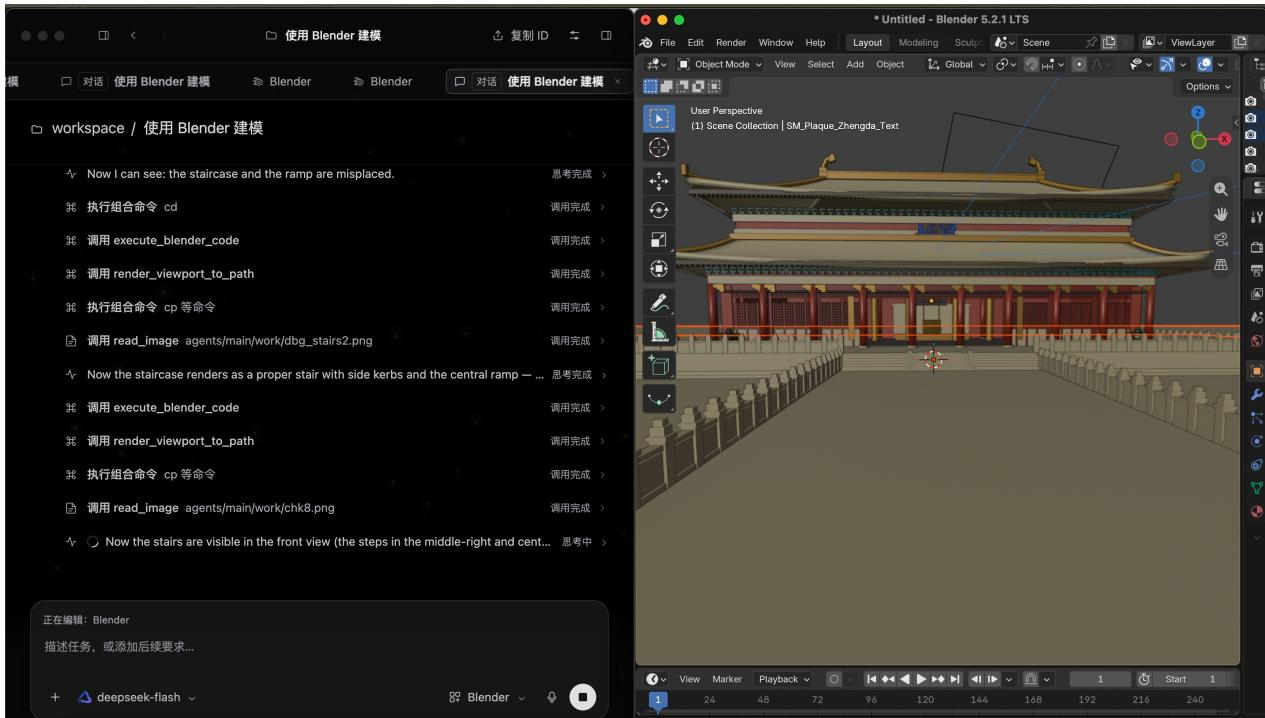
COWORKOS is evaluated across twelve benchmarks spanning tool use, productivity, search, and ML coding, where it is compared with OpenHands, Codex, and DeepSeek Harness and shows the strongest overall performance with top results in several domains. Qualitative experiments on real-world tasks including frontend websites, games, office artifacts, interactive visualizations, CAD, and Blender rendering indicate that COWORKOS produces clearer grouping, richer detail, and more legible interactive deliverables. In AI automated post-training experiments, COWORKOS uses GLM-5.3 to direct five feedback-driven training rounds for a Qwen model, improving the average benchmark score from 33.19 to 42.95 and demonstrating sustained long-horizon model improvement.
COWORKOS places among the top two harnesses in every domain average, leading the Productivity and ML Coding averages and closely matching the leaders in Tool Use and Search. It records the best scores on SkillsBench, JobBench, WideSearch, and both ML Coding benchmarks, indicating broad strength across tool execution, knowledge work, information retrieval, and machine-learning experiments. Overall, COWORKOS shows the strongest performance among the evaluated harnesses on this benchmark set. COWORKOS places among the top two harnesses in every domain average and achieves the highest averages in Productivity and ML Coding. It posts the best scores on SkillsBench, JobBench, WideSearch, and both ML Coding benchmarks, while closely matching DeepSeek Harness in Tool Use and OpenHands in Search. In Productivity, COWORKOS leads JobBench and ranks among the top two on Harvey Legal Agent Bench, WorkspaceBench-Lite, and GDPVal, supporting strong practical knowledge-work performance.
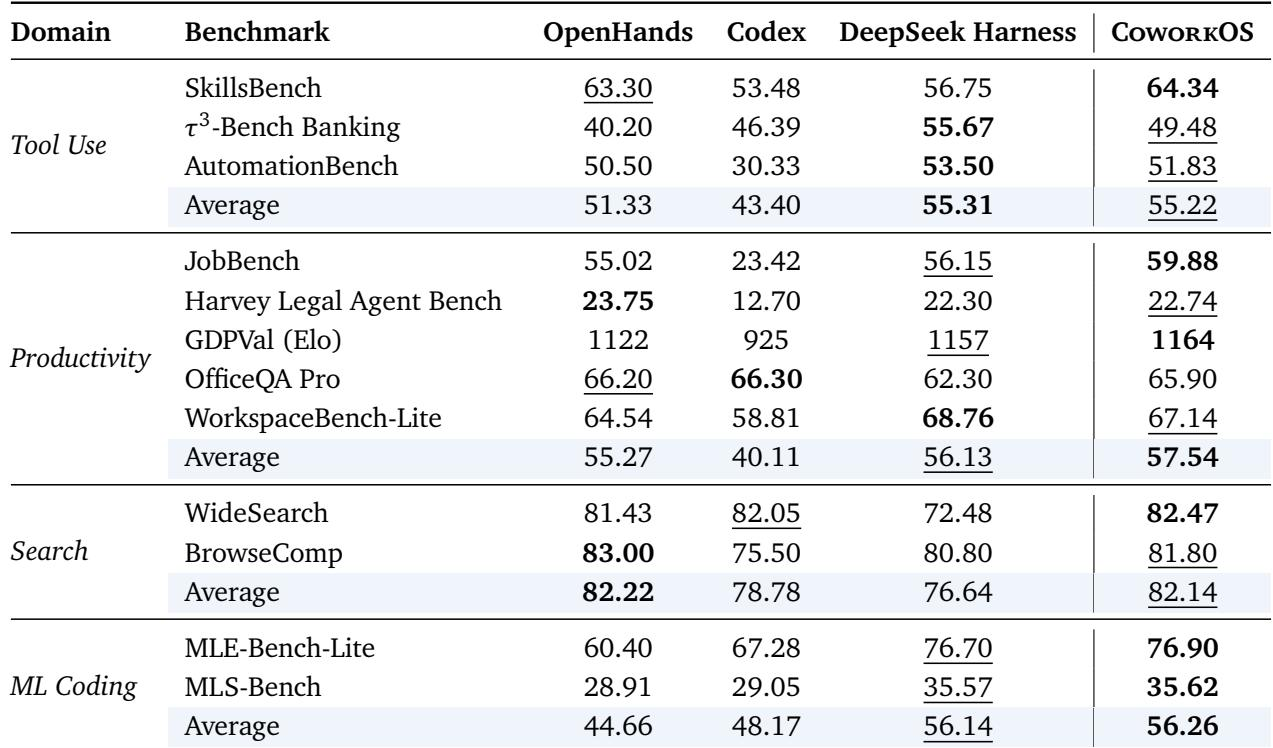
COWORKOS places among the top two harnesses in every domain average, with the highest averages in Productivity and ML Coding and the best scores on SkillsBench, JobBench, WideSearch, and both ML Coding benchmarks. It closely matches DeepSeek Harness in Tool Use and OpenHands in Search, while leading JobBench and ranking among the top two on Harvey Legal Agent Bench, WorkspaceBench-Lite, and GDPVal. These results indicate broad strength across tool execution, knowledge work, information retrieval, and machine-learning experiments, making COWORKOS the strongest overall performer in the benchmark set.