Command Palette
Search for a command to run...
分離型予測的意思決定:エージェントのための共有条件付き予測器
分離型予測的意思決定:エージェントのための共有条件付き予測器
Lang Mo Xingxuan Zhang Qi Wang Mingchao Hao Hao Yuan Chunjing Gan Wang Lu Peng Cui
概要
エージェントの意思決定は、デプロイ時の観測によって明らかになり、タスク記述だけでは解決されないままになる経験的関係に依存する。これらの関係を学習するには、過去の証拠を予測へ変換する機構が必要である。我々は、エージェントの意思決定を汎用条件付き推論として定式化し、共有事前学習済み学習器が異種の意思決定役割を担うアーキテクチャである分離型予測的意思決定(DPDM)を導入する。言語モデルが現在および過去の記録の意味表現を提供し、汎用条件付き予測器が、表現された証拠からタスク定義された目標を予測する。事前学習は再利用可能な推論能力を供給し、デプロイ時の証拠は、いずれのモデルのニューラルパラメータも更新せずに問題固有の予測を具体化する。これにより、ツール判断、候補選好、推論評価は共通の証拠・クエリインターフェースを共有し、予測は決定規則によって選択へと写像される。このアーキテクチャは、言語事前学習を通じて獲得される意味知識と、構造化データ事前学習を通じて獲得される経験的推論という、相補的なエージェント能力の源泉を確立する。我々は条件付き予測器を、構造化データで事前学習され、評価したすべての意思決定役割で共有される LimiX-2 によって具体化する。5つのタスクカテゴリにわたり、DPDM は Qwen3.5 などの意味エンコーダからの表現を受け入れる。Qwen3.5-27B を意味エンコーダとした場合、DPDM は50のベンチマークにわたる平均精度を、少数ショットプロンプティングの78.80%から、各手法の評価履歴バジェットの下で84.92%へ向上させ、同一の履歴とクエリでは82.33%に達する。ToolPRMBench の BFCL および ToolSandbox タスクでは、各手法の評価履歴バジェットの下で、絶対精度の向上はそれぞれ34.26%および28.87%である。精度は履歴が増えるにつれて向上する。同一の不均衡な履歴を用いた場合、5つの推論ステップ評価タスクと4つのエンコーダにわたり、平均均衡精度の絶対向上は14.51%である。DPDM は、経験からの学習を独立して改善可能な基盤モデル能力とし、条件付き予測の進歩がエージェントタスク全体にわたる意思決定を改善するための共有経路を生み出す。
One-sentence Summary
Researchers from Stable AI and Tsinghua University propose Decoupled Predictive Decision Making (DPDM), an architecture that pairs a shared LimiX-2 conditional predictor with semantic encoders such as Qwen3.5, improving mean accuracy across 50 benchmarks from 78.80% to 84.92% by enabling empirical inference without updating model parameters.
Key Contributions
- The paper presents Decoupled Predictive Decision Making (DPDM), an architecture that reformulates task-defined agent decisions as conditional prediction problems through a semantic encoder, a shared pretrained conditional predictor, and a decision rule.
- The conditional predictor is instantiated with LimiX-2, allowing heterogeneous decision roles such as tool judgments, candidate preferences, and reasoning assessments to share one evidence-and-query interface without task-specific neural-parameter updates.
- With Qwen3.5-27B as the semantic encoder, DPDM raises mean accuracy across 50 benchmarks from 78.80% with few-shot prompting to 84.92% under their respective evaluated history budgets, and achieves absolute gains of 34.26% and 28.87% on ToolPRMBench BFCL and ToolSandbox tasks; accuracy improves as history grows.
Introduction
Generalist agents need to combine semantic interpretation with learning from feedback, because the best tool choice, retrieval strategy, or reasoning allocation can depend on problem conditions. Prior language-model-centered systems often perform semantic interpretation, empirical inference, and answer generation within the same pretrained model, leaving the mechanism for learning deployment-specific relationships not separately replaceable or independently improvable. The authors introduce Decoupled Predictive Decision Making (DPDM), which reformulates task-defined agent decisions as conditional prediction problems. A language model encodes the decision context and candidates, a shared conditional predictor estimates the unknown target from historical feedback, and a decision rule converts the prediction into a choice. The approach is instantiated with LimiX 2, a structured-data foundation model, and demonstrates that a single frozen conditional predictor can improve decision accuracy across tasks and semantic encoders without task-specific neural-parameter updates.
Method
The authors propose an architecture that decouples the semantic understanding of a decision problem from the utilization of historical feedback to resolve it. The overall framework consists of a semantic encoder to represent the current context and candidate choices, a shared conditional predictor to estimate the decision target from represented historical examples, and a decision rule to select the final answer.
As shown in the figure below:
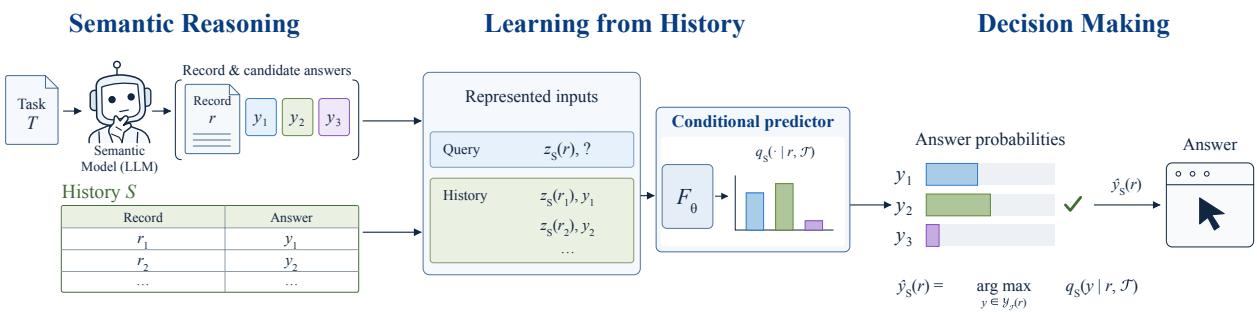
The pipeline begins by formulating decision making as a history-conditioned prediction problem. A task specification defines the observable input fields, the meaning of the prediction target, and the candidate answer set YF(r) for a given record r. The system maintains a history of records and their observed targets, denoted as S={(ri,yi)}i=1M, while a query record r describes the current decision with an unknown target y. The primary objective is to estimate the conditional probability distribution qS(y∣r,F) over the candidate answers.
To achieve this, the authors employ a shared conditional predictor Fθ that takes three inputs: represented historical records, their observed targets, and a represented query. A frozen semantic encoder Jϕ first represents each record in the context of its target question and candidate descriptions. This interface places decision-specific structure into the represented inputs and historical evidence, allowing the shared conditional predictor to infer the answer without requiring task-specific updates to its neural parameters. A feature adapter then maps these inputs into a structured representation:
zS(r)=AψS(Jϕ(r;T),bT(r))Here, ψS denotes any state fitted from historical inputs, such as a feature transformation. This same fitted mapping is applied consistently to both historical and query records. Historical targets are excluded from the semantic record encoding and supplied separately as supervision. The conditional predictor receives the represented history S~={(zS(ri),yi)}i=1M and the represented query zS(r) to compute the output probabilities:
qS(⋅∣r,T)=Fθ(S~,zS(r))The authors instantiate the conditional predictor Fθ using LimiX-2, a model pretrained for conditional prediction over structured data independently of the evaluated decision tasks. Both the semantic encoder parameters ϕ and the conditional predictor parameters θ remain fixed during deployment.
When adapting to new observations, the system updates the history supplied to the conditional predictor. Newly obtained labels or observed outcomes provide additional records ΔS, yielding an expanded history S+=S∪ΔS. The core model parameters remain unchanged, meaning ϕ+=ϕ and θ+=θ. However, the history-dependent adapter state ψS+ and the resulting prediction qS+ may change. Any required input transformations are refitted on the updated historical inputs and applied consistently, while semantic representations can be reused if the encoder and record specification remain unchanged. Finally, a decision rule selects the answer by taking the argmax over the predicted candidate probabilities.
Experiment
Across 50 benchmarks and five task categories, the experiments test a shared frozen conditional predictor (DPDM) with Qwen and Llama semantic encoders against direct zero-shot and few-shot prompting, including matched history and controlled ablation settings. The results show that DPDM improves decision accuracy for all encoders and task categories, benefits from growing histories and distinct labeled observations, and is less affected by majority-label bias than few-shot prompting. Interventions confirm that both historical input-target pairings and semantic features contribute to performance, while cost measurements show reduced repeated semantic processing of histories.
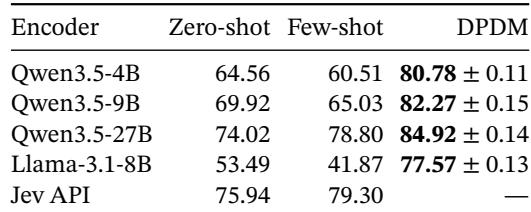
DPDM outperforms few-shot prompting for all four semantic encoders in every category, with overall accuracy rising substantially for smaller models. Gains are broad across individual benchmarks, as DPDM improves nearly all or all of the 50 datasets depending on the encoder. External API few-shot prompting reaches higher accuracy than its zero-shot setting, but no DPDM comparison is reported for that API. DPDM outperforms both zero-shot and few-shot prompting for all four semantic encoders, including cases where few-shot prompting underperforms zero-shot. DPDM improves accuracy on nearly all or all of the 50 benchmarks depending on the encoder, with the largest prompting-to-DPDM gain observed for Llama-3.1-8B.
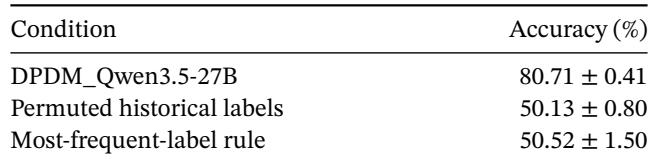
Correct historical input-target pairings substantially improve decision accuracy on the six evaluated tasks. Permuting historical labels while preserving class counts reduces performance to roughly the level of always predicting the most frequent historical class. The original pairings outperform both controls on all six tasks. Original historical input-target pairs yield a large accuracy advantage over permuted labels. Permuted labels and the most-frequent-label rule achieve similar accuracy, indicating class frequency alone explains little of the performance. The advantage of correct pairings holds across all six evaluated tasks.
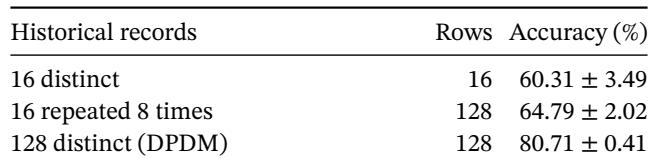
Across six tasks, using 128 distinct historical examples yields substantially higher accuracy than reusing the same 16 examples eight times. Repeating examples provides only a modest improvement over the smaller 16-row history, while expanding to distinct records offers clear gains. Distinct observations therefore contribute more useful historical evidence than repeated rows at the same total history size. Repeating 16 examples eight times improves accuracy only modestly compared with using 16 distinct examples. At the same 128-row budget, 128 distinct observations outperform repeated examples by 15.92 percentage points, with gains on all six tasks.
The full DPDM model achieves the highest accuracy across all tested history sizes and tasks. Removing semantic features lowers accuracy at every history size, while permuting historical labels causes an even larger decline. Larger histories improve all conditions, but the gains are strongest when semantic features and correct input-target pairings are preserved. DPDM outperforms both ablations at every tested history ceiling. Permuting historical labels is more damaging than removing semantic features across all history sizes. At the highest history ceiling, DPDM beats both ablations on all eight tasks. Accuracy improves with larger histories for all conditions, but the full model benefits most.
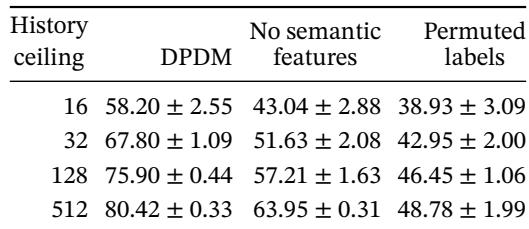
The experiments evaluate DPDM against zero-shot and few-shot prompting across four semantic encoders and many benchmarks, then probe the role of historical information through controlled ablations. DPDM consistently outperforms prompting baselines, with especially large gains for smaller encoders, and the results show that correct historical input-target pairings are essential because permuting labels reduces performance to majority-class levels. Using distinct historical examples rather than repeating a small set also yields substantial accuracy gains. Further ablations confirm that the full DPDM model with semantic features and correct pairings benefits most from larger histories, while removing semantic features lowers accuracy and permuting historical labels causes an even larger decline.