Command Palette
Search for a command to run...
構造化された教科書からの数学的証明スーパービジョンのスケーリング
構造化された教科書からの数学的証明スーパービジョンのスケーリング
Youqing Fang Zhouqi Hua Yinhao Tang Yuzhe Gu Lingkai Kong Bin Liu Weiming Zhang Kai Chen Yanan Sun Wenwei Zhang
概要
言語モデルに対する数学的スーパービジョンは、通常、問題と解答の孤立したペアへと平坦化され、元の資料が持つカリキュラム上の構成や論証構造が捨象されてしまう。本論文では、大学レベルの数学科目の中核領域を網羅する2,118冊の教科書を、章の順序、命題と証明の対応関係、依存参照、出典情報を保持したまま、約38万件の構造化された証明スーパービジョンレコードへと変換した大規模コーパスTOME-Math(Textbook-Oriented Mathematical Evidence)を導入する。これらの構造的信号を活用し、複数の数学科目にわたるカリキュラム学習を探究するとともに、スーパービジョンの量と出典の広がりに関するスケーリングパターンを特徴付ける。全規模において、TOME-Mathによるファインチューニングは、独自の評価セットおよび確立された公開ベンチマークにおける重みなし平均スコアをベースモデル比で16.7ポイント向上させ、評価対象とした3つの公開命令データベースラインすべてを総合的に上回った。本研究の知見は、構造化された教科書が数学的スーパービジョンのスケーラブルな供給源であると同時に、データの組織化が数学的推論に与える影響を研究するための実証的枠組みとして機能することを示している。構造化された数学的スーパービジョンに関するさらなる研究を促進するため、コーパスを公開する予定である。
One-sentence Summary
Researchers from the University of Science and Technology of China, Fudan University, Shanghai AI Laboratory, and Shanghai Jiao Tong University introduce TOME-Math (Textbook-Oriented Mathematical Evidence), a corpus of approximately 380K structured proof-supervision records derived from 2,118 university mathematics textbooks that preserves chapter order, proposition-proof links, dependency references, and source provenance; curriculum-learning finetuning on TOME-Math improves held-out and public benchmark scores by 16.7 percentage points over the base model and outperforms three public instruction-data baselines.
Key Contributions
- TOME-Math is introduced as a large-scale proof-supervision corpus built from 2,118 university-level mathematics textbooks, producing 380,292 Concept and Gap QA records while retaining chapter progression, proposition-proof links, dependency references, and source provenance.
- On book-heldout textbook exercises and established public benchmarks, full-corpus fine-tuning on TOME-Math improves the unweighted six-benchmark mean from 29.17% to 45.83% over the base model, achieves the best performance on five of six evaluations, and outperforms all three public instruction-data baselines in aggregate.
- Controlled experiments show that textbook structure improves mathematical reasoning: structure-guided retrieval raises proof-generation pass@1 from 13.25% to 17.38% under a matched context budget, forward textbook curricula outperform shuffled and reverse schedules across six subjects and three data scales, and broader source coverage yields further gains under a fixed training-token budget.
Introduction
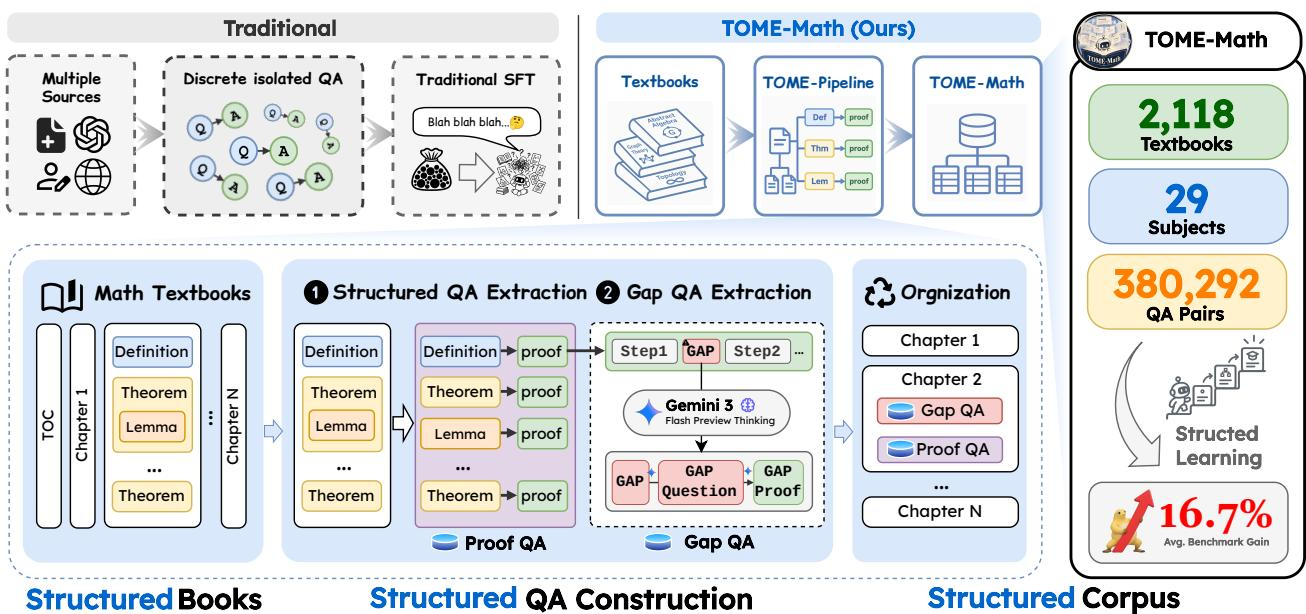
Mathematical reasoning in large language models has advanced through larger supervised question-answer datasets and additional reasoning-time computation, but prior work shows that data organization, question diversity, solution format, and teacher-model quality matter beyond raw example count. However, the dominant paradigm still treats mathematical supervision as isolated problem-solution pairs, even though textbooks already contain structured knowledge such as definitions, theorems, proofs, exercises, chapter ordering, and dependency relations. Treating textbooks only as content sources leaves their native structure underexploited. The authors introduce TOME-Math, a proof-supervision corpus built from 2,118 mathematics textbooks that preserves hierarchical, dependency, and curriculum structure across 380,292 proof-oriented QA pairs in 29 subjects. Supervised fine-tuning with TOME-Math raises a 30B model's average score on six benchmarks from 29.17% to 45.83%, and controlled experiments show consistent benefits from structure-guided retrieval, textbook-aligned curricula, and broader source coverage.
Dataset

Dataset Overview
- TOME-Math contains 380,292 QA pairs built from 2,118 canonical textbooks across 29 subject categories.
- The corpus has two streams: 205,861 Proof QA pairs and 174,431 Gap QA pairs.
Sources
- Raw textbook PDFs are selected against university course syllabi and reviewed by domain experts.
- After canonicalization and deduplication, the source collection includes 2,118 textbooks.
- Subject and language coverage, task composition, structural complexity, quality, and provenance are detailed further in Appendix B.
Processing Pipeline
- OCR and structure extraction: DeepSeek-OCR converts each PDF into multimodal Markdown with page images. A page-wise gpt-oss-120b pass separates the table of contents and main body from covers, prefaces, and other front matter, then reconstructs a hierarchical table of contents.
- Chapter segmentation: A state machine reads the body in order and assigns pages to current or next chapters, retrying ambiguous assignments. This produces ordered chapter-level documents while preserving textbook hierarchy.
- Core concept versus exercise separation: A second page-wise pass separates expository core concepts from textbook exercises. Exercises are kept as an independent reservoir but are excluded from Proof QA generation.
- Proof QA extraction: For each core concept chapter, gemini-3.1-flash-lite-preview extracts theorem–proof, lemma–proof, and definition–proof units and retrieves earlier propositions needed to interpret each proof. These source-grounded units form the Proof QA stream.
- Gap QA construction: gemini-3-flash-preview with thinking inspects proofs for implicit or missing reasoning steps. When a substantive gap is detected, gemini-3.1-flashlite-preview rewrites the missing obligation as a self-contained proposition and completes its proof, producing the Gap QA stream.
Filtering and Quality Control
- Structural checks validate the table-of-contents hierarchy, ambiguous page boundaries, question continuity across pages, question–answer alignment, and standalone completeness.
- A source-conditioned gpt-oss-120b judge audits proposition candidates along five axes: completeness, accuracy, LaTeX formatting, self-containment, and atomicity.
- Accuracy is treated as critical. Invented proof steps, altered mathematical relations, or other unsupported content are failure cases rather than stylistic defects.
- The Gap QA stream retains 174,431 of 918,235 generated candidates, a yield of 19.00%.
Schema and Provenance
- Each record carries book, chapter, and source location metadata.
- Proof QA records also include proposition identifiers and resolved references.
- Evaluation units are defined at the book level.
- Held-out exercises are used for item-level generalization, and held-out books are used for source-level generalization.
- Duplicate groups are identified by global content hash and respected during evaluation splits.
Usage in the Paper
- The dataset provides two complementary forms of proof supervision: explicit proposition–proof pairs and targeted gap-filling supervision for intermediate reasoning left unstated in the source.
- The provided excerpt defines evaluation scopes but does not specify explicit training mixture ratios.
Method
The authors construct TOME-Math through a structure-preserving pipeline that converts raw textbook PDFs into two complementary streams of proof supervision: Proof QA pairs derived from explicit proposition-proof units and Gap QA pairs derived from missing or implicit proof obligations. Source collection is anchored to university course syllabi and reviewed by domain experts, yielding 2,118 canonicalized and deduplicated input PDFs. The full pipeline produces 380,292 QA pairs, consisting of 205,861 Proof QA pairs and 174,431 Gap QA pairs.
For document parsing, DeepSeek-OCR converts each PDF into multimodal Markdown together with page images. A page-wise gpt-oss-120b pass separates front matter, table of contents, and main body, then reconstructs a hierarchical table of contents. Conditioned on this hierarchy, a state machine reads the body in order and determines whether each page belongs to the current chapter, the next chapter, or an internal boundary. Ambiguous assignments are retried before the chapter state is updated. This produces ordered chapter-level documents while preserving textbook hierarchy. A second page-wise pass separates expository core concepts from exercises. Exercises are kept as an independent reservoir but are excluded from the Proof QA generation path.
For each core concept chapter, the authors use gemini-3.1-flash-lite-preview to extract theorem-proof, lemma-proof, and definition-proof units and to retrieve the earlier propositions required to interpret each proof. These source-grounded units form the Proof QA stream. Next, gemini-3-flash-preview with thinking enabled inspects each proof for gaps, meaning implicit or missing reasoning steps. When a substantive gap is detected, gemini-3.1-flash-lite-preview rewrites the missing obligation as a self-contained proposition and completes its proof, producing the Gap QA stream. This design preserves explicit textbook proofs while adding targeted supervision for intermediate reasoning that the source leaves unstated.
Quality control operates at both structural and semantic levels. Structural checks validate the table-of-contents hierarchy, ambiguous page boundaries, question continuity across pages, question-answer alignment, and standalone completeness. For proposition extraction, a source-conditioned gpt-oss-120b judge audits candidates along five axes: completeness, accuracy, LaTeX formatting, self-containment, and atomicity. Accuracy is treated as critical, so invented proof steps, altered mathematical relations, or other content unsupported by the source are treated as failure cases.
Beyond dataset construction, the retained textbook structure provides explicit signals such as chapter progression, proposition dependencies, and source provenance. These signals enable training-free structure-guided retrieval without updating model parameters. In this regime, a structured policy retrieves proposition-proof records using chapter position and recovered dependencies, and an augmented policy also includes Gap QA. All context-augmented conditions share the same context-token budget, backbone model, prompt, decoding configuration, and reference-guided verifier. The target exercise and any material overlapping its reference answer are removed from every retrieval pool, isolating the effect of evidence selection rather than additional test-time tokens.
Experiment
All experiments use Qwen3-30B-A3B-Base and evaluate on proof-heavy problems from held-out textbooks plus objective and public math benchmarks. The full-corpus comparison shows TOME-Math improves over larger public SFT corpora, suggesting that supervision source and structure matter beyond example count. Controlled studies find that structure-guided retrieval with proposition and Gap QA context improves proof solving, while forward chapter order with Gap-first scheduling is the strongest curriculum across subjects and data scales. Broader source coverage at a fixed token budget and strong cross-subject transfer further support structured supervision, and full-recipe ablations confirm that Gap QA and ordering are complementary contributors, especially for proof benchmarks.
Mathematical instruction resources center on problem-solution supervision and scale from small human-authored sets to large synthetic corpora, while textbook-oriented resources provide text from books, papers, and web. TOME-Math contrasts with these resources by retaining textbook hierarchy and proposition references, turning text into structured proof supervision. Broader source coverage and explicit local proof obligations are associated with stronger proof generalization beyond scale alone. Existing math instruction datasets use solutions as the shared supervision unit, with synthetic augmentation scaling human-authored seeds to millions of QA pairs. Textbook-derived resources such as MathPile provide large-scale text supervision from books, papers, and web, while TOME-Math adds hierarchical and proposition-level structure. Spreading the same supervision budget across more textbooks improves average performance, especially in topology and differential geometry, and explicit proof obligations yield the largest proof benchmark gains.
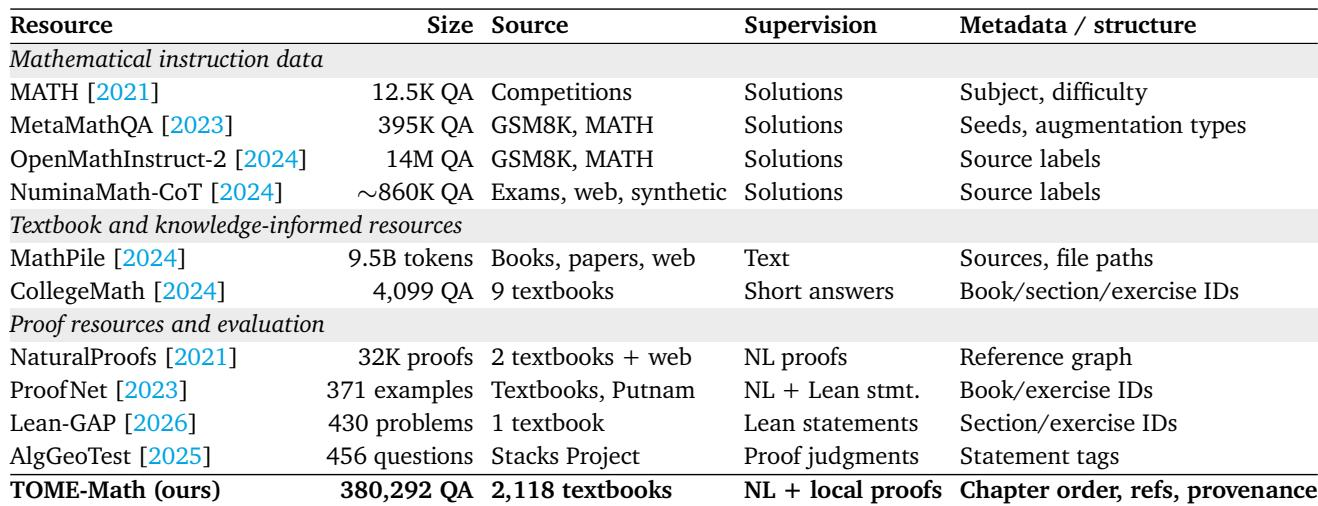
Models fine-tuned on TOME-Math achieve the highest unweighted average across the six evaluations and the best score on five of six benchmarks, with second place on AIME 2026. The improvement over the strongest public baseline is broad, and the largest margins occur on proof-oriented long-form and proof-net evaluations. TOME-Math also outperforms the much larger OpenMath1 corpus on every benchmark, indicating that supervision source and form matter beyond example count alone. TOME-Math ranks best on five of six benchmarks and second on AIME 2026. It outperforms OpenMath1 on all six benchmarks despite OpenMath1 containing roughly 4.8 times as many examples.

Structure-guided TOME retrieval improves average pass@1 over closed, random same-book, and local chapter baselines. The best setting combines proposition and gap signals, producing the highest overall average and the strongest results in several subjects. Gains vary by area, with larger improvements in topology, differential geometry, and mathematical analysis and smaller changes in probability and discrete mathematics. TOME retrieval with propositions and gap information achieves the highest average pass@1 among the compared retrieval contexts. Proposition-only TOME already surpasses the non-TOME baselines on average, and adding gap information further improves performance. Subject-level gains are uneven, with topology and differential geometry showing especially large improvements while probability improves only modestly.

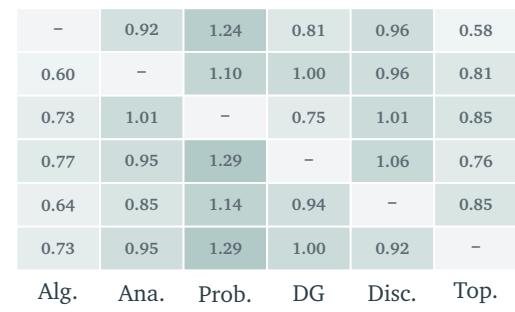
The cross-subject transfer matrix shows that subject-specific checkpoints generalize across mathematical fields, with an average target-normalized coefficient of 0.92. Topology and differential geometry are the strongest sources, transferring at or above in-domain target performance in several cases, especially to probability. Matched-budget breadth results further show that spreading the same supervision budget across more books improves performance. Subject-specific checkpoints transfer across fields with an average normalized score of 0.92. Topology and differential geometry have the strongest source-side transfer means, with several pairs exceeding target-specialist performance. Spreading the same supervision budget across more books yields gains, especially in topology, differential geometry, and discrete mathematics.
The full TOME-Math recipe achieves the highest pass@1 on all six benchmarks, and every ablation lowers performance across the board. Gap-first scheduling is the primary ordering signal for the TOME benchmarks, while removing Gap QA causes the largest declines on proof benchmarks. The complete recipe also leads on MATH-500 and AIME-26, suggesting the structured components extend gains beyond proof-focused evaluations. The full recipe outperforms every ablation on all reported benchmarks. Removing Gap QA produces the largest drops on proof benchmarks, with smaller effects on MATH-500 and AIME-26. Gap-first scheduling contributes more than forward chapter progression on the TOME benchmarks; global shuffling adds only modest further losses.

The experiments evaluate TOME-Math against standard math instruction and textbook corpora, along with ablations on retrieval, training breadth, and ordering signals. Models fine-tuned on TOME-Math achieve broad gains across proof-oriented and general math benchmarks, outperforming the much larger OpenMath1 corpus and showing that structured proof supervision matters beyond example count alone. Structure-guided retrieval using proposition and gap information improves pass@1, with especially large benefits in topology and differential geometry, while subject-specific checkpoints transfer well across fields. Ablations confirm that gap-first scheduling and gap question-answer supervision are central to the recipe, as removing them causes the largest performance declines.