Command Palette
Search for a command to run...
WorkFactory: スケーラブルなエージェント訓練のための専門的意図から実行可能な作業への変換
WorkFactory: スケーラブルなエージェント訓練のための専門的意図から実行可能な作業への変換
概要
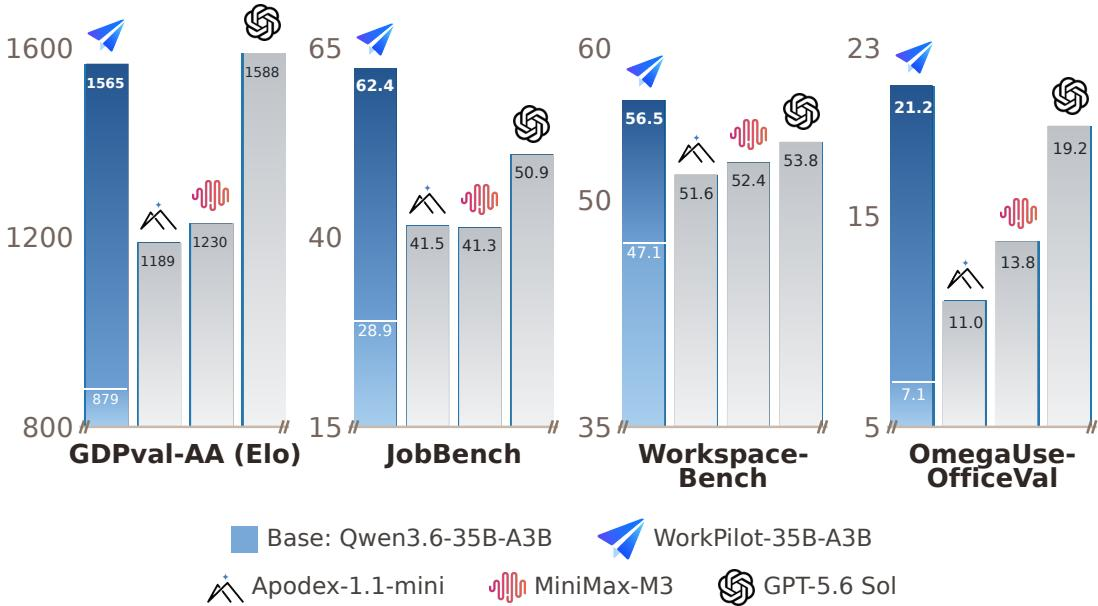
作業エージェントの教師あり訓練をスケールさせるには、信頼できる専門家デモンストレーションを生み出す多様な専門的タスクが必要である。しかし、タスク情報の欠落や不整合は教師の実行を妨げ、得られる教師信号を弱めうる。我々は、一貫性があり実行可能な専門的タスクを構築するスケーラブルなフレームワークWorkFactoryを提案する。専門的意図から出発し、情報レベルの計画が情報支援グラフを構築してタスクの具体化を導き、意図された出力に必要な情報の依存関係と所在を明示的に表現する。次にプローブ実行が支援の失敗を特定し、意図された作業を保持しつつ修復を導く。我々は612の職業にわたる112,686件のタスクを構築し、収集した教師軌跡を用いてQwenモデルを4B、27B、35B-A3Bスケールでファインチューニングし、WorkPilotファミリーを得た。3つのモデルはすべて、4つの専門的作業ベンチマークにおいてそれぞれのベースモデルを上回り、WorkPilot-35B-A3BはGDPval-AA v2.1でEloを879から1565に向上させた。スケーリング分析ではモデル依存的な逓減が明らかになり、実行長は最初増加しその後減少した。制御された構成要素分析により、計画と修復がプローブ診断されたタスク環境の欠陥を低減し、下流性能を向上させることが示された。データとモデルはhttps://github.com/IQuestLab/WorkFactoryで入手可能である。
One-sentence Summary
Researchers at IQuest Research, Zhejiang University, and collaborating institutions propose WorkFactory, a scalable framework that converts professional intents into coherent, executable tasks via information-level planning with an information support graph and probe-execution repair, then fine-tunes Qwen models at 4B, 27B, and 35B-A3B scales to yield the WorkPilot family, with WorkPilot-35B-A3B improving from 879 to 1565 Elo on GDPval-AA v2.1.
Key Contributions
- WorkFactory constructs coherent and executable professional tasks by working backward from intended outputs to build an information support graph that coordinates dependencies and locations across reused and synthesized materials, then applies probe-based execution and repair to preserve task executability. Controlled component analyses show that planning and repair reduce probe-diagnosed task environment defects and improve downstream performance.
- A scaling study on 112,686 tasks spanning 612 occupations examines working-agent performance and execution behavior, finding model-dependent diminishing returns, execution length first increasing then decreasing, and changes in tool-use reliability.
- The resulting WorkPilot family fine-tuned at 4B, 27B, and 35B-A3B scales improves over its base models across four professional-work benchmarks, with WorkPilot-35B-A3B increasing from 879 to 1565 Elo on GDPval-AA v2.1 and WorkPilot-27B achieving frontier-level performance on GDPval-AA. A subset of task data and model weights is released.
Introduction
Language agents that interleave reasoning and actions are increasingly applied to professional digital work, and supervised fine-tuning on expert demonstrations is a common post-training strategy. Scaling this approach requires many executable tasks, but prior automatic task-construction methods often struggle to ensure that teacher demonstrations reliably exhibit the intended professional competencies because supporting information is distributed across artifacts and connected through intermediate calculations. The authors propose WorkFactory, a framework that plans backward from intended outputs using an information support graph to organize where supporting information should appear while leaving derived results for the solver, then uses an isolated probe and execution-based repair to correct environment defects before collecting teacher trajectories.
Dataset
Dataset description: WorkFactory
-
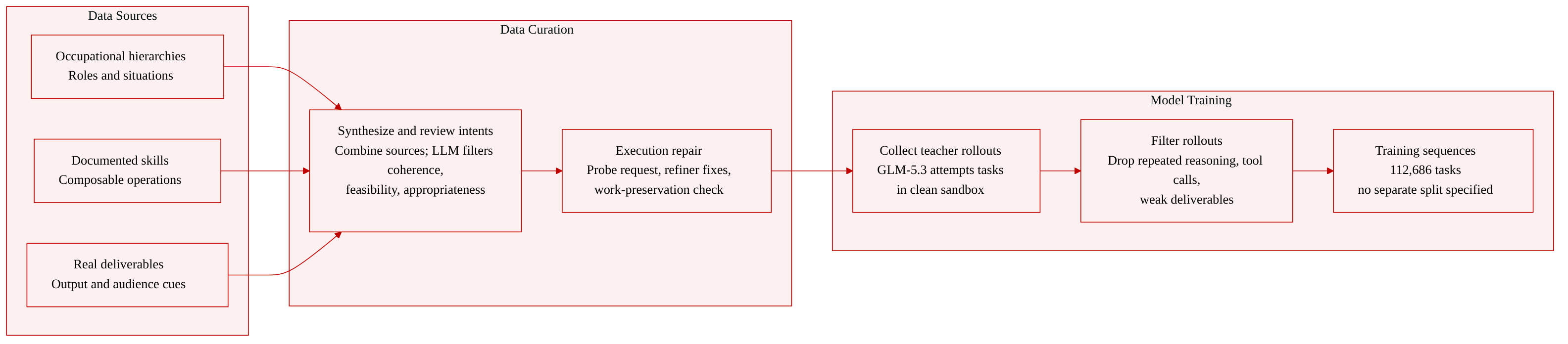
Sources and intent composition The authors build WorkFactory from three professional sources: occupational hierarchies, documented skills, and real professional deliverables. Occupational hierarchies ground work in roles and situations. Documented skills identify operations that can be composed into workflows. Real deliverables provide cues about intended outputs and audiences. These sources are used to expand occupations into roles, compose skills where one operation supplies inputs for another, and infer objectives from deliverables through instruction backtranslation.
-
Intent filtering and task pool creation Candidate intents from all three routes are reviewed by an LLM for internal coherence, feasibility, professional appropriateness, and plausibility as real workplace activities. Accepted intents form a shared intent library. After environment construction, execution-based repair diagnoses whether the realized environment supports the task. A refiner can revise the request and reference files while preserving file number, types, and dependency structure. Revisions must pass construction checks and an LLM work-preservation review. Tasks that pass repair form the candidate pool for trajectory collection.
-
Trajectory collection and training data For each retained task, GLM-5.3 independently attempts the task in a clean sandbox with the same information access boundary as the probe. The resulting interaction trace and deliverables form an initial teacher rollout. The authors keep rollouts that pass lightweight filters for repeated reasoning, repeated tool calls, and missing or insufficiently substantive deliverables. For the 5% of tasks with the longest initial rollouts, they apply selective rejection sampling based on pairwise deliverable comparisons. Retained rollouts are converted into one or more training sequences for masked autoregressive supervision.
-
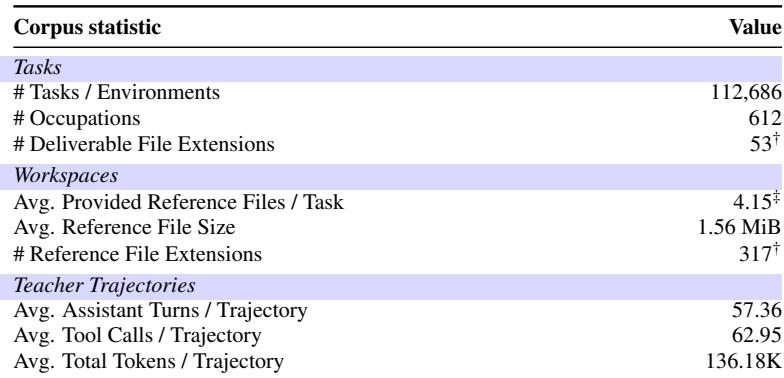
Final corpus statistics The final training corpus contains 112,686 tasks spanning 612 fine-grained occupations and 23 major occupational groups. Teacher trajectories are collected using the Stirrup and Claude Code harness. The corpus is screened against evaluation tasks using request-overlap checks, manual review of flagged pairs, and file hashes. The checks identify no evaluation-task reuse or byte-identical files shared with the training corpus.
-
Usage details The data are used to produce training sequences for masked autoregressive supervision. The provided excerpts do not specify a separate training split, mixture ratios, cropping strategy, or detailed metadata schema beyond the task and environment structure described above.
Method
The authors present WorkFactory, a pipeline designed to construct executable professional tasks for training working agents. The process begins with Multi-source Professional Intent Synthesis, where the system draws on occupational hierarchies, documented skills, and real professional deliverables to generate a diverse intent library. An LLM-based review evaluates these candidate intents for coherence, feasibility, and professional appropriateness before adding them to the shared library.
For each intent, the system proceeds to Graph-guided Environment Construction. To ensure that each requested output is supported by a complete chain of solver-visible premises while leaving the actual calculations and judgments for the solver, the authors introduce an information support graph Ginfo=(Vinfo,Vcarrier,Einfo,Eloc). Here, Vinfo contains information units, Vcarrier identifies their carriers, Einfo represents support relations among information units, and Eloc binds them to locations. The planner works backward from the intended output to identify required calculations and trace them to necessary information, forming the nodes and edges of the graph. Location bindings then assign this information to specific carriers, such as user requests or reference artifacts, ensuring that internal construction requirements remain hidden from the solver. The graph is subsequently translated into an artifact-level construction plan, which an environment worker follows to reuse, adapt, or synthesize artifacts.
As shown in the figure below:
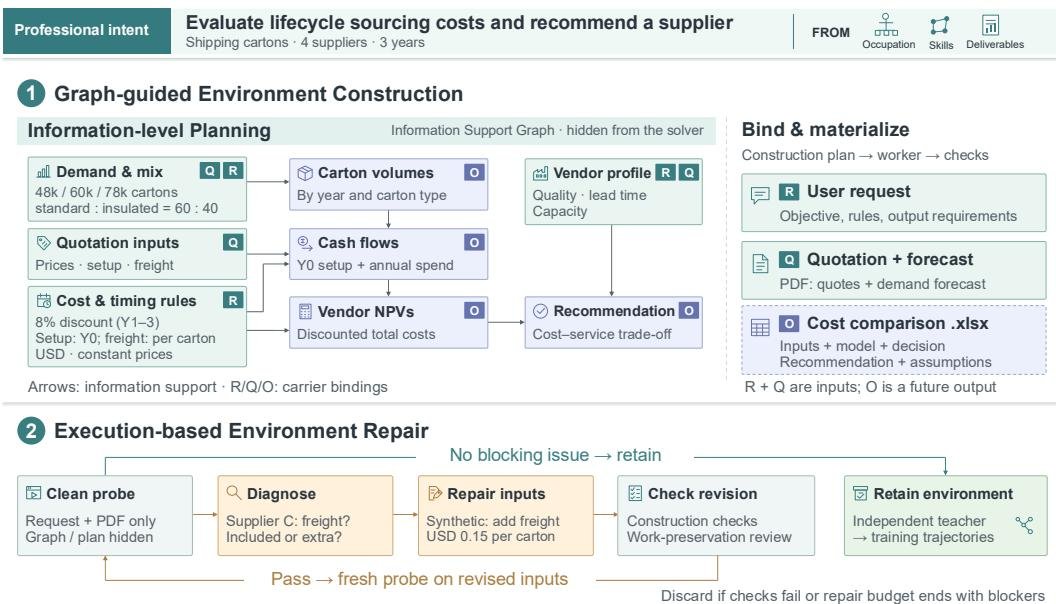
Because dependencies may be lost or contradicted during materialization, the authors implement Execution-based Environment Repair. A probe solver attempts the task using only solver-visible inputs. If blocking issues are identified, a refiner edits the request and reference files to restore necessary support without performing the intended work for the solver. Each revision undergoes construction checks and a work-preservation review. This loop continues until no blockers remain or the repair budget is exhausted.
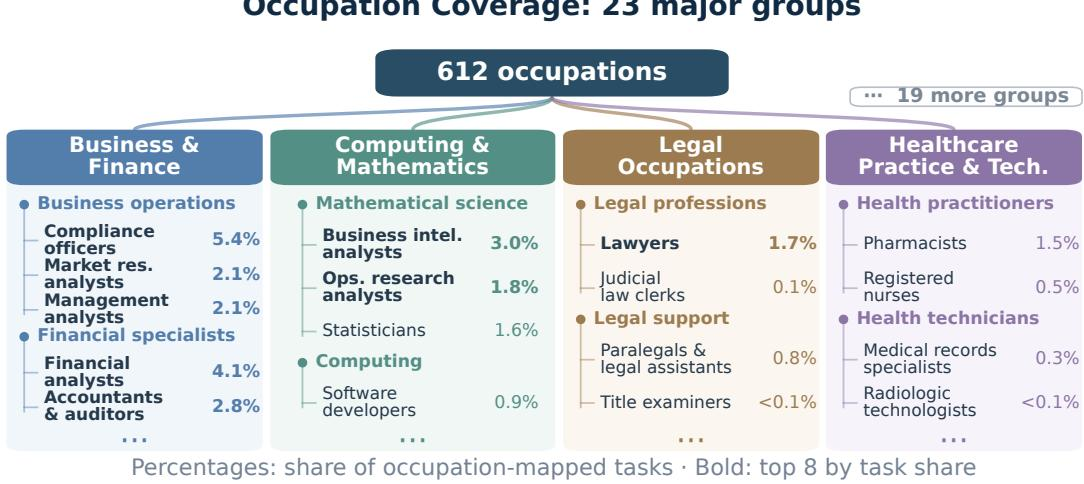
Tasks that pass this rigorous process form the candidate pool for trajectory collection. An independent teacher model attempts each task in a clean sandbox, generating interaction traces and deliverables. The authors apply lightweight filters to remove rollouts with repeated reasoning or insufficient deliverables. For the longest rollouts, selective rejection sampling is applied based on pairwise deliverable comparisons. The resulting training corpus spans 612 fine-grained occupations across 23 major occupational groups.
The figure below illustrates the distribution of these occupations across major groups such as Business & Finance, Computing & Mathematics, Legal Occupations, and Healthcare Practice & Technology.
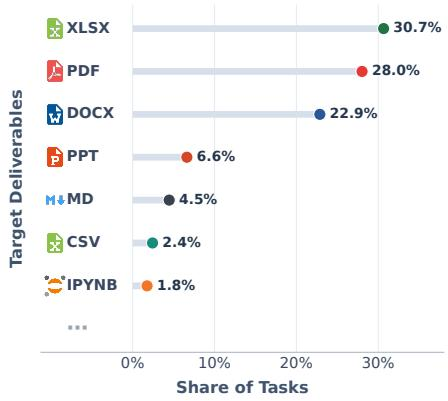
Finally, the target deliverables in the training corpus encompass a variety of file formats. The distribution of these file types is detailed in the following figure, showing a prevalence of spreadsheet, document, and presentation formats.
Experiment
The experiments compare WorkPilot models fine-tuned on WorkFactory synthetic trajectories with their matched base models and with frontier and open-weight baselines on professional-work benchmarks including GDPval, JobBench, Workspace-Bench, and OmegaUse-OfficeVal. Fine-tuning improves all tested model scales, with the largest model approaching frontier-level performance, and scaling analyses show model-dependent diminishing returns plus execution length that first expands and then contracts as accuracy improves. Component studies find that information-level planning and execution-based repair reduce task defects and improve downstream training utility, while teacher choice affects gains and WorkPilot models remain on a favorable cost-performance frontier.
The WorkFactory training corpus contains over one hundred thousand tasks spanning hundreds of occupations and dozens of deliverable file types. It provides modest workspace context on average, with roughly four reference files per task and file sizes around one and a half MiB, while some tasks rely on web search instead of supplied references. The corpus covers broad occupational and deliverable diversity, with hundreds of occupations and dozens of file extensions represented. Most tasks include only a few reference files on average, and some provide no references, requiring web search for necessary information. Reference files tend to be small, averaging around one and a half MiB per file.
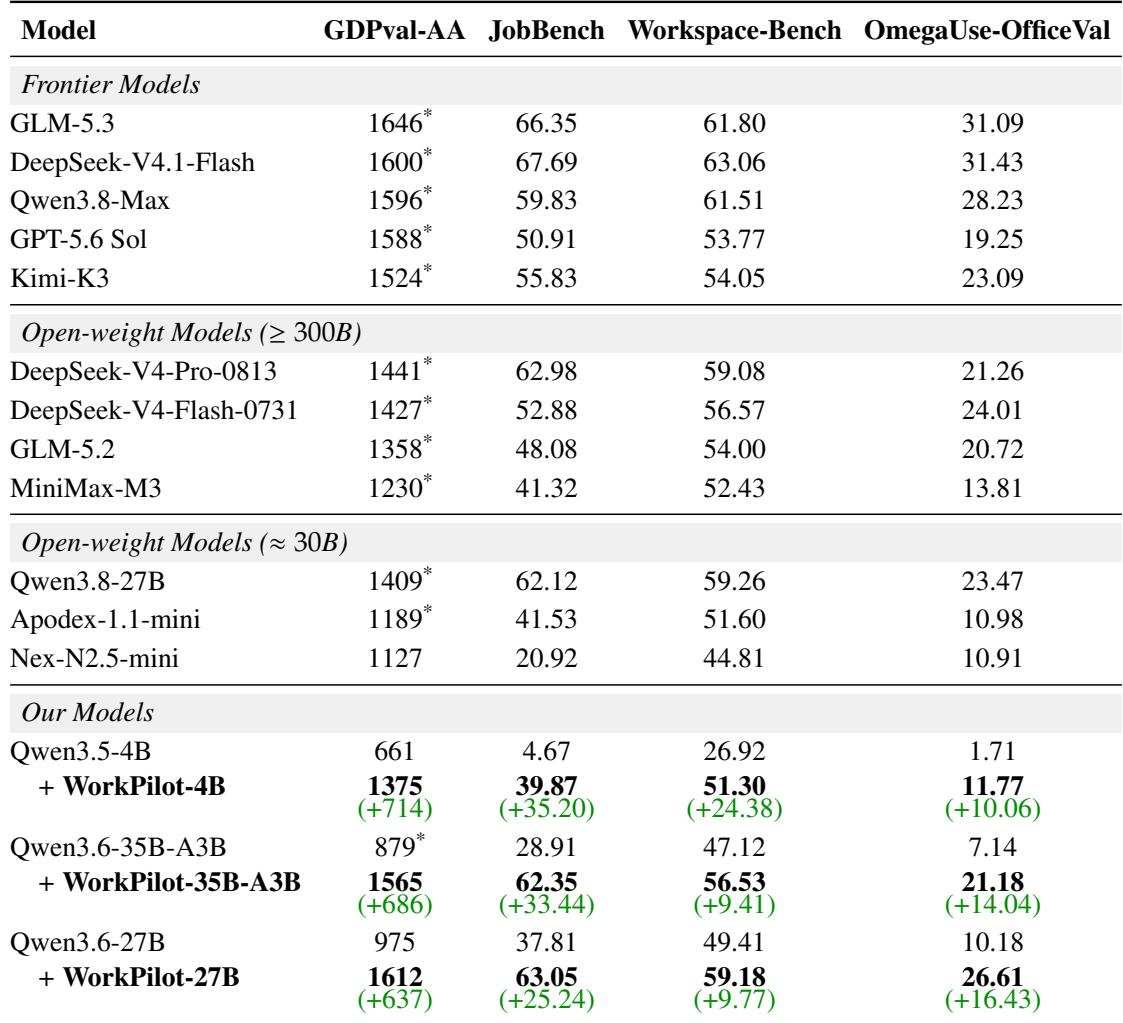
Fine-tuning on the WorkFactory corpus improves all tested base model scales across the four professional-work benchmarks. The resulting WorkPilot models reach frontier-adjacent performance, with the 27B model sitting between DeepSeek-V4.1-Flash and GLM-5.3 on GDPval-AA and the 4B model outperforming a smaller baseline on two benchmarks. WorkPilot-35B-A3B improves over its base model across GDPval-AA, JobBench, Workspace-Bench, and OmegaUse-OfficeVal. WorkPilot-27B exceeds DeepSeek-V4.1-Flash on GDPval-AA and sits just below GLM-5.3, while WorkPilot-4B outperforms Apodex-1.1-mini on GDPval and OmegaUse-OfficeVal.
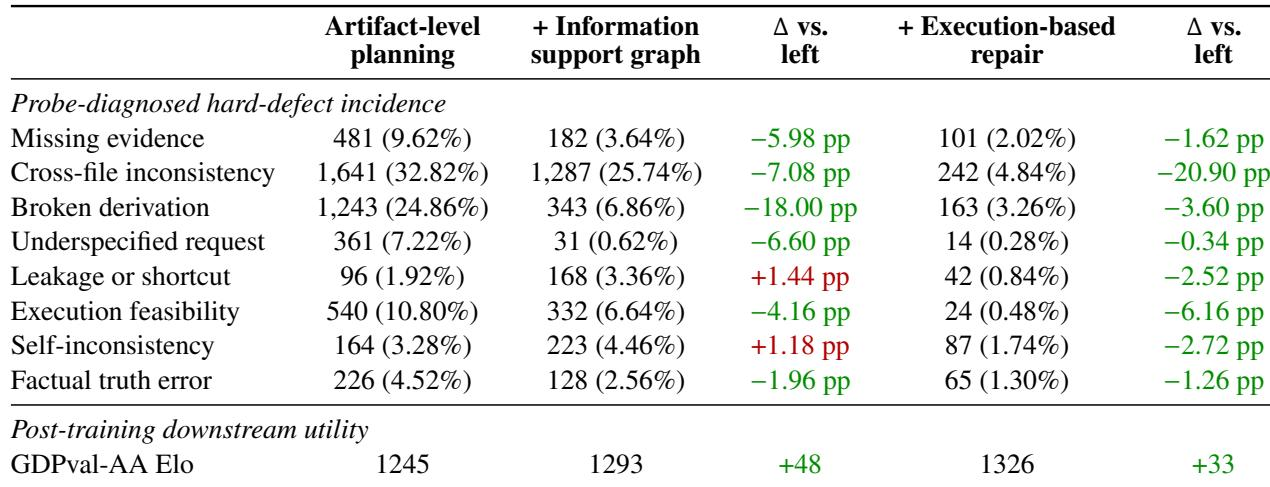
Adding information-level planning reduces probe-diagnosed hard defects in most categories, especially broken derivations and underspecified requests, though leakage or shortcut issues rise slightly. Subsequent execution-based repair reduces reported defects across all categories and yields the highest downstream utility. The improvements in task quality are accompanied by higher GDPval-AA Elo compared with direct artifact-level planning. Information-level planning reduces hard-defect incidence in most categories, with large relative declines in broken derivations and underspecified requests. Leakage or shortcut defects are the exception, increasing modestly when moving from artifact-level planning to information-level planning. Execution-based repair further reduces defects in every reported category and boosts downstream GDPval-AA Elo beyond information-level planning alone.
The WorkFactory corpus covers broad occupational and deliverable diversity with modest workspace context, often relying on small reference files or web search. Fine-tuning on this corpus improves all tested base model scales, and the resulting WorkPilot models approach frontier-level performance across professional-work benchmarks. Information-level planning reduces most hard defects, especially broken derivations and underspecified requests, though leakage or shortcut issues increase slightly. Execution-based repair further reduces defects across all categories and yields the highest downstream utility.