Command Palette
Search for a command to run...
ワークエージェント:システム・能力・最適化
ワークエージェント:システム・能力・最適化
概要
基盤モデルが情報生成からデジタルワークの実行へと進化するにつれて、エージェントはツール、アプリケーション、ワークフローを横断して複雑なタスクを遂行する能力を高めている。しかし、エージェントが委任された作業をどのように信頼性高く達成するかについて、既存研究には統一的な視点が欠けている。このギャップを解消するため、本論文では、ワークエージェントを、基盤モデルとランタイムハーネスを組み合わせ、状態を持つワークスペース内でタスクを実行し検証可能な成果を提供するシステムとして捉える、作業中心のシステムレベルの視点を提示する。我々は、作業条件を特徴づける2つの相補的な次元として作業持続性(work persistence)と作業開放性(work openness)を導入し、タスクの範囲と編成に応じてデジタルワークを5つの形態に分類する。この枠組みに基づき、信頼性の高い作業実行に必要とされる5つの中核的能力群を特定し、モデル最適化、ハーネス最適化、およびそれらの統合的最適化へのアプローチを検討する。さらに、作業成果の観点から既存の評価手法と指標を分析する。最後に、持続的な作業委任、開放環境への適応、作業実行と能力向上の相互作用など、今後の研究方向性を議論する。本論文は、ワークエージェントを理解・最適化・評価するための統一的枠組みを提供し、信頼性が高く、検証可能で、実用的価値のある作業成果を提供できるシステムの開発を支援する。
One-sentence Summary
Researchers from Shanghai Jiao Tong University and collaborating institutions propose a work-centric, system-level framework that treats work agents as systems combining foundation models with runtime harnesses, introduces work persistence and work openness dimensions, classifies digital work into five forms, identifies five core capability families, and analyzes model, harness, and joint optimization along with outcome-focused evaluation to support reliable, verifiable work execution.
Key Contributions
- The paper presents a work-centric, system-level framework that treats work agents as systems combining foundation models and runtime harnesses to execute tasks in stateful workspaces and deliver verifiable outcomes, and introduces work persistence and work openness as two complementary dimensions for characterizing working conditions.
- The paper classifies digital work into five forms according to task scope and organization, identifies five core capability families required for reliable work execution, and examines model optimization, harness optimization, and their joint optimization.
- The paper analyzes existing evaluation methods and metrics from the perspective of work outcomes and discusses future research directions including sustained work delegation, adaptation to open environments, and the interaction between work execution and capability improvement.
Introduction
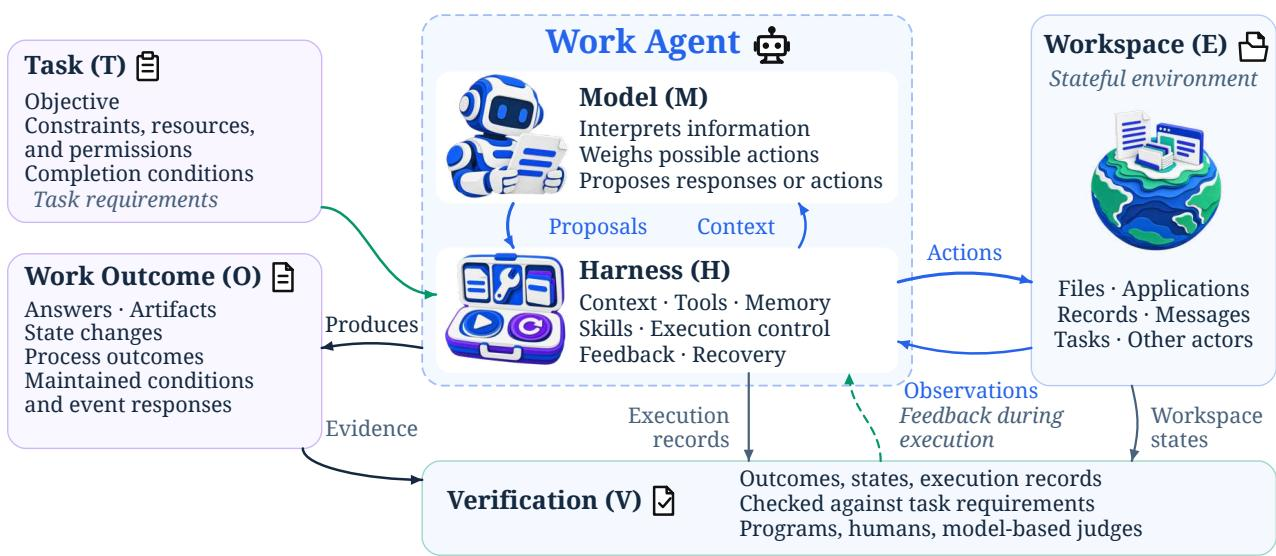
The authors situate the work in the shift from short, narrowly scoped agent tasks to delegated digital knowledge work across software engineering, office productivity, enterprise operations, and scientific research. In these settings, agents must maintain objectives over multiple stages and ground decisions in evidence spread across files, applications, and earlier actions, so isolated model outputs or individual tool calls are not a sufficient unit of analysis. Prior paradigms such as long-horizon, computer-use, and office agents each emphasize only one facet of this process, leaving gaps in how to represent persistent delegated responsibility, open or under-specified task conditions, and verifiable work outcomes. To address this, the authors propose a work-centric framework built around the concept of a work agent, defined through six interacting elements (task, model, harness, workspace, work outcome, and verification), and introduce work persistence and work openness as organizing dimensions for capabilities, optimization, evaluation, and sustained delegation.
Dataset

The authors describe a family of workspace-level benchmark and training resources rather than one fixed dataset. The main data artifacts are work environments, corpora, trajectories, and validation checks.
Sources and composition
- Source materials include documents, spreadsheets, message histories, code repositories, linked business records, public source files, tutorials, enterprise schemas, mobile interface transitions, and completed work artifacts.
- The authors build tasks around dependencies across files and applications, so agents must locate relevant objects, retrieve pages, compare sources, or derive results from multiple materials.
- Named example resources include:
- Workspace-Bench: tasks require identifying relevant objects and their dependencies across heterogeneous workspace content.
- GraphForge: represents evidence across retrieved files as a graph, then generates instructions and source-linked rubrics; it retains 2,169 training trajectories from 2,153 selected tasks.
- WorkGenesis: builds occupational requests using public source files and synthesized companion attachments.
- OfficeQA Pro: full-corpus tasks require finding the pages needed to answer a question.
- DRBench: application-based tasks require retrieving enterprise material for a research report.
- ViDoRe with ColPali: retrieval can require reading page charts and layouts.
- daVinci-Env: reconstructs software tasks from repositories.
- Spreadsheet-RL: uses paired workbooks and an Excel runtime.
- WorkForge: starts from expert workflow plans, retrieves real files, and identifies facts that guide instructions, solution plans, and checks; it constructs 16,665 tasks.
- WorkBorne: organizes tasks around artifact transitions, producing 7,882 task environments and 15,485 trajectories from 1,061 artifact corpora.
- CoworkEnv: jointly generates requests, service records, completion checks, and permitted actions, then validates consistency before collecting teacher trajectories.
- CompoWorld: builds reusable multi-service environments with typed states, common interfaces, and sampled dependency graphs.
- AgentTrek, EnterpriseLab, TDScaling, and SEE: collect web interaction, enterprise tool dependency, business scenario, and mobile interface transition trajectories.
Task and metadata schema
- Each training task typically includes an initial workspace, available actions, a request, and checks for evaluating results.
- Tasks are grounded in work materials through workflows, evidence graphs, source-linked rubrics, or artifact transition references.
- Task, workspace, and trajectory identifiers are preserved for coverage analysis and data splits based on shared sources.
- Shared and changing state is represented in several resources, such as updated customer records, revised workbooks, stateful users, and multi-service dependencies.
Processing and filtering
- Pipelines validate that a task can be completed and that the verifier accepts correct results while detecting errors.
- WorkForge combines programmatic and semantic checks; in a matched 1K-trajectory setting, combined checks reach an ALE score of 22.11, compared with 15.62 for semantic-only and 14.89 for programmatic-only selection.
- GraphForge uses a corruption audit: deleting a worksheet reduces the target rubric score by 0.377, while finer row-level, numerical, and citation errors change scores by less than 0.03 on a 0 to 1 scale.
- Artifact checks filter for successful outcomes, but failed attempts are retained for recovery and state-tracking examples.
- Data selection is also evaluated through downstream training, with methods such as OpenThoughts-Agent comparing task sources, teachers, data mixtures, and filtering under matched token budgets, and CurateEvo using development-set failures to improve augmentation and filtering.
- Construction and development data are kept separate from held-out evaluation tasks. When tasks share files, splitting by workspace or source family is used to test generalization.
How the data is used
- The environments provide tasks for interaction, corpora provide relevant knowledge, and trajectories record observations, actions, and results for supervised fine-tuning and reinforcement learning.
- CoworkEnv teacher demonstrations are used for SFT, improving mean Claw-Eval score from 46.6 to 64.1, while the same environments support student RL comparisons.
- WorkForge scales from 1K to 16K training trajectories, improving ALE by 13.0 points and WildClaw by 8.4 points.
- WorkBorne compares broader artifact coverage with more transitions per corpus; broader coverage performs better at 1K, 3K, and 5K trajectories, while both strategies become similar at 8K.
- In CompoWorld, using 1K SFT trajectories with the same backbone and training procedure raises AutomationBench success from 12.83 percent in single-service environments to 33.33 percent in composed multi-service environments.
Method
The authors propose a comprehensive framework for work agents that defines their core capabilities, the forms of work they undertake, and the systematic optimization processes required to build these systems.
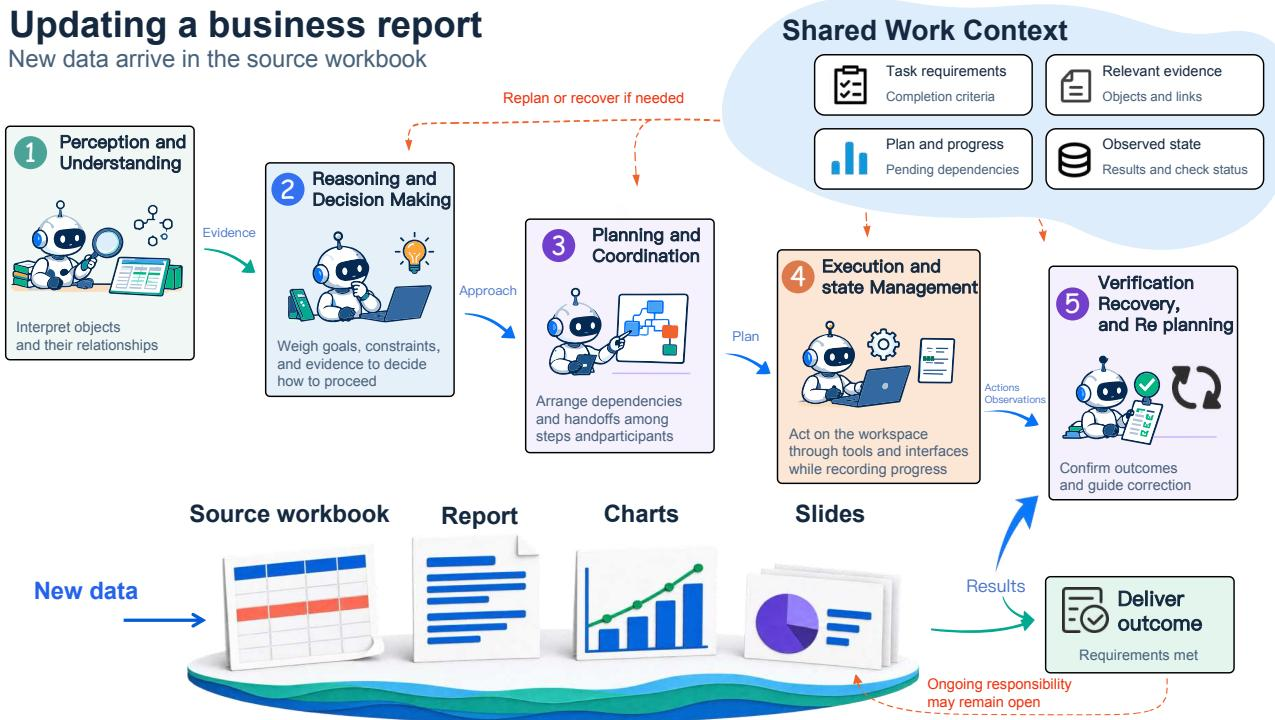
At the foundation of this architecture is a cycle of five core capabilities that agents use to interpret tasks, organize actions, and verify effects. As illustrated in the framework diagram for updating a business report, these capabilities include Perception and Understanding, which interprets objects and their relationships; Reasoning and Decision Making, which weighs goals and constraints; Planning and Coordination, which arranges dependencies among steps; Execution and State Management, which acts on the workspace through tools while recording progress; and Verification, Recovery, and Replanning, which confirms outcomes and guides correction. These functions operate as a cycle rather than a linear pipeline, interacting through a shared work context that retains task requirements, evidence, plans, and observed states.
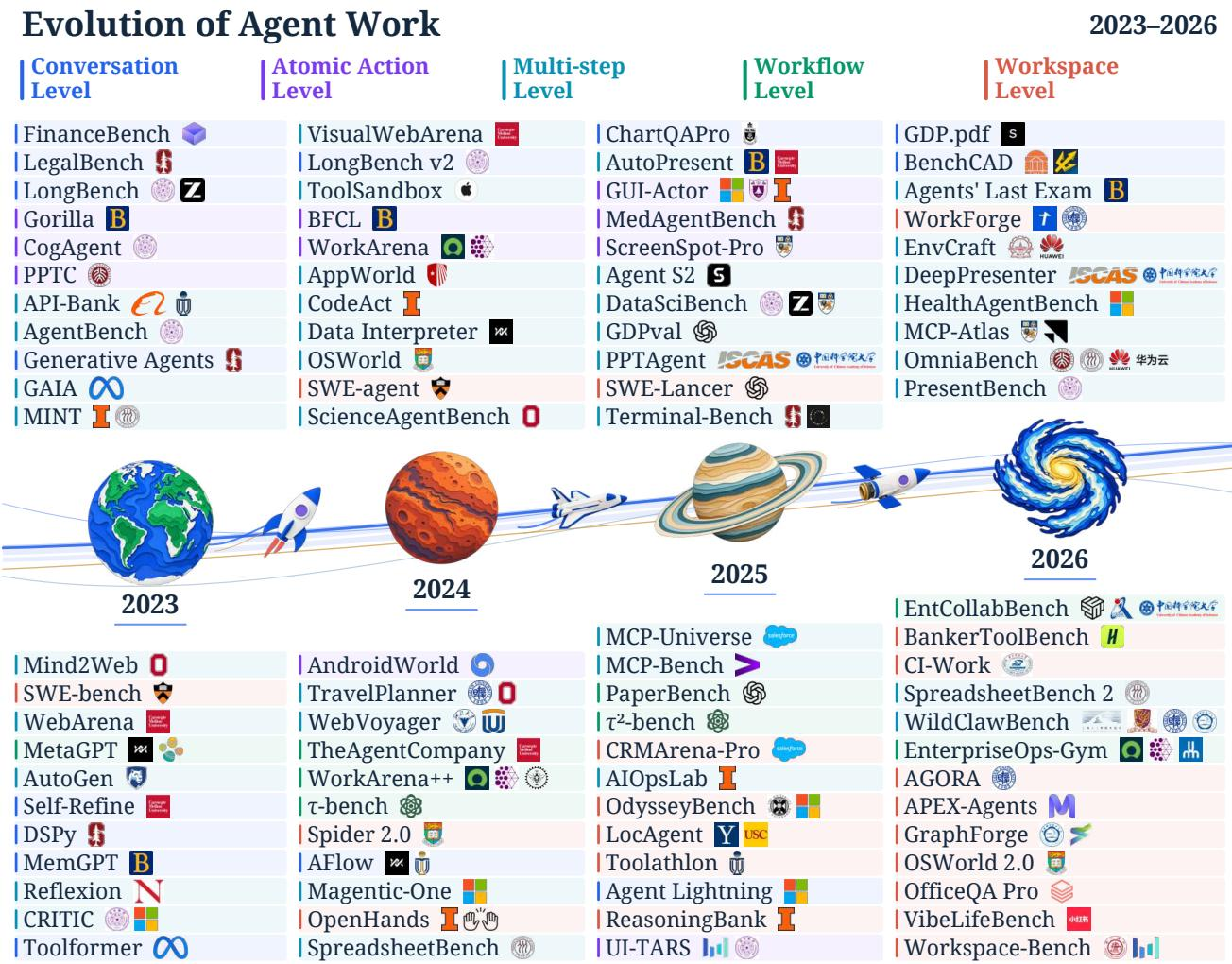
The demands on these capabilities depend on the scope of the delegated work. The authors categorize work into five forms, ranging from the Conversation Level, where the agent produces informational results, to the Atomic Action Level, involving local operations on work objects. The complexity increases at the Multi-step Level, where agents coordinate dependent actions, and the Workflow Level, where the agent advances through procedural stages. At the Workspace Level, the agent must discover and manage relationships across files, records, and applications without explicit specification. As shown in the figure below, representative task settings from recent years are mapped to these broadest required forms, demonstrating the expanding scope of agent responsibilities.
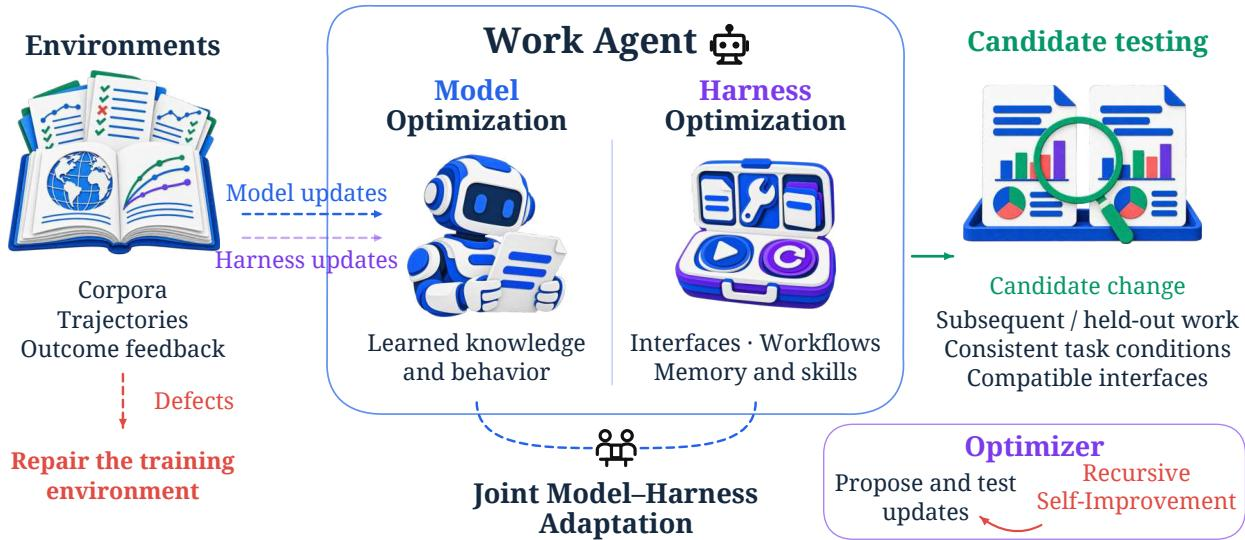
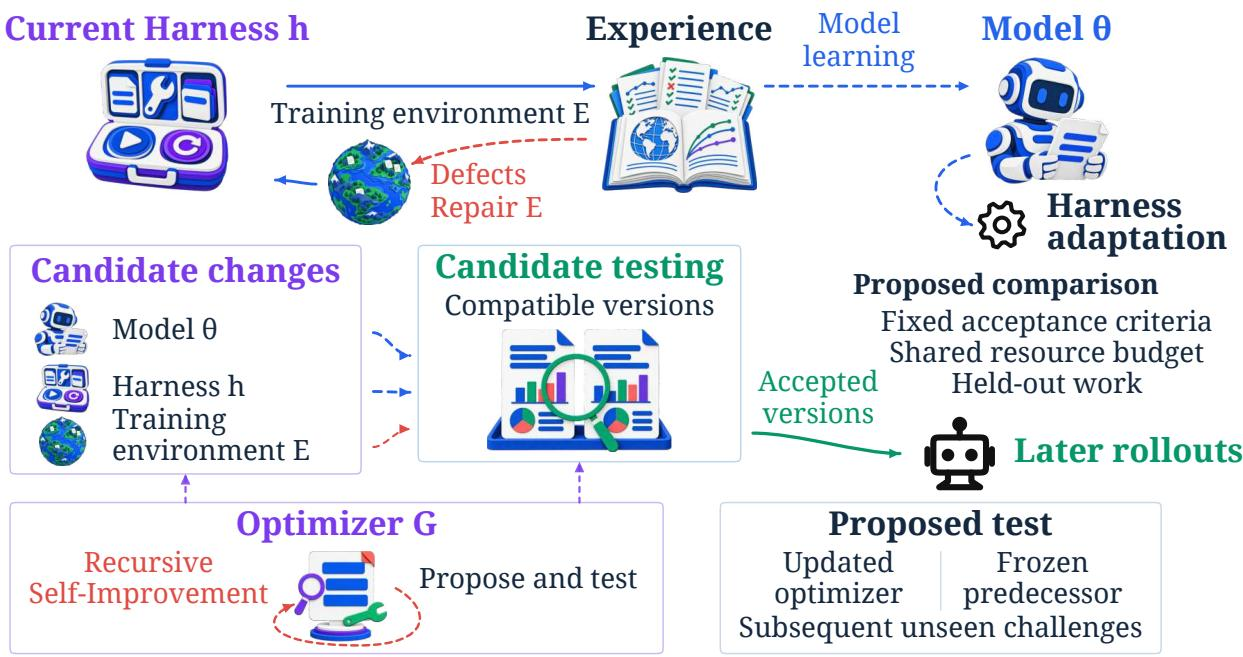
To cultivate these capabilities, the authors present a systematic optimization approach that targets both the model and the harness. As shown in the figure below, training environments, corpora, trajectories, and outcome feedback inform candidate changes to the system. Model optimization updates learned knowledge and behavior, while harness optimization improves interfaces, workflows, memory, and skills. Joint adaptation coordinates changes between the two components, and an optimizer proposes and tests updates, potentially through recursive self-improvement. Defects in the training environment may also require repair before collecting useful trajectories.
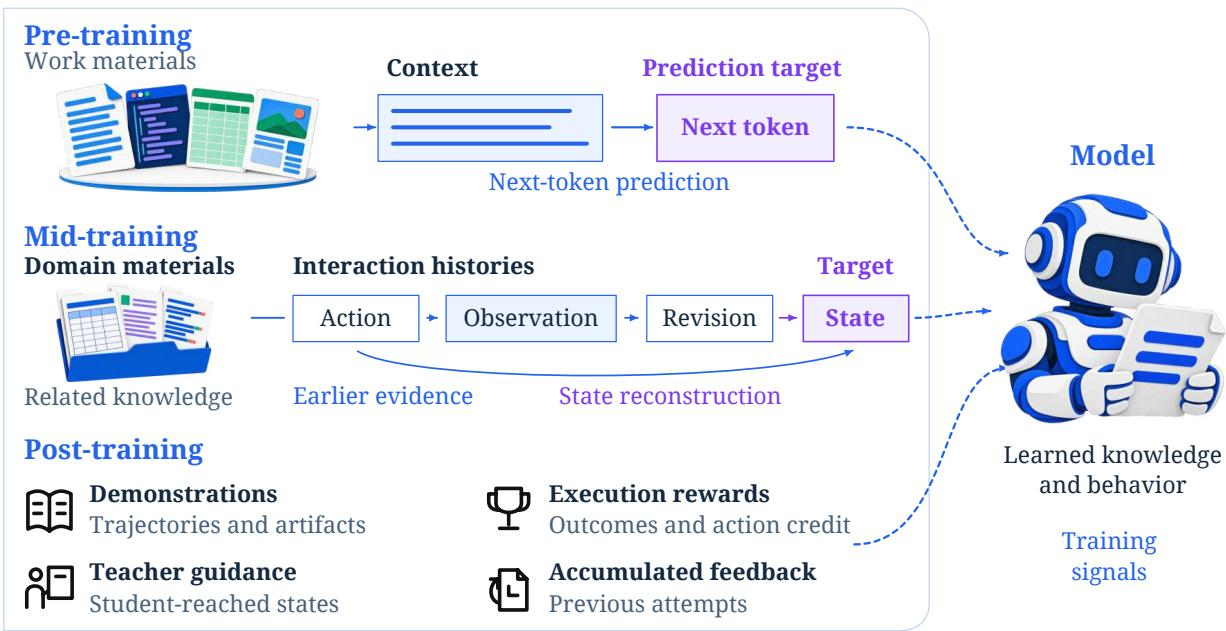
Model optimization develops the necessary knowledge and decision-making capabilities through three distinct stages. As illustrated in the figure below, pre-training builds broad semantic, computational, and visual knowledge using next-token prediction on diverse work materials. Mid-training enriches domain knowledge and introduces interaction patterns and long-context use by processing interaction histories and performing state reconstruction. Post-training strengthens behavior using demonstrations, execution rewards, teacher guidance, and accumulated feedback to supervise decisions, trajectories, and artifacts.
Beyond the model, the harness provides essential external support. Observation and action interfaces determine what the agent can inspect and how it translates decisions into operations. Workflows organize execution, verification, and recovery, while memory and skills preserve task progress and reusable procedures across interactions. The effectiveness of the agent depends heavily on the coupling between the model and the harness. As shown in the figure below, the current harness shapes the experience used to train the model, and model updates can subsequently motivate harness adaptation. An optimizer proposes candidate changes to the model weights, harness configuration, or training environment, testing them against compatible versions and held-out work. This process supports joint model-harness adaptation and recursive self-improvement, allowing the system to evolve its optimization procedures and adapt to changing work conditions over time.
Experiment
These experiments evaluate work agents by constructing benchmarks from expert-designed tasks, real requests, interactive environments, and professional workspaces, then judging outcomes at the answer, artifact, environment-state, or workflow level through rule-based checks, LLM or agent judges, and expert assessments. They validate that final objectives depend on intermediate results across data science, document and artifact creation, travel planning, and operational changes, and that acceptance criteria must match the work object. The findings emphasize that benchmark scores are tied to task construction, harness configuration, verification methods, and cost, so performance should be interpreted alongside execution cost and economic value rather than as an isolated capability measure.
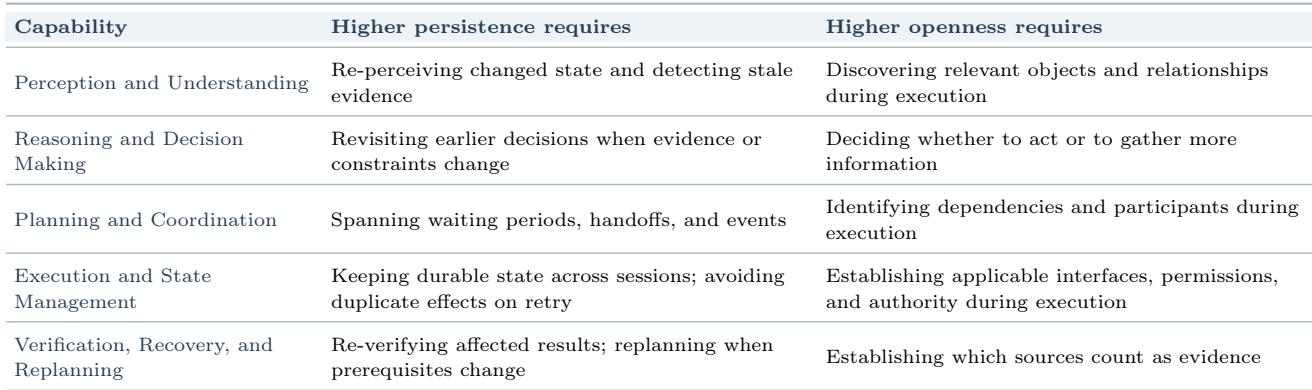
Persistence and openness raise distinct demands across the five core capabilities. Persistence requires capabilities to operate across time: re-perceiving changed state, revisiting decisions, spanning handoffs and events, keeping durable state, and re-verifying affected results. Openness requires discovery during execution: finding relevant objects and relationships, deciding whether to gather more information, identifying dependencies and participants, establishing interfaces and authority, and determining which sources count as evidence. Persistence shifts the core capabilities toward continuity and rechecking, including re-perceiving state, revisiting decisions, spanning waiting periods, keeping durable state, and re-verifying results. Openness shifts the core capabilities toward runtime discovery, including finding relevant objects, choosing whether to act or gather information, identifying dependencies, establishing authority, and selecting evidence sources.
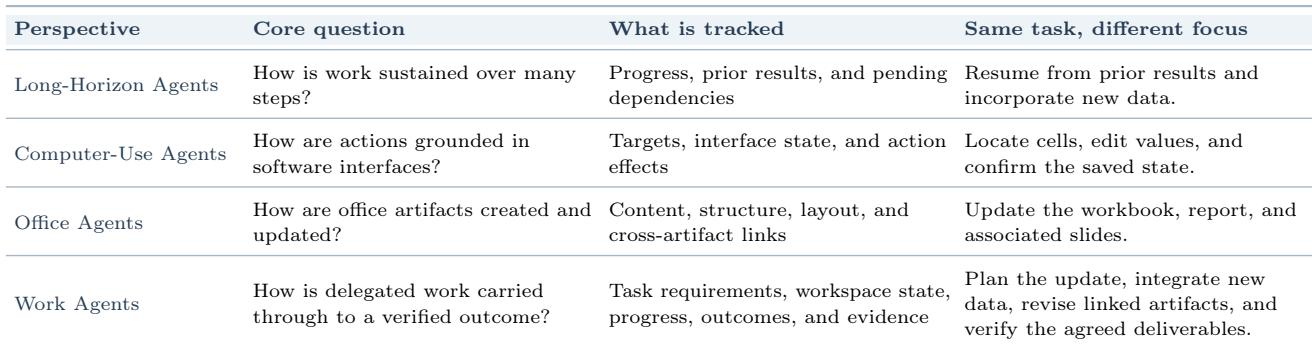
The comparison uses a business-report update task to show how long-horizon, computer-use, office, and work agents each track a different layer of the same delegated work. The related paradigms are complementary and can be combined in one system, with the work-agent view integrating task requirements, workspace state, progress, outcomes, and evidence. Long-horizon agents focus on sustaining work over many steps by tracking progress, prior results, and pending dependencies. Computer-use agents ground actions in software interfaces by tracking targets, interface state, and action effects. Office agents track content, structure, layout, and cross-artifact links when creating or updating artifacts such as workbooks, reports, and slides. Work agents track requirements, workspace state, progress, outcomes, and verification evidence to carry delegated work through to an accepted result. The paradigms are complementary rather than mutually exclusive and can be combined when a delegated task requires multiple layers of tracking and execution.
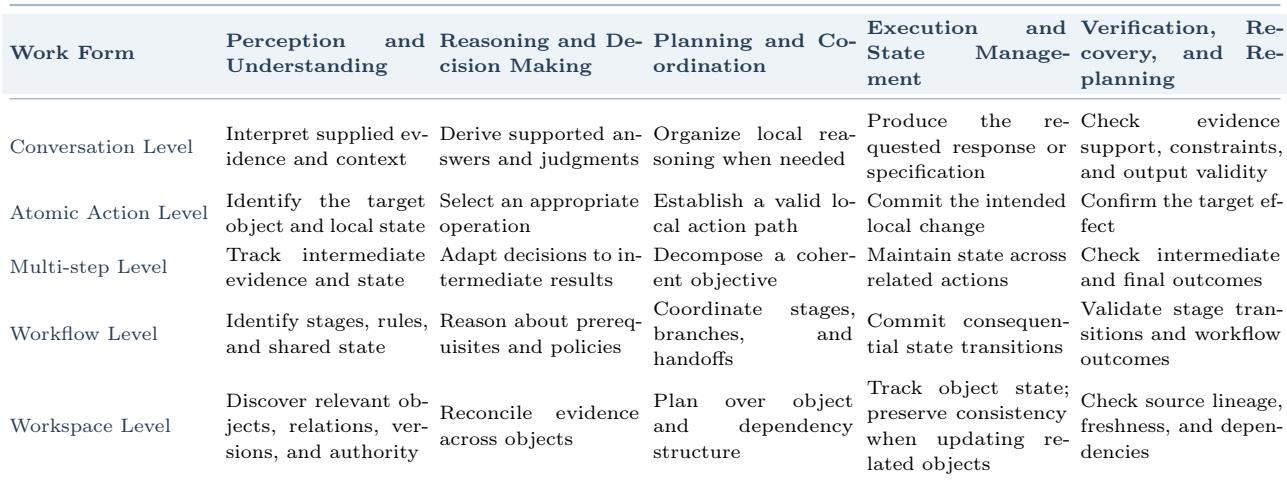
Across the five work forms, capability demands expand from producing a supported response or local change to coordinating multi-step, workflow, and workspace dependencies. Perception, reasoning, planning, execution, and verification shift from local evidence and effects to shared state, procedural rules, and relationships among objects. Verification likewise broadens from checking output validity to validating stage transitions, source lineage, freshness, and dependencies. Capability demands broaden as work moves from conversation and atomic actions to workflow and workspace responsibilities. Perception shifts from interpreting supplied evidence toward discovering relevant objects, relations, versions, and authority. Planning and execution move from local action paths toward coordinating stages, handoffs, consequential transitions, and object consistency. Verification expands from confirming local effects and output validity toward checking stage transitions, source lineage, freshness, and dependencies.
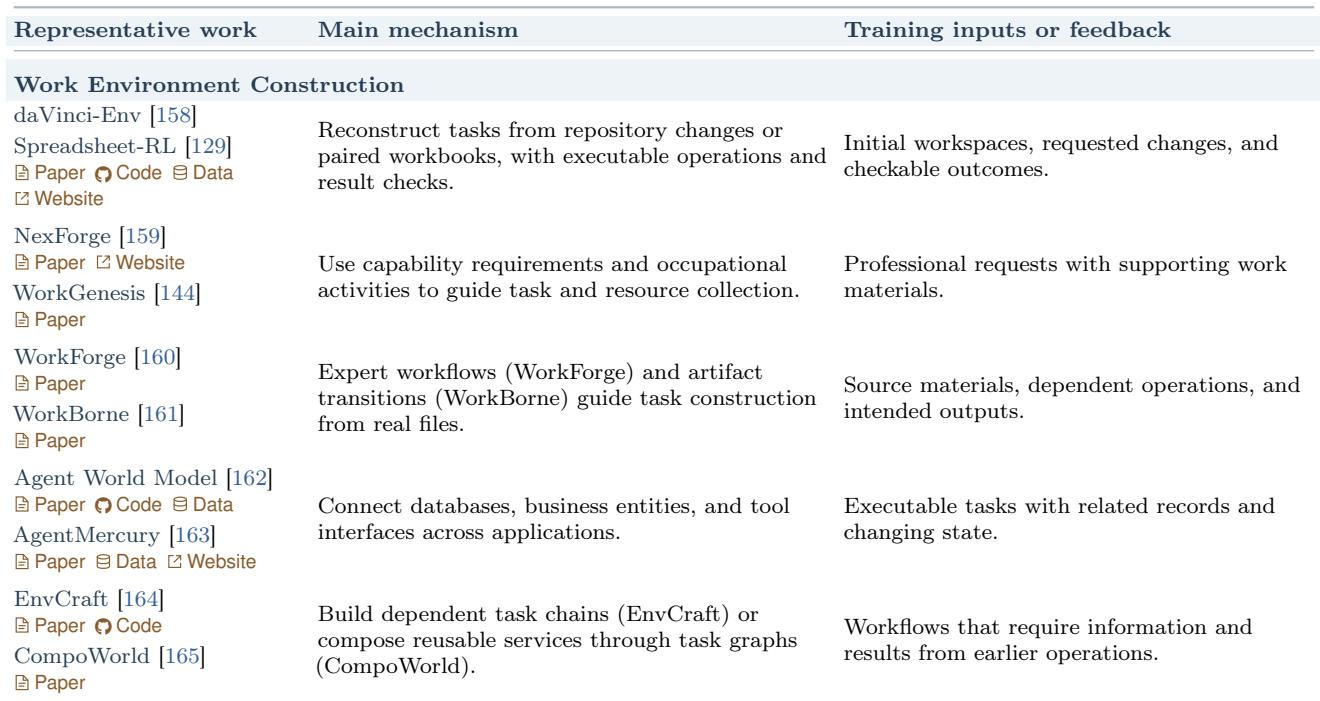
Work-agent experience construction spans several distinct mechanisms: reconstructing tasks from repository or workbook changes, guiding collection with capability requirements and occupational activities, leveraging expert workflows and artifact transitions, connecting databases and tool interfaces, and composing dependent task chains or service graphs. These mechanisms produce training inputs and feedback such as initial workspaces, professional requests with materials, source files, executable tasks with state changes, and workflows that require outputs from earlier operations. The common emphasis is on executable operations, checkable outcomes, and dependencies among tasks. Some approaches reconstruct tasks from repository changes or paired workbooks and provide checkable outcomes as learning signals. Capability requirements and occupational activities guide task and resource collection in methods such as NexForge and WorkGenesis. Expert workflows and artifact transitions create tasks from real files, yielding source materials, dependent operations, and intended outputs. Several systems connect databases, business entities, and tool interfaces to produce executable tasks with related records and changing state. Dependent task chains and task graphs compose workflows that require information and results from earlier operations.
The compared approaches span constructing or repairing interactive environments and curating demonstrations or trajectories for training. Environment-focused methods add realism through stateful user input, workflow constraints, and diagnosis or repair of incompatible components. Data-focused methods emphasize verified, dependency-preserving, context-rich trajectories and mixtures chosen by downstream transfer. Environment construction ranges from validating requests, records, tools, and checks with a stateful user to replaying and repairing incompatible components under fixed requirements. Trajectory curation tends to favor demonstrations that link instructions to verified actions, preserve data dependencies, include failed attempts, or are filtered by downstream training transfer.
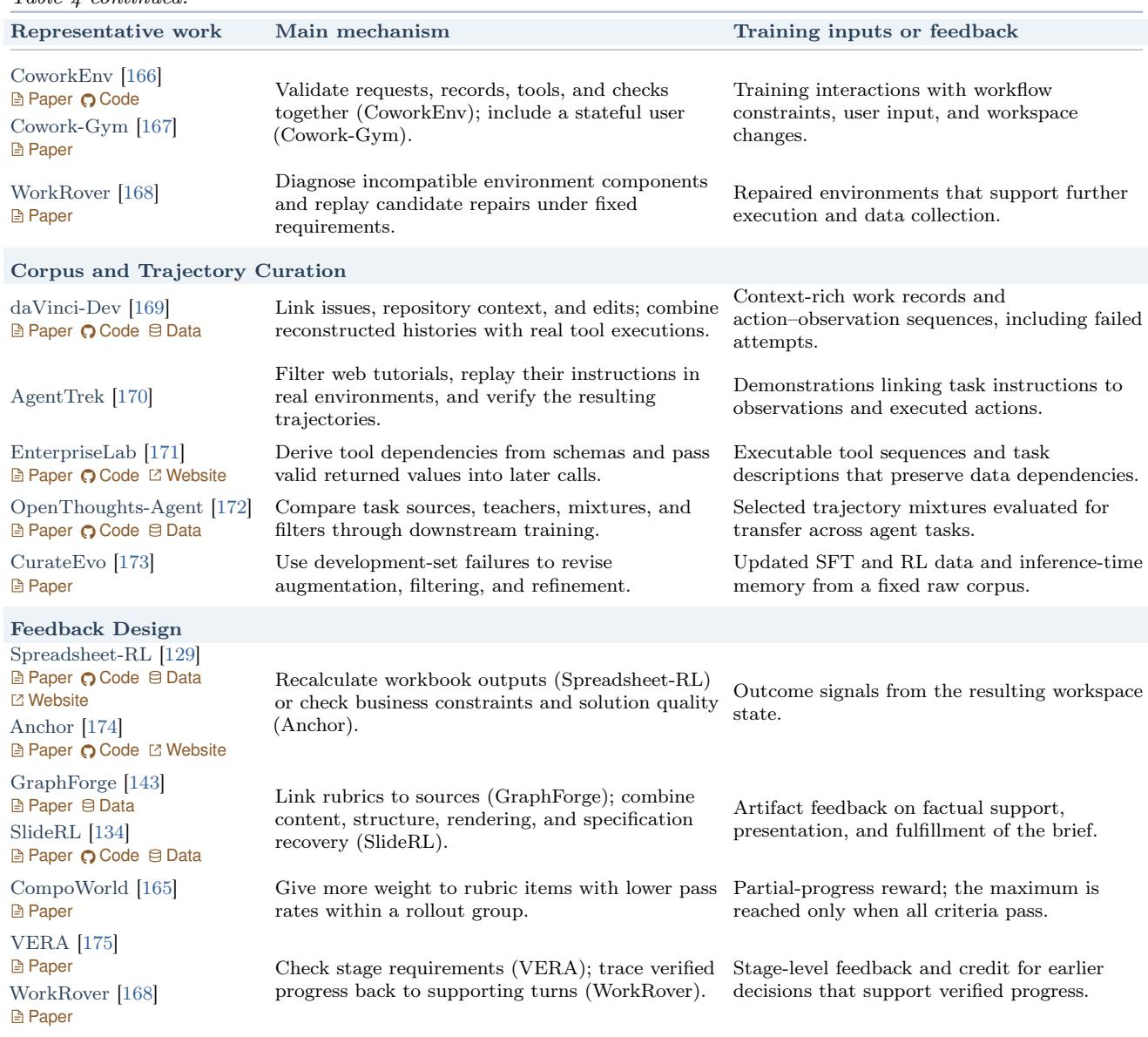
The evaluations use qualitative comparisons across concepts and task setups. One comparison examines how persistence and openness impose different demands on the five core capabilities, with persistence emphasizing continuity and rechecking while openness emphasizes runtime discovery. A business-report update task shows that long-horizon, computer-use, office, and work agents track complementary layers of delegated work, and comparisons across work forms show capability demands broadening from local outputs to workflow and workspace dependencies. Further comparisons characterize mechanisms for constructing work-agent experience and contrast environment-focused realism and repair with data-focused trajectory curation.