Command Palette
Search for a command to run...
物理AIにおける再帰的自己改善に向けて
物理AIにおける再帰的自己改善に向けて
概要
再帰的自己改善(RSI)とは、システムが自身の行動だけでなく、改善を行うプロセスそのものも改善することを指す。近年のデジタルエージェントは、自身のコードを書き換え、各バージョンを実行可能なテストで検証することでこの考え方を試している。こうした仕組みを物理世界へ持ち込むには、コストのかかる試行を通じた部分観測から学習するとともに、変化する動作条件や不可逆的な結果が生じうることを考慮する必要がある。本稿ではRSIをロボット学習の中に位置づけ、ロボットの能力向上から、その能力を生み出すプロセスの向上へと至る経路をたどる。物理的経験がこれらの改善メカニズムをどのように強化できるか、また、そこで得られた利得がメカニズム自体のさらなる自己改善をいつ支えられるかを検討する。利得が引き継がれるのは、フィードバックが残された学習ニーズに対処し、変更を受け取る構成要素がその変更を活用でき、その価値がタスクやハードウェアの変化を経ても持続し、継続的な実践が安全かつ手頃な費用で実施できる場合に限られる。マニピュレーションに集中している既存研究は、行動の改善、その後の学習への便益、手続きの改善を支持している。一部のシステムは改善主体の知識やツールも変更するが、本稿で検討した物理的研究は、再帰に帰属する利得をまだ分離できていない。以上の知見を、試行ごとに自らの改善の仕方を安全に改善する機械に向けた評価原則と研究課題へ統合する。
One-sentence Summary
Researchers from the National University of Singapore, Huazhong University of Science and Technology, Shanghai Jiao Tong University, Nanyang Technological University, and Hong Kong Baptist University position recursive self-improvement within robot learning, trace pathways from improving robot capabilities to improving the processes that generate them, and synthesize existing physical studies into evaluation principles and research directions for machines that safely improve how they improve.
Key Contributions
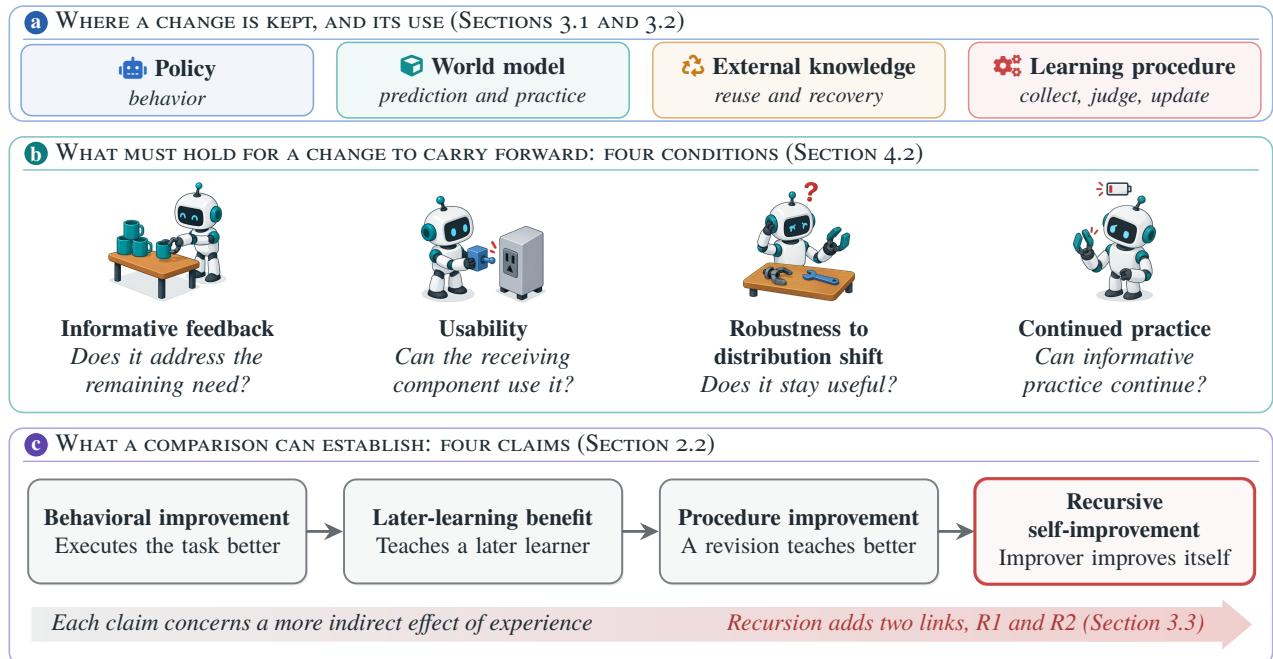
- The paper positions recursive self-improvement within robot learning as a ladder of claims from improved policies, world models, and knowledge to improved learning procedures and improved improvers, and it specifies four conditions for gains to carry forward: feedback addresses remaining learning needs, the receiving component can use the change, value survives task or hardware changes, and continued practice remains safe and affordable.
- Existing physical robot learning studies, concentrated in manipulation, support behavioral improvement, later-learning benefits, and procedure improvement, but no reviewed physical study isolates a gain attributable to recursion.
- The paper contributes evaluation principles and research directions, including controlled comparison against a version of the improver whose acquired knowledge is frozen and evaluation on tasks that the revising system cannot tune against.
Introduction
Robots that learn from physical experience are moving beyond fixed controllers toward policies, world models, and learning procedures that improve with use. This matters because recursive self-improvement would let a robot improve not only its behavior but also the process by which it improves, yet prior work in reinforcement learning, self-training, continual learning, meta-learning, and AutoML typically keeps the outer revision recipe fixed and does not isolate gains attributable to recursion. Physical deployment adds further limits such as costly resets, sparse supervision, wear, distribution shift, and safety constraints. The authors introduce a formal ladder of claims from behavioral improvement to procedure improvement, define two controlled recursion criteria based on frozen-knowledge comparisons, and survey the state of physical robot self-improvement while identifying open problems for verified recursive self-improvement.
Dataset
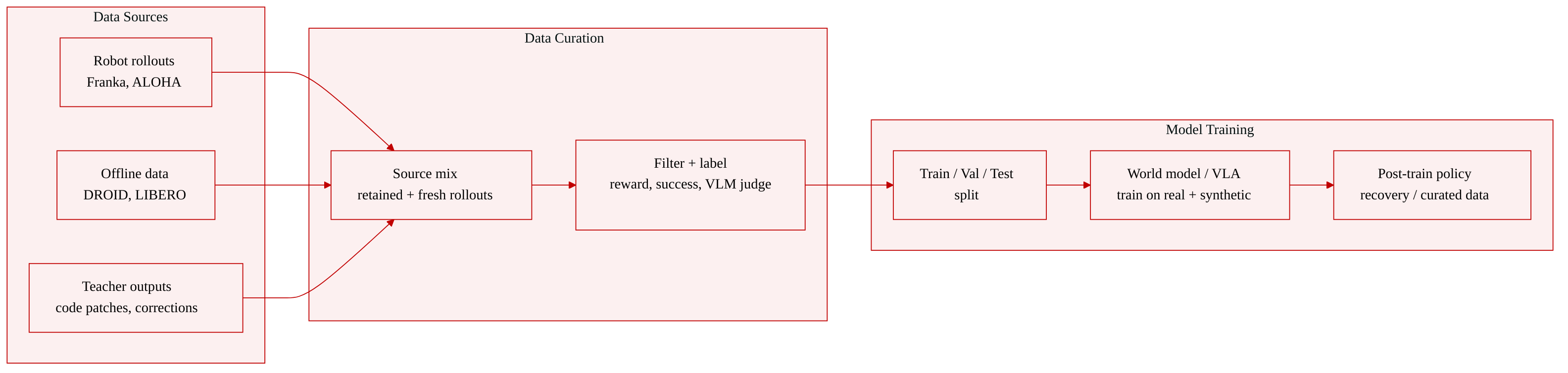
The authors describe training data as a dynamically shaped collection rather than a single fixed corpus. The main sources are robot rollouts, retained offline data, teacher or model outputs, generated labels, and human or expert corrections, with each system applying its own filtering and reuse rules.
-
Sources and composition
- Real robot rollouts: successful, failed, near-success, and recovery episodes from Franka, ALOHA, and other real task setups.
- Offline or benchmark data: DROID, LIBERO, LIBERO-Pro, LIBERO-Goal, RoboTwin 2.0, R2R-CE, and robosuite.
- Teacher and model outputs: specialist rollouts, recovery demonstrations, code patches, VLM-generated language-action pairs, and verified execution traces.
- External corrections: human video used to propose corrective actions at failed states.
-
Key filtering and dataset construction rules
- VLAW combines first-round real rollouts with retained DROID data, uses a reward model to filter imagined trajectories, and trains on reward-filtered imagined successes plus real successes. It uses 50 physical rollouts per task category per round across five real task categories.
- World-VLA-Loop refits its video model and reward head on success and near-success rollouts from each new policy, then restarts the policy. The reported setting covers two real Franka tasks over two rounds.
- WoVR refits its world model on rollouts from an already improved policy under a 2,500-trajectory budget in LIBERO.
- WorldSample refits a video model on accumulating real rollouts and admits synthetic transitions into critic training based on value balance and policy entropy.
- Demo-SCORE trains a success classifier on robot rollouts and removes demonstrations that resemble failures, evaluated on real ALOHA tasks.
- CUPID attributes closed-loop outcomes to individual demonstrations with influence functions and keeps useful demonstrations using 25 curation rollouts on a real Franka task.
- LACY uses one VLM to generate actions, describe them back, and judge agreement, then filters its own generated data with that judge.
- RSI-Nav writes instructions for unlabeled trajectories, keeps those it can follow to the goal, and retrains before labeling the next shard. It uses about 2.5M generated samples for simulated R2R-CE.
- RE-0 admits a stronger teacher’s code patches only when paired rollouts from the same simulator snapshot show a gain. On robosuite restacking, this improves performance from 4/50 to 31/50.
- ConfAL-WM uses a confidence probe to allocate a fixed post-training data budget across tasks and gives larger training weight to frames and image patches where the model is least reliable, evaluated on RoboTwin 2.0.
- Memory Anchors enriches replay with selected old transitions so earlier distinctions remain visible while new behavior is learned.
-
How the data is used
- To train generalist policies from specialist rollouts and to distill specialist recoveries back into a generalist.
- To train world models and VLAs, including closed-loop imagined trajectories and reward-filtered synthetic successes.
- To curate demonstrations or post-train policies, such as recovery-augmented post-training of a policy checkpoint on LIBERO-Goal.
- To support iterative self-training loops in which a policy or VLM labels, filters, generates, and retrains on new data.
-
Processing and metadata details
- The text does not describe image cropping, but it does describe selection-weighted training: ConfAL-WM weights image patches by confidence, and Memory Anchors selects old transitions for replay.
- Data schemas vary by system: language-action pairs for LACY, instructions for RSI-Nav, action-video pairs for RIWANav, success and near-success labels for reward filtering, and paired rollout outcomes for RE-0.
Method
The authors review mechanisms for physical self-improvement by categorizing what a system actually changes. This framework follows a hierarchy where experience produces a retained change that affects later attempts or learning. A retained change can serve four primary uses: choosing or executing actions, predicting outcomes to supply practice, supporting reuse through saved recoveries, or changing how later data are collected, judged, and turned into updates. These uses are typically carried by policies, world models, external knowledge, and learning procedures, respectively.
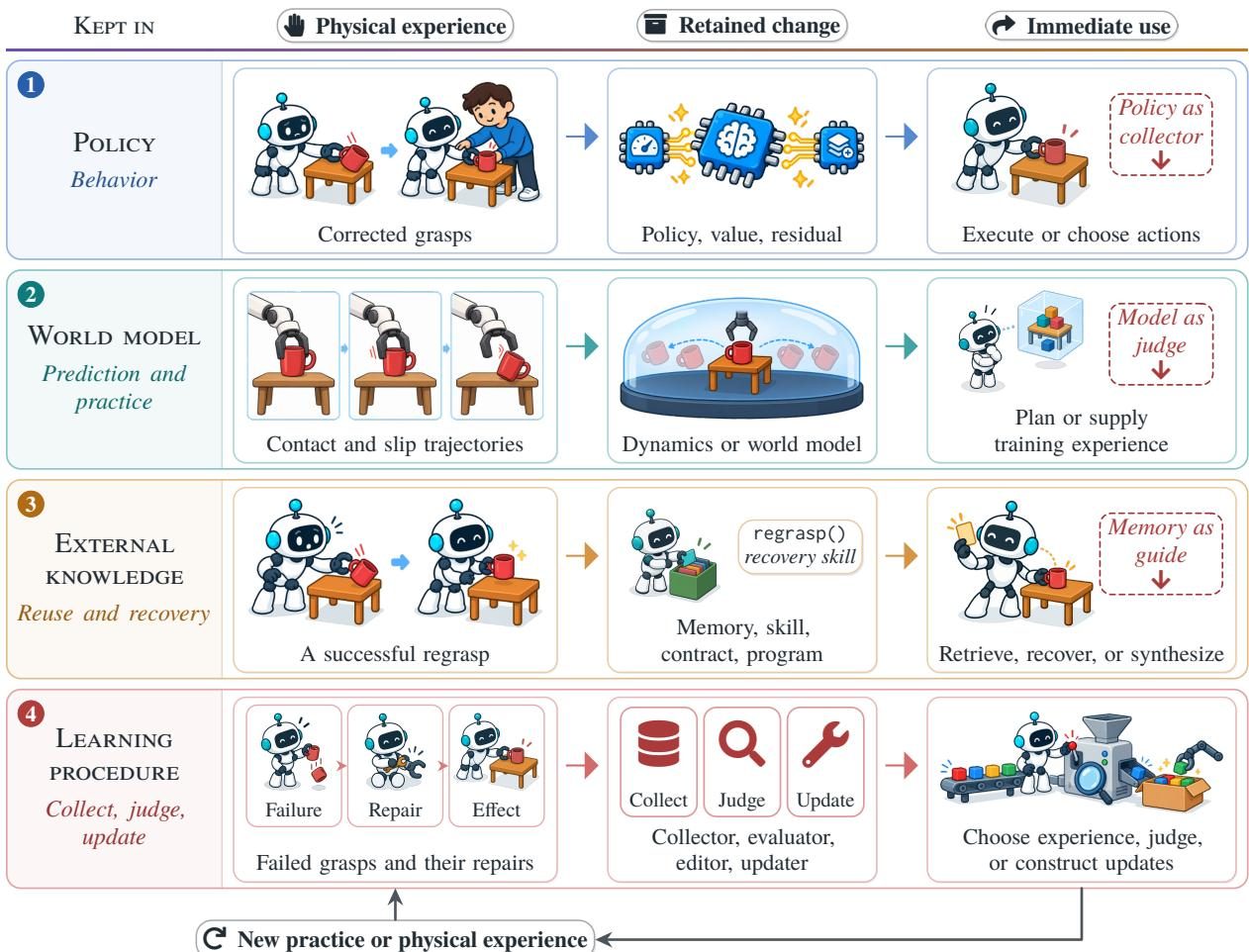
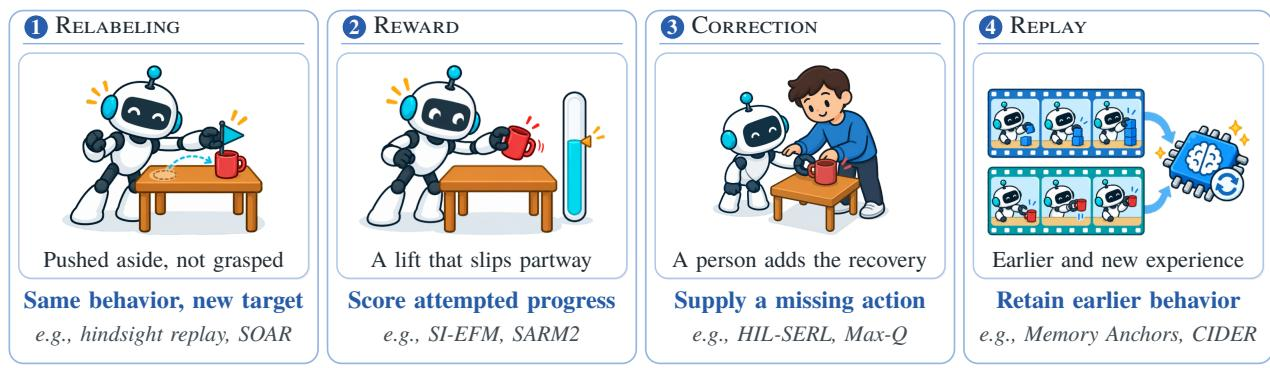
The most direct way for experience to help is to change the policy itself. The authors identify four kinds of teaching signals that recur in this process. Relabeling reinterprets behavior that has already happened, such as treating a pushed cup as a successful push rather than a failed grasp. A reward scores attempted outcomes so optimization can prefer better ones. A correction supplies an action the policy did not take, typically from a human intervenor. Replay reuses earlier experience to preserve or recover previously learned behavior.
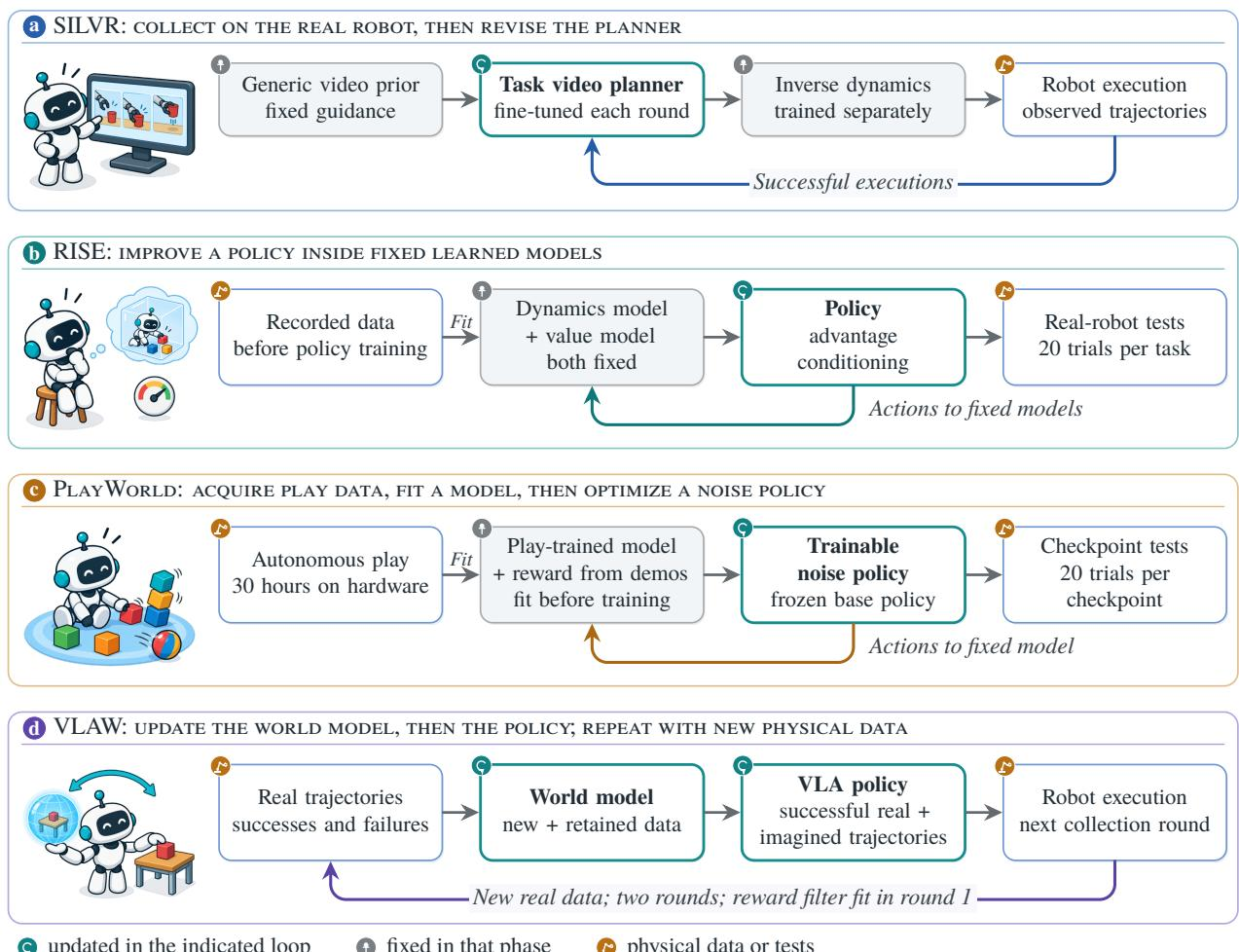
Physical trials are slow and costly, so a natural extension is to learn a world model and practice inside it. A world model predicts how a physical state may change after an action. The prediction can serve as a plan that must be translated into motion, as imagined experience from which a policy is trained, or as predicted features supplied to a policy. Different systems update different components within their learning loops. For example, SILVR collects on the real robot and then revises the planner, while RISE improves a policy inside fixed learned models. PlayWorld acquires play data, fits a model, and then optimizes a noise policy. VLAW updates the world model, then the policy, and repeats the cycle with new physical data.
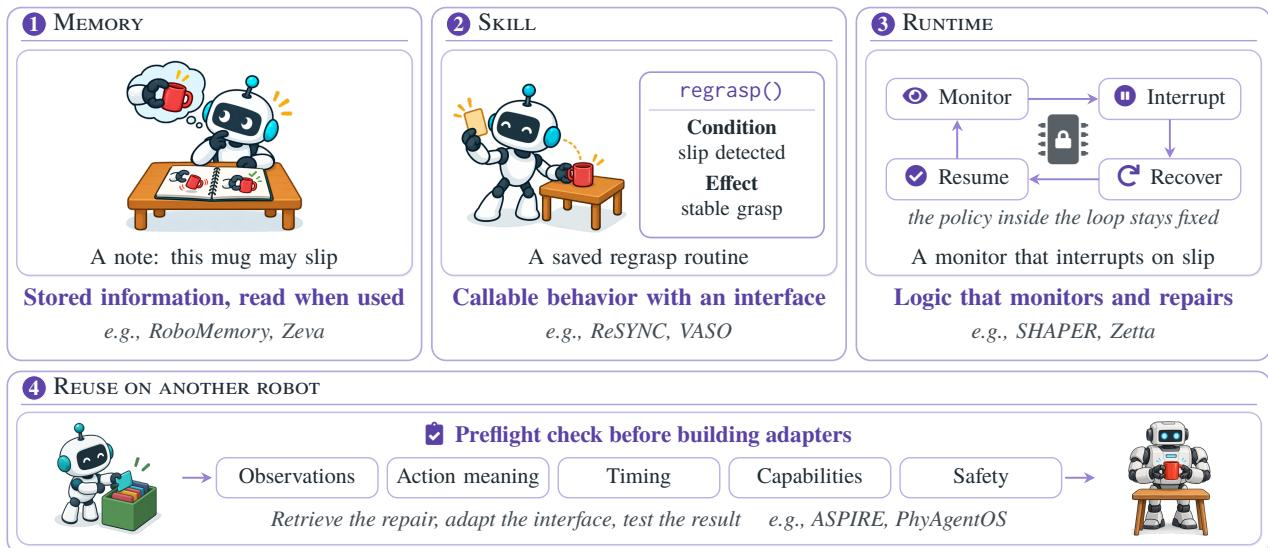
Not every useful change needs to enter a policy weights or a world model. The authors distinguish between memory, skill, and runtime. Memory refers to stored information that must be interpreted when used. A skill is a callable behavior with an execution interface. Runtime or software encompasses the logic that retrieves, composes, monitors, or repairs those behaviors. Reuse on another robot requires checking the interface, observations, action meaning, timing, capabilities, and safety before building adapters.
The changes reviewed above also alter what the next round of learning starts from. An improved policy reaches states that were previously inaccessible, changing the data available for the next update. Along this chain, a change of any form can take on a new role in the learning procedure. Improving that procedure is where recursive self-improvement would begin, because it changes how the robot learns rather than only what it does.
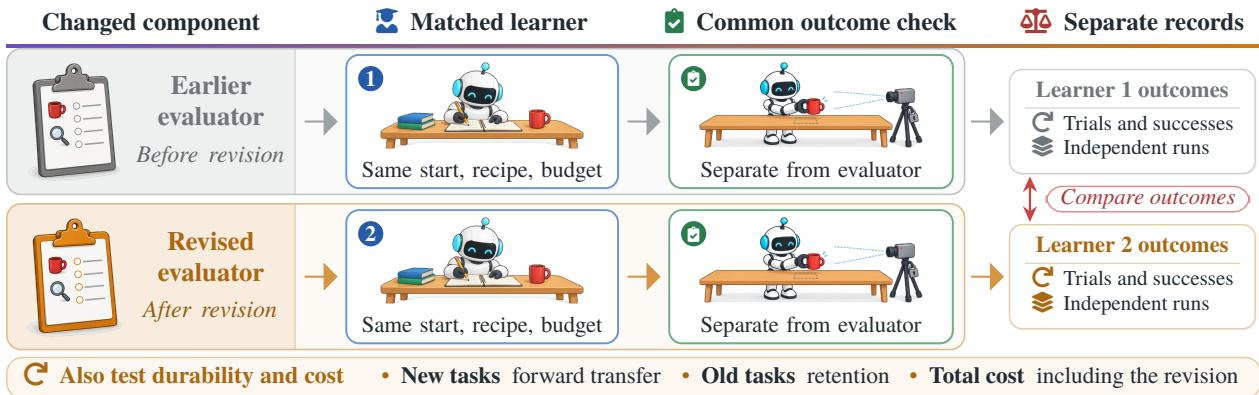
To determine if a revised component actually helps the next learner, the authors propose a matched comparison. Two learners differ only in the component under test, such as an earlier evaluator versus a revised evaluator. Both start with the same recipe and budget. Their outcomes are measured against a common outcome check that remains separate from the evaluator. Comparing the learners outcomes tests procedure improvement, while separate records track trials, successes, and independent runs.
Experiment
The evaluation setup spans simulation suites such as LIBERO, RoboCasa, and RoboDojo as well as study-specific hardware tasks, but most benchmarks assess a system at a single point in time rather than across self-improvement rounds, so claims about improvement require added protocols for held-out tasks, matched learners, independent success judgments, and cost accounting. Experiments on automating physical loops show that coding agents can build reusable infrastructure, revise training code, run rollouts, and transfer procedural knowledge between related tasks, yet their gains mostly establish component level or single-round improvement rather than isolated recursion. The main qualitative conclusions are that self-improvement stalls when collected data stop being informative, when learned models and evaluators no longer cover the improved policy's behavior, when bottlenecks move to other components, when retained knowledge is lost or applied in the wrong context, and when maintenance and infrastructure costs outrun reuse savings. The review therefore identifies protected multi-round evaluation and a shared reporting standard as necessary next steps.
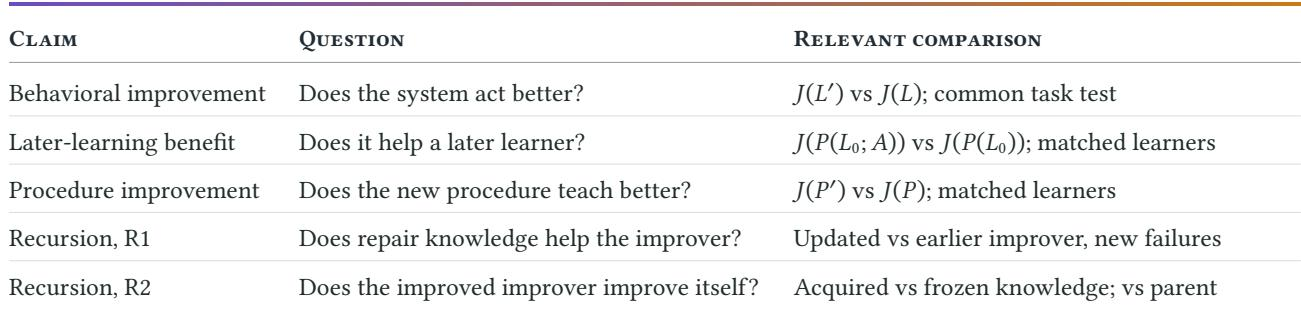
The comparison framework defines the controlled evidence needed for claims about recursive self-improvement. Behavioral improvement, later-learning benefit, and procedure improvement are assessed through matched learners and budgets by comparing task performance, transfer to later learners, and teaching quality of revised procedures. Recursive claims add stronger tests: an updated improver must be compared with an earlier improver on new failures, and the stronger condition requires acquired knowledge to outperform frozen knowledge and the parent improver. Behavioral improvement is tested by comparing later task performance with the original learner on a common task. Later-learning benefit is isolated by giving acquired knowledge to a later learner and comparing against matched learners without that knowledge. Procedure improvement tests whether the revised procedure teaches better than the prior procedure under matched learners and budgets. The stronger recursive condition requires acquired knowledge to beat frozen knowledge and the parent improver, while the basic recursion test compares updated and earlier improvers on new failures.
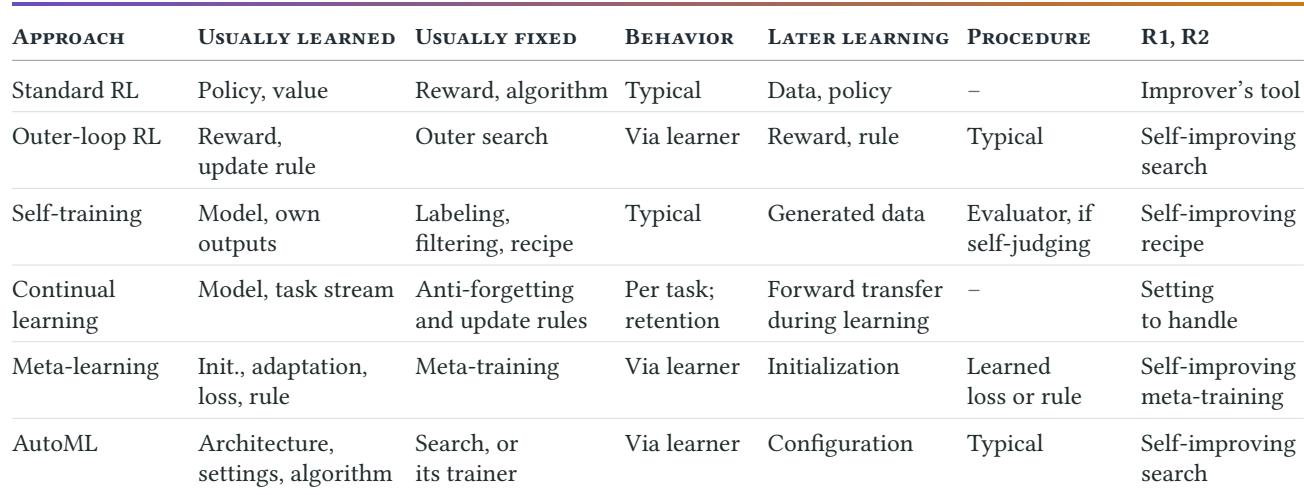
The comparison classifies learning paradigms by what they usually learn, what remains fixed, and which improvement claims they can support. Standard RL and self-training primarily yield behavioral improvement and useful data or policies for later learning, while outer-loop RL, meta-learning, and AutoML more directly enable procedure-level improvement. Continual learning acts mainly as a problem setting to handle rather than a mechanism that revises the improver. Standard reinforcement learning typically improves behavior and supplies data or policies for later learning while keeping the reward and algorithm fixed. Outer-loop reinforcement learning learns elements such as rewards or update rules, making procedure-level improvement a typical outcome. Self-training improves behavior and creates generated data for later learning, but its training recipe stays fixed unless the evaluator is also self-judging. Continual learning is framed as a setting to handle, with per-task performance and retention but no direct procedure-level improvement. Meta-learning and AutoML lean toward procedure-level improvement through learned losses, rules, initialization, or searched training configurations.
The benchmark landscape spans simulation task suites for manipulation, navigation, and household activity, along with component and digital benchmarks that isolate particular self-improvement mechanisms. Simulation supports large-scale mechanism comparisons, whereas hardware evaluations rely on study-specific task suites and vary widely in trial budgets. Most suites assess performance at one point in time; LIBERO's lifelong protocol is an exception because it scores transfer and forgetting across a task sequence. Task suites stress different capabilities, including perturbation robustness, bimanual manipulation, and everyday kitchen tasks. Component and digital benchmarks target prerequisites such as success detection, world-model calibration, training-code revision, and closing the remaining performance gap. Hardware evaluation budgets range from a small number of trials per task to hundreds of episodes, and direct cross-study comparisons are limited by differing tasks, trial counts, and metrics.

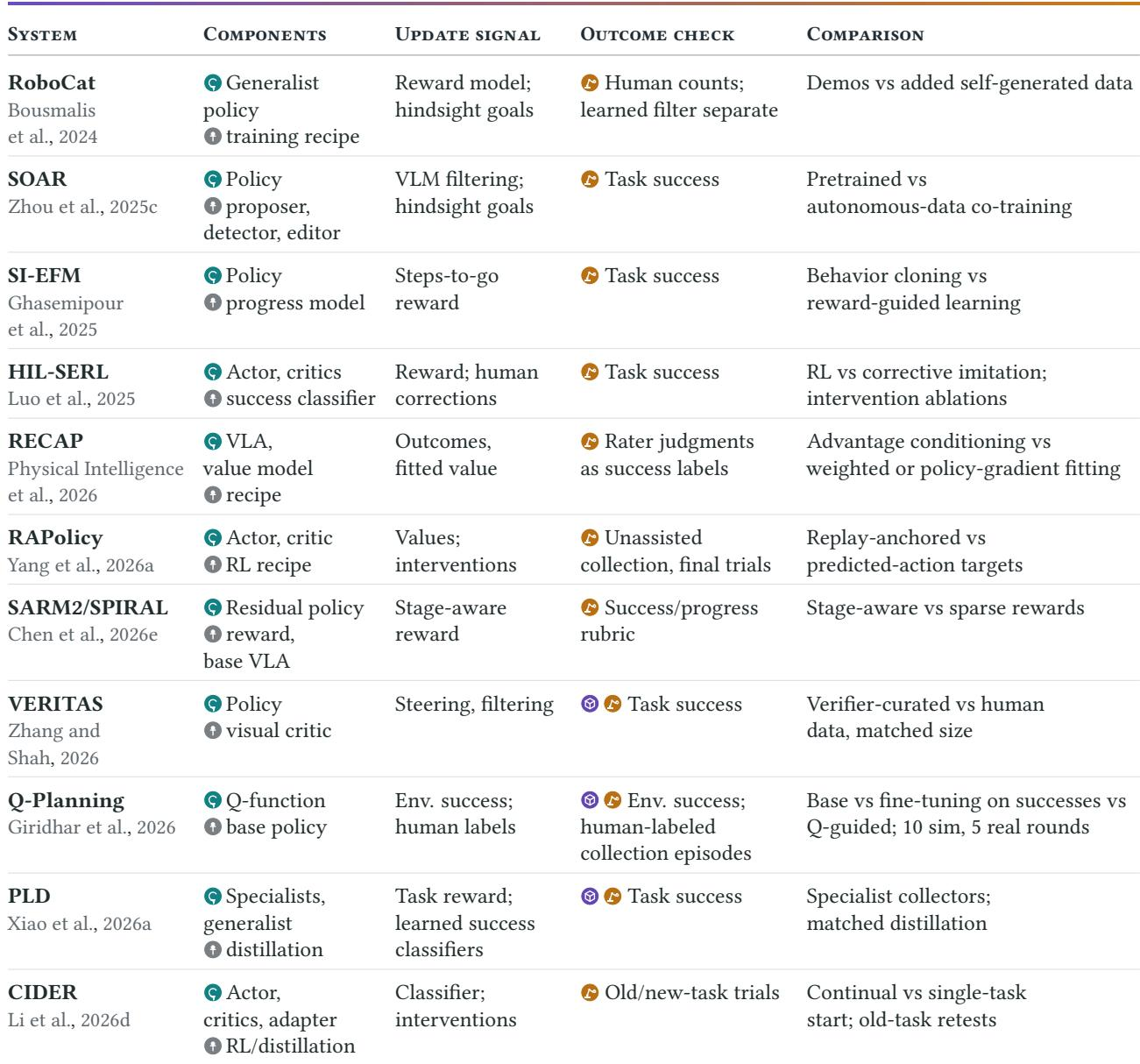
Selected policy-update studies compare learning from demonstrations versus self-generated or autonomous data, reward-guided learning versus behavior cloning, and reinforcement learning versus corrective imitation. Outcome checks rely on task success, human counts, or rater judgments, with learned filters sometimes kept separate from final evaluation. The broader analysis cautions that added autonomous data can saturate or regress, while human demonstrations from failure conditions and corrective signals often provide more useful learning targets. RoboCat compares demonstrations with added self-generated data and separates human outcome counts from its learned filter. SOAR compares pretrained and autonomous-data co-training using VLM filtering and hindsight goals. SI-EFM contrasts behavior cloning with reward-guided learning from incomplete real-robot attempts via a steps-to-go progress model. HIL-SERL compares reinforcement learning with corrective imitation and includes intervention ablations, while RECAP compares value-fitting variants under rater-judged outcomes. Autonomous data can yield gains that saturate or regress, and human demonstrations from prior failure conditions can be more informative than randomly chosen ones. Outcome checks vary in judge independence, and a shared judge used for learning may not reveal systematic errors in its own criterion.
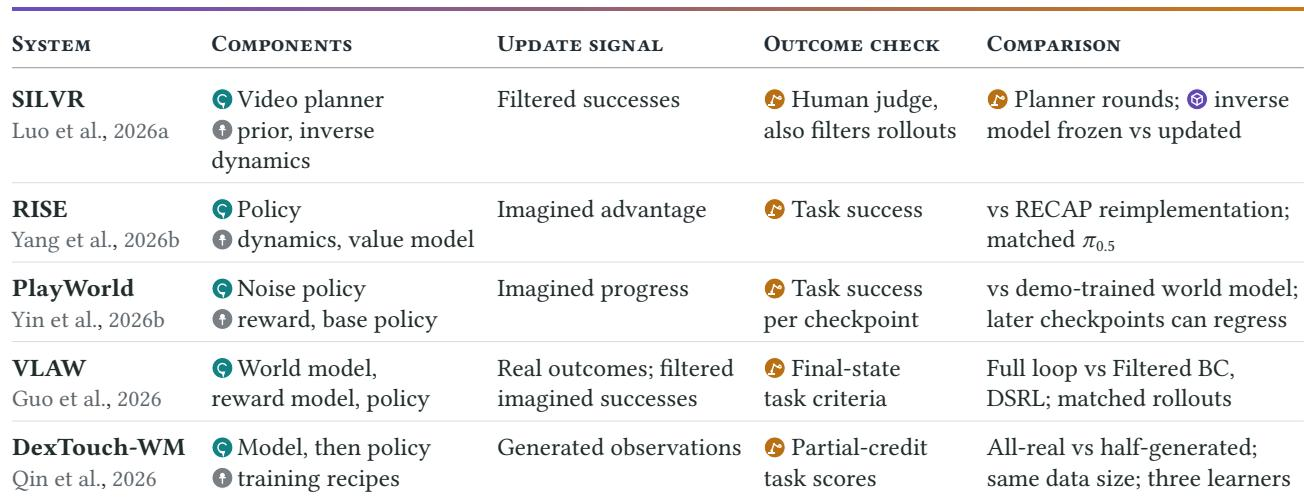
Model-assisted learning systems improve policies through world models, imagined rollouts, or generated observations, but their components, update signals, and outcome checks differ widely. Updating both a video planner and its inverse-dynamics translator improves simulated success over freezing the translator, while gains from optimizing inside learned models do not always transfer and can regress on real tasks. Evaluation protocols vary, with some systems using human judges for both filtering and final outcomes. In simulated manipulation, updating both the video planner and the inverse-dynamics translator improves success relative to freezing the translator. PlayWorld's best reported task improves substantially over its base policy, yet later optimization inside the fitted world model can reduce real success. RISE compares against a matched RECAP reimplementation because the original model version is unavailable. VLAW compares its full loop against filtered behavior cloning and DSRL with matched rollouts, while DexTouch-WM compares all-real and half-generated data at the same data size across three learners.
The comparison framework defines controlled recursive self-improvement evidence by matching learners and budgets across behavioral, transfer, and procedure-level tests. The surveyed paradigms show that standard reinforcement learning and self-training mostly support behavioral and later-learning gains, whereas outer-loop reinforcement learning, meta-learning, and AutoML more directly target procedure improvement. Benchmark and policy-update results indicate that simulation suites and component tests vary widely in protocols, with autonomous or generated data often saturating or regressing while demonstrations from failure conditions and corrective signals remain more informative. Model-assisted learning studies further show that updating multiple learned components can help, but gains from optimizing inside learned world models do not reliably transfer to real tasks.