Command Palette
Search for a command to run...
Épi: 自律的研究のための永続的で自己改善するエージェントを目指して
Épi: 自律的研究のための永続的で自己改善するエージェントを目指して
概要
本研究では、モデルセッションをまたいで調査を持続し、蓄積された経験を通じて手法を進化させる自律的研究エージェントÉpiを提示する。Épiは、永続的な研究履歴、階層的メモリ、分岐、および独立したレビューを組み合わせることで、研究の連続性を保ち、実験から学習し、代替アプローチの探索と再検討を行う。実験はセッション境界をまたいで実行され、固定された検証器がその出力を評価する。Épiは120件の記録更新成果を生み出した。内訳は、12のファミリーにまたがる数値的な界記録20件と、8つのファミリーにまたがる構築記録100件である。これらには、n-queens定数の区間を約84倍狭めた成果と、四次Feigenbaumアトラクタ次元に対する厳密な区間を360万倍以上狭めた成果が含まれる。厳密な双対証憑により、10次元および11次元において、Cohn–Elkies線形計画法の界がsharpになり得ないことが確立された。数値的な改善に加え、Épiは、分裂グラフのうち、8頂点のクリック部分と高々3つの三角形アクティブ近傍タイプを持ち、多重度は任意であるクラスに対するTuzaの予想について、計算機支援証明を与えている。さらに、この研究過程を、車両経路問題、スケジューリング、生産計画などのタスクに対する実行可能なソルバを開発する軽量構成であるÉpi-turboによるアルゴリズムコーディングへ拡張した。30件のFrontierORタスクにおいて、Épi-turboは同一の基盤モデルと推論負荷設定を用いた上で、Codexの64%のモデルコストで、合計ベンチマークスコアを5.4%向上させた。Épiは、計算結果を研究者が検討し発展させられる明示的な手法や数学的議論へと接続することで、人間の理解を支持するよう設計されている。
One-sentence Summary
The authors present Épi, a persistent, self-improving autonomous research agent that sustains investigations across model sessions through research history, hierarchical memory, branching, independent review, cross-session experiments, and a fixed verifier, yielding 120 record-setting results, including 20 numerical bound records and 100 construction records, plus a computer-assisted proof of Tuza’s conjecture for split graphs, while its Épi-turbo configuration develops executable solvers that achieve a 5.4% higher total benchmark score than Codex on 30 FrontierOR tasks at 64% of Codex’s model cost under the same underlying model and reasoning effort.
Key Contributions
- Épi is introduced as an autonomous research agent that sustains investigations across model sessions by coupling persistent research history, hierarchical memory, branching, independent review, and a fixed verifier to learn from experiments and revisit alternative approaches.
- Épi yields 120 record-setting results, including an approximately 84-fold narrower interval for the n-queens constant and a more than 3.6-million-fold narrower rigorous interval for the quartic Feigenbaum attractor dimension. Épi also supplies exact dual certificates showing that the Cohn-Elkies linear-programming bound cannot be sharp in dimensions 10 and 11 and a computer-assisted proof of Tuza’s conjecture for split graphs with an eight-vertex clique part and at most three triangle-active neighborhood types.
- Épi-turbo extends this research process to algorithmic coding, developing executable solvers for vehicle routing, scheduling, and production planning. On 30 FrontierOR tasks, Épi-turbo achieves a 5.4% higher total benchmark score than Codex at 64% of Codex's model cost under the same underlying model and reasoning effort.
Introduction
Autonomous research agents matter for workflows where progress depends on many experiments, program generation, and executable checking, especially in mathematical discovery and algorithmic optimization. Earlier systems show that LLMs can propose code and evaluate it, but they can struggle when research must continue across sessions, convert results into reusable lessons, and explore alternative methods without losing the evidence that made a choice successful or unsuccessful. The authors introduce Épi, a persistent autonomous research agent that uses hierarchical memory, versioned branches, independent review, and a fixed verification protocol to sustain and refine long running investigations.
Method
The authors present Épi, an autonomous research system designed to conduct verifiable investigations and improve its methods through accumulated experience. The overall architecture orchestrates a continuous research loop where an agent explores alternative formulations, executes durable experiments, and submits candidates to a frozen evaluation environment.
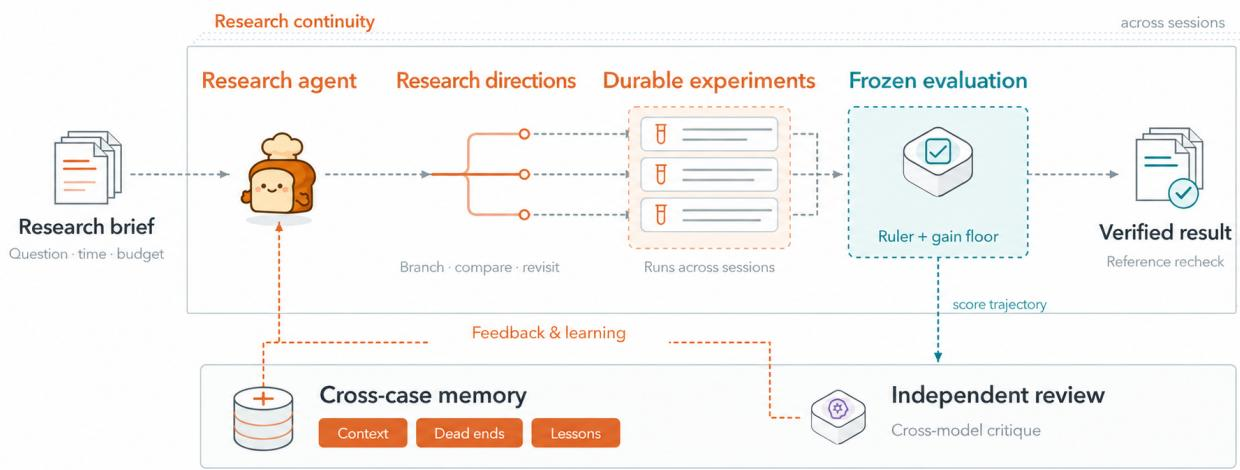
As illustrated in the framework diagram, the process begins with a research brief containing the question, time budget, and constraints. The research agent develops methods on versioned branches, allowing it to branch, compare, and revisit different approaches. These durable experiments run across sessions and feed into a frozen evaluation module. This module applies a strict ruler and a gain floor to produce a verified result, which is then subjected to a reference recheck. The system incorporates a feedback and learning loop driven by cross-case memory and an independent review model.
To ensure consistent validity checks, the authors establish a fixed evaluation rule, termed a ruler, before the search begins. For a minimization problem, the verifier’s feasibility decision is denoted as V(x)∈{0,1}, the objective as f(x), and the reference value as b. The improvement is defined as Δ(x)=b−f(x). The system specifies a positive gain floor δ>0, representing the smallest meaningful improvement. A candidate is accepted when it satisfies both feasibility and the gain threshold:
V(x)=1,Δ(x)≥δ.For maximization tasks, the improvement is defined as Δ(x)=f(x)−b. This rigid evaluation framework ensures that every branch is compared under a shared rule, providing a consistent basis for method comparison throughout the investigation.
The research agent improves its methodology through three core mechanisms: branching, hierarchical memory, and independent review. First, the system maintains versioned branches to develop alternatives while preserving each method’s code and evidence. The agent can backtrack by returning to a saved implementation and trying a different continuation, or it can abandon a branch while recording the reason for later inspection.
Second, Épi leverages a hierarchical memory structure to accumulate and reuse research experience. Short-term memory supports the current investigation, while long-term memory retains experience for subsequent research. The cross-case memory store retains research context, lessons that capture reusable findings, and dead ends that document unproductive approaches. At a session boundary, the agent records its findings and a handover note. A subsequent session retrieves these relevant memory records to guide its next experiment without needing to replay the full history of earlier sessions.
Third, to mitigate the limited perspective of the developing agent, the system employs an independent review model. This separate model assesses the score trajectory, attempted approaches, retrieved findings, and resource use. The reviewer evaluates whether the agent’s interpretation of progress is justified and whether a score increase reflects the intended task rather than reward hacking. The isolated verifier checks the candidate’s validity and gain under the fixed ruler, while the reviewer evaluates the overall research direction.
The execution infrastructure, Breadboard, supports these processes by providing isolated experimental environments and enabling long-running jobs across model sessions. It stores the research history, including code, branch states, and experimental outputs, and runs the fixed verifier. For fast, low-cost algorithm design tasks, the authors introduce Épi-turbo, a lightweight configuration that runs campaigns as continuous sessions, strictly controls model call budgets, and stops the campaign when additional sessions fail to improve the best verified score.
Experiment
Experiments were conducted with frontier language models over bounded budgets, comparing final artifacts against literature or registry baselines across mathematical and optimization tasks. The results show broad record-setting activity in geometric packing, numerical bounds, and specialized constructions, while case studies validate refined packings, a structural limitation of the Cohn-Elkies method, tightened constants, and certified optimization bounds. On the FrontierOR protocol, Épi-turbo generally produced algorithms that balanced solution quality and runtime while using less compute than the coding-agent baseline. Overall, the evaluation supports Épi as a practical research tool for constructing verified mathematical artifacts and designing efficient standalone solvers.
The reported numerical records show tighter bounds across several families, with each entry pointing in its improving direction. Several interval widths are also reduced, indicating more concentrated numerical estimates. The improvements are supported by diverse forms of evidence, including rational witnesses, exact certificates, exhaustive checks, inequalities, and explicit constructions. Several bound families are tightened in their stated improving directions. The supporting evidence is varied, including rational witnesses, dual certificates, exhaustive assignments, integer inequalities, and graph or gadget constructions.
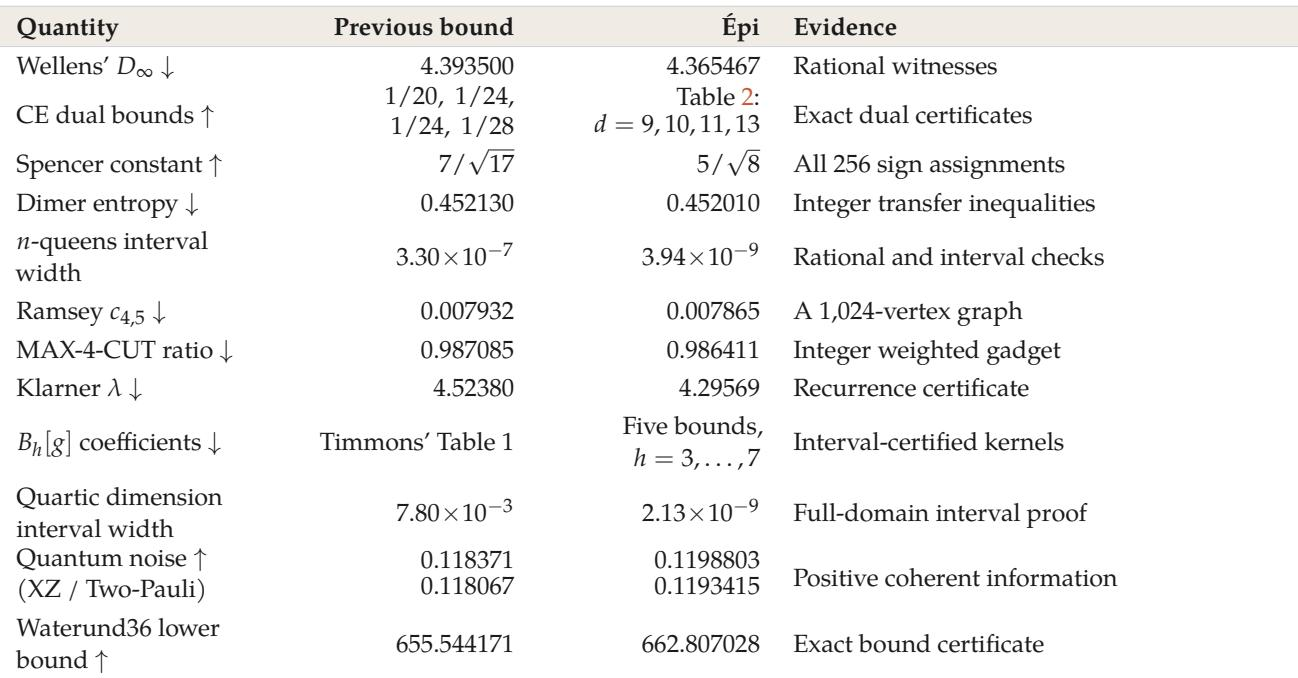
The reported center-density lower bounds from the Épi dual approach improve on the earlier dual bounds in dimensions 9, 10, 11, and 13. In dimensions 10 and 11, the new lower bounds exceed the corresponding packing upper bounds even with conservative rounding, giving a strict separation between packing density limits and the best Cohn-Elkies bound. Dimensions 9 and 13 are included as improved lower-bound cases, but the shown values do not establish the same separation. The new Épi dual bounds are stronger than the earlier dual bounds in every listed dimension. In dimensions 10 and 11, the lower bounds exceed packing upper bounds, showing that the Cohn-Elkies method is not tight there.

On FrontierOR tasks, Épi-turbo achieves a higher overall benchmark score than Codex while using less model budget. Its advantage comes mainly from faster held-out programs and more frequent task-level wins, with gains exceeding losses. The speed advantage also helps offset cases where solution quality is similar or slightly lower. Épi-turbo scored higher on more tasks and produced larger aggregate gains than its losses. Its generated programs ran faster during held-out evaluation, making speed a key source of the score difference.
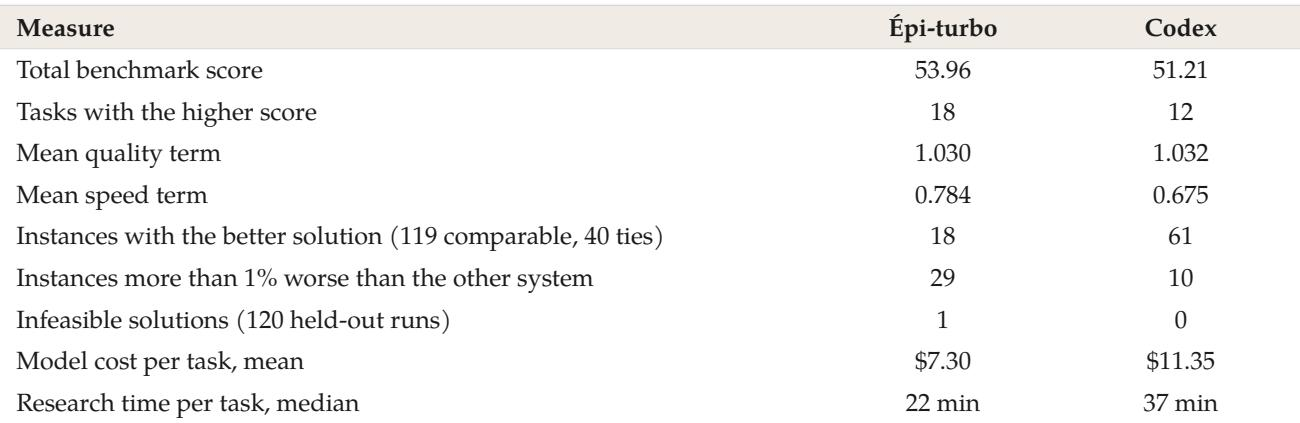
The results show that Epi-turbo has a slightly higher overall score than Codex across the task set while using substantially less model cost. Its advantage is clearer on the hardest task group, where its aggregate score is about 10 percent higher and it wins more tasks than it loses, while the middle ranked tasks are much closer. The pattern suggests that much of the score gain comes from faster generated programs rather than only better solutions. Epi-turbo has the higher total score across all tasks while spending much less than Codex. On the hardest task group, Epi-turbo wins most tasks and has a clearly higher aggregate score. The score gap narrows on the middle ranked tasks, where the two systems are close. Several tasks show Epi-turbo combining a higher score with lower model cost. Faster execution helps Epi-turbo's score, while long runs can reduce Codex's speed advantage.

Across tasks with the largest score differences favoring Épi-turbo, generated programs cover diverse optimization areas including routing, scheduling, planning, and clustering. The advantage is often driven by faster execution, while solution quality remains comparable or better in several highlighted cases. These selected examples also align with broader results showing that Épi-turbo frequently uses less model cost than Codex. Speed is a major source of advantage, because Épi-turbo programs often run well below the runtime used by Codex. Solution quality is strong in several cases, with Épi-turbo matching references or producing better solutions. The selected wins span many problem types, showing broad practical relevance. Model costs are often lower for Épi-turbo in these comparisons.
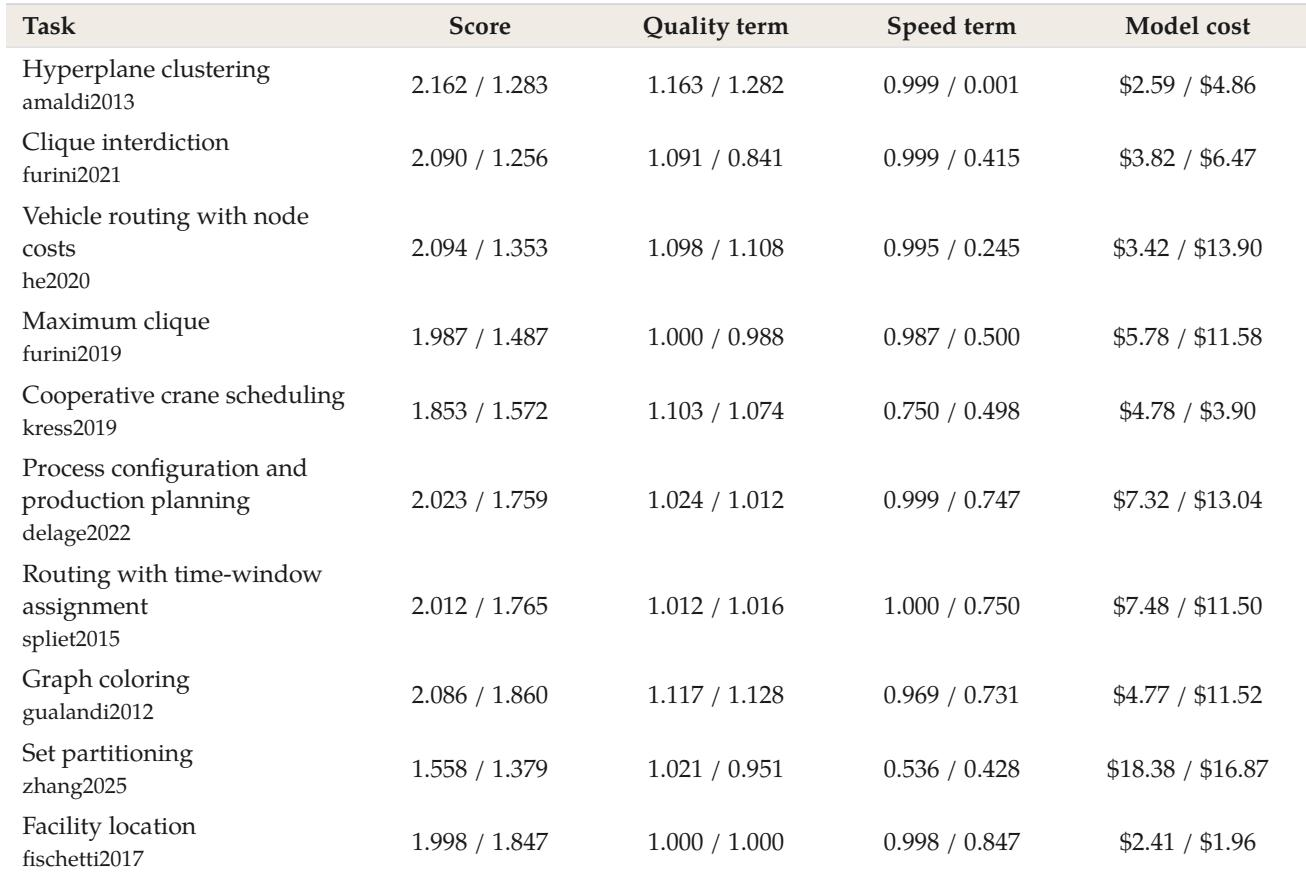
The experiments validate the approach through tighter numerical bounds, more concentrated interval estimates, and stronger center-density lower bounds obtained from the Épi dual framework, with improved separation in selected dimensions. They also evaluate FrontierOR tasks, where Épi-turbo achieves a higher overall score than Codex at lower model cost, especially on harder tasks and broader optimization settings. The qualitative results indicate that faster generated programs are a major source of advantage, while solution quality remains comparable or better across diverse cases.