Command Palette
Search for a command to run...
R2Orch: スキル内在化ループ内での自己対戦を通じたエージェントオーケストレーションのための再帰的自己改善
R2Orch: スキル内在化ループ内での自己対戦を通じたエージェントオーケストレーションのための再帰的自己改善
Mingda Zhang Yun Huang Qiang Huang Yanjin Li Rui Qian Qichao Zhao Tiesunlong Shen Na Zhao Jian Wang Xiaoying Tang
概要
近年、エージェントによるオーケストレーションは複雑な人間のタスクを解決するために広く応用されている。しかしながら、既存のオーケストレーション学習は、人手で設計されたカリキュラム、タスクのロールアウトがすべて同じ結果に到達する場合のアドバンテージ崩壊、各スキルを単一のノイズの多いスコアで評価する信頼性の低い評価信号といった重要な課題に依然として直面している。これらの課題に対処するため、我々はR2Orchを提案する。これは再帰的自己対戦オーケストレーションという新しいパラダイムであり、自己選択タスク上でオーケストレータを改善する内側ループと、内側ループの改善方法自体を改善する外側ループからなる。このパラダイムを支えるため、我々は再帰的学習可能性(Recursive Learnability)を導入する。これは、スキルが引き抜かれるにつれてロールアウトが異なる結果に到達し続けるタスクを選択した提案者(Proposer)に報酬を与える学習目的である。この目的に基づき、我々はさらにスキル引き抜き(Skill Withdrawal)を提案する。これは、自己対戦内の制御された評価によって、オーケストレータがそのスキルなしでも同等の性能を示すことが確認された時点で、外側ループが各スキルを引き抜く仕組みである。さらに、これら2つのループは1つの循環を形成する。失敗はスキルへ、スキルはパラメータへと蒸留され、引き抜きは提案者を新たな失敗へと導くため、オーケストレータはゼロスキル展開へと近づいていく。12のデータセットにおける実験結果は、R2Orchが質問応答、数学、コード、対話的タスクにわたり、一貫してベースラインを上回ることを示している。我々のコードは github.com/beita6969/R2Orch で公開されている。
One-sentence Summary
Researchers at The Chinese University of Hong Kong, Shenzhen, Fudan University, University of Illinois Urbana-Champaign, Tsinghua University, and National University of Singapore propose R2Orch, a recursive self-play orchestration paradigm whose inner loop improves the orchestrator on self-chosen tasks and whose outer loop improves how the inner loop improves through Recursive Learnability and Skill Withdrawal, driving zero-skill deployment and outperforming baselines on twelve question answering, math, code, and interactive datasets.
Key Contributions
- R2Orch is a recursive self-play orchestration paradigm that combines an inner loop for improving an orchestrator on self-chosen tasks with an outer loop for improving how the inner loop operates, moving the system toward zero-skill deployment.
- Recursive Learnability rewards a task Proposer for selecting problems whose rollouts continue to yield different outcomes as candidate skills are withheld, and Skill Withdrawal removes a skill once controlled self-play evaluation shows the orchestrator performs as well without it.
- Experiments on twelve benchmarks covering question answering, math, code, and interactive tasks show that R2Orch outperforms all baselines on every benchmark, improves six other Worker backbones without retraining, and retains accuracy when tested with zero skills.
Introduction
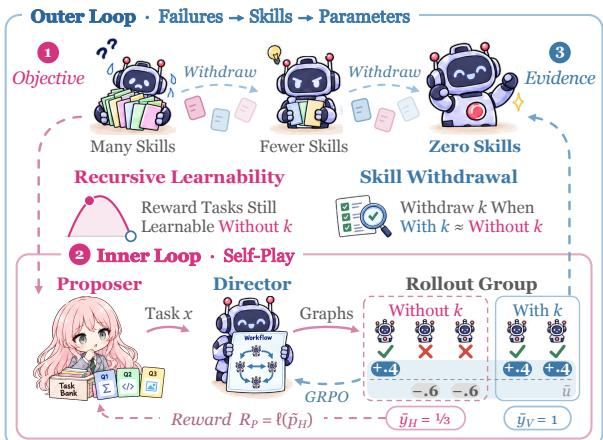
Agentic systems increasingly rely on agent graphs where nodes are roles and edges are hand-offs, giving orchestrators controllable, compositional, and reusable ways to solve tasks. However, existing orchestrators usually learn from human-collected tasks and depend on in-prompt skills, making them costly to scale and hard to improve autonomously. Prior work on learned orchestration, self-improving agents, and skill scaffolds still faces hand-designed curricula, advantage collapse in group-based reinforcement learning, and unreliable evaluation signals. The authors propose R2Orch, a recursive self-play orchestration paradigm with an inner loop that improves a Director on Proposer-chosen tasks and an outer loop that improves the inner loop. It introduces Recursive Learnability to reward tasks whose rollouts remain diverse when a candidate skill is withheld, and Skill Withdrawal to retire skills using controlled evaluation inside randomized rollout groups. The approach outperforms baselines across twelve benchmarks and maintains accuracy at zero-skill deployment.
Method
The authors introduce the R2Orch framework, which orchestrates model improvement through two nested self-play loops built upon a single randomized rollout group. This architecture integrates Recursive Self-Play Orchestration, Recursive Learnability, and Skill Withdrawal to continuously refine both the task selection and the underlying capabilities of the model.
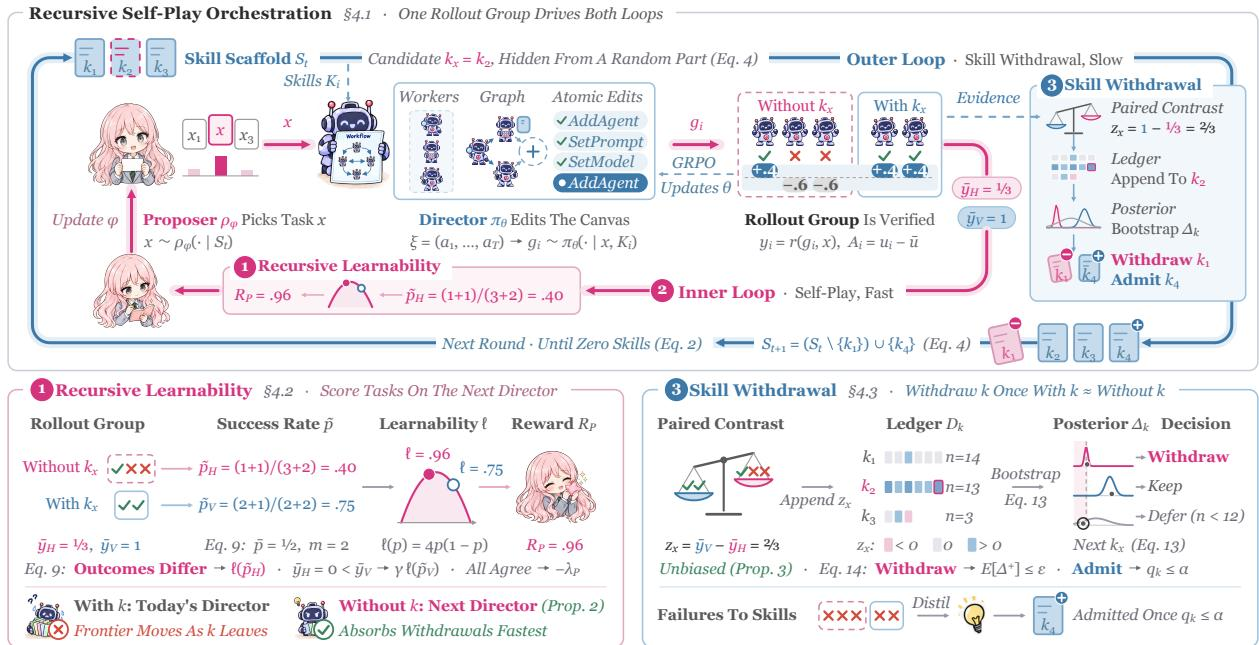
The core mechanism, Recursive Self-Play Orchestration, operates on two distinct time scales. On the fast time scale, the inner loop employs self-play to improve the Director on tasks selected by the Proposer. Both policies execute proximal best responses through clipped steps, formulated as:
θt+1≈argθmaxEvK(x;θ)−β1KL(πθ∥πθt) ϕt+1≈argϕmaxERP(x)−τKL(ρϕ∥ρ0)The Director is trained on the Proposer's picks and evaluated based on the value of the context it reads, while the Proposer is optimized using a specific reward signal. On the slow time scale, the outer loop updates the skill scaffold from the same rollout groups using the rule St+1=Φ(St;{Πk}k∈St,Ft). This scaffold dictates the randomized context for every group, effectively rewriting the objectives of the inner loop at each outer step. By sharing a single randomized rollout group, the framework ensures that the inner loop prepares for each skill withdrawal by training the Director without the candidate skill for the majority of its updates.
To guide the Proposer in selecting the most beneficial tasks, the authors design the Recursive Learnability module. This component serves as the downward channel where the outer loop sets the inner loop's objective. It rewards the Proposer for choosing tasks where rollouts continue to yield diverse outcomes even when the candidate skill is withheld. The learnability of a task is quantified by the curvature of the log-partition function of the proximal step, which corresponds to the outcome variance. Specifically, the recursive target is defined as:
ℓrec(x):=4∂β2logZKx∖kxβ=0=4p−(1−p−)where p− is the success probability when the candidate skill is removed. The Proposer reward is calculated as an empirical-Bayes plug-in estimate of this recursive learnability on the hidden part of the rollout group, discounted when progress is limited to the visible part and penalized upon collapse. This reward mechanism shapes a curriculum that tilts the base model toward tasks exhibiting high recursive learnability.
Complementing this, the Skill Withdrawal module acts as the upward channel, supplying evidence from the inner loop to the outer loop. Its purpose is to minimize the cost of scaffold changes by withdrawing a skill once controlled evaluations demonstrate that the Director performs equally well without it. Because the hidden part of the rollout group is drawn randomly, each group functions as a randomized block. The difference in part means provides an unbiased estimator of the skill's effect:
zx=nv1i∈Vx∑yi−nh1i∈Hx∑yiThese contrasts are accumulated into a Bayesian-bootstrap posterior for each skill. Based on this posterior, the system makes Bayes-optimal decisions to either withdraw or admit skills, ensuring that each withdrawal incurs minimal expected cost. Furthermore, the same posterior mechanism identifies the least helpful skills for revision and distills new skills from groups where both parts fail, seamlessly closing the outer loop.
Experiment
The experiments evaluate R2 Orch on six in-distribution and six held-out benchmarks against six baseline families, testing overall performance, backbone transfer, recursive self-play orchestration, recursive learnability, and skill withdrawal. R2 Orch outperforms all baselines on every benchmark, with gains coming from orchestration rather than backbone training, and its trained Director transfers to other Worker backbones without retraining, especially improving weaker backbones. Ablations confirm that both recursive self-play loops are necessary, that Recursive Learnability selects tasks that continue yielding learning signals as skills are withdrawn, and that Skill Withdrawal removes each skill only once it no longer helps the Director.
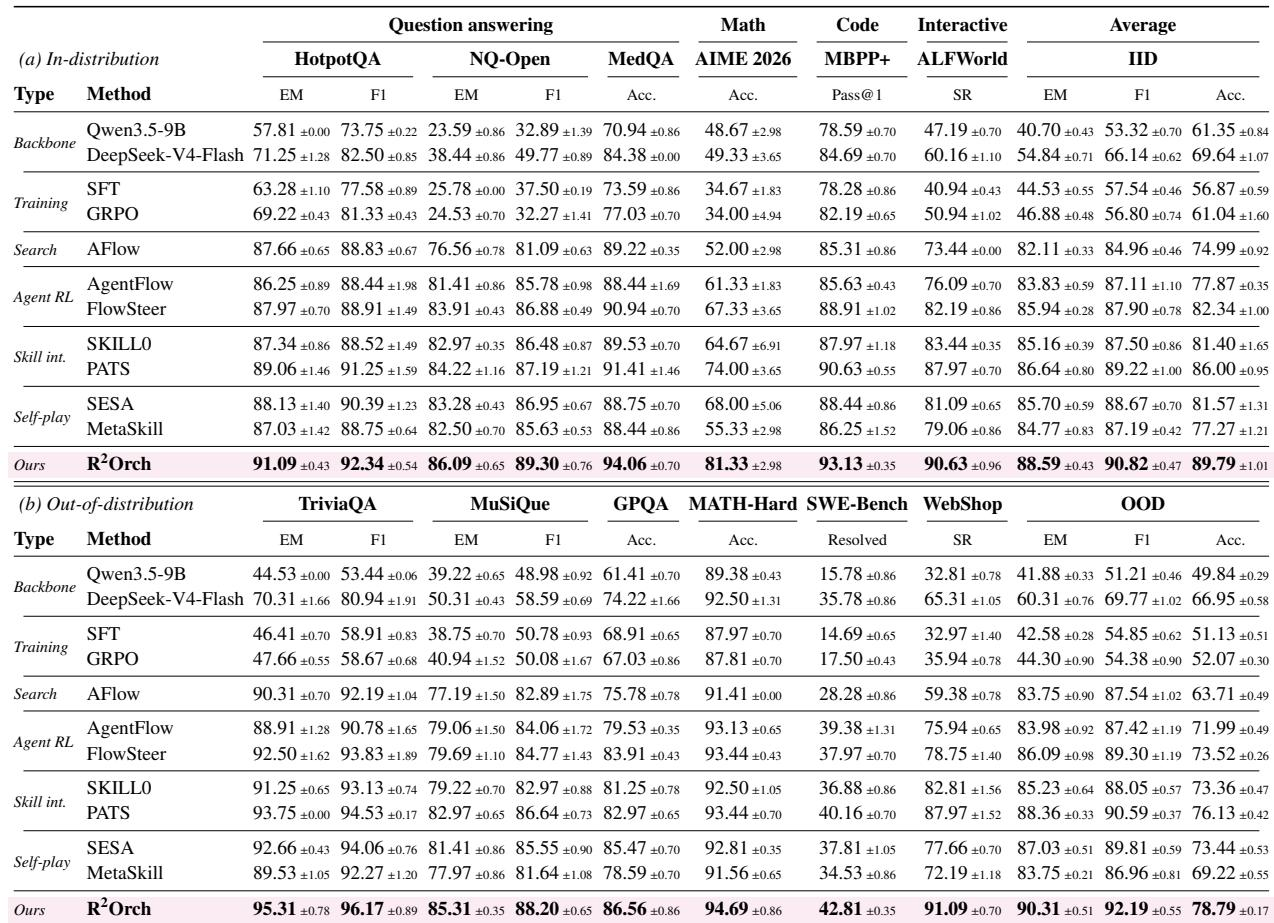
Under a shared protocol with frozen workers and matched compute, R2 Orch outperforms all baselines on every in-distribution and held-out benchmark. The gains come primarily from orchestration rather than backbone training, and the advantage is largest on tasks such as AIME 2026, WebShop, and ALF-World. The trained Director also transfers to other worker backbones without retraining, tightening the performance spread across backbones. R2 Orch is the only method that leads across all twelve benchmarks, with the strongest advantage on tasks where alternative objectives and ablations degrade most. Orchestration of frozen workers contributes more than backbone training alone, and the learned Director transfers across worker backbones without retraining.
The ablation isolates each orchestration component under a zero-skill evaluation. Removing recursive self-play or replacing parts with simpler alternatives reduces accuracy across in-distribution and out-of-distribution benchmarks, while direct prompting of the backbone scores far lower than any orchestration variant. The largest costs appear on interactive tasks such as WebShop and ALF-World, where skill withdrawal and recursive learnability matter most. Direct prompting of the Qwen3.5-9B backbone is much weaker than any orchestration variant, confirming that orchestration drives the gains. Ablations that remove or simplify recursive self-play, recursive learnability, or skill withdrawal reduce zero-skill accuracy, with the largest drops on interactive tasks like WebShop and ALF-World.
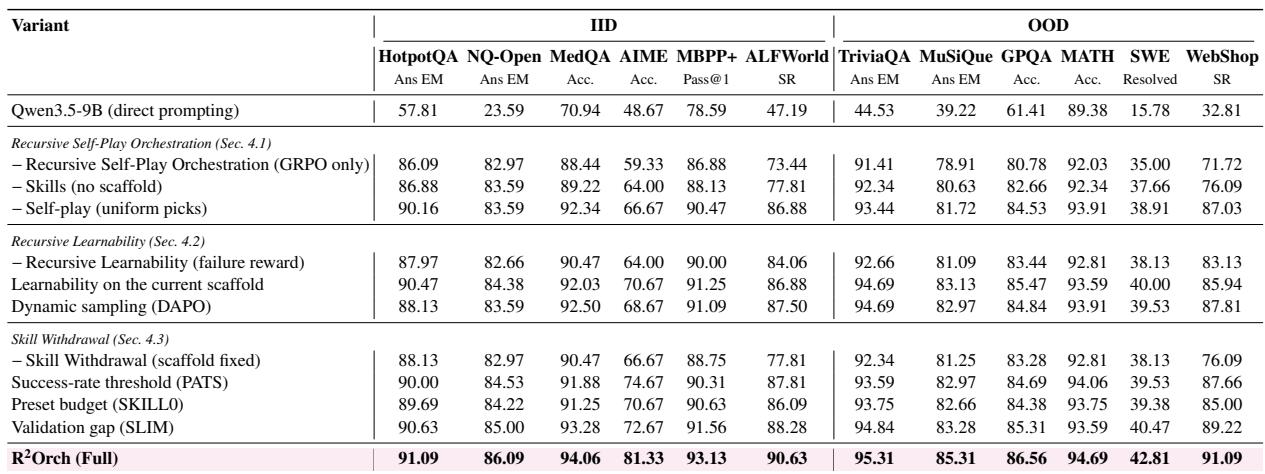
The experiments evaluate R2 Orch against baselines under a shared protocol with frozen workers and matched compute, and separately ablate its orchestration components in a zero-skill setting. The comparison shows that orchestration of frozen workers, rather than backbone training, drives consistent gains, with R2 Orch leading across all twelve benchmarks and its trained Director transferring to other worker backbones without retraining. The ablation confirms that recursive self-play, recursive learnability, and skill withdrawal are important, since removing or simplifying them lowers accuracy across in-distribution and out-of-distribution benchmarks, especially on interactive tasks such as WebShop and ALF-World. Overall, the results attribute R2 Orch's broad advantage primarily to its orchestration mechanism.