Command Palette
Search for a command to run...
ExeWorldBench:コードベースの実行可能な3Dワールドモデリングのベンチマーク
ExeWorldBench:コードベースの実行可能な3Dワールドモデリングのベンチマーク
概要
コーディングエージェントは、世界がどのように見えるかを再現する段階を超えて、世界がどのように機能するかを捉えた実行可能な世界を構築する方向へと進化しつつある。この転換は、実行可能なワールドモデリングを要請する。それは、世界の構造的・機械的・因果的原理を推論する世界理解と、その理解を物理的相互作用から挙動が創発するコードベースのシステムへと翻訳する実行可能な実現という、二つの中核的能力を統合するものである。しかし、既存のベンチマークは物理推論、視覚的忠実度、行動の正しさのいずれかに焦点を当てた断片的な評価しか提供しておらず、これらの能力の統合は十分に評価されていない。このギャップを埋めるため、我々はExeWorldBenchを導入する。これは、我々の知る限り、コードベースの3Dワールド構築を通じて世界理解と実行可能な実現を包括的に評価する最初のベンチマークである。ExeWorldBenchは、段階的に難易度が上がる三つのタスクから構成される。すなわち、視覚的観察から個々のメカニズムの実現を評価するMechanism Executability、空間的・機械的・因果的依存関係を持つ多段階システムへと拡張するCompositional Executability、そして高次の目標と物理的要件から実行可能な世界を構築することを要求するIntent-Driven Executable World Synthesisである。最先端モデルに対する大規模な実験により、実行可能なワールドモデリングにおける実質的な限界が明らかになり、より物理的に基盤づけられ因果的に首尾一貫した世界構築システムの開発に向けた示唆が得られた。
One-sentence Summary
Researchers from University of Science and Technology of China and The Chinese University of Hong Kong introduce ExeWorldBench, the first benchmark to comprehensively evaluate code-based executable 3D world modeling by assessing world understanding and executable realization through Mechanism Executability, Compositional Executability, and Intent-Driven Executable World Synthesis; experiments expose substantial limitations in frontier models.
Key Contributions
- ExeWorldBench is introduced as a benchmark for evaluating executable 3D world modeling through code-based construction of mechanisms, multi-stage causal systems, and intent-driven worlds.
- The benchmark defines three progressively challenging tasks: Mechanism Executability, requiring a Blender program inferred from a single reference image; Compositional Executability, extending evaluation to multi-stage systems with spatial, mechanical, and causal dependencies; and Intent-Driven Executable World Synthesis, requiring construction from high-level goals and physical requirements.
- Experiments on frontier models reveal substantial limitations in executable world modeling, showing that high code executability does not guarantee structural, mechanical, or causal correctness and that performance declines as causal complexity and execution horizon increase.
Introduction
The authors address a shift in coding agents from general-purpose programming toward building executable worlds, where success depends not only on visual reconstruction but also on modeling physical mechanisms and causal interactions. Prior benchmarks evaluate only partial capabilities: reasoning benchmarks test physical understanding through question answering, construction benchmarks emphasize appearance and static geometry, and behavior benchmarks often use simple or isolated motion in simplified 2D or browser environments. These evaluations do not show whether a model can translate physical world understanding into coherent executable 3D realization. To close this gap, the authors introduce ExeWorldBench, the first benchmark designed to evaluate executable 3D world modeling through three progressively difficult tasks: Mechanism Executability, Compositional Executability, and Intent-Driven Executable World Synthesis. Benchmarking frontier models reveals substantial gaps between code executability and physically coherent world construction.
Dataset
Dataset overview
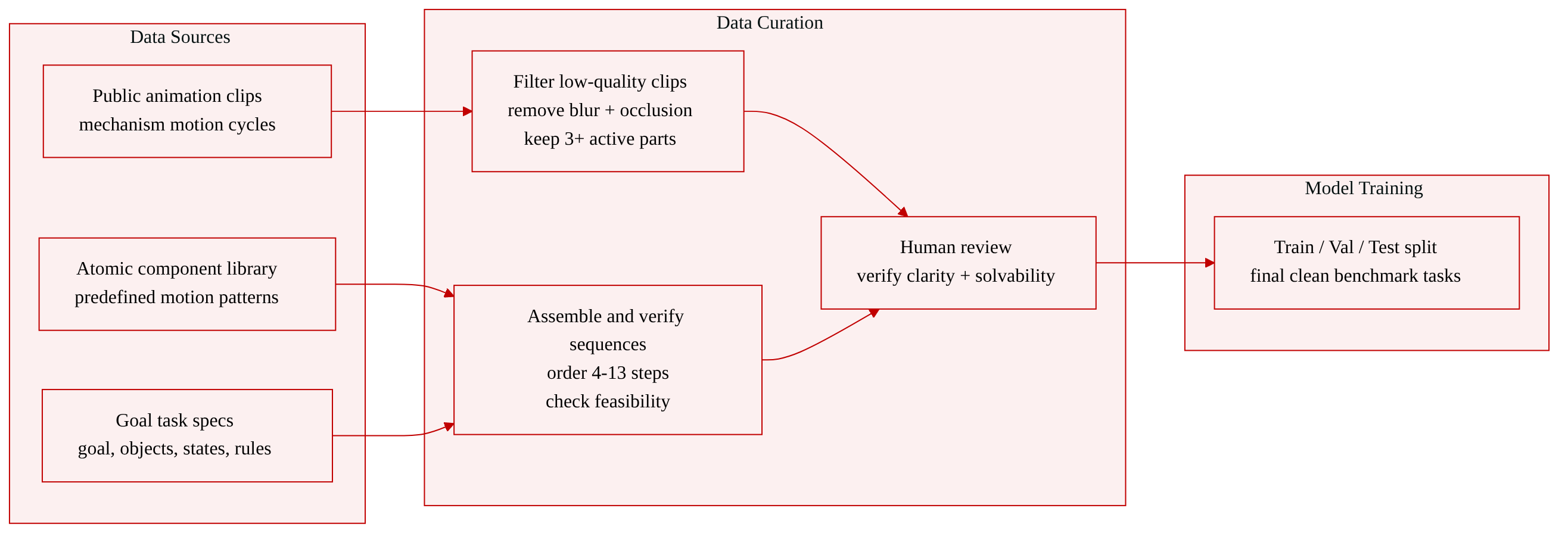
The authors construct three task-specific data pipelines for EXEWORLDBENCH: T1 Mechanism Executability, T2 Compositional Executability, and T3 Intent-Driven Executable World Synthesis. The provided text focuses on dataset construction and verification; it does not report total sample counts or training/evaluation splits.
T1: Mechanism Executability
- Source: publicly available animations illustrating mechanical principles and dynamic mechanical systems.
- Each sample provides a clear view of the mechanism and its complete motion cycle.
- Visual filtering: a visual quality assessment model removes blur, JPEG compression, and severe distortion.
- Mechanical filtering: GPT-6 Astra removes cases with severe occlusion, ambiguous component boundaries, or fewer than three mechanically active components.
- Motion inferability is assessed through a generate-infer-validate-verify pipeline:
- GPT-6 Astra extracts three pieces of static-only visual evidence over three interactive rounds.
- Opus 5 derives a motion description from the static image and evidence without access to motion reference frames.
- GPT-6 Astra performs cross-modal consistency checking between the description and reference motion.
- Five human annotators manually review and remove samples with low motion inferability or ambiguous structural evidence.
T2: Compositional Executability
- Source: a code library of atomic mechanical components with predefined motion patterns.
- Component filtering: components are retained only if their motion is visually identifiable, unambiguous, and reflects meaningful physical or mechanical behavior rather than decorative animation.
- GPT-6 Astra generates ordered textual sequences of components for multi-step mechanical systems with 4 to 13 steps, including intended transitions between stages.
- Manual review ensures component order and stage-to-stage transitions are physically coherent.
- For each retained sequence, GPT-6 Astra with Codex CLI assembles the predefined component implementations from the code library and adjusts spatial layout to produce a continuous reference animation.
T3: Intent-Driven Executable World Synthesis
- Source: reuses the T2 atomic component library for Component-Constrained Synthesis; uses GPT-6 Astra for Goal-Constrained Synthesis task specifications.
- Component-Constrained Synthesis: randomly samples 4 to 12 components to form tasks with 4 to 12 stages.
- Goal-Constrained Synthesis: creates easy, medium, and hard tasks. Specifications include the goal, required objects, state and event definitions, initial state, physical rules and dependencies, and final state.
- Verification:
- Component-Constrained tasks are checked by GPT-6 Astra for coherent ordering, physically plausible causal connections, and participation of all sampled components in one complete execution chain.
- Goal-Constrained tasks are validated by Opus 5 for internal consistency, clarity, mechanical feasibility and solvability, and whether a valid reference solution can be constructed.
- Retained tasks then undergo manual review for specification consistency, mechanical feasibility, and solution validity.
Processing and usage notes
- No explicit cropping strategy is described.
- The main metadata structures are the task specifications, ordered component sequences, and reference animations or motion frames.
- The provided excerpts do not specify training split ratios, mixture ratios, or sampling weights; the data is described as task construction for benchmark evaluation.
Method
The authors construct the ExeWorldBench dataset through three distinct data construction pipelines, each tailored to the specific challenges of the three progressively difficult tasks. As shown in the figure below:
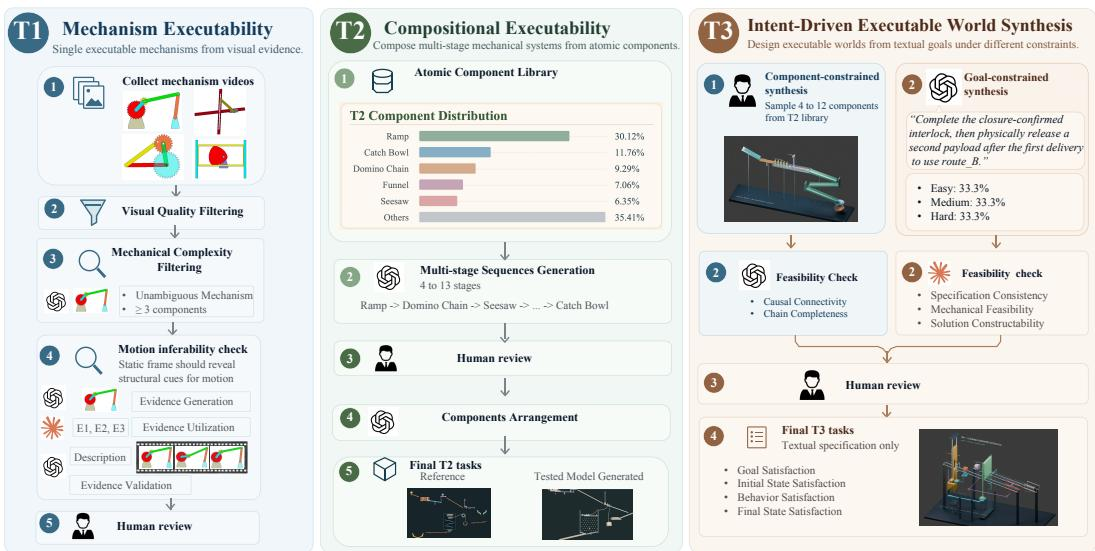
For Task 1 (Mechanism Executability), the pipeline begins by collecting real-world mechanism videos. These undergo visual quality filtering and mechanical complexity filtering to ensure unambiguous mechanisms with at least three components. To assess motion inferability, the authors implement a generate-infer-validate-verify pipeline. First, evidence generation extracts three pieces of visual evidence from a static reference image that can infer the target motion. Next, evidence utilization prompts a capable model to derive a complete motion description from this evidence without seeing the motion sequence. Evidence validation then performs a cross-modal consistency check between the generated description and the reference motion sequence. Finally, human review removes cases with low motion inferability or ambiguous structural evidence.
For Task 2 (Compositional Executability), the authors first build an atomic component library containing predefined motion patterns for visually identifiable mechanical parts. They then generate multi-stage sequences ranging from 4 to 13 steps, specifying the intended transitions between consecutive stages. After a human review ensures physical coherence in the component order and transitions, the system arranges the components spatially to produce a continuous reference animation.
For Task 3 (Intent-Driven Executable World Synthesis), the pipeline splits into two settings. In Component-Constrained Synthesis, the authors randomly sample 4 to 12 components from the Task 2 library. A feasibility check verifies causal connectivity and chain completeness. In Goal-Constrained Synthesis, tasks are generated across three difficulty levels with complete textual specifications. The feasibility check here evaluates specification consistency, mechanical feasibility, and solution constructability. Both settings conclude with a human review to finalize the textual specifications for the executable world synthesis tasks.
Experiment
The evaluation benchmarks diverse frontier models on executable world tasks across mechanism, compositional, and goal-driven settings, using a VLM judge to assess visual structure, mechanical motion, executable causal mechanisms, and goal satisfaction. Code-level repair substantially improves executability but yields only modest gains in world modeling metrics, indicating that producing runnable code is necessary but not sufficient. Strong single-mechanism motion does not reliably transfer to multi-stage causal execution, and models are better at satisfying initial-state requirements than behavioral or final-state requirements. Performance also declines as execution horizons grow longer, while adding motion references provides limited improvement, highlighting the difficulty of translating visual motion evidence into stable executable causal structure.
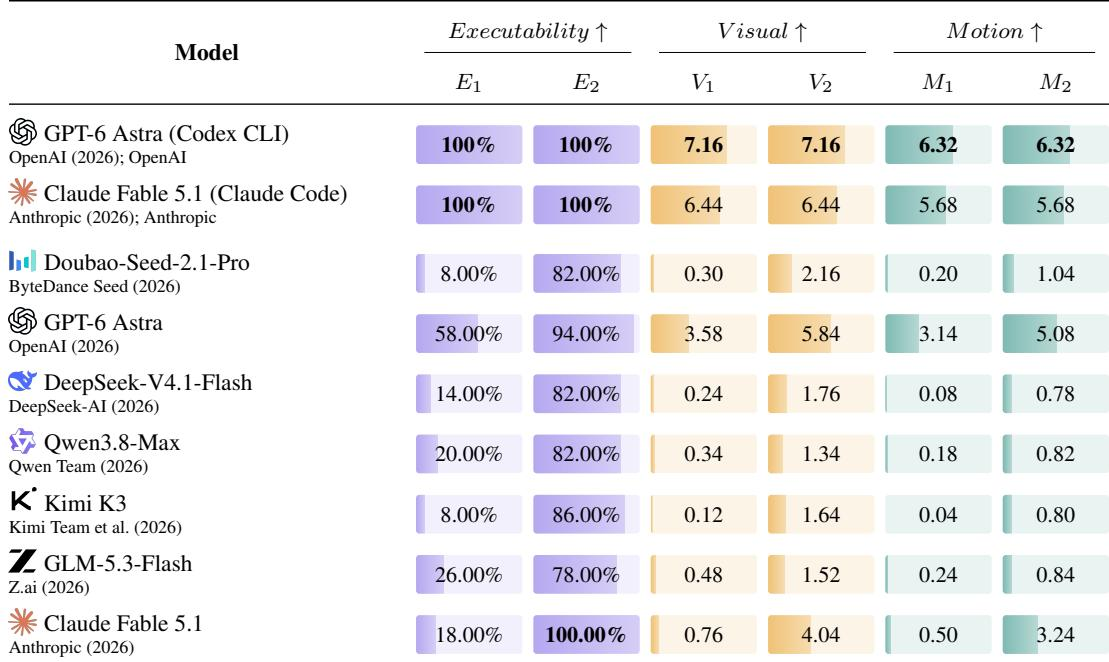
On the mechanism executability task, the leading models achieve near-perfect initial and repaired executability along with the highest visual and motion scores. Lower-performing models improve substantially in executability after repair, but their visual structure and mechanical motion scores remain comparatively low. Motion tends to trail visual structure across models, showing that runnable code and plausible structure do not guarantee correct mechanical dynamics. After repair, several low-executability models become highly executable, but their visual and motion scores improve only modestly. Visual structure scores are generally higher than mechanical motion scores, so strong structural scores do not ensure strong motion performance.
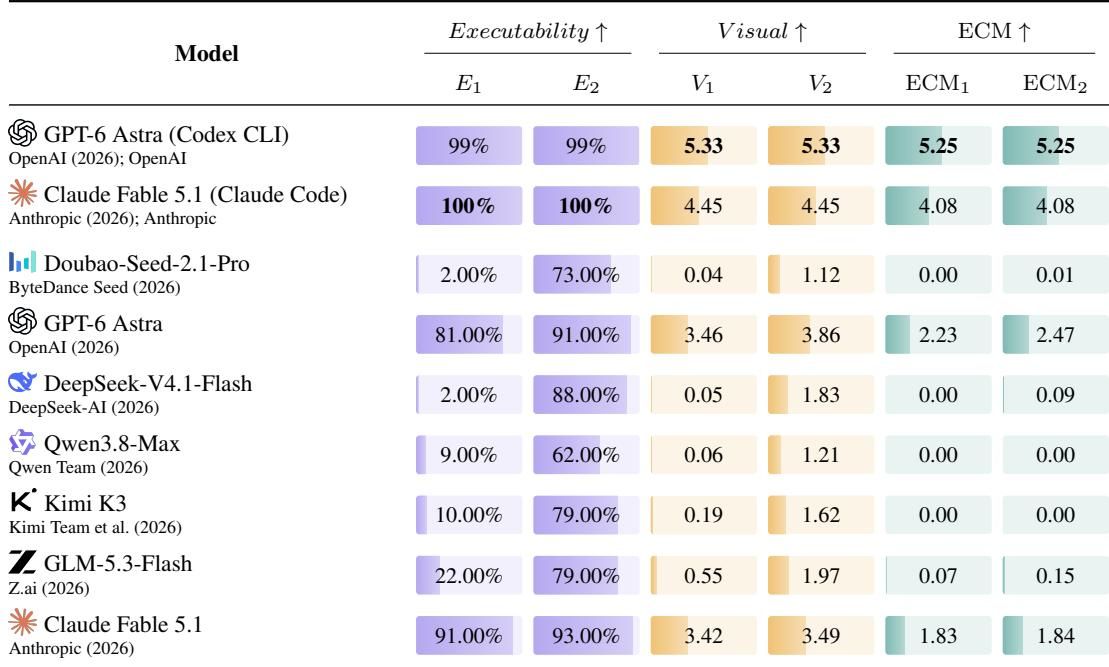
Compositional executability results show that harness-based models reach near-perfect executability and substantially higher visual structure and executable causal mechanism scores, while API-based models improve executability after repair but still struggle on world modeling metrics. The gap between executability and causal or visual scores indicates that producing runnable code is necessary but insufficient for building coherent executable worlds. Removing component-level guidance further lowers causal mechanism performance, and initial-state requirements are satisfied more reliably than behavioral or final-state requirements. Harness-based models achieve near-perfect executability and clearly outperform API-based models on visual structure and executable causal mechanism. After repair, executability improves sharply for most models, but visual and causal scores remain low for many API-based systems, showing that runnable generation does not ensure valid world modeling. Only harness-based models reach relatively strong executable causal mechanism scores after constrained repair, while most API-based models remain near zero. Models satisfy initial-state requirements more reliably than behavioral and final-state requirements, indicating difficulty in sustaining causal processes to the intended outcome.
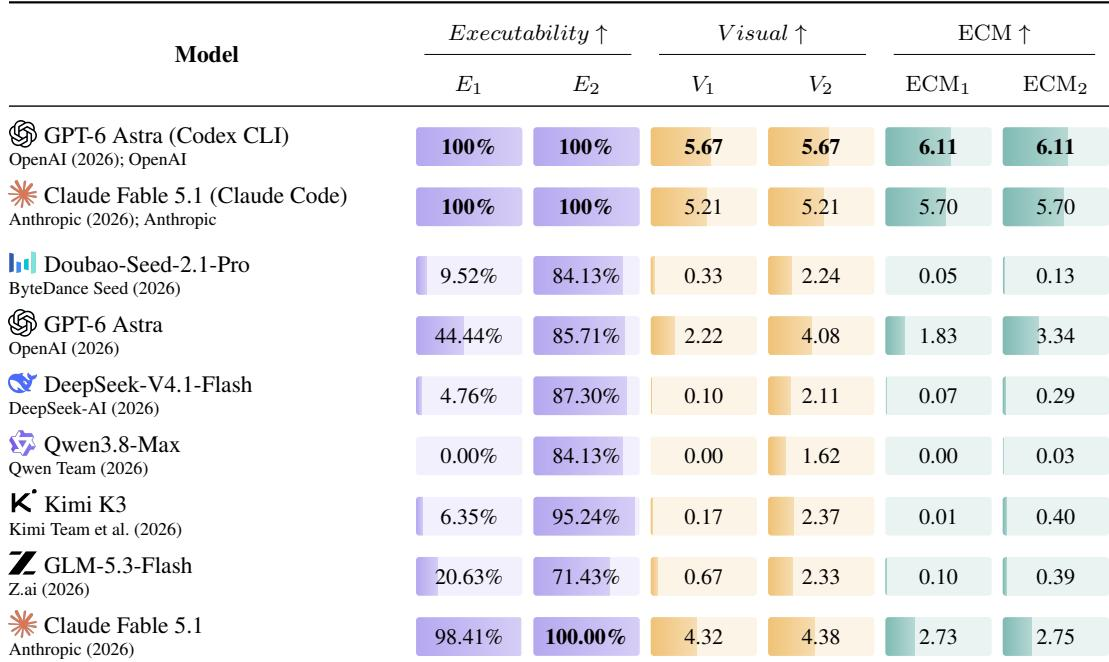
On component-constrained synthesis, harness-based models achieve near-perfect executability and much stronger visual and executable-world modeling scores than API-based models. API-based models initially generate few runnable programs, but after technical repair their executability rises substantially while visual and executable-world modeling gains remain modest. Longer execution horizons are associated with declining performance, indicating that sustaining causal chains across many stages remains a key challenge. Harness-based models approach perfect executability and clearly outperform API-based models on visual and executable-world modeling metrics. Repaired API-based outputs become mostly executable, but their visual and executable-world modeling scores improve only modestly, showing that runnable code alone is insufficient for valid world modeling.
In goal-constrained synthesis, harness-based models generate runnable Blender programs almost perfectly, while API-based models initially show much lower executability. Repair raises executability substantially across API-based models, but their visual, executable-world modeling, and goal satisfaction scores improve far less. This gap shows that producing runnable code is not enough for structural and causal coherence under high-level goals. Harness-based models achieve near-perfect executability on goal-constrained synthesis, whereas API-based models often start at low or zero executability. After technical repair, API-based executability rises sharply, but visual quality, executable-world modeling, and goal satisfaction remain relatively low and improve only modestly. Goal satisfaction is notably weaker than executability, especially for API-based models, and initial-state requirements are generally met more reliably than behavioral or final-state requirements.
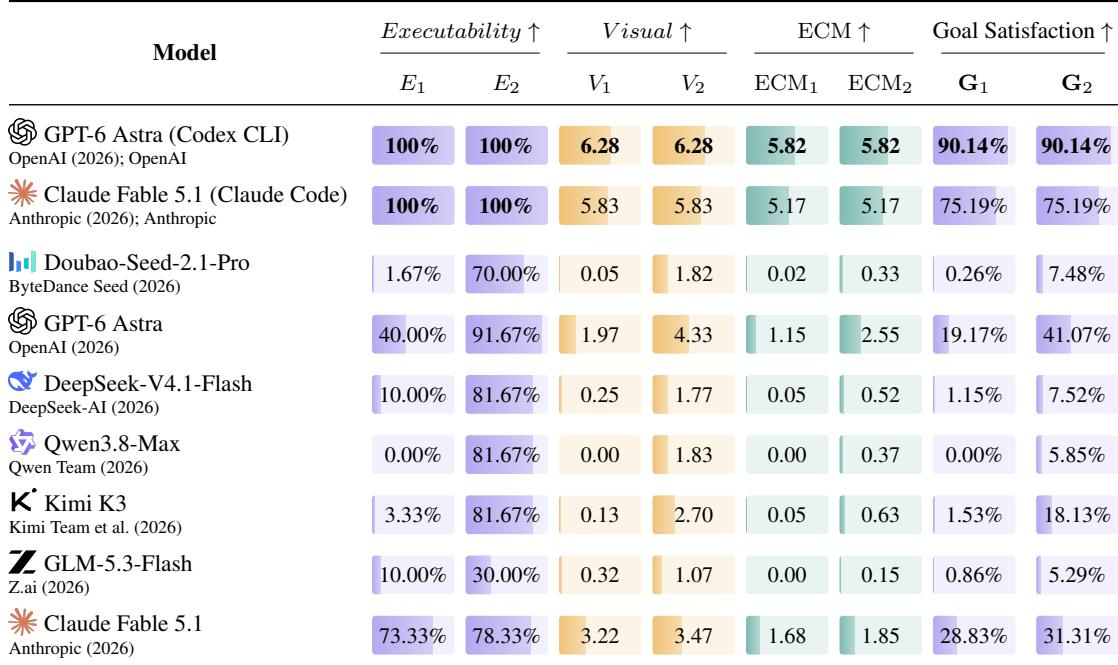
Across the executability, compositional, component-constrained, and goal-constrained synthesis tasks, harness-based models consistently achieve near-perfect runnable code and stronger visual structure, mechanical motion, and executable world modeling, while API-based models often improve sharply in executability after repair but show only modest gains in these higher-level qualities. The results show that producing runnable code is necessary but insufficient for building coherent executable worlds, since visual structure, causal mechanism, motion, and goal satisfaction remain comparatively weak. Initial-state requirements are generally met more reliably than behavioral or final-state requirements, and performance tends to decline over longer execution horizons.