Command Palette
Search for a command to run...
GroundingPI: 視覚プリミティブを用いた物理的知能に向けたグラウンディング基盤モデル
GroundingPI: 視覚プリミティブを用いた物理的知能に向けたグラウンディング基盤モデル
概要
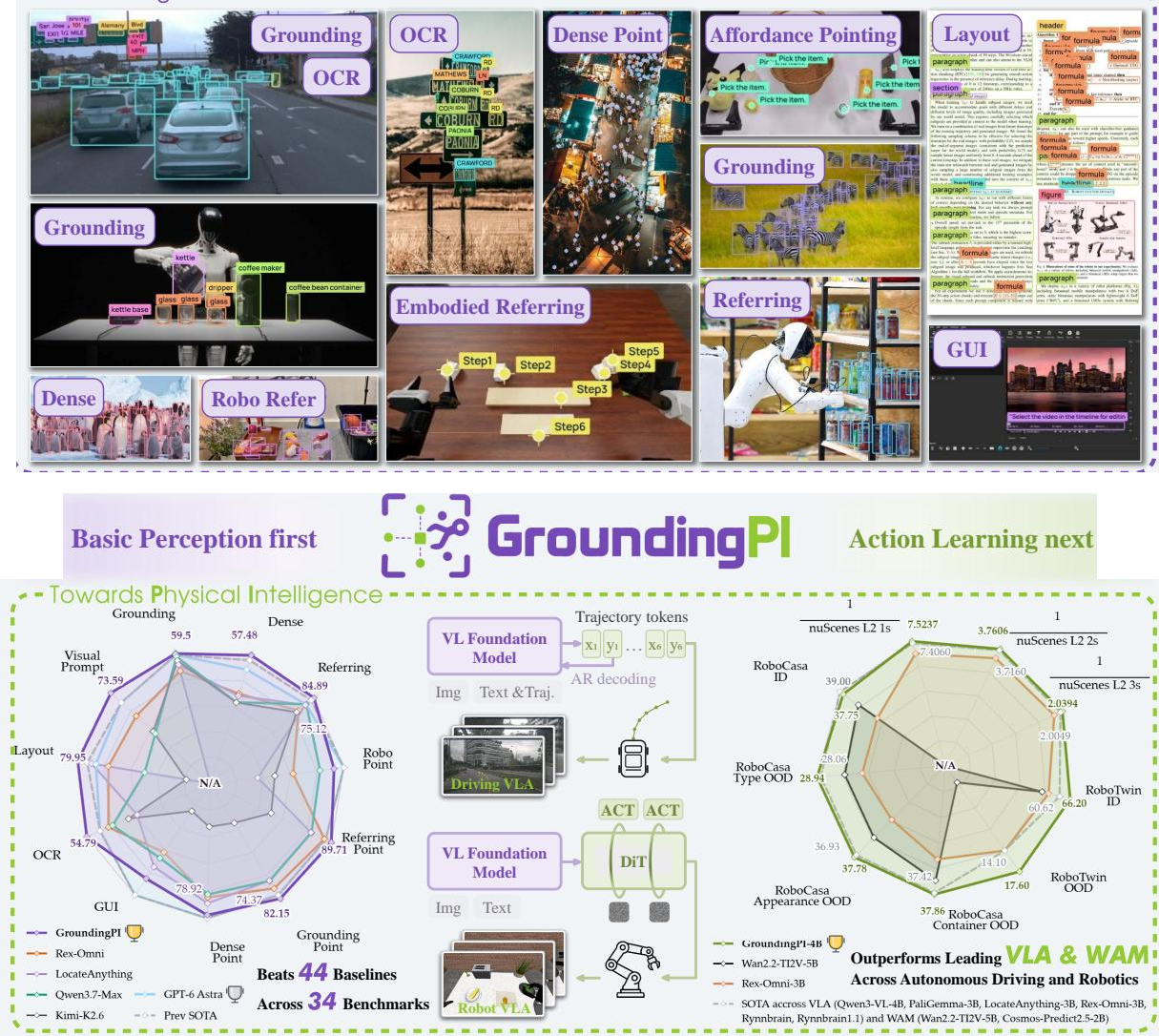
正確なグラウンディングは重要である。それは、雑然とした環境や微小物体であっても、どの物体が対象でその物体がどこにあるかを特定し、閉ループ制御に十分な速度でなければならない。しかし、視覚言語行動(VLA)モデルや世界行動モデル(WAM)は、汎用の視覚言語バックボーンや動画生成バックボーンから知覚を得ており、これらの設定では依然として失敗する。我々は、点とボックスを共有語彙内の量子化座標として生成する4Bのグラウンディング基盤モデルGroundingPIを提案する。学習では、マルチモーダル事前学習と空間的事前学習、教師ありファインチューニング、GRPOによる強化学習を組み合わせ、公開データセットと専用データエンジンからの教師信号を利用する。11の知覚能力にわたる34のグラウンディングベンチマークにおいて44のベースラインと比較し、GroundingPIは平均73.68%を達成して新たな最高水準を樹立し、より大規模なGPT-6 Astra(71.54%)を上回る。下流の視覚バックボーンとして、GroundingPIはロボット操作と自動運転の性能を向上させる。RoboTwin 2.0では、評価したすべての主流バックボーンを4つの分布外設定のすべてで上回り、最強のバックボーンと比較して最大24.8%の改善を示す。RoboCasa-GR1では、デモンストレーションの50%で学習したGroundingPIが、75%で学習したベースライン群を上回る。視覚バックボーンとして使用したnuScenesでは、GroundingPIは平均オープンループL2誤差0.296 mを達成する。我々はGroundingPIの事前学習を規模とデータ構成の観点から系統的に分析する。事前学習を大規模化するにつれて、下流の自動運転とロボット操作の性能が向上する。これら11の知覚能力にわたるデータレシピの分析から、高密度なグラウンディングが両方に大きな利益をもたらし、OCRが知覚学習の触媒となる可能性が示される。これらの結果は、グラウンディングを知覚的基盤とみなすこと、そして専用の知覚事前学習が物理的知能の基盤モデルにとって有望な方向であることを支持する。
One-sentence Summary
Researchers at XPeng Inc., Peking University, and other institutions introduce GroundingPI, a 4B grounding foundation model that represents points and boxes as quantized coordinates in a shared vocabulary and is trained through multimodal and spatial pretraining, supervised fine-tuning, and GRPO reinforcement learning, thereby achieving state-of-the-art grounding while improving downstream robotic manipulation and autonomous driving.
Key Contributions
- The paper introduces GroundingPI, a 4B grounding foundation model that generates points and boxes as quantized coordinates in a shared vocabulary and is trained with multimodal and spatial pretraining, supervised fine-tuning, and GRPO reinforcement learning. GroundingPI establishes a new state of the art across 34 grounding benchmarks, averaging 73.68% and exceeding the larger GPT-6 Astra at 71.54%.
- The paper demonstrates transfer to physical intelligence as a downstream visual backbone. On RoboTwin 2.0, GroundingPI outperforms mainstream backbones in all four out-of-distribution settings by up to 24.8% relative to the strongest backbone; on RoboCasa-GR1, training with 50% of demonstrations outperforms baselines trained with 75%; on nuScenes, it attains an average open-loop L2 error of 0.296 m.
- The paper systematically analyzes pretraining scale and data composition. Scaling pretraining improves downstream autonomous driving and robotic manipulation, dense grounding substantially benefits both domains, and OCR may act as a catalyst for perceptual learning, supporting grounding as a perceptual foundation and dedicated perceptual pretraining for System 1 physical intelligence.
Introduction
Visual grounding is central to physical intelligence because models must localize objects, handles, and task-relevant structures before planning how to act. Existing vision-language-action and world-action models often inherit general-purpose vision-language or video-generation backbones that are not optimized for precise grounding, and evaluations reveal weaknesses in dense scenes and tiny objects; recent policy-level perceptual objectives are often task-specific and hard to scale. To close this perceptual gap, the authors introduce GroundingPI, a 4B-parameter grounding foundation model built on visual primitives such as points and bounding boxes, using a shared quantized-coordinate vocabulary to unify grounding, referring, pointing, OCR, GUI and layout grounding, and visual prompting. GroundingPI is trained with multimodal and spatial pretraining, supervised fine-tuning, and reinforcement learning, and it achieves state-of-the-art grounding across 34 benchmarks while transferring effectively to autonomous driving and robotic manipulation.
Dataset

The authors describe GroundingPI data as a hybrid training set built from public datasets and model-generated annotations.
- Sources: Public datasets are combined with annotations produced by the authors’ data engine.
- Composition: The excerpt does not list specific public datasets, dataset sizes, or mixture ratios.
- Annotation processing: The data engine fuses multi-teacher annotations at the field level and applies task-specific validation.
- Label refinement: Accepted labels train a unified grounding expert for iterative annotation. Complementary teachers and local observations resolve uncertain cases to expand supervision and refine existing labels.
- Model usage: The resulting labels are used to train the grounding expert iteratively, improving supervision and label quality.
- Additional processing details: Field validation, task dependencies, and label revision are documented in Section A.3. The excerpt does not specify cropping strategies or metadata schema.
Method
GroundingPI is designed as an autoregressive grounding foundation model for language-conditioned perception and serves as a shared perceptual backbone for downstream physical intelligence tasks.
At its core, the authors couple a MoonViT-V2 visual encoder with a Qwen3-4B language decoder. A learnable projector aggregates adjacent 2×2 visual features and maps them into the language embedding space through a two-layer MLP with GELU and output normalization.
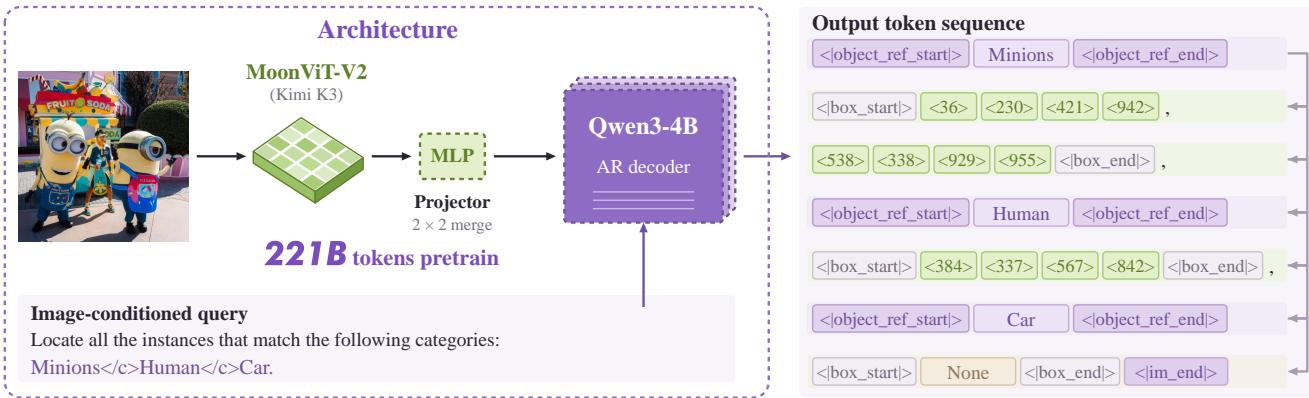
Given an image I and a query P, the encoder Eψ and projector Cϕ produce visual embeddings
V=Cϕ(Eψ(I)).The decoder then generates a variable-length response Y autoregressively:
pθ(Y∣I,P)=i=1∏∣Y∣pθ(yi∣V,P,y<i).Semantic labels, protocol markers, and 1,000 quantized coordinate tokens, written as <0> to <999>, share the output vocabulary. Responses are variable-length, and an absent queried category is emitted as None.
The training data combine public datasets with annotations produced by a dedicated data engine. The engine fuses multi-teacher annotations at the field level and applies task-specific validation.
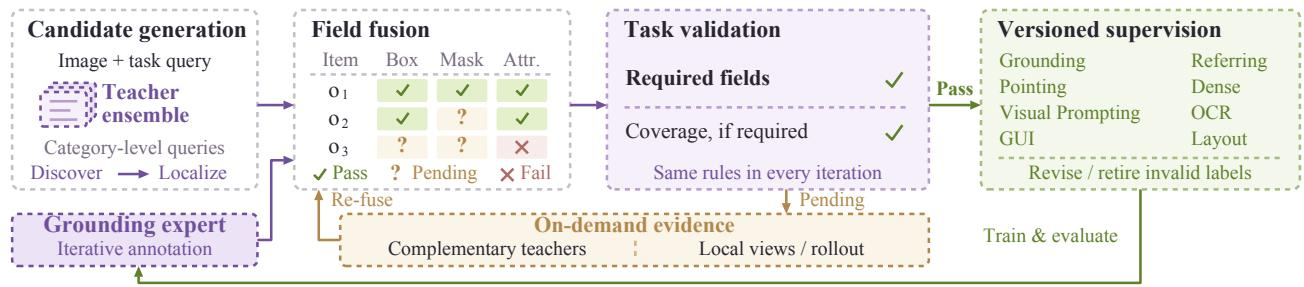
Accepted labels train a unified grounding expert for iterative annotation. Complementary teachers and local observations resolve uncertain cases, expanding supervision and refining existing labels over successive rounds.
The training process consists of base VLM training, supervised fine-tuning, and reinforcement post-training. Base training first aligns the projector using image-caption supervision while freezing both backbones. It then updates all modules in two stages: joint multimodal pretraining on text and image-text supervision, followed by general visual and video understanding through question answering and captioning. All stages use causal next-token prediction.
Supervised fine-tuning aligns coordinates with visual locations and learns the shared output protocol. Under teacher forcing, the authors minimize
LSFT=−∣S∣−1t∈S∑logpθ(yt∣I,P,y<t),where S contains assistant-response labels, protocol markers, and coordinates, while excluding prompt and visual positions. Supervised adaptation first updates all modules and then freezes the vision encoder and projector for language-side refinement.
The final stage applies group relative policy optimization.
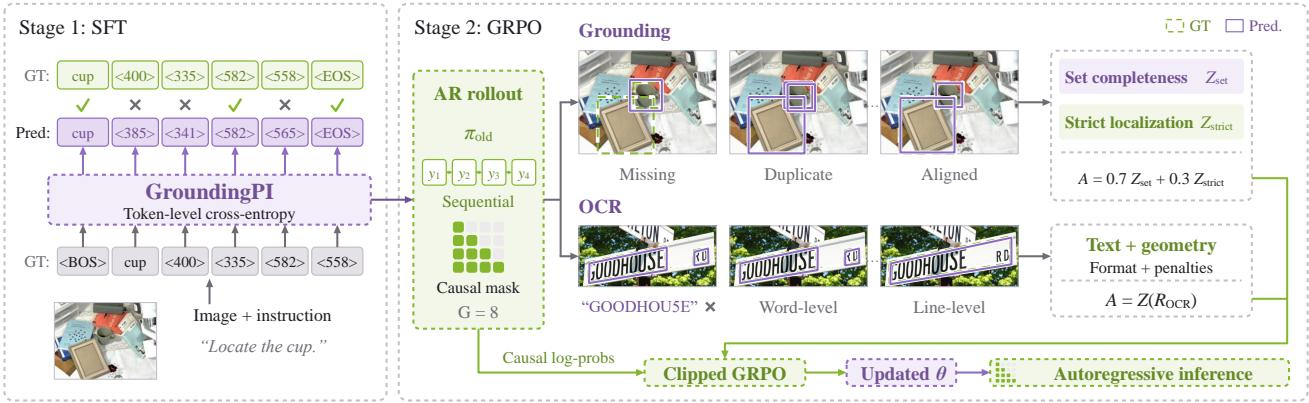
GRPO samples G=8 autoregressive responses per image-query pair. For grounding, Rset measures coverage through reference-wise maximum-IoU matching with class validation. The complementary Rstrict combines multi-threshold F1, localization, format, count, and ordering scores, penalizing duplicate and oversized boxes. The independently standardized rewards are combined as
Ai=0.7Z(Rset,i)+0.3Z(Rstrict,i).For OCR, Hungarian one-to-one matching evaluates text and geometry across complete word or line views and complementary references. Format gating and output penalties produce a composite reward:
Ai=Z(ROCR,i).Here Z standardizes each active reward within a prompt, and the combined advantages are then standardized across the response batch. The authors optimize a clipped GRPO objective with a frozen SFT reference and update only the language parameters.
For physical intelligence, GroundingPI provides a perceptual interface for action learning. In autonomous driving, the task is formulated as language-conditioned trajectory prediction. Given the current front-camera image and historical ego states, the model represents the future trajectory as six ordered waypoints at 0.5-second intervals over a three-second horizon. Each waypoint specifies a cumulative position in the current ego frame, with forward and left axes measured in meters. Fixed metric ranges map these coordinates to the existing <0> to <999> vocabulary. The language head generates the trajectory autoregressively, and response-only cross-entropy provides the adaptation objective. Decoding recovers metric waypoints while preserving temporal order.
For robot manipulation, the authors adopt a π-style flow-matching policy with layer-wise connections. The pretrained foundation encodes the visual observation and language instruction once. Its intermediate features are projected and resampled, then injected into the corresponding cross-attention layers of an Action DiT. Conditioned on these features and the robot state, the action expert denoises a noisy action chunk into continuous controls. In controlled comparisons, the Action DiT, robot data, action representation, optimization budget, and inference procedure are kept fixed while only the pretrained foundation is varied.
Experiment
The experiments evaluate GroundingPI, a compact grounding foundation model, on broad perception benchmarks and on downstream physical-intelligence tasks including autonomous driving and robot manipulation. Benchmark results show strong dense detection, spatial and GUI grounding, OCR, layout, and object pointing relative to comparable models, though some challenging settings remain limited. Transfer tests with fixed action learners indicate that stronger grounding perception supports lower driving error, higher manipulation success, better out-of-distribution generalization, and more data-efficient action learning. Ablations further show that scaling grounding pretraining improves both perception and manipulation, dense grounding provides a core spatial signal, auxiliary OCR, layout, and GUI supervision amplifies transfer when combined with the full mixture, and perception-native foundations may be better suited to fast execution while broader reasoning models serve planning.
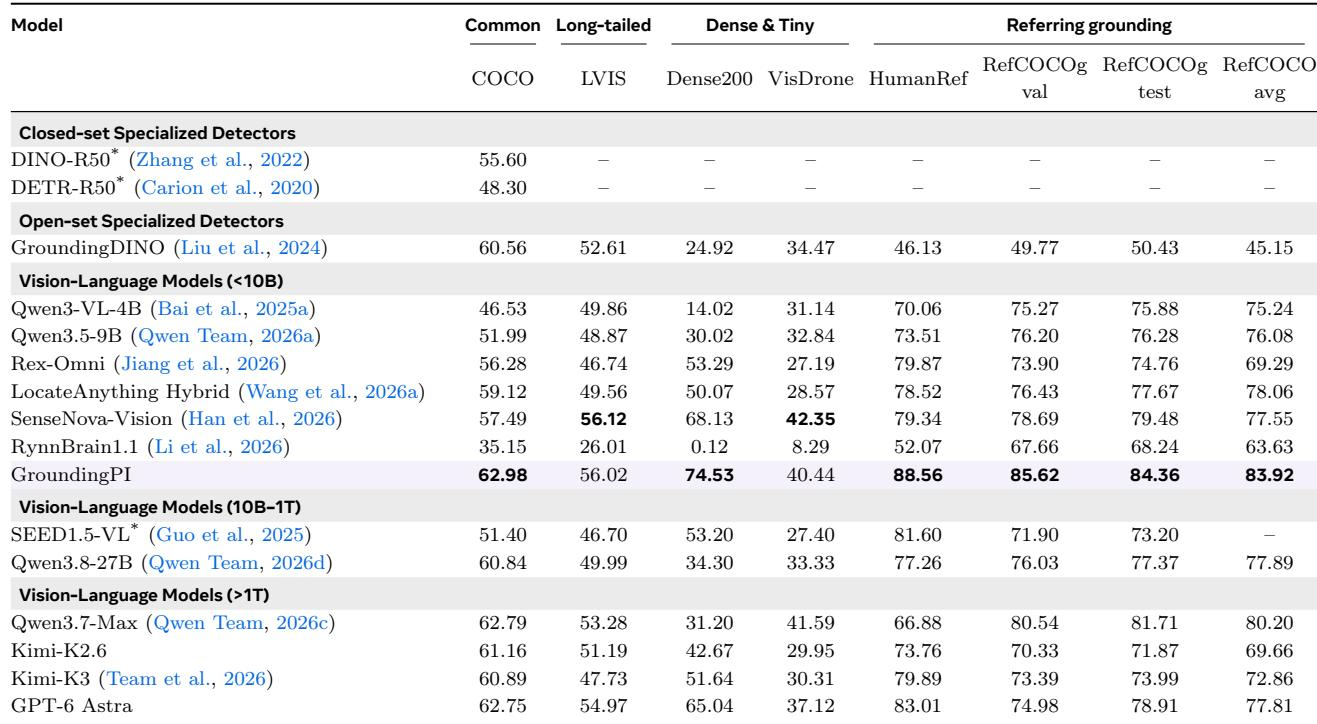
GroundingPI reaches a 73.68% average across the detection and referring grounding suite, ahead of similarly sized models and competitive with a frontier reference at 71.54%. The open-set detector shown has stronger common-object and long-tailed detection than dense and tiny-object detection, where scores are notably lower. Referring grounding results fall between common detection and dense detection, indicating broad coverage with remaining localization challenges. GroundingPI's overall grounding average exceeds similarly sized models and is competitive with the frontier reference. Open-set specialized detection improves reported COCO performance over closed-set detectors but remains much weaker on dense and tiny-object benchmarks. The open-set detector scores higher on RefCOCOg than on HumanRef, suggesting referring grounding varies by benchmark difficulty. Quantized coordinates and the MoonViT-V2 encoder help lift the model's average over alternative design choices.
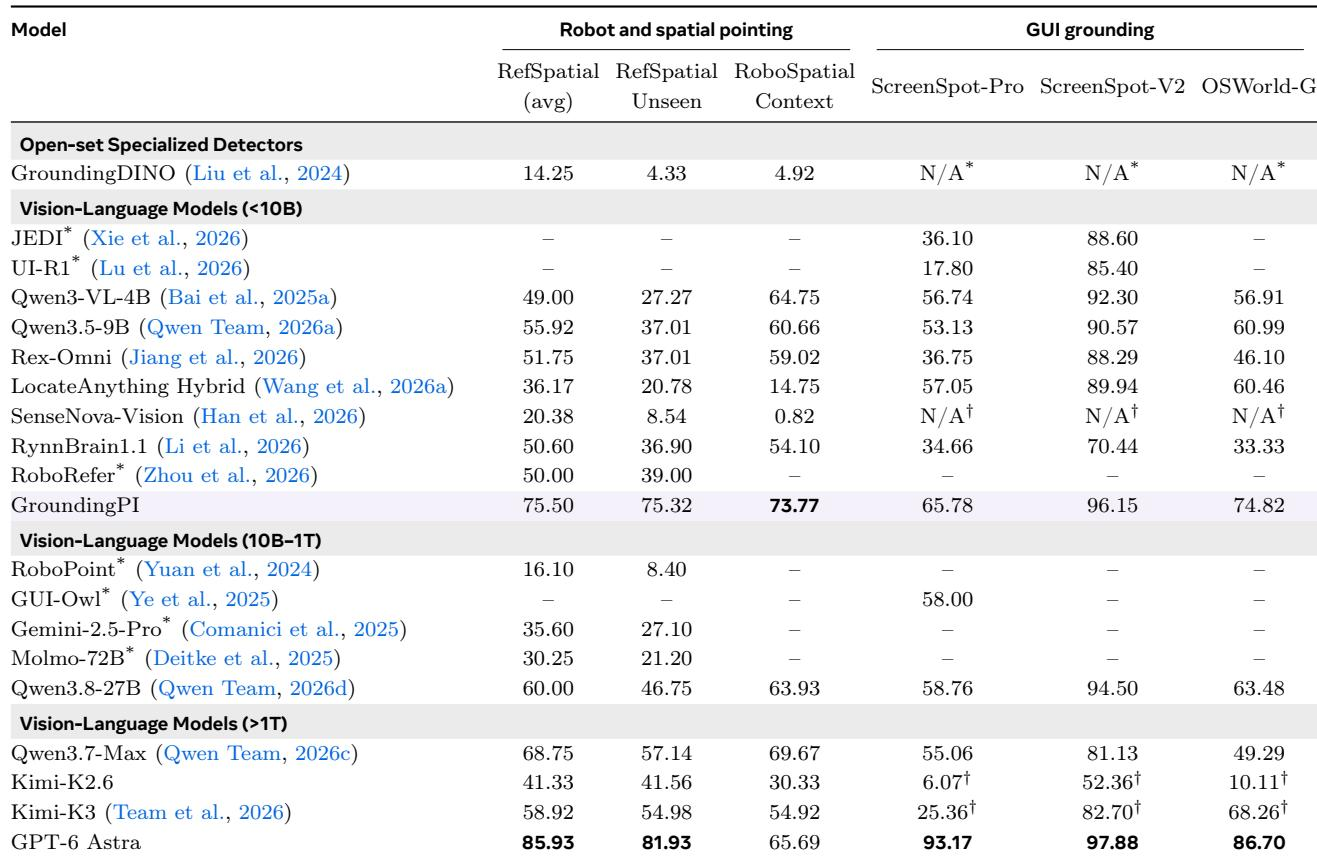
Grounding performance differs sharply across model types and benchmark difficulty. A specialized detector is limited on spatial pointing and lacks GUI grounding coverage, while a general small vision-language model provides the broadest coverage and leads the listed subsets. GroundingPI improves over similarly sized baselines and remains competitive with the frontier reference. A specialized detector trails general vision-language models on spatial pointing and cannot be evaluated on the listed GUI grounding benchmarks. Among sub-10B vision-language models, Qwen3-VL-4B is the only listed model covering both robot/spatial and GUI grounding, and it leads the reported subsets. GUI-focused models perform relatively well on ScreenSpot-V2 but show substantially lower ScreenSpot-Pro accuracy, indicating difficulty on the harder screen grounding benchmark. GroundingPI achieves the highest reported overall average, outperforming similarly sized models and remaining competitive with the frontier reference.
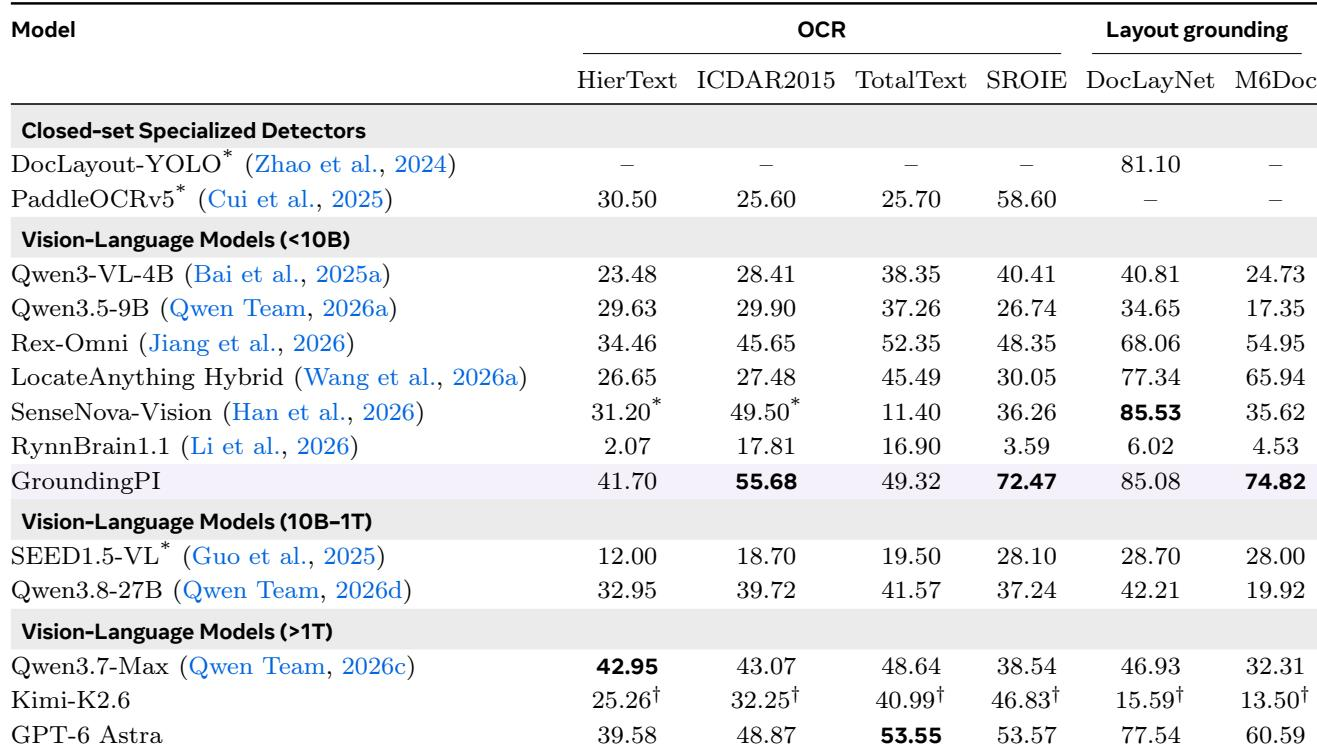
Among the listed OCR and document layout results, DocLayout-YOLO leads document layout by a wide margin, and PaddleOCRv5 has its strongest OCR result on SROIE but lower text detection scores elsewhere. The sub-10B Qwen VLMs trail on document layout, with Qwen3-VL-4B generally outperforming Qwen3.5-9B on SROIE, DocLayNet, and M6Doc while Qwen3.5-9B is slightly stronger on HierText and ICDAR2015. Broader evaluation context reports GroundingPI as competitive with GPT-6 Astra on average grounding performance. DocLayout-YOLO reports the highest listed document layout score and greatly exceeds the Qwen VLM results. PaddleOCRv5 shows its strongest listed OCR result on SROIE, with comparatively low text detection scores on HierText, ICDAR2015, and TotalText. Qwen3-VL-4B outperforms Qwen3.5-9B on SROIE, DocLayNet, and M6Doc, while Qwen3.5-9B performs slightly better on HierText and ICDAR2015.
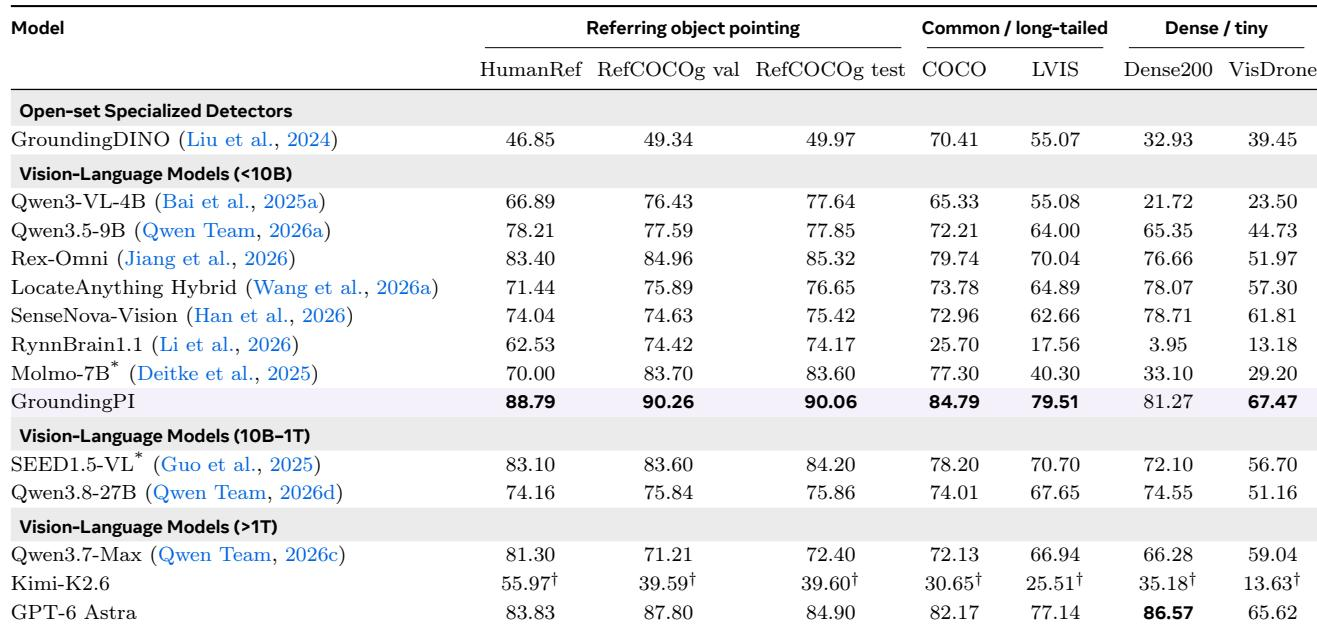
The listed object pointing results show Rex-Omni ahead of the other baselines on every reported benchmark column, with its largest gap over Qwen3.5-9B in the Dense200 scenario. Qwen3-VL-4B is competitive on HumanRef and RefCOCOg but has much lower dense and tiny-object scores. In the broader evaluation, GroundingPI reaches a 73.68% average, outperforming similarly sized models and remaining competitive with GPT-6 Astra at 71.54%. Rex-Omni leads all listed benchmark columns, with Dense200 showing its largest advantage over Qwen3.5-9B among the reported categories. Qwen3-VL-4B performs well on HumanRef and RefCOCOg but trails substantially on Dense200 and VisDrone relative to other listed VLMs.
GroundingPI shows much more compact output serialization than SEED1.5-VL while reporting comparable or higher boxes per image. Its token cost per box is more than an order of magnitude lower on both COCO and Dense200, and total tokens per image remain far smaller even in denser scenes. The pattern indicates efficient per-box encoding with output overhead spread across many boxes. GroundingPI uses more than an order of magnitude fewer tokens per box than SEED1.5-VL on COCO and Dense200. GroundingPI predicts comparable or more boxes per image while keeping total tokens per image substantially lower. Dense outputs amplify the efficiency advantage, with large reductions in serialized tokens per image relative to SEED1.5-VL.

The experiments evaluate GroundingPI across detection and referring grounding, spatial and GUI grounding, OCR and document layout, object pointing, and output token efficiency. GroundingPI reaches a 73.68% average grounding score, outperforming similarly sized models and remaining competitive with the frontier reference, with quantized coordinates and the MoonViT-V2 encoder improving performance. Baseline comparisons show task-specific strengths such as Rex-Omni leading object pointing and DocLayout-YOLO leading document layout, while specialized detectors struggle on dense, tiny-object, and GUI grounding benchmarks. GroundingPI also produces far more compact serialized outputs than SEED1.5-VL, using more than an order of magnitude fewer tokens per box while retaining comparable or higher box predictions.