Command Palette
Search for a command to run...
PPOにおけるクリティック学習の再考:価値平坦化の理解と緩和
PPOにおけるクリティック学習の再考:価値平坦化の理解と緩和
概要
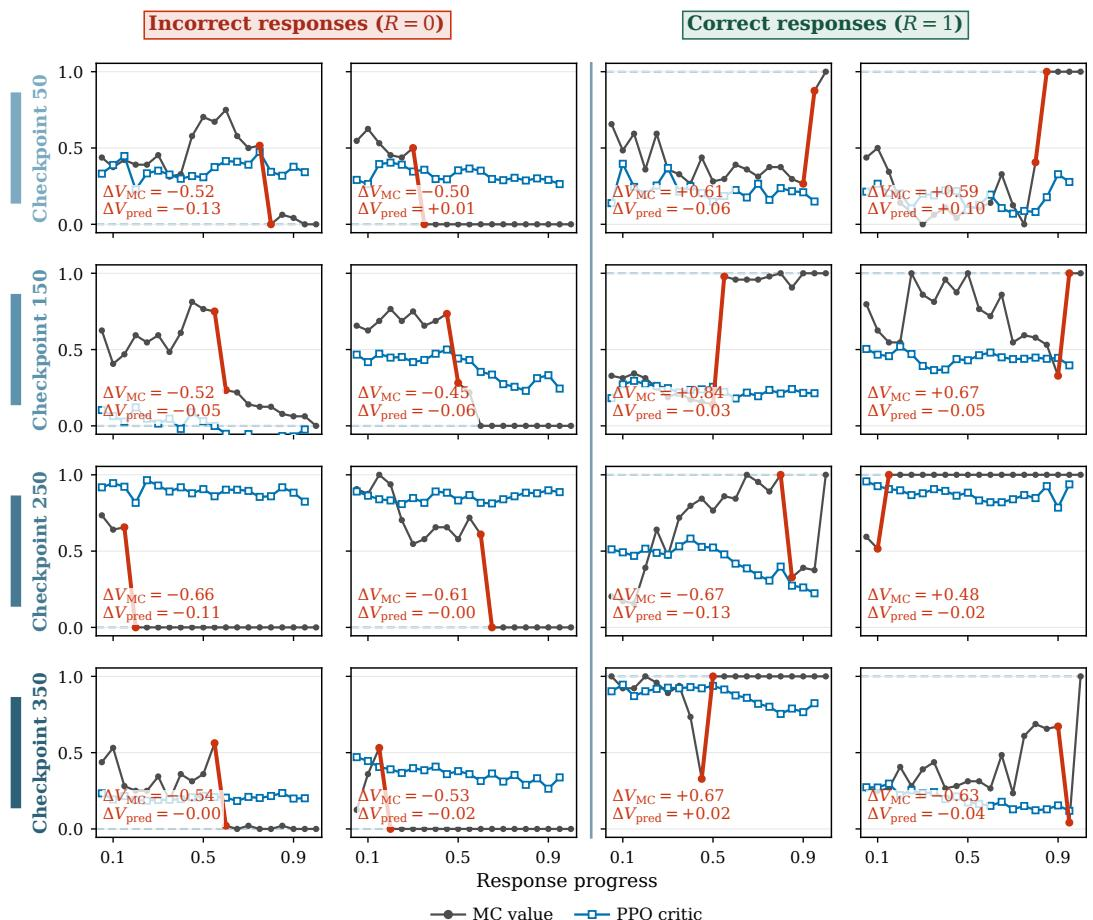
大規模言語モデルの強化学習において、Proximal Policy Optimization (PPO) は一般的に、状態価値を推定し方策更新の分散を低減するためにクリティックを使用する。しかし、我々はPPOクリティックにおける体系的な故障モードを発見し、これを「価値平坦化」(Value Flattening) と呼ぶ。すなわち、複数のモンテカルロ継続から推定された状態価値は、中間状態間で急激に変化する一方で、クリティックの予測は比較的平坦なままである。さらに、この現象を制御されたFrozenLake環境で観察し、状態空間が大きくなるほど顕著になることを見出す。我々の理論的および実証的分析は、価値平坦化をクリティック損失における暗黙の分散ペナルティと、類似した勾配を持つ時間的に相関した状態からの冗長な更新に関連付ける。これらの発見に動機付けられ、我々はSParse Proximal Policy Optimization (SP3O) を導入する。これは、各応答内の少数の適切に分離された状態にのみ価値損失を適用することで、両方の影響を緩和する。Qwen3-Baseでの実験は、応答ごとにわずか3つの状態を監視するSP3Oが価値平坦化を緩和し、モデルサイズと評価スイート全体で学習された方策を一貫して改善することを示す。まとめると、我々の結果は、価値平坦化が標準PPOにおけるクリティック学習の重要でありながら見過ごされた故障モードであることを特定し、単純なスパース監視戦略がそれを緩和できることを示す。
One-sentence Summary
Researchers from Shanghai Jiao Tong University, Shanghai AI Laboratory, Westlake University, Nanjing University, Tsinghua University, The Chinese University of Hong Kong, and Nanyang Technological University identify Value Flattening, a systematic failure in Proximal Policy Optimization (PPO) where critic predictions remain flat despite sharp Monte Carlo value changes across states, and propose SParse Proximal Policy Optimization (SP3O), which applies the value loss to only three well-separated states per response, mitigating this issue and consistently improving policy performance on Qwen3-Base.
Key Contributions
- Identifies and names Value Flattening, a failure mode in PPO critics for large language model reasoning where critic predictions remain flat despite sharp changes in state values estimated from multiple Monte Carlo continuations; the phenomenon is demonstrated in a controlled FrozenLake environment and becomes more pronounced as the state space grows.
- Attributes Value Flattening to two causes: an implicit variance penalty in the critic's mean squared error loss that discourages value differences across token positions, and redundant updates from temporally correlated states with similar gradients, supported by theoretical and empirical analyses.
- Introduces SParse Proximal Policy Optimization (SP3O), which supervises the critic at only a few well-separated states per response to mitigate both effects; experiments on Qwen3-4B-Base and Qwen3-8B-Base show SP3O mitigates Value Flattening and consistently improves actor performance across mathematical and out-of-distribution reasoning benchmarks.
Introduction
Reinforcement learning (RL) is used to train large language models (LLMs) for complex reasoning tasks that require long sequences of decisions. A key challenge in this setup is policy optimization, which needs fine-grained credit assignment: the model must know which intermediate steps helped or hurt the final outcome. Proximal Policy Optimization (PPO) handles this by using a critic network to estimate the value of each state and generate token-level advantages. For this to work, the critic must accurately reflect changes in expected success across different points in a response.
However, the authors find that PPO critics often fail at this task. They observe a phenomenon they call Value Flattening: the critic's predicted state values stay nearly constant within a response, even when the true expected return (estimated using Monte Carlo simulations of multiple continuations) changes sharply. This issue persists across training checkpoints and is present in both correct and incorrect responses, suggesting it is a learned property of the critic rather than an artifact of specific trajectories. In controlled FrozenLake experiments, the flattening becomes more severe as the state space grows.
The authors identify two contributing factors. First, the critic's mean squared error (MSE) loss, applied at every token position under standard PPO with terminal-only rewards, includes an implicit variance penalty that pushes predictions toward a flat value profile. Second, since neighboring states differ by only one token, they are highly temporally correlated, leading to similar gradients and redundant updates that further homogenize predicted values.
To address this, the authors propose SParse Proximal Policy Optimization (SP3O), which applies the critic loss at fewer, widely separated states. This restricts the variance penalty and reduces redundant updates. Experiments on Qwen3-4B-Base and Qwen3-8B-Base show that SP3O mitigates Value Flattening and consistently improves policy performance on mathematical and out-of-distribution reasoning benchmarks.
Method
The authors leverage Proximal Policy Optimization (PPO) as the foundational framework for aligning large language models. In this setup, a policy πθ generates a response y=(y1,…,yT) given a prompt x, forming a trajectory τ. The state at step t is defined as st=(x,y<t) and the action as at=yt. The framework employs a critic network Vϕ(st) to estimate the policy-conditioned state value. Under a terminal reward setting where rt=0 for t<T and rT=R(τ), the generalized advantage estimation targets simplify such that the critic regression target Gt equals the terminal return R(τ) for all t. The standard critic is trained by minimizing the mean squared error between its predictions and these targets across all token positions in the response.
However, the authors identify a critical failure mode in this standard approach termed Value Flattening. Despite Monte Carlo estimates of state values exhibiting sharp local transitions during reasoning, the critic's predicted value profile remains comparatively flat, failing to capture the magnitude and direction of these changes.
The authors attribute Value Flattening to two primary factors inherent in the standard training process. First, applying the mean squared error loss at every token position with a shared terminal target introduces an implicit variance penalty, which directly penalizes variation in the critic's predictions within a single response. Second, because adjacent states in an LLM trajectory differ by only one token, they are highly temporally correlated. Supervising all positions leads to redundant updates from neighboring states that produce aligned gradients, further suppressing value variation.
To mitigate these issues, the authors propose SParse Proximal Policy Optimization (SP3O). This method retains the standard actor objective and rollout procedure but fundamentally alters the critic supervision strategy. Instead of applying the value loss at every token, SP3O restricts the critic loss to a small, well-separated subset of states I(τ) within each trajectory. The sparse critic objective is formulated as:
LVSP3O(ϕ)=∑τ∈B∣I(τ)∣1τ∈B∑t∈I(τ)∑(Vϕ(st)−Gt)2By selecting fewer positions, the per-response variance penalty is restricted, and by spacing them apart, the accumulation of aligned gradients from highly correlated neighboring states is reduced.
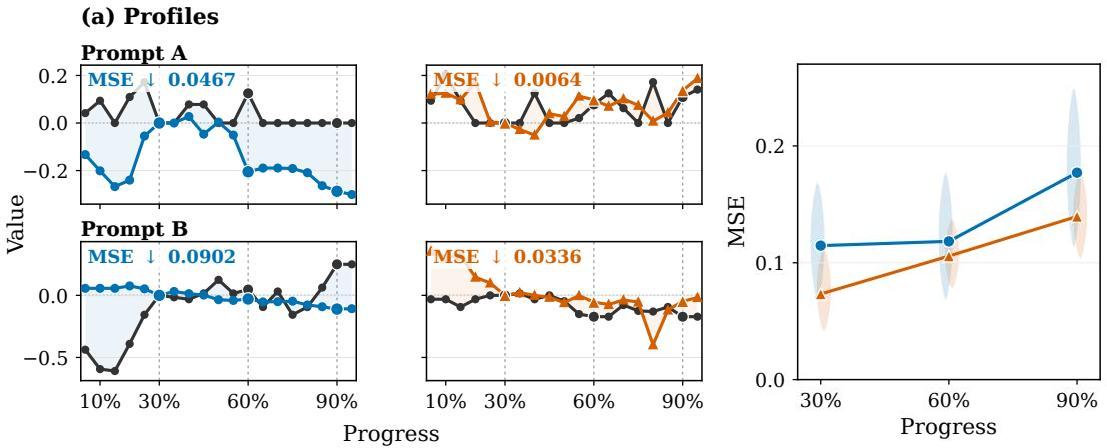
The impact of this sparse supervision is evident in both critic predictions and optimization dynamics. When compared to standard PPO, the SP3O critic more closely tracks the direction and magnitude of local changes in Monte Carlo values, significantly reducing the profile mean squared error across response progress.
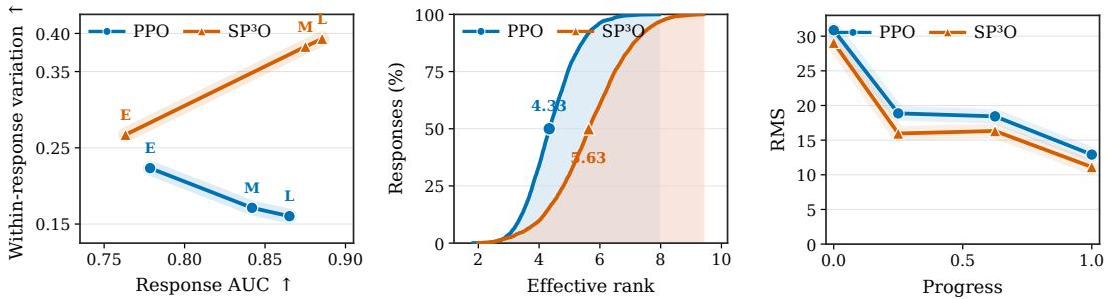
Furthermore, sparse supervision preserves richer hidden representations and reduces redundant updates. The SP3O critic achieves higher within-response variation while maintaining response-level outcome discrimination, and it shifts the effective rank of response-centered hidden states upward, indicating greater dimensional diversity. Additionally, it exhibits lower RMS discrepancy between value-head gradients induced by terminal-return targets and Monte Carlo values, leading to smoother actor optimization throughout training.
Experiment
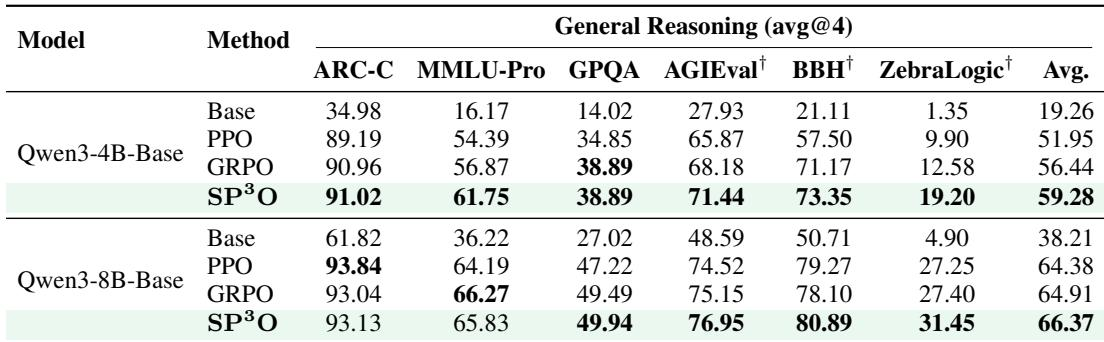
SP3O, which applies sparse critic supervision with explicit late-tail coverage, consistently outperforms standard PPO and GRPO on both in-domain and out-of-distribution reasoning benchmarks across Qwen3-4B-Base and Qwen3-8B-Base. Ablations show that a small number of well-spaced supervision anchors (K=3 to 8) yields better training rewards than denser supervision, and that fixed-position placement outperforms random placement. Adding a tail anchor specifically improves both final performance and generation stability by reducing repetition, indicating that mitigating critic value flattening enhances policy learning rather than just critic diagnostics.
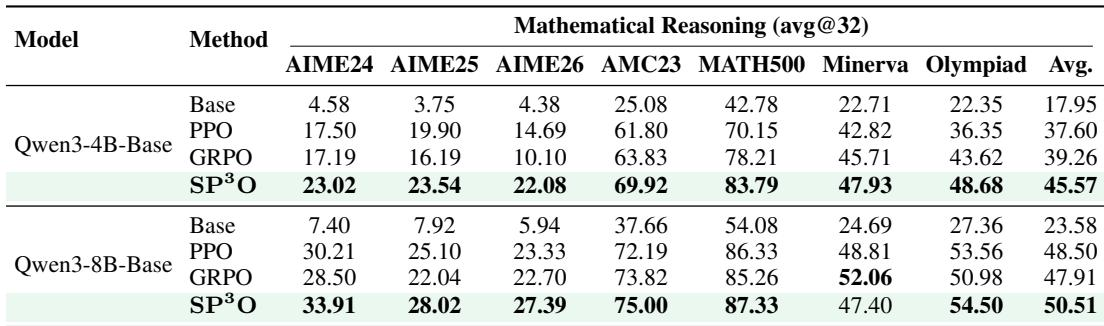
The proposed method consistently improves in-domain mathematical reasoning accuracy over both PPO and GRPO baselines across two model sizes, with the largest gains observed on the Qwen3-4B model. The approach also yields more stable training dynamics, as indicated by smaller actor updates and higher validation accuracy compared to standard PPO. Sparse supervision with a few well-placed anchors appears to be more effective than dense supervision, and adding a tail anchor notably improves performance and reduces repetition. The method outperforms both PPO and GRPO on the average across seven mathematical reasoning tasks for both 4B and 8B models. The performance gain over PPO reaches nearly 8 percentage points on the in-domain average. Training with the method shows smaller and less variable actor updates than PPO, along with higher validation accuracy and rollout reward after the early stage. Sparse supervision with a small number of anchors (K=3 to 8) yields better training rewards than denser configurations or standard token-level critic supervision. Adding a final tail anchor improves the average score and drastically reduces generation repetition compared to omitting it.
SP³O consistently outperforms both PPO and GRPO on out-of-distribution reasoning tasks across two model sizes, with the largest gains over PPO. The method also leads to more stable training dynamics, characterized by smaller actor updates and improved validation accuracy compared to PPO. SP³O achieves the highest average accuracy on all six out-of-distribution tasks for both Qwen3-4B-Base and Qwen3-8B-Base. The improvement of SP³O over PPO is especially large on the ZebraLogic task, while gains on other tasks are more modest. SP³O shows consistent gains over GRPO, particularly on tasks like MMLU-Pro and AGIEval. Training with SP³O exhibits more stable policy updates and maintains higher validation accuracy than PPO after the early training phase.
This ablation study compares different anchor placement strategies for sparse-supervision training on Qwen3-4B-Base with K=3. Fixed-position anchor placements substantially outperform random placement in accuracy, and the fixed scheme with later anchors achieves the highest performance, highlighting the importance of well-spaced coverage of the trajectory. Random anchor placement yields the lowest accuracy among the compared schemes, underperforming both fixed-position placements. The fixed anchor placement at 0.2/0.5/0.8 improves accuracy by a large margin over the random baseline, from about 36.6% to 44.7%. Shifting the anchors later (0.3/0.6/0.9) further boosts accuracy to 45.6%, the best among all placement variants.
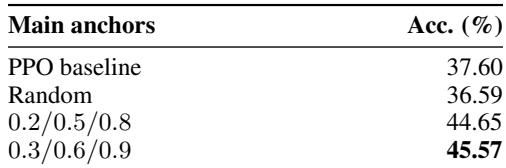
The proposed method consistently outperforms PPO and GRPO on both in-domain and out-of-distribution mathematical reasoning tasks across 4B and 8B models, with the largest gains over PPO, and it also yields more stable training dynamics as indicated by smaller actor updates and higher validation accuracy. Sparse supervision with a small number of well-placed anchors is more effective than dense supervision, and adding a final tail anchor substantially improves accuracy while reducing generation repetition. An ablation on anchor placement confirms that fixed-position schemes outperform random placement, with later anchors providing the best results.