Command Palette
Search for a command to run...
Mi-Ripple: 反復的AI編集により劣化した画像の復元
Mi-Ripple: 反復的AI編集により劣化した画像の復元
Jiayin Chen Yicheng Xu Muting Wang
概要
反復的な参照条件付き画像編集は、デジタルリップルと一般に称される格子状および粒状のテクスチャを導入しうる。我々は、画像構造を保護しつつこのデジタルリップルを抑制する、診断誘導型復元ワークフローMi-Rippleを提案する。Mi-Rippleは、周期的な格子アーティファクトを内容に絡みついた粒状テクスチャから分離した後、選択的スペクトルノッチフィルタリング、構造認識平滑化、および清浄化参照画像の再生成を組み合わせる。この分離により、アーティファクトがスペクトル的に孤立している場合には低歪みのフィルタリングが可能となり、フィルタリングが正当な詳細を消去してしまう場合には視覚的再構築が可能となる。ノッチフィルタのみを適用した14回の実行において、画像全体の残差標準偏差はCIELAB明度単位で0.08~0.44であった。一対比較による再生成の事例では、参照画像の清浄化により出力に含まれる破片状ノイズの密度が45%低減した。Mi-Rippleは、単にスペクトルスコアを最適化するのではなく、測定可能なアーティファクト低減を視覚的により清浄な生成画像へと結びつける。
One-sentence Summary
Researchers from Miyang Technology, Chinese Academy of Sciences, and Shanghai Jiao Tong University propose Mi-Ripple, a diagnosis-guided restoration workflow that suppresses digital ripple artifacts from iterative AI editing by separating periodic lattice artifacts from content-entangled granular texture and applying selective spectral notching, structure-aware smoothing, and cleaned-reference regeneration, achieving whole image residual standard deviations of 0.08–0.44 in CIELAB lightness units across fourteen notch-only executions and a 45% reduction in output debris density in a paired regeneration example, linking measurable artifact reduction to visibly cleaner images.
Key Contributions
- A diagnosis-guided restoration workflow separates periodic lattice artifacts from content-entangled granular texture in iterative reference-conditioned image editing, enabling artifact-specific treatment decisions.
- The workflow combines selective spectral notching for isolated peaks, structure-aware smoothing, and cleaned-reference regeneration to suppress digital ripple while protecting legitimate image structure.
- Across fourteen notch-only executions, whole-image residual standard deviation is 0.08–0.44 in CIELAB lightness, and a paired regeneration example reduces output debris density by 45%, linking measurable artifact reduction to visibly cleaner images.
Introduction
Iterative reference-conditioned image editing can propagate structured artifacts such as grids, honeycomb patterns, and granular surfaces that become visible at native resolution, a phenomenon the authors term digital ripple. Prior work largely focused on detecting synthetic images or explaining artifact formation at the architectural level, not on restoration in recursive editing pipelines, leaving open whether spectral contamination can be removed without harming legitimate detail or is entangled with scene content. The authors introduce a diagnosis-driven restoration workflow that distinguishes lattice artifacts (isolated spectral peaks) from content-entangled granular texture, applying selective notch filtering with distortion verification for the former and cleaned-reference regeneration for the latter, thereby recovering clean surfaces while preserving real texture.
Dataset
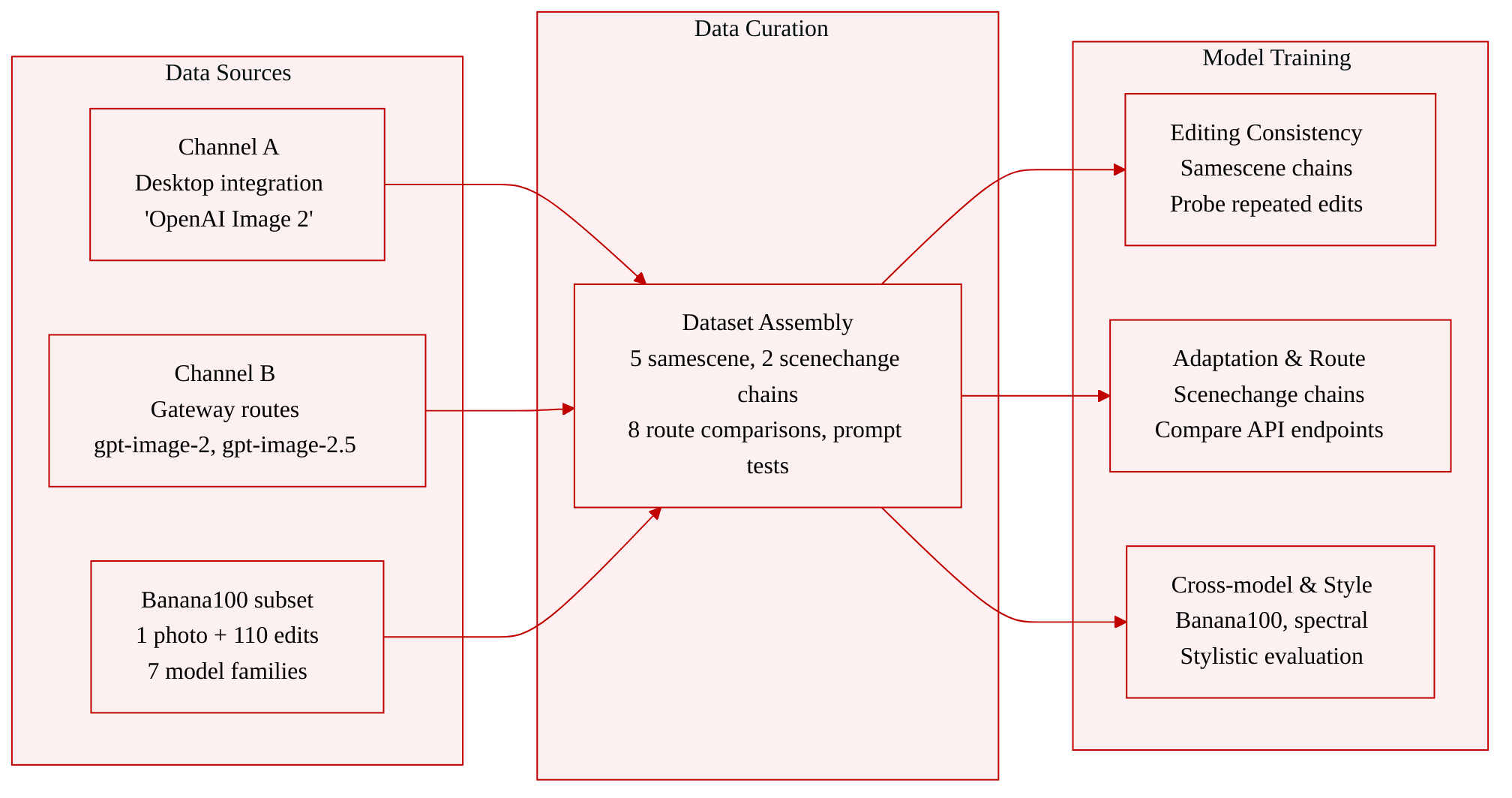
The authors construct a custom image-editing dataset by interacting with two commercial editing channels, without access to model internals. The data is used exclusively for experimental analysis, not for model training.
-
Sources and access conditions
- Channel A: a desktop integration advertised as “OpenAI Image 2.”
- Channel B: an OpenAI-compatible gateway that exposes routes named
gpt-image-2andgpt-image-2.5. - Both channels are treated as sampled access points, not as independent models or a vendor ranking.
-
Dataset composition and subsets
- Samescene chains (Channel B): 5 chains, each containing an initial output (gen0) and four edits (gen1–gen4). The prompt stays unchanged and the previous output is reused as input.
- Scenechange chains (Channel A): 2 chains, each with gen0 and four edits, where the scene changes across edits.
- Prompt comparisons: 2 foliage-rich scenes used to compare editing behaviour under different prompts.
- Route comparison: 8 scenes edited through both
gpt-image-2andgpt-image-2.5routes. - Ancillary material: 4 photographs, 5 web references, 15 generated images for a spectral survey, 4 fixed-condition repeats, and 6 watercolour portrait originals for a pipeline case series.
- External evidence (Banana100
more_modelssubset): 1 starting photograph and 110 edited outputs from 7 model families, organised into 11 ten-step sequences that include different-chat and same-chat variants.
-
How the data is used
- The chains are the core experimental units: samescene chains probe consistency under repeated editing, scenechange chains test adaptation to new prompts, and route comparisons highlight differences between API endpoints.
- Prompt comparisons and the spectral survey investigate stylistic and structural properties of the outputs.
- The Banana100 subset provides external evidence for cross-model analysis.
- No training split or mixture ratios apply; all data serves qualitative and quantitative evaluation of editing behaviour.
-
Processing and metadata
- No explicit cropping strategy is mentioned. The outputs are used as generated, with gen0 marking the initial image and gen1–gen4 the sequential edits.
- Metadata consists of the generation index, chain type (samescene/scenechange), source channel/route, and prompt conditions.
Method
The authors propose a diagnosis-guided restoration workflow comprising three sequential stages: diagnosing the artifact, filtering or regenerating from a cleaned reference, and verifying the resulting candidate. This pipeline distinguishes between deliverable-grade filtering, which preserves pixel alignment, and reference-grade cleaning, which prepares an input for regeneration. This separation allows for stronger reference preparation without presenting it as a finished image.
In the first stage, complementary spectral and spatial probes determine the appropriate restoration route. All lightness measurements utilize the CIELAB L* scale from 0 to 100. For a lightness patch P and a Hann window w, the authors define the spectral amplitude as:
S=log(1+F[(P−Pˉ)w]),A(u,v)=S(u,v)−B(r)where B(r) is the median log-amplitude at radius r. The baseline survey uses the median peak across 384-pixel flat patches per image. Autocorrelation of high-passed lightness supplies a separate period estimate.
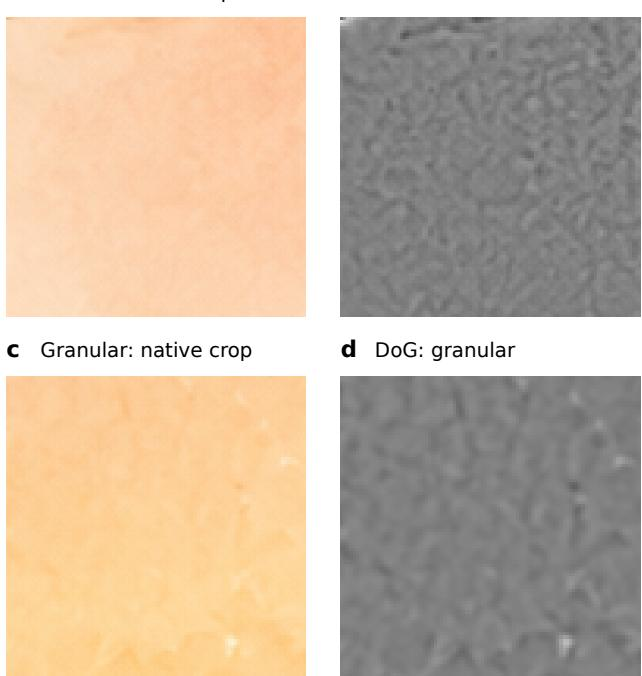
To differentiate between artifact types, the whole-image lattice probe uses a 21×21 local median of the log-amplitude spectrum. It retains connected components with an excess above 1.2, outside radius 24, and support of at most 80 frequency bins. Diagnosis requires at least two retained components and a largest excess of at least 2.5. A flat-window probe tests 96-pixel windows for band-pass strength, excess kurtosis, blob coverage, and isotropy, while a complementary whole-frame scale index reports the percentage of qualifying 128-pixel tiles. The nominal 3 to 8-pixel band isolates diagnostic texture but imposes a size preference, so periodicity is checked separately without that band-pass. Granular regions exhibit weak autocorrelation maxima at inconsistent displacements, whereas the lattice produces repeatable period vectors. Directional rendering changes are treated separately from both forms. Visual examples of these distinct artifact manifestations are presented below.
In the second stage, the pipeline either filters the image or regenerates it from a cleaned reference. For a lattice artifact, isolated-peak notching uses the diagnostic probe's component-selection criterion. Let K indicate retained components and E be their positive excess above the local baseline. With Gaussian feathering G1.5, the filtered spectrum is:
F=Fexp[−G1.5(KE)]This operation preserves phase and normally modifies lightness alone, using reflection padding to reduce boundary effects. Compact-peak selection avoids the extended spectral ridges associated with directional image content. For granular texture, which lacks isolated peaks for notching, a strict mask based on edge strength, orientation coherence, and texture density permits local band reduction while protecting structure. Where artifacts overlap legitimate foliage or material texture, the pipeline requests human review rather than increasing filtering strength. When content reconstruction is acceptable, reference-grade cleaning permits broader suppression before regeneration, with explicit face protection. The regenerated output is diagnosed again, and newly introduced isolated lattice peaks can be notched.
The final stage verifies distortion and records the decision. Acceptance relies on image differences rather than the anomaly score optimized by the filter. Structural windows must have a residual standard deviation of at most 0.6 lightness units and high-frequency retention of at least 90%. Retention is the output-to-input ratio of SD(L−G1L), where G1 is Gaussian smoothing with a standard deviation of one pixel. The flat-window band-pass standard deviation must not increase by more than 0.02, and the whole-image residual standard deviation must not exceed 1.0. These empirical checks measure filtering damage, and human review determines whether to adopt the candidate. Rule-based routing serves as the default implementation, with an optional language-model layer selecting among permitted actions without changing numerical thresholds. Execution records retain observations, allowed actions, decisions, and verification results. Regeneration requires explicit permission and a bounded retry count.
Experiment
The evaluation setup uses native-resolution periodicity measurements, cross-resolution Lanczos downsampling, and normalized multi-scene chains to assess artifact signatures and restoration routes. Restoration experiments demonstrate that selective frequency notching and reference cleaning can reduce visible grain and lattice artifacts, but the appropriate route depends on whether the artifact is separable from image content; dense, entangled regions require masked suppression or regeneration. Characterization reveals that lattice signatures are strongly configuration-dependent and not predictable from vendor labels, while granular texture is linked to scene content and repetition, with prompt-based texture constraints failing to provide a consistent control.
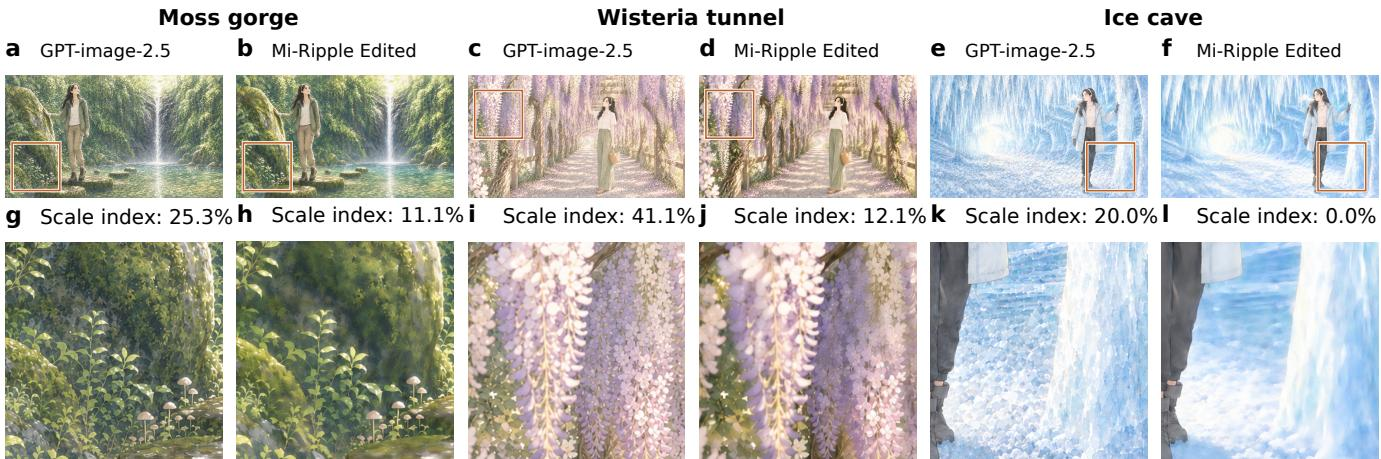
Generated images exhibit elevated spectral anomalies compared to photographic controls, and granular scale texture can accumulate across same-scene iterations. Targeted regeneration and notching treatments reduce structured texture, while portrait restoration preserves identity-bearing hair structure with high retention. Generated-source controls show median spectral anomalies of 4.13–4.61, substantially higher than the 1.73 observed in photographic controls. Same-scene moss chains increase granular coverage from 0.9% to 23.7%, while face chains remain at 0.0% qualifying scale tiles.
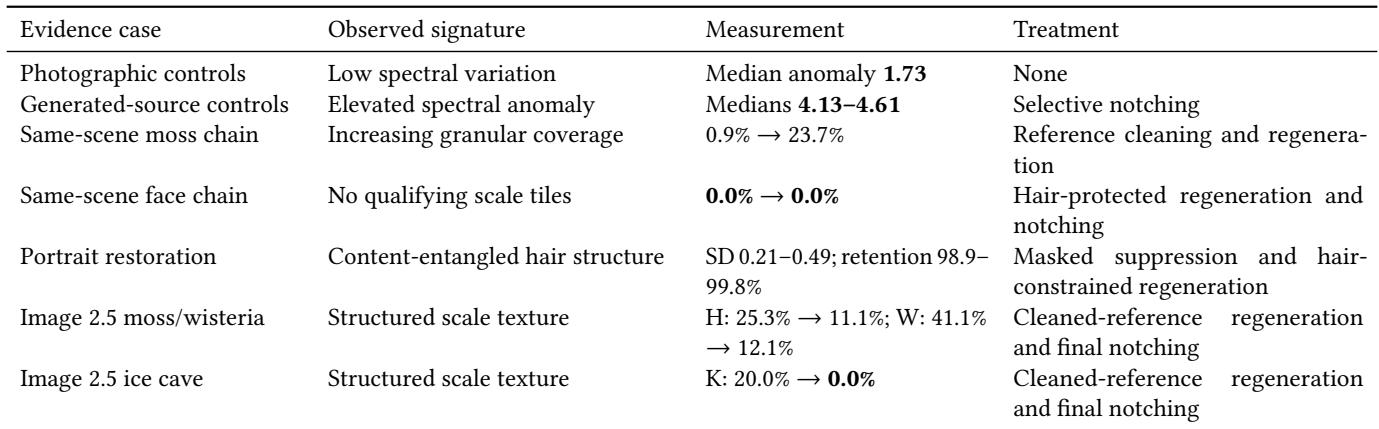
Experiments compare generated images against photographic controls, revealing that generated outputs exhibit higher spectral anomalies and accumulate granular texture across same-scene iterations. Targeted regeneration and notching treatments effectively reduce structured texture, while portrait restoration preserves identity-bearing hair structure with high fidelity. These findings highlight the presence of spectral artifacts in generated images and demonstrate that iterative same-scene generation amplifies granular coverage, though interventions can mitigate these effects.