Command Palette
Search for a command to run...
マッチングには二者が必要:共進化する生成型検索モデルと強化学習
マッチングには二者が必要:共進化する生成型検索モデルと強化学習
Runpeng Dai Kaili Huang Changsung Kang Ciya Liao
概要
検索は現代の検索・広告システムの第一段階であり、大規模なアイテム集合から候補集合を選び出し、後段のランキングやオークションに渡す役割を担う。近年の研究では、クエリ拡張、データ合成、検索フィードバック訓練を通じて検索を改善するために大規模言語モデル(LLM)を活用する事例が増えている。しかし、生成コンポーネントは主にクエリ側の拡張に用いられ、最終的なマッチングは依然として後段の検索器に委ねられている。本研究では、LLMを訓練してクエリ側とアイテム側の両方で直接検索表現を構築させる検索フレームワークCoGRを提案する。各生成器はコンパクトなキーワード集合を生成し、これらを転置インデックスを通じて直接マッチングすることで、既存のキーワードベース検索基盤との互換性を維持する。CoGRは2段階の訓練パイプラインを採用する。まず教師ありファインチューニングによって整合性のあるキーワード空間を確立し、その後、共進化的強化学習により、クエリ側とアイテム側の生成器を、相手側の凍結されたインデックスに対してGRPOを用いて交互に最適化する。両者は同一のクエリ対アイテム検索のF1値を目的関数として最適化する。クエリ側は検索F1値を直接受け取り、アイテム側は自身の生成キーワードによって引き起こされたクエリ側F1値の変化を測る反実仮想限界報酬を受け取る。代表的なスパース、デンス、生成型の10のベースラインと比較し、CoGRは社内アプリマーケットプレイスデータセットと公開ベンチマークWANDSの両方で最高性能を達成し、最強のベースラインに対してF1値をそれぞれ10.9%と36.1%改善した。さらなる分析により、安定した共進化と、訓練を通じて次第に整合性が高まるクエリとアイテムのキーワード空間が示された。
One-sentence Summary
Researchers from the University of North Carolina at Chapel Hill and Apple propose CoGR, a retrieval framework where LLMs generate keywords for both queries and items, matched via an inverted index, and co-evolve through reinforcement learning with GRPO, optimizing retrieval F1 via direct and counterfactual marginal rewards, achieving state-of-the-art F1 improvements of 10.9% on an APP Marketplace dataset and 36.1% on WANDS.
Key Contributions
- CoGR is a generative retrieval framework where LLMs directly produce keyword sets for both queries and items, enabling end-to-end matching through an inverted index without a downstream retriever.
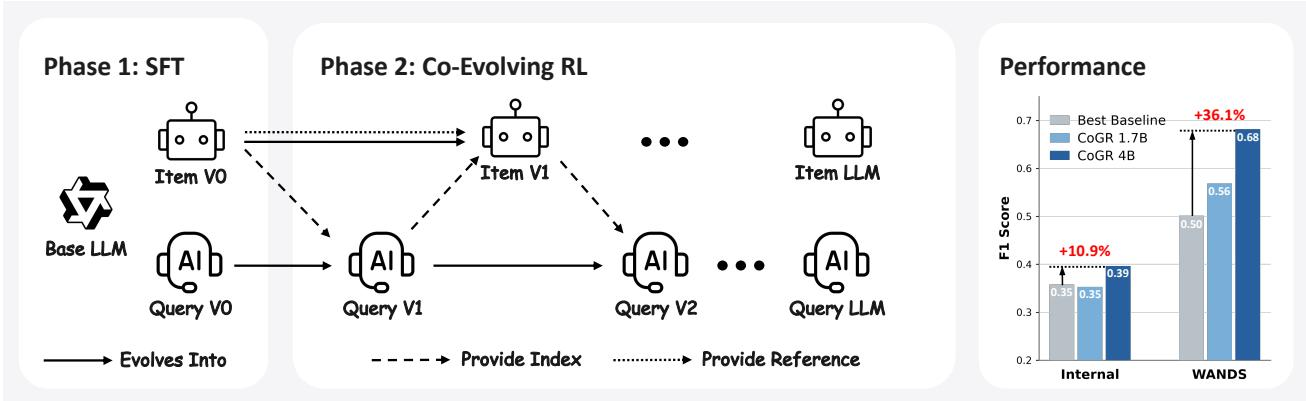
- The framework uses a two-stage training pipeline that first aligns keyword spaces via supervised fine-tuning, then alternately optimizes query and item generators with GRPO reinforcement learning against a frozen opposite-side index under a shared retrieval F1 objective.
- Experiments on an internal APP Marketplace dataset and the public WANDS benchmark show that CoGR outperforms ten sparse, dense, and generative baselines, improving F1 by 10.9% and 36.1% over the strongest baseline, with analysis confirming stable co-evolution and increasingly aligned query-item keyword spaces.
Introduction
Retrieval is the critical first stage in search and recommendation systems, where errors are irreversible: missing an item cannot be recovered later, while irrelevant candidates burden downstream ranking. Classical lexical methods like BM25 rely on exact term matches but struggle with deeper semantic relationships, and dense retrieval maps queries and items into continuous vector spaces, while generative retrieval predicts identifiers autoregressively but faces scalability and generalization challenges. Recent work uses large language models (LLMs) to improve retrieval through query expansion or keyword generation, yet these approaches typically train only the query side and still depend on a separate retriever for matching. The authors propose CoGR, a co-evolving generative retrieval framework that trains separate LLMs to generate compact keyword sets for both queries and items, enabling direct matching via an inverted index. They address the core challenge of aligning the two keyword spaces through a two-stage pipeline: supervised fine-tuning initializes aligned representations, and alternating reinforcement learning with GRPO optimizes each side against a frozen opposite-side index using a shared retrieval F1 reward, allowing the keyword spaces to co-adapt progressively.
Dataset
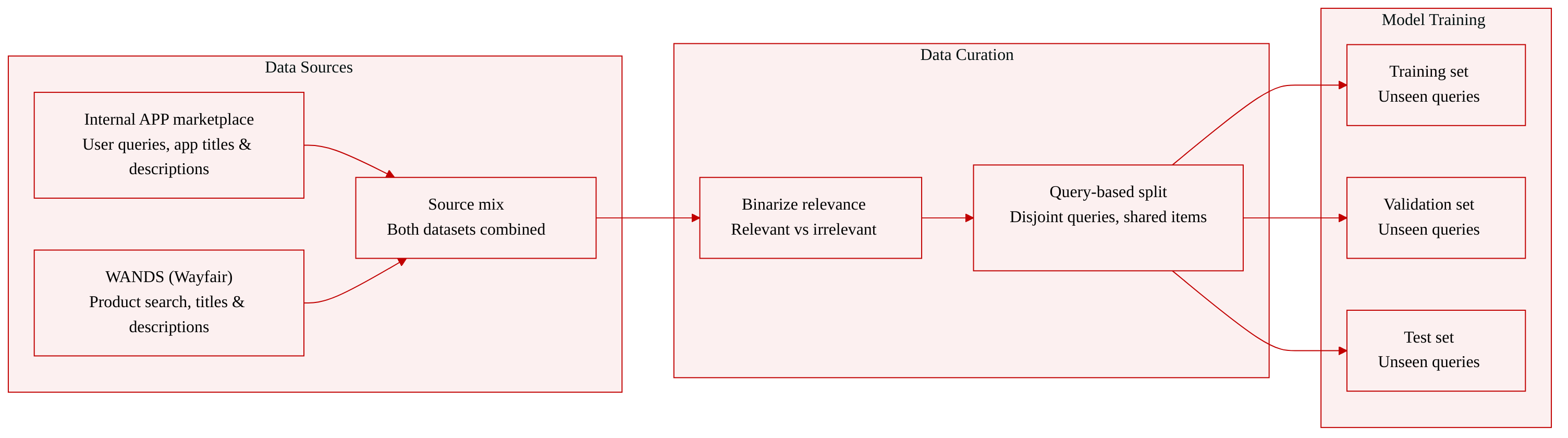
The authors use two industrial search datasets, both containing many relevant items per query to better reflect practical retrieval settings.
-
Dataset sources and composition
- Internal APP marketplace dataset: de-identified, randomly sampled user queries; each item is an application represented by its title and description.
- WANDS (Wayfair): a public product-search dataset where each item is a product, also represented by title and description.
-
Key details for each subset
- Both datasets provide categorical relevance annotations for (query, item) pairs.
- Annotations are binarized into relevant and irrelevant classes (details in Appendix A).
- The full item universe is retained for both training and validation.
- Dataset statistics (including the number of relevant items per query) are summarized in Table 1 of the paper.
- No explicit size or filtering rules beyond binarization are described in the text; the internal dataset is randomly sampled, and WANDS is used as-is.
-
Data processing and usage
- The data is split only along the query dimension, so training and validation sets contain disjoint queries but share the same item catalog.
- This split ensures that validation performance reflects generalization to unseen queries.
- No cropping or additional metadata construction is mentioned; items are used with their title and description text.
- The paper does not specify mixture ratios or other training-split details beyond the query-based split.
Method
The authors propose CoGR, a retrieval framework that generates keywords for both queries and items to perform keyword-based matching. Given a query q∈Q and an item i∈I, two separate keyword generators, Gq and Gi, produce keyword sets Sq=Gq(q) and Si=Gi(i). The retrieved item set is defined as Iret(q)={i:(Sq∪{q})∩(Si∪{i})=∅}. To enable retrieval ranking, the keyword sets are treated as bags of words, and items are ranked using BM25 scores.
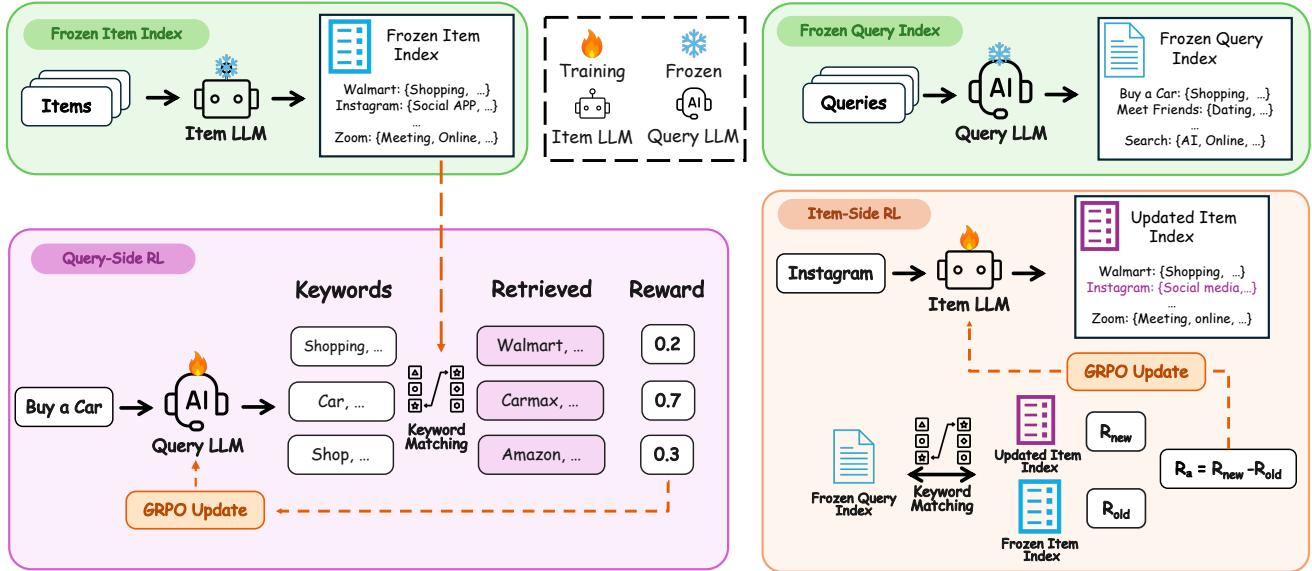
The training pipeline consists of two stages: a supervised fine-tuning (SFT) stage to initialize the generators, followed by a reinforcement learning (RL) stage to optimize retrieval quality. The alternating training paradigm of the RL stage is illustrated in the figure below:
Phase 1: Initialization with Supervised Fine-Tuning The SFT stage establishes an aligned keyword space and provides a meaningful initialization for the RL phase. For each item i, the original LLM generates an initial item-side keyword set Si. To construct query-side targets, the authors collect relevant items for each query q, pool their initial item-side keywords, and select the top-N most frequent keywords as the target set Sq. This ensures keyword overlap between relevant query-item pairs. The query-side generator Gq and item-side generator Gi are then trained on {(q,Sq)} and {(i,Si)} respectively, yielding initialized policies GSFTq and GSFTi.
Phase 2: Co-Evolving Reinforcement Learning Following initialization, the RL stage optimizes the generators directly for retrieval quality using an alternating training paradigm. The query-side and item-side generators are updated in turn, while the inverted index from the opposite side remains frozen. This allows each generator to optimize against a fixed retrieval environment.
Query-Side RL Given the frozen item indexes, the query-side generator produces a keyword set Sq for each query q. The retrieved set Iret(q) is evaluated using the F1 score to balance precision and recall:
P(q)=∣Iret(q)∣∣rel(q)∩Iret(q)∣,R(q)=∣rel(q)∣∣rel(q)∩Iret(q)∣,F1(Iret(q),rel(q))=P(q)+R(q)2P(q)R(q)To constrain the output length, a maximum keyword budget Kmax is imposed. The reward function is defined as:
Rq(Sq)={F1(Iret(q),rel(q)),0,∣Sq∣≤Kmax∣Sq∣>KmaxFollowing the GRPO paradigm, multiple keyword sets are sampled for each query, and the rewards are normalized within each rollout group to compute relative advantage signals for optimization.
Item-Side RL Item-side RL refines item keywords by evaluating the marginal contribution of a candidate keyword set Si to the overall retrieval quality. At the start of each update round, the query-side index is frozen. A counterfactual index is constructed by replacing only the reference keywords of item i with Si. The item-side reward is defined as the difference in aggregate retrieval quality between the counterfactual and reference indexes:
Ri(Si)={∑q∈QF1(Iretcand(q;Si),rel(q))−∑q∈QF1(Iretref(q),rel(q)),−1,if ∣Si∣≤KmaxotherwiseThis difference-based formulation isolates the effect of Si and enables efficient computation by only evaluating queries whose F1 scores change.
Co-Evolving Process The RL phase iteratively alternates between query-side and item-side optimization. Starting from the post-SFT models, each side is optimized against an index built by the latest model of the other side. This co-evolution process allows the two generators to progressively adapt to each other's keyword space, jointly evolving to improve overall retrieval quality. The framework remains flexible, allowing the F1 reward to be replaced by a weighted F-measure if precision and recall have different business priorities.
Experiment
The method is evaluated on two industrial search datasets with binarized relevance, comparing against sparse, dense, and generative retrieval baselines. Experiments show that the co-evolving reinforcement learning process jointly aligns query and item keyword spaces, yielding the strongest and most consistent retrieval performance. Ablations confirm that each component (marginal item-side reward, separate generators, SFT initialization) contributes to the gains, while keyword evolution analysis reveals a shift toward more specific, multi-word phrases and balanced vocabularies. The framework also benefits from richer textual context, such as item descriptions and external search results.
The internal app marketplace dataset is substantially larger in query volume, with 13,500 training queries compared to 430 in WANDS, while both datasets cover a similar item universe of roughly 40,000 items. The internal dataset also exhibits a much higher density of relevant items per query, averaging around 1,000, versus approximately 200 for WANDS. The internal dataset contains roughly five times more relevant items per query than WANDS (≈1,000 vs ≈200). Both datasets have comparable item universes of about 40,000 items, but the internal dataset provides over 30 times more training queries.

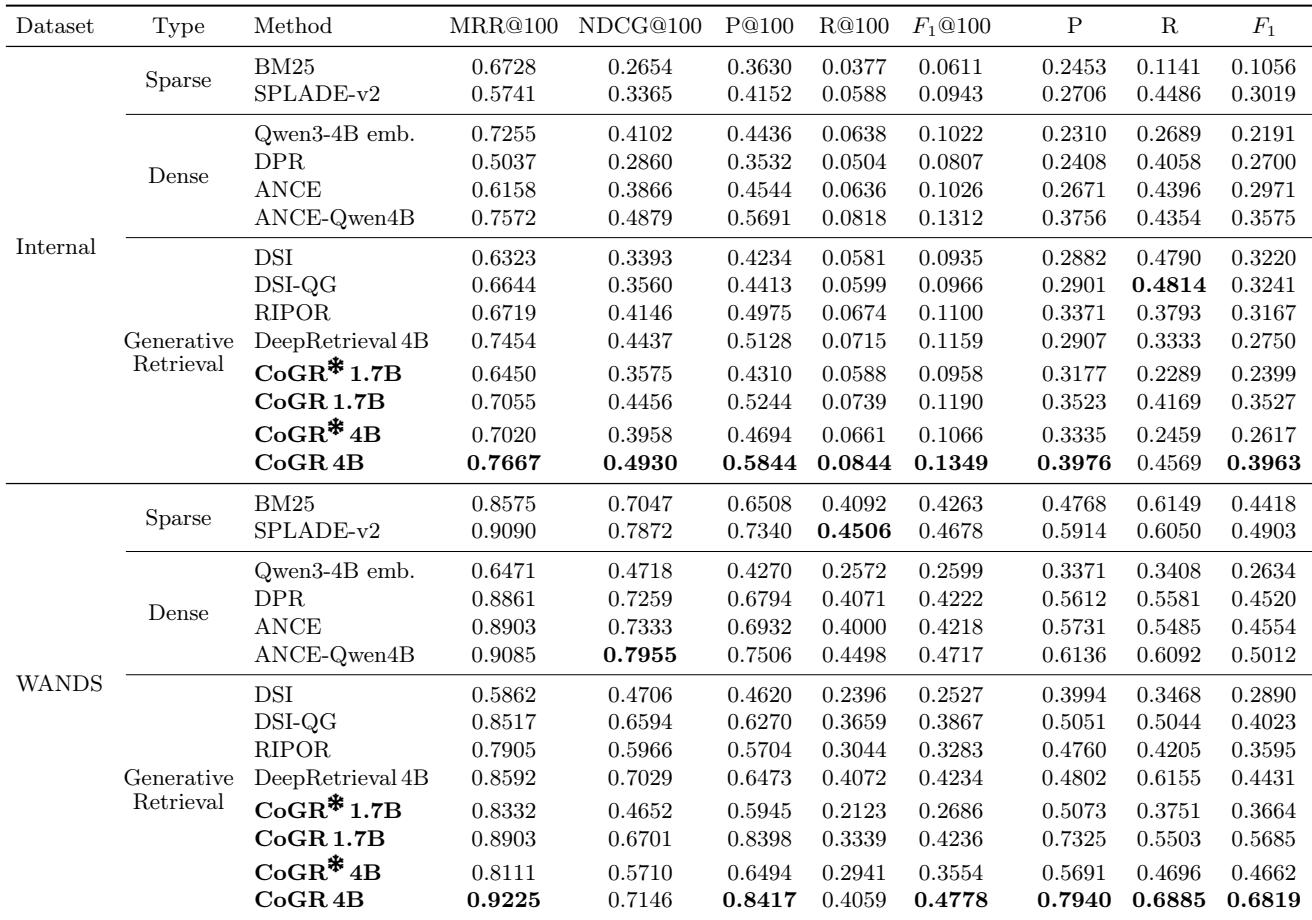
CoGR achieves the highest overall F1 on both validation datasets, surpassing all baselines. Jointly evolving query and item keyword spaces is crucial, as CoGR substantially outperforms variants that optimize only the query side. Among baselines, dense retrieval with ANCE-Qwen4B is the most consistent, while sparse and generative methods show clear dataset-specific weaknesses. CoGR attains the best overall F1 on Internal (0.396) and WANDS (0.682). Co-evolving query and item keywords yields large gains over query-only optimization, seen by CoGR's lead over CoGR* and DeepRetrieval. Dense retrieval with ANCE-Qwen4B is the strongest baseline, while sparse retrieval struggles on the Internal dataset and generative retrieval degrades on WANDS.
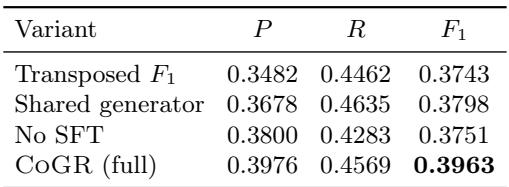
The full CoGR model achieves the highest retrieval F1 among all configurations. Removing the marginal item-side reward, sharing the generator, or skipping SFT initialization each degrades performance, but all variants still yield reasonable results, demonstrating the robustness of the co-evolving framework. The full CoGR model attains the best F1 score, outperforming all ablated variants. Sharing a single generator for both query and item sides reduces retrieval performance compared to using separate generators. Skipping the SFT initialization phase and starting RL directly from the base model lowers F1, confirming the benefit of warm-start training. Replacing the marginal item-side reward with a symmetric item-centric objective decreases precision and F1. All ablated variants maintain stable and reasonable retrieval performance, indicating the framework is resilient to these design changes.
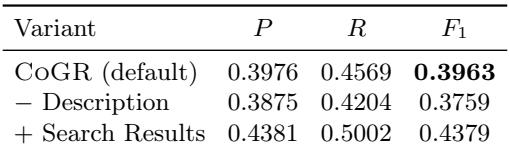
Enriching the textual context for keyword generators consistently improves retrieval performance. Removing item descriptions reduces F1, while adding search results to the query-side prompt substantially raises both precision and recall, mainly by helping resolve ambiguous or non-standard queries. Removing item descriptions drops F1 from 0.3963 to 0.3759, showing that descriptions provide important cues when titles alone are underspecified. Adding search results lifts F1 to 0.4379, with the largest gains coming from better handling of ambiguous, misspelled, entity-centric, or non-English queries.
Experiments on an internal app marketplace dataset and the public WANDS dataset show that CoGR, which jointly evolves query and item keyword spaces via reinforcement learning, achieves the highest retrieval F1, outperforming dense, sparse, and generative baselines. Co-evolving both sides is essential, as query-only optimization lags significantly, while adding item descriptions and search result context further boosts performance. Ablations confirm the robustness of the framework, with all variants maintaining reasonable results even when individual components are removed.