Command Palette
Search for a command to run...
Dr. Claw: バイブ研究のためのAI科学者ワークスペース
Dr. Claw: バイブ研究のためのAI科学者ワークスペース
概要
コマンドラインコーディングエージェント(例:Claude Code、Gemini CLI)は、ファイルの読み書きや長時間のセッション維持をすでに実現しているが、エンドツーエンドの研究は依然としてチャットツール、IDE、ターミナル、ライティング環境に断片化しており、監査可能にする意思決定はほとんど保存されない。我々は、別の自律エージェントを導入するのではなく、既存のコーディングエージェント実行基盤を制御可能かつ監査可能な人間参加型ワークフローに包み込むオープンソースのワークスペースであるDr. Clawを提案する。永続的な状態オブジェクト、再利用可能なスキルライブラリ、マルチ実行基盤の連携により、人間の意思決定をAI実行に結び付け、計画、実行、執筆を単一の追跡可能で復元可能なループに変換する。我々は、インタラクティブな3ビューシナリオと障害復旧のウォークスルーを通じてDr. Clawを実演し、同じバックエンド実行基盤を共有する素のコマンドラインエージェントと比較評価する。これにより、比較は、ラップされるエージェントと、オーケストレーション層全体(タスクグラフ、状態オブジェクト、スキルライブラリ)の対比となる。実行基盤を固定した場合、Dr. Clawは研究の完全性で高いスコアを達成しつつ、監査可能で復元可能なプロセスの痕跡を永続化する。デモアクセス:リポジトリ https://github.com/OpenLAIR/dr-claw、AGPL-3.0で公開され、GPL-3.0の上流コンポーネントを含む。
One-sentence Summary
Researchers from Lehigh University, University of Illinois Chicago, University of Pennsylvania, University of Maryland, University of Notre Dame, and University of British Columbia introduce Dr. Claw, an open-source workspace that wraps existing coding-agent executors in a controllable, auditable human-in-the-loop workflow, using persistent state objects, a reusable skill library, and multi-executor coordination to link human decisions to AI execution, and they demonstrate that, with the executor held fixed, it achieves higher research completeness and a traceable, recoverable process trail compared to a bare command-line agent.
Key Contributions
- Formalizes Vibe Research, a human-in-the-loop research-orchestration paradigm that separates AI execution from human decision responsibilities, distinguishing it from end-to-end autonomous approaches.
- Implements this paradigm in Dr. Claw, an open-source workspace wrapping existing command-line coding agents, with task-graph-centric orchestration, a chat-driven planner, a modular skill library (58 stage-mapped skills across five research stages, 171 in the deployed catalogue), and a multi-agent execution layer compatible with mainstream coding agents.
- A controlled pilot evaluation, holding the backend executor fixed, shows Dr. Claw scores higher than the bare agent on research completeness by closing research-hygiene gaps, while persisting an auditable, recoverable process trail; a retrospective study additionally associates the integrated workflow with gains in efficiency, quality, and usability over non-integrated ones.
Introduction
Large foundation models and agentic tools have advanced the five core research operations, and command-line coding agents like Claude Code and Gemini CLI excel at execution by living in the terminal and sustaining context. However, these agents optimize execution, not control: the plans, intermediate decisions, and artifacts that make research reviewable are scattered or lost, leaving humans with few explicit takeover points. The bottleneck has shifted to full-process orchestration, as researchers still juggle separate tools for decomposition, scheduling, tracking, validation, and writing, which weakens reproducibility and delivery reliability. HCI evidence highlights that collaboration costs are dominated by verification and context maintenance, and that process visibility and interruptible control are critical, yet existing demos improve usability without addressing cross-stage state continuity or artifact closed-loop management.
The authors propose Dr. Claw, a one-stop workspace that unifies planning, execution, and writing into a controllable, traceable, recoverable, and auditable research loop. They formalize a paradigm called Vibe Research, a human-in-the-loop approach where users state high-level goals and constraints in natural language, AI compiles them into an executable loop, and humans retain control over direction, evaluation criteria, and final acceptance. Dr. Claw wraps an existing command-line coding agent rather than introducing a new executor, adding a state, control, and audit layer that such agents lack. It features a task-graph-centric orchestration, a chat-driven planner, a modular skill library with 58 stage-mapped skills, and a multi-agent execution layer. The authors evaluate Dr. Claw by holding the backend executor fixed, showing it scores higher on completeness by closing research-hygiene gaps while persisting an auditable process trail, and a retrospective human study associates the integrated workflow with gains in efficiency, quality, and usability over non-integrated approaches.
Method
3 System Overview
Dr. Claw is designed around one central question: how to let researchers complete problem definition, experiment progression, and paper production in a continuous workflow rather than switching among isolated tools. It models research as an explicitly traceable workflow that organizes human decisions with AI execution into a stable collaboration structure.
3.1 Design Goals and System Abstraction
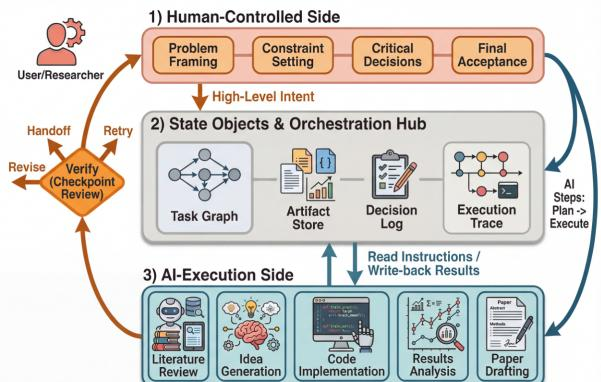
Dr. Claw orchestrates four state objects: Task Graph, Artifact Store, Decision Log, and Execution Trace. Together they convert interaction history into a reviewable process supporting iterative orchestration rather than one-shot generation: users provide high-level goals and constraints, and the system maps them to executable tasks with continuous inspection and takeover. One task interaction is a state transition:
Statet+1=f(Statet,Actiont,Obst),where State denotes the workflow state at time t (jointly formed by Task Graph, Artifact Store, Decision Log, and Execution Trace), Actiont is a system- or user-triggered action, and Obst is the observed feedback. This formulation highlights that Dr. Claw optimizes iterative state updates rather than single responses.
3.2 Three-Layer System Architecture
Dr. Claw uses three collaborative layers:
- Interaction: unified workspace for chat, task views, files, and version operations.
- Orchestration: state and lifecycle management from high-level intent to stage tasks.
- Execution: backend invocation, result return, and exception handling across heterogeneous executors.
This design enables backend switching without changing workflow semantics while preserving unified state and audit views.
Refer to the framework diagram:
3.3 Workflow-Centric Interaction Loop
Given a research idea, the system generates a structured brief and dependency-aware task plan, then runs workflow steps of Plan–Execute–Verify–Write-back. Execution outputs are written into Artifact Store, task states are updated in Task Graph, and all interventions are retained in Decision Log and Execution Trace. This workflow supports long-horizon iteration with explicit human checkpoints.
3.4 Skill-Based Capabilities and Multi-Executor Coordination
Dr. Claw provides a reusable skill library covering ideation, literature processing, experimentation, analysis, and writing. Each skill is a directory with a SKILL.md manifest whose YAML frontmatter declares a name and description, and commonly a version, license, allowed tools, and stage or domain tags. Skills are versioned and schema-checked before activation, and reach a task by three routes: a stage-skill map resolves the task’s stage and type to a set of suggested skills, which are attached to the task node and injected into its next-action prompt; keyword detection over user instructions and task text can auto-load a skill; and users may invoke any catalogue skill manually from the Skills dashboard. Dr. Claw also coordinates multiple executors in one project context, so users switch execution strategy by task type, and on failure or constraint violation can retry, revise, or take over without breaking global state.
3.5 Safety and Controllability Mechanisms
Given risks from external calls and code execution, Dr. Claw treats permission management as a first-class mechanism, supporting fine-grained tool and command policies that distinguish secure defaults from trusted extended settings. Actions are allowed only if they belong to the action set defined by the current policy:
Actiont∈A(Policyt),where Policy is the permission configuration at time t and A(Policyt) is the executable action space, guaranteeing consistency between execution capability and safety boundaries.
Experiment
The evaluation demonstrates Dr. Claw's orchestration layer against a bare command-line coding agent across open-ended research tasks, showing that it improves research completeness (pooled 0.952 vs 0.873) primarily through research hygiene elements like limitations sections, subgroup analysis, and real citations, while matching on modeling rigor. The system also provides auditable traceability through persisted task graphs and execution traces, though the pilot results are not yet statistically significant. A separate failure recovery demonstration shows non-destructive in-place recovery from induced errors, preserving prior artifacts. A retrospective human study with seven AI PhD researchers associates Dr. Claw with shorter completion times, higher output quality, fewer tool switches, and significantly better user experience compared to no-AI and general-purpose AI assistant baselines.
Dr. Claw distinguishes itself by combining persistent research-state objects, mid-run takeover, and wrapping an existing CLI agent, whereas prior systems typically support only subsets of these capabilities. The design emphasizes controllability and auditability over raw automation, with structured artifacts enabling in-place recovery and human oversight. Dr. Claw is the only system that combines wrapping a CLI agent, built-in research state, in-place recovery, and mid-run takeover. Most end-to-end autonomous systems support unattended operation but lack mid-run takeover and built-in research state. Dr. Claw persists a queryable task graph, execution trace, decision log, and claim-to-evidence maps, while a bare agent persists none. In a failure-recovery demonstration, Dr. Claw recovered in place, retaining all pre-existing files and adding corrected artifacts. In a human study, Dr. Claw was associated with shorter completion times, higher output quality, fewer tool switches, and better self-reported experience compared to no AI tools or general assistants.
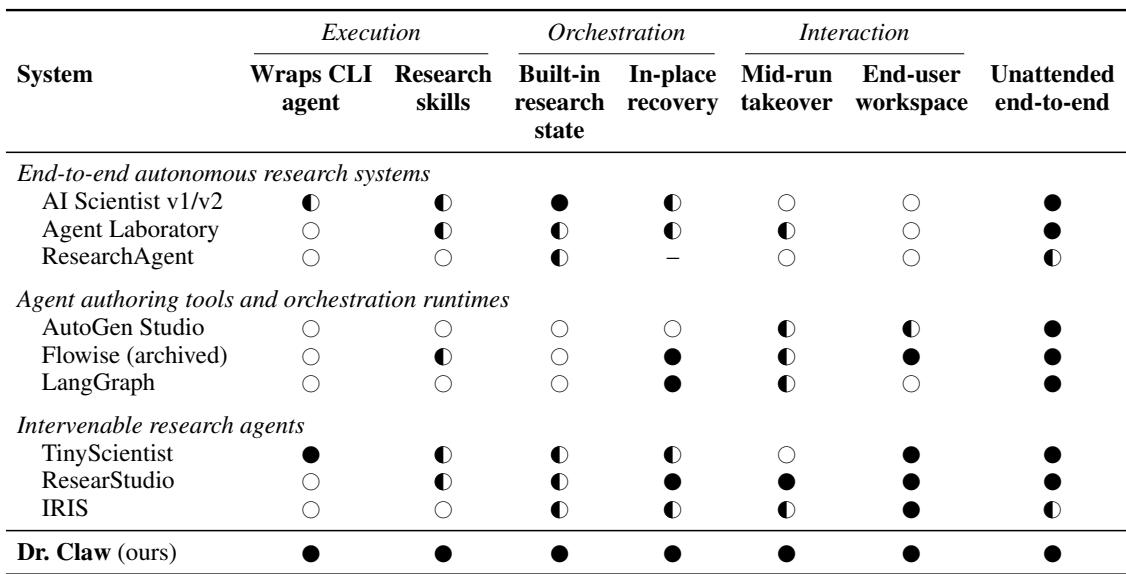
Dr. Claw is evaluated as a system that uniquely combines persistent research state, mid-run takeover, and wrapping of an existing CLI agent, unlike prior systems that support only subsets of these features. The design prioritizes controllability and auditability, with structured artifacts enabling in-place recovery and human oversight. A failure-recovery demonstration shows Dr. Claw retaining pre-existing files while adding corrected outputs, and a human study reports shorter completion times, higher output quality, fewer tool switches, and better user experience compared to no AI tools or general assistants.