Command Palette
Search for a command to run...
再利用すべきでない時を知る:自律的LLMポストトレーニングにおける条件付き経験移転
再利用すべきでない時を知る:自律的LLMポストトレーニングにおける条件付き経験移転
Tingyun Li Wenfeng Feng Weiqing Li Abudukelimu Wuerkaixi Guohua Liu Yuewei Zhang
概要
大規模言語モデルは幅広い能力を提供するが、進化するドメイン、ツール、要件への適応には、しばしば反復的なポストトレーニングが必要となる。自律システムは、更新案の提案、候補の訓練、評価フィードバックを用いた後続提案の選択を行うことで、このプロセスの一部を自動化する。証拠が蓄積されるにつれて、中心的な問題が浮上する。すなわち、後続の訓練によって親モデルが変化した後も、過去のどの更新証拠が依然として実行可能なのか、という問題である。更新の効果は、その親モデル、データ、訓練段階に依存する。過去の成功を文脈に依存しない許可と見なすことは、計算資源を浪費する可能性がある。結果として得られた子モデルが採用された場合、その後の訓練の軌道を悪化させる可能性もある。我々はこの問題を条件付き経験移転として定式化し、重みを変更する訓練の前に経験の再利用を認可する手法であるBoundary-Calibrated Intervention Transfer (BCIT)を導入する。BCITは、観測された効果をその発生源の文脈に結びつけ、適用条件を確認し、明示的なハードコンフリクトを持つ候補を拒否し、必要に応じて限定的な訓練試行を通じて現在の状態に関する証拠を取得する。完全に訓練された候補は依然として共有の採用ルールに直面し、観測されたイベントのみが記憶を拡張する。金融推論、Text-to-SQL、関数呼び出しにわたって適応された一つの4Bモデルにおいて、候補となる更新は評価された文脈間で異質な目標効果と保持効果を示した。候補、証拠、計算資源を一致させた条件下で、BCITは評価された代替手法と比較して、有害な更新の認可数が少なく、同一予算下でより高い最終モデル品質を達成した。これらの結果は、自律的ポストトレーニングにおいて経験の認可を独立した問題として扱うことを支持するものである。
One-sentence Summary
Alibaba Cloud Computing proposes Boundary-Calibrated Intervention Transfer (BCIT), a conditional experience transfer method for autonomous LLM post-training that verifies reuse conditions, vetoes hard conflicts, and obtains current-state evidence through bounded trials, thereby reducing harmful updates and improving final model quality on a 4B model across finance reasoning, text-to-SQL, and function calling tasks.
Key Contributions
- The paper formulates conditional experience transfer as a distinct problem in autonomous LLM post-training, where past update successes are not universally actionable after the parent model has changed.
- It introduces Boundary-Calibrated Intervention Transfer (BCIT), a method that binds observed effects to source contexts, checks applicability conditions, vetoes hard conflicts, and uses bounded training trials to gather current-state evidence before authorizing full training.
- Experiments on a 4B model adapted across finance reasoning, text-to-SQL, and function calling show that BCIT authorizes fewer harmful updates and achieves higher equal-budget final-model quality than evaluated alternatives, supporting experience-conditioned compute allocation.
Introduction
In many continual learning and multi-task settings, models are updated sequentially with post-training compute, but improvements from one context can inadvertently harm performance on others. Prior approaches often allocate compute unconditionally, assuming past success justifies further modification, which risks introducing conflicts and degrading overall capability. The authors introduce BCIT, a method that conditions post-training compute allocation on evidence from the current context. It rejects hard conflicts, validates candidate updates against the parent model, and applies a frozen rule to grant full training budgets, then uses a policy-shared adoption rule to promote or roll back each child model. This evidence-conditioned strategy authorizes fewer harmful updates while preserving beneficial ones, yielding higher cross-task performance than shared-model alternatives.
Experiment
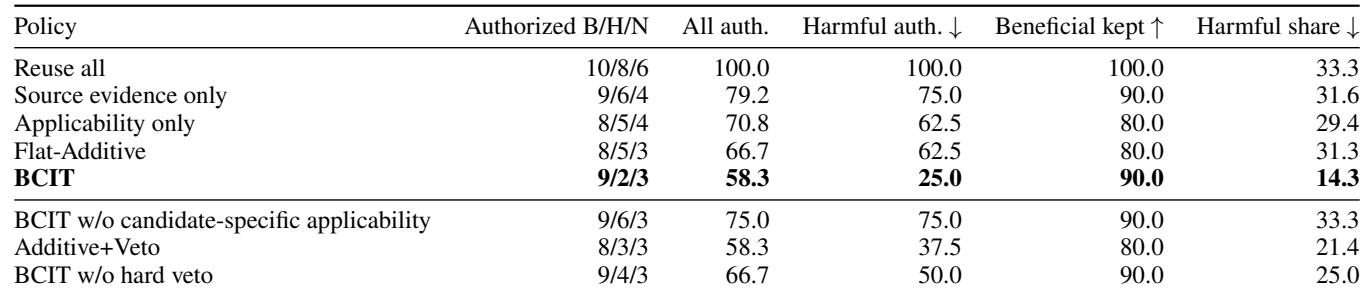
The BCIT policy achieves the strongest trade-off, authorizing far fewer harmful outcomes than any other policy while still preserving most beneficial outcomes. Removing candidate-specific applicability from BCIT causes its harmful authorization rate to triple, reverting to the level of the source-evidence-only baseline. Policies like additive+veto also reduce harmful authorizations but sacrifice more beneficial outcomes than BCIT. BCIT authorizes only a quarter of harmful outcomes while retaining 90% of beneficial ones, yielding the lowest harmful share. Without candidate-specific applicability, BCIT's harmful authorization rate jumps to 75%, matching the source-evidence-only policy. Source-evidence-only keeps 90% of beneficial outcomes but still authorizes three-quarters of harmful outcomes. Flat-additive and applicability-only policies both keep 80% of beneficial outcomes and authorize nearly two-thirds of harmful outcomes.
Under a fixed 36 GPU-hour budget, the Add. + veto method achieves the highest cross-task average and the largest minimum improvement over the base model, while also delivering the best instruction-following scores among shared models. Single-task specialists surpass shared models on their respective tasks but consume the full budget per task, making them computationally expensive. The multi-task approaches consistently improve over the base model across all tasks without exceeding the budget. Add. + veto yields the highest cross-task mean (46.1) and the largest minimum gain over the base model (+2.7 points) among shared-model methods. Single-task specialists reach 39.6 on TAT-QA, 49.3 on BIRD, and 65.1 on BFCL, outperforming the best shared model but requiring 36 GPU-hours each. Instruction-following (IFEval) scores are highest for Add. + veto (76.0 prompt-level, 82.1 instruction-level) compared to other shared models.
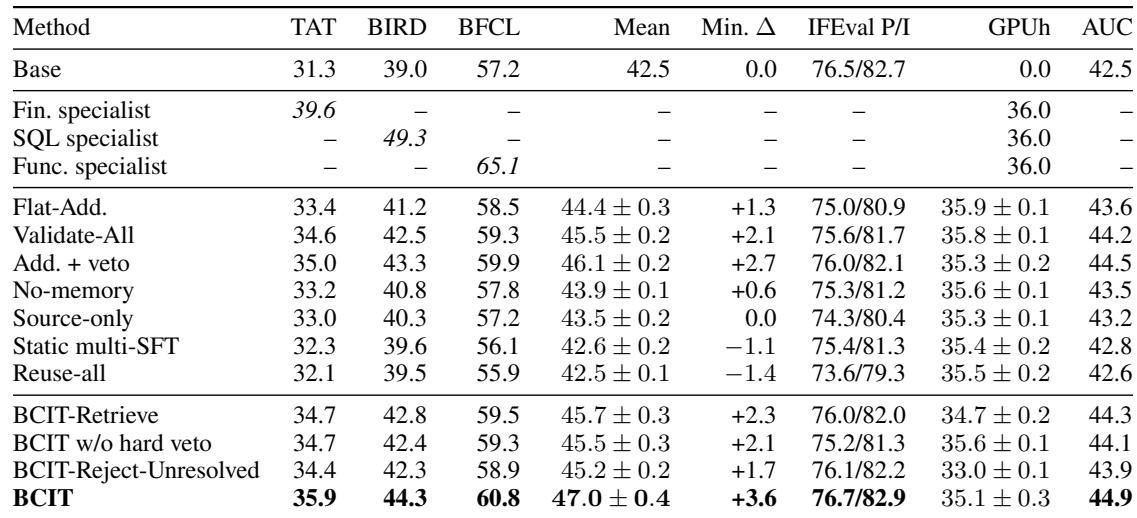
In safety evaluations, the BCIT policy achieves the best trade-off between harmful and beneficial authorizations, drastically reducing harmful outcomes while preserving most beneficial ones; this advantage depends on candidate-specific applicability, without which harmful authorizations rise sharply. In multi-task training under a fixed compute budget, the Add. + veto method yields the highest cross-task average and instruction-following scores among shared models, while single-task specialists achieve higher per-task performance but at much greater computational cost.