Command Palette
Search for a command to run...
最近傍法を用いた高情報量射影の効率的推定
最近傍法を用いた高情報量射影の効率的推定
David Hofmeyr
概要
本論文では、多変量データの興味深い射影を見つけるのに非常に効果的な、直感的な次元削減手法を提案する。既存の多くの手法と同様の直感的動機に基づき、提案手法はデータ内の最近傍関係を強化することに基づいている。提案する射影は、データの局所共分散構造を符号化するように設計された行列のスペクトル分解から得られる。ここで、ある点における局所共分散は、その最近傍点のペアによって捉えられる。標準的な正則条件の下で、この行列がいわゆる「密度情報行列」(DIM)の一致推定量となることを示す。DIMはフィッシャー情報行列のノンパラメトリックな類似物である。DIMのスペクトル分解は、独立成分分析や、教師あり学習の文脈における十分次元削減といった重要な問題と関連することが示されている。しかし、既存のDIM推定量は計算コストが高く、真の密度の二乗に比例する代理密度のDIMのみを対象としている。さらに、クラスタ分析や外れ値検出といった下流タスクを支援する上での本手法の実用的な有用性についても探求する。
One-sentence Summary
Researchers at Lancaster University introduce an efficient dimensionality reduction method that builds a matrix from nearest-neighbor pairs to capture local covariance, yielding a consistent estimator of the Density Information Matrix (a non-parametric analogue of the Fisher Information Matrix) that enables high-information projections for tasks such as cluster analysis and outlier detection, while avoiding the computational cost of previous surrogate-density-based estimators.
Key Contributions
- A dimensionality reduction method is proposed that constructs a projection from the spectral decomposition of a matrix encoding local covariance through pairs of nearest neighbors, designed to enhance nearest-neighbor relationships.
- Under standard regularity conditions, this matrix is a consistent estimator of the Density Information Matrix (DIM), a nonparametric analogue of the Fisher information, overcoming the high computational cost and surrogate-density limitation of previous DIM estimators.
- The method's practical utility is demonstrated in downstream cluster analysis and outlier detection tasks.
Introduction
Dimension reduction aims to preserve useful structure in multivariate data, either through global variance-based methods such as PCA or through local graph-based manifold learning. An alternative information-theoretic view treats projections with low entropy after accounting for scale as more informative, since multimodality and long-tailedness are associated with clusters and outliers. The Density Information Matrix provides a nonparametric analogue of the Fisher Information Matrix and has links to independent component analysis and departure from Gaussianity, but it is difficult to estimate directly. Prior work has largely estimated the DIM of a surrogate density proportional to the squared data density, which the authors find less effective in high-dimensional settings. The authors introduce a simple linear dimensionality reduction method based on a k-nearest neighbor estimator of the DIM. Their approach projects data onto leading eigenvectors of a local compactness matrix times the overall covariance, emphasising high-density local structure to produce low-entropy projections useful for clustering and outlier detection.
Method
The authors develop a nearest-neighbor-based estimator for the Density Information Matrix (DIM) and use it to construct a dimension reduction procedure. The core quantity is the matrix I(X,k), which is computed from the k-th and (k+1)-th nearest neighbor distances and difference vectors within a sample X. For each point Xi, the k-th and (k+1)-th neighbors are identified, and the outer product of their difference is normalized by the squared distances. Summing over all points yields an estimate that, under regularity conditions, converges in probability to the population DIM I(fX) as n→∞, provided k(n)→∞ and k(n)2−p/4/n1−p/4→0.
The theoretical analysis proceeds in two stages. First, for a fixed point x, the conditional expectation of the normalized outer product of the k-th and (k+1)-th nearest neighbor differences is expanded. Using the conditional independence structure of order statistics and a Taylor expansion of the density, the authors show that
E[Dx,n−1,(k)2Dx,n−1,(k+1)21(Xx,n−1(k)−Xx,n−1(k+1))(Xx,n−1(k)−Xx,n−1(k+1))′]decomposes into a leading isotropic term involving E[1/Dx,n−1,(k)2+1/Dx,n−1,(k+1)2] and a term proportional to fX(x)21∇fX(x)∇fX(x)′, plus higher-order contributions from the Hessian. Averaging this expression over the sample and using properties of order statistics, the expectation of I(Xn,k) is shown to converge to I(fX), while the variance vanishes under the rate condition on k(n). Lemma 2 provides uniform convergence of the ratio of consecutive neighbor distances, ensuring that the Hessian-dependent bias terms integrate to zero asymptotically.
To improve finite-sample performance, the authors introduce three practical modifications. First, variance is reduced by averaging I(X,k) over a range of k values, defining I(X,k0,k1)=k1−k0+11∑k=k0k1I(X,k). Provided both k0(n) and k1(n) satisfy the conditions of Theorem 1, this averaged estimator remains consistent.
Second, a bias adjustment is applied to the spectral decomposition of the averaged estimator. Let I(X,k0,k1)=UDU′. The diagonal entries of D are replaced by Dii∗=max{Dii,(ui′ΣXui+ϵ)−1}, where ΣX is the sample covariance matrix and ϵ a small constant. This correction exploits a known lower bound: for the population DIM, each eigenvalue Δii satisfies Δii≥1/Var(vi′X), where vi is the corresponding eigenvector. The adjusted matrix I(X,k0,k1)∗ thus respects this bound and converges to I(fX) as well.
Finally, the projection basis is obtained from the matrix product I(X,k0,k1)∗ΣX. Its eigenvectors are orthogonalised via singular value decomposition: if W contains the eigenvectors, the final projection directions are the columns of W∗=WuWv′, where Wu and Wv are the left and right singular vectors of W. This step ensures that the projected data retain more of the total variance, improving downstream tasks such as clustering and outlier detection. The overall pipeline thus estimates the DIM from nearest neighbor statistics, refines it through averaging and bias correction, and produces an orthogonalised projection that preserves the structure captured by the DIM.
Experiment
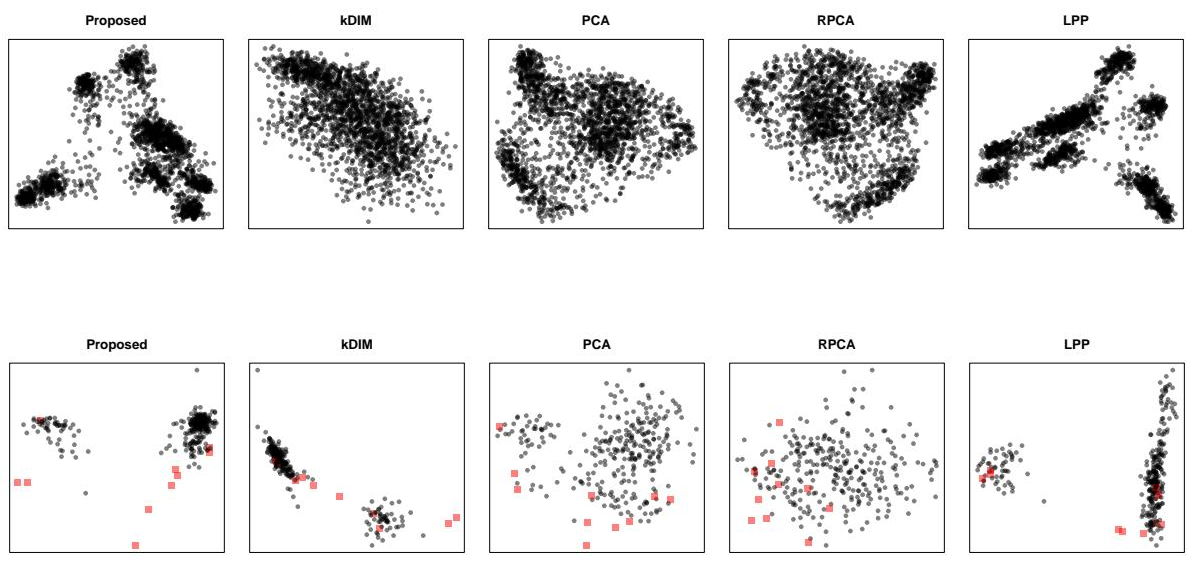
The experiments evaluate the proposed nearest-neighbors DIM (nnDIM) against PCA, robust PCA, LPP, and kDIM as dimension reduction tools for clustering and outlier detection on 45 classification datasets, with estimation accuracy validated on Gaussian data. For clustering, nnDIM is the only method that consistently improves performance across all four clustering algorithms when applied to higher-dimensional data. In outlier detection, nnDIM pairs well with sLOF and Isolation Forest for datasets with one or two inlier classes, though improvements are less conclusive for single outlier class setups.