Command Palette
Search for a command to run...
世界モデルをスケールさせる検証可能な軌跡データエンジンとしてのエージェント型ゲーム開発
世界モデルをスケールさせる検証可能な軌跡データエンジンとしてのエージェント型ゲーム開発
Pengfei Zhou Hexin Wang Zhengfeiyang Zhang Yixing Ma Zhenglin Wan Kaipeng Zhang Wangbo Zhao Yang You
概要
世界モデルをスケールさせる一般的な戦略は、より多くの計算資源を用いて、より大量のクローリング動画で学習することである。我々は、この戦略は非効率的であると主張する。世界モデルのスケーリングには、根拠のある報酬信号を提供する再帰的なデータエンジンも必要である。コードエージェントの成功は、この点が重要である理由を示している。コードは実行可能であるため、コンパイラとランタイムは大規模言語モデル(LLM)の強化学習(RL)によるポストトレーニングに対して高品質な報酬を提供できる。対照的に、空間生成は依然としてCLIPスコアのような曖昧な代理指標に大きく依存している。これらの信号は曖昧で偏りがあるため、RLによるポストトレーニングを支えることが困難である。これらと比較して、ゲーム開発は空間世界モデルに欠けている報酬環境を提供する。ゲームエンジンによって符号化されたシーンは実行可能な世界仕様であり、エンジンは衝突判定、物理演算、ナビゲーション可能性、および限定的なプレイ可能性を効率的にチェックできる一方で、開発者はそのシーンを受け入れるべきかを判断することで、大域的な検証信号を提供する。また、ゲーム開発はRLポストトレーニングのための実世界の長期的な軌跡データも提供する。そこで我々は、人間とエンジンによる検証付き強化学習(RLHEV)を提案する。これは、開発プロセスからの密なエンジン信号と暗黙的な人間の受容フィードバックを組み合わせたポストトレーニングパラダイムである。この学習目的を、我々が提案するエージェント型世界モデル(AWoMo)に適用する。AWoMoは、シーンの編集を提案し、人間とエンジンによる検証を観測し、受容または修復されたマルチモーダルな痕跡を学習データに変換する世界構築エージェントである。提案手法を制御実験により評価する。200例のUnityアセット編集評価であるUnitySceneBenchにおいて、我々のRLHEVは最高スコアを獲得した。汎化性能に関しては、転移学習が分布外シフトに対して有効であり、Unreal EngineおよびGodotを用いたクロスエンジン実験において肯定的な信号を示した。AWoMoによって拡張された学習は、R2R、Gymnasium MuJoCo、およびD4RL Gym-MuJoCoにおける方策の身体化されたパフォーマンスも改善した。再現のため、エージェント型アーティファクトを公開する: https://github.com/LanceZPF/cardinal-preview。
One-sentence Summary
National University of Singapore, UC Berkeley, and collaborators propose Reinforcement Learning with Human-Engine Verification (RLHEV), a post-training paradigm that combines dense game-engine signals with implicit human acceptance to train an Agentic World Model (AWoMo) for scene generation, thereby providing grounded reward signals for spatial world models and improving embodied policy performance on R2R and MuJoCo.
Key Contributions
- RLHEV is a post-training paradigm that combines dense engine verification signals (collision, physics, navigability) with implicit human acceptance feedback from game development to provide grounded rewards for spatial world models.
- AWoMo is an agentic world model that proposes scene edits, observes human-engine verification, and converts accepted or repaired multimodal traces into training data.
- On UnitySceneBench, RLHEV achieves the highest score. Transfer learning yields positive signals in Unreal and Godot cross-engine experiments, and AWoMo-augmented training improves embodied policy performance on R2R, Gymnasium MuJoCo, and D4RL Gym-MuJoCo.
Introduction
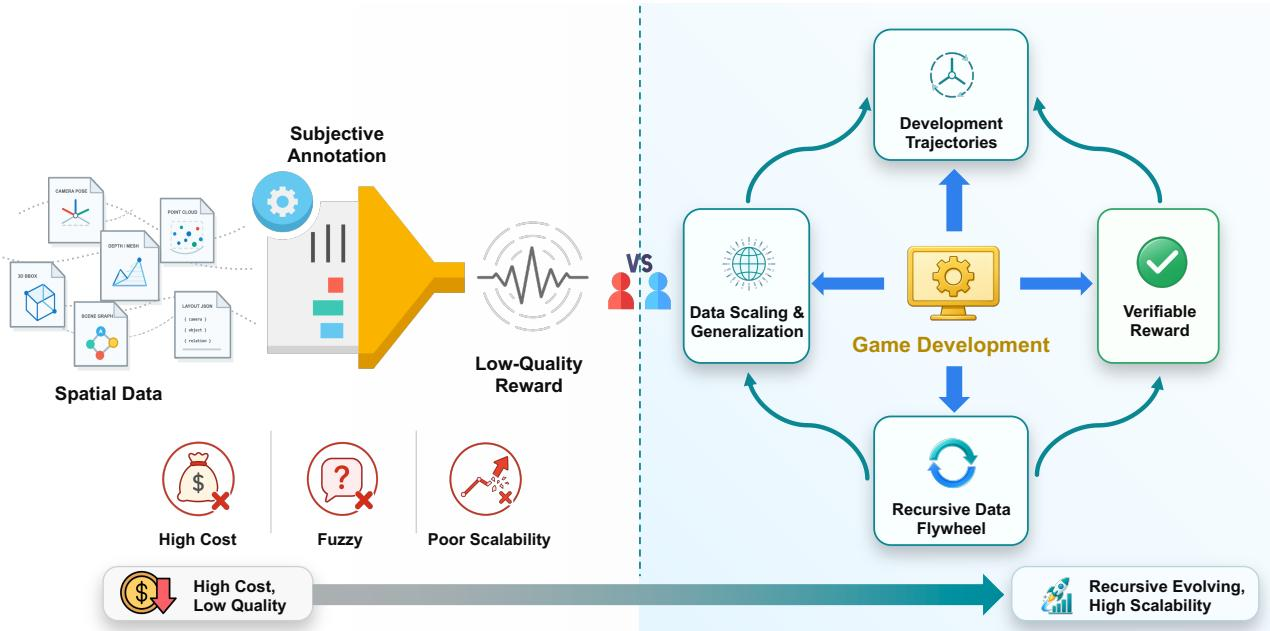
Spatial intelligence tasks like video generation, 3D synthesis, and world modeling lack the scalable, reliable verification that has accelerated progress in code and reasoning agents. Prior work depends on fuzzy proxy metrics such as FVD and CLIP similarity and on expensive, low-bandwidth human ratings, which introduce noise and bias that cap post-training at imitation rather than correctness. The authors argue that game development supplies a practical recursive data engine: game engines automatically verify structural properties (collisions, navigation, script integrity) while human developers provide final acceptance judgments, yielding dense, grounded feedback. They propose the Agentic World Model (AWoMo), a developer-centered agentic workflow that captures complete world-building trajectories, and train it with Reinforcement Learning with Human-Engine Verification (RLHEV). This dual-verification loop transforms world construction into a self-improving process, giving spatial models a post-training path analogous to the one that succeeded for code.
Method
The authors propose Reinforcement Learning from Human-Engine Verification (RLHEV) to address the limitations of fuzzy, subjective reward proxies in spatial generation. Instead of relying solely on expensive and noisy human annotations for final outputs, RLHEV leverages game engines as cheap, grounded verifiers for structural properties, while reserving human judgment for final acceptance and intent alignment.
As shown in the framework diagram:
This approach shifts the paradigm from high-cost, low-quality subjective annotations to a recursive, evolving loop. The core system, named AWoMo, is organized around an omni-modal world model with four distinct interfaces. The intent interface receives task briefs and design constraints. The action interface emits scene programs, asset edits, and repair actions. The verification interface records engine checks such as collision, physics stability, and navmesh reachability. Finally, the review interface captures developer acceptance, rejection, and critique. The execution loop follows a propose, render, verify, repair, and review cycle, generating structured traces that serve as training data.
Refer to the figure below:
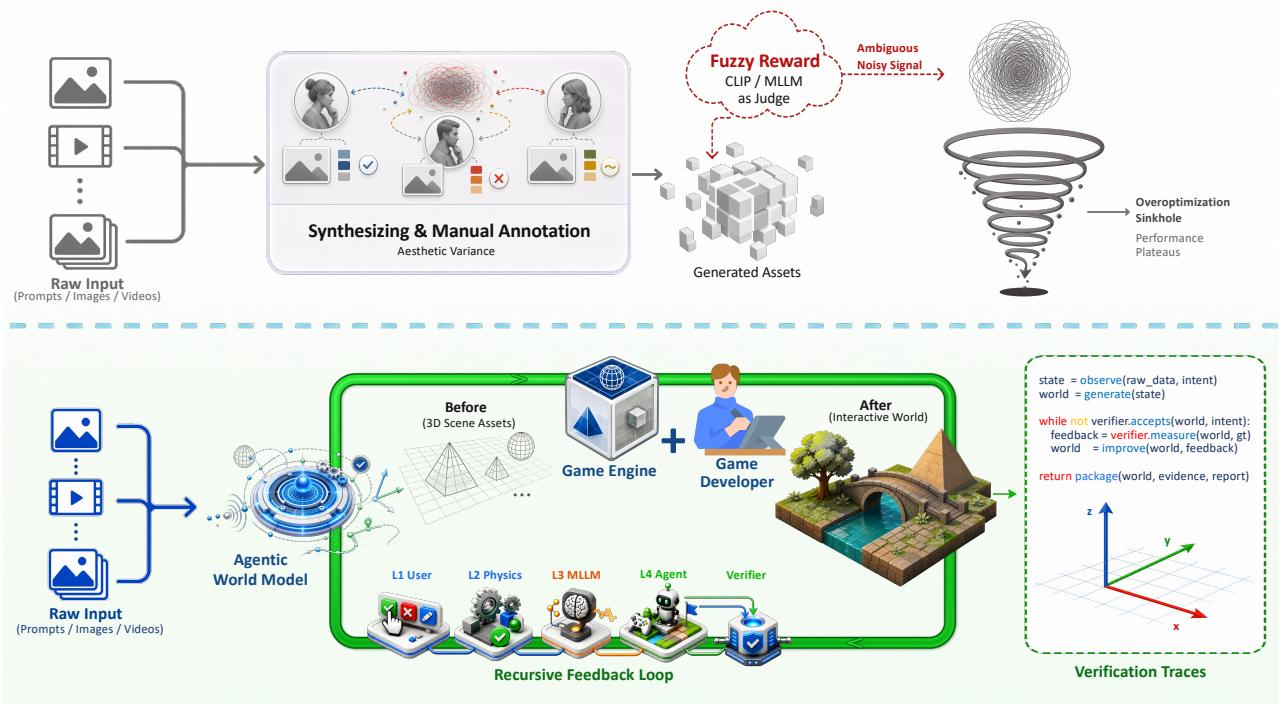
The bottom pipeline illustrates this human-engine feedback loop. Raw inputs are processed by an Agentic World Model, which interacts with a Game Engine and a Game Developer. The engine provides localized failure signals through a recursive feedback loop involving user intent, physics, multimodal large language models, and agents. This contrasts sharply with the top pipeline, where synthesizing and manual annotation lead to fuzzy rewards and overoptimization sinkholes.
At the heart of this architecture is a shared executable scene-program representation.
As illustrated in the figure below:
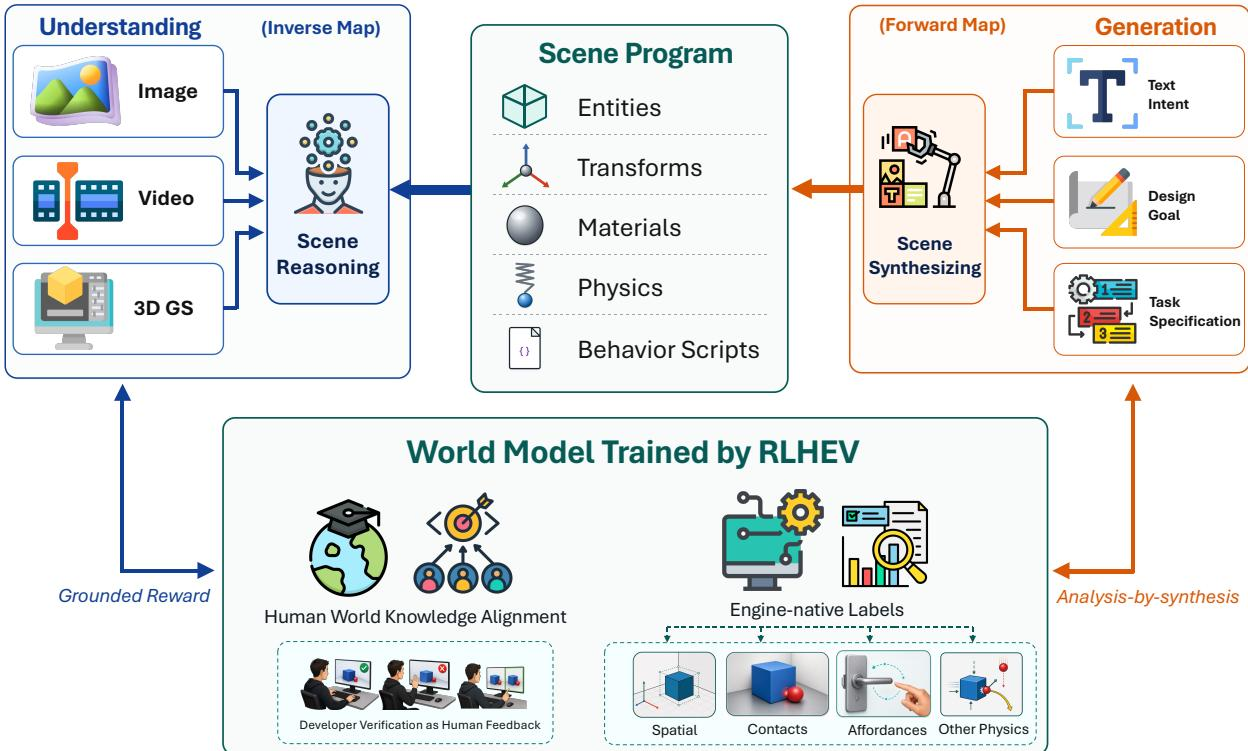
The World Model Trained by RLHEV bridges understanding and generation through this Scene Program. The generation process (Forward Map) maps text intent, design goals, and task specifications into scene synthesizing, producing entities, transforms, materials, physics, and behavior scripts. The understanding process (Inverse Map) performs scene reasoning on images, videos, and 3D Gaussian Splatting to reverse-engineer the scene program. The model is grounded by Engine-native Labels (spatial, contacts, affordances, physics) and Human World Knowledge Alignment (developer verification).
To formalize the data collection, the authors introduce the Unified World-Development Protocol (UWDP). This typed multimodal protocol converts ordinary game-development work into state-action-check-review traces. A compact instance is defined as ut=(b,ot,st,at,gt,vt,ht,ρt), where b is the design intent, ot is the object identifier, st stores spatial and semantic fields, at is the edit action, gt is the engine output, vt is rendered evidence, ht is the reviewer decision, and ρt links repairs and risks. This protocol ensures that the workflow used to build a world simultaneously emits its own verifiable training data.
Experiment
The evaluation uses a human-engine verification workflow where a world model generates or edits game assets, receives feedback from engine checks and a human reviewer, and is post-trained on that signal. Experiments on UnitySceneBench show that combining human and engine rewards achieves the best asset classification performance, while pretraining on source data improves out-of-distribution generalization within Unity and yields positive transfer gains to Unreal and Godot engines. Embodied diagnostic runs further demonstrate that AWoMo-augmented training improves policy performance on navigation and locomotion tasks. Overall, the pilot studies support human-engine verification as a practical feedback source, with the strongest gains observed under dual verification, though larger-scale studies are needed to confirm generalization.