Command Palette
Search for a command to run...
拡散モデルにおけるオンポリシー自己蒸留
拡散モデルにおけるオンポリシー自己蒸留
概要
強化学習は拡散モデルを人間の選好やタスク固有の目的に整合させることができるが、エンドポイント報酬は中間のノイズ除去予測がどのように変化すべきかを規定しない。我々は、画像レベルの報酬ガイダンスを、サンプリングされたクエリにおけるクリーン出力予測のための明示的なターゲットに変換するオンポリシー自己蒸留フレームワークとしてDiffusionOPSDを導入する。各外部反復において、凍結された挙動方策が軌道を生成し、クエリ状態とアンカーを供給する。報酬勾配は各アンカーの周囲に有界な正および負のターゲットを構築する。訓練可能な方策は、有限回のフィッティングを通じてこれらのターゲットを分離された教師信号として適合させ、その後、指数移動平均更新によって挙動方策を更新する。この設定により、ターゲット構築と有限実現を個別に測定できる。制御された同一クエリ実験では、ターゲット構築の利得が大きいことが、単一のフィッティング更新後の実現利得の大きさに必ずしも結びつかないことを示す。SD3.5-Mとステップ蒸留されたZ-Image-Turboにわたり、我々の手法は2つのバックボーンと10の評価器を用いた20の報酬整合設定のうち19において、最終的なホールドアウトスコアで最良を達成した。最も強力な競合手法を最大44.0%上回り、SD3.5-MではDiffusionNFTと比較して訓練GPU時間を40%、Z-Image-Turboでは63%削減する。これらの結果は、画像レベルの報酬ガイダンスを明示的かつ継続的に更新される中間教師信号へと変換することにより、拡散モデルのポストトレーニングに対する効率的かつ解析可能なアプローチとしてのオンポリシー自己蒸留を支持し、より効率的で診断可能な整合への道を開くものである。
One-sentence Summary
Researchers from ByteDance Seed, National University of Singapore, UC San Diego, and other institutions introduce DiffusionOPSD, an on-policy self-distillation approach that translates image-level reward gradients into bounded positive and negative clean-output targets, fits them via finite fitting and EMA policy updates, and attains the best held-out scores in 19 of 20 reward-matched settings on SD3.5-M and Z-Image-Turbo while reducing training GPU-hours by up to 63%.
Key Contributions
- DiffusionOPSD is an on-policy self-distillation framework that converts image-level reward guidance into explicit, bounded positive and negative clean-output targets at sampled denoising queries, fits them as detached supervision, and refreshes the targets as the behavior policy evolves.
- The framework separates target construction from model fitting, and controlled same-query experiments show that larger target-construction gains do not necessarily translate into larger realized gains after a single fitting update.
- Across SD3.5-M and Z-Image-Turbo, DiffusionOPSD achieves the best final held-out scores in 19 of 20 reward-matched settings across ten evaluators, outperforms the strongest competing method by up to 44.0%, reduces training GPU-hours relative to DiffusionNFT by 40% on SD3.5-M and 63% on Z-Image-Turbo, and improves all three optimized rewards over DiffusionNFT in joint multi-reward training.
Introduction
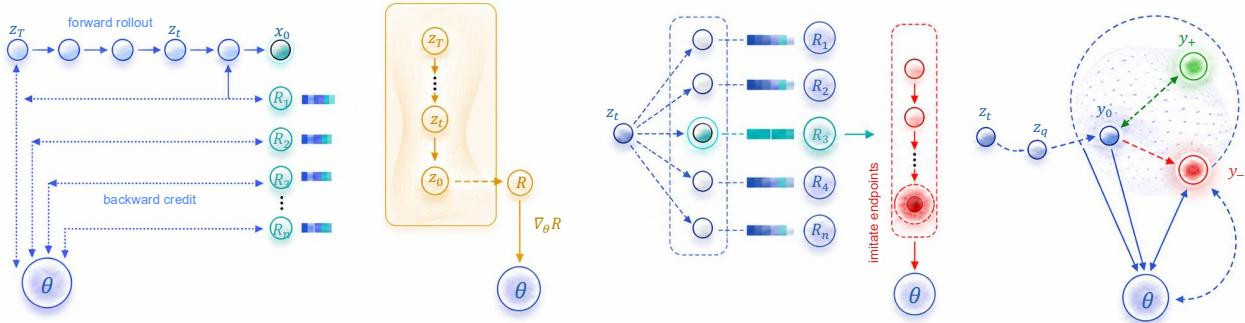
Diffusion and flow models are widely used for high-fidelity image generation, and reinforcement learning is increasingly applied to align them with human preferences, aesthetics, and task-specific rewards. A core challenge is that reward is observed only after the final decoded image, while the diffusion policy acts through many intermediate denoising predictions, so outcome-level feedback must be converted into useful local supervision. Prior approaches rely on sampled trajectory credit, backpropagate through a single late clean-output prediction without decoding the full rollout, or reweight final endpoints while leaving the desired intermediate change implicit. The authors introduce DiffusionOPSD, an on-policy self-distillation method that constructs bounded positive and negative targets from image-level reward gradients at behavior-policy queries, fits those targets as detached intermediate supervision, and rebuilds them as the behavior policy evolves. This separates target construction from finite model fitting and enables both stages to be measured independently.
Method
The authors propose DiffusionOPSD, a framework that treats diffusion reward optimization as an on-policy self-distillation process. By converting image-level reward gradients into detached targets for intermediate predictions, the method continuously rebuilds these targets as the behavior policy evolves.
Refer to the framework diagram below for a comprehensive overview of the architecture and training pipeline.
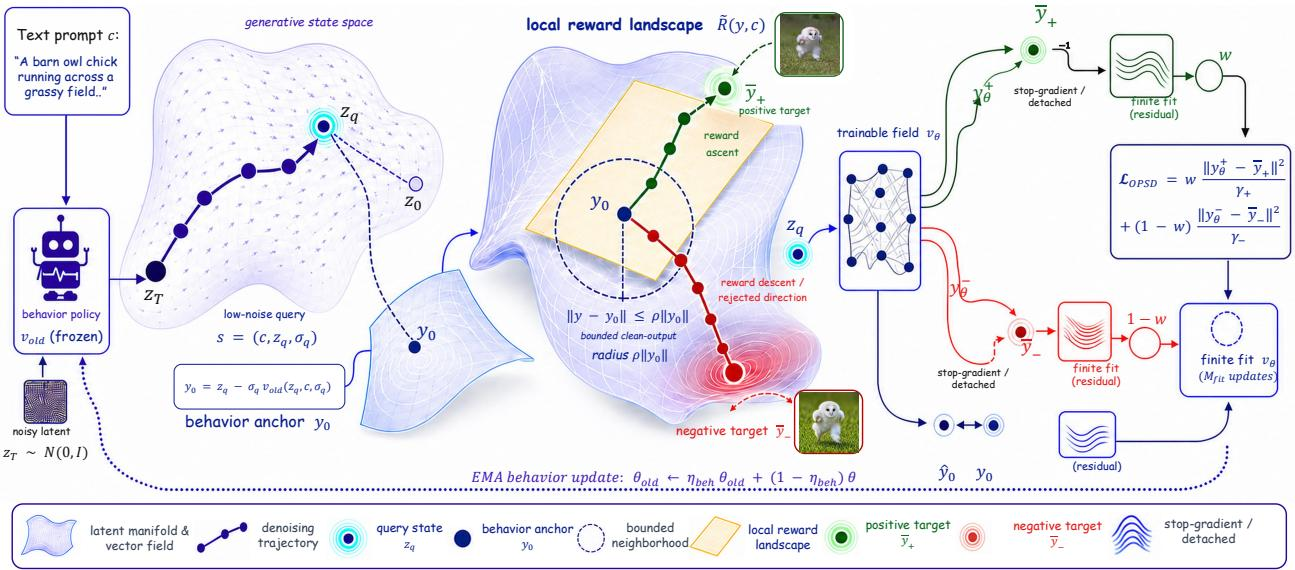
The process begins by establishing a clean-output coordinate system to decode and evaluate predictions. Let vθ be the trainable rectified-flow velocity field and vold denote the velocity field of the behavior policy. For a given prompt c, noisy latent zσ, and noise level σ, the query tuple is defined as s=(c,zσ,σ). Under the rectified-flow path, the clean-output prediction yθ(s) corresponding to the velocity prediction is computed as:
yθ(s)=zσ−σvθ(s)This prediction is evaluated through the local reward R(y,c)=R(D(y),c), where D is the latent decoder.
During each outer iteration, a frozen behavior policy collects trajectories to supply query states and anchors. A low-noise query state zq is selected from the trajectory, and the behavior anchor y0 is computed as the clean-output prediction of the behavior policy at that query. Endpoint rewards from the collected trajectories determine a group-normalized fitting weight ω. This weight centers each reward within its prompt group while using a global standard deviation over the complete rollout batch, ensuring that all prompt groups are placed on a common scale.
To guide the optimization, the authors construct bounded positive and negative targets starting from the behavior anchor y0. They apply stabilized normalized reward-gradient steps to iteratively update the positive and negative targets. Each update step is projected back onto a trust-region ball to ensure the displacement remains bounded by a radius ρ∥y0∥2. The final detached positive target yˉ+ is intended to improve the reward, while the negative target yˉ− acts as a repulsive reference.
The trainable velocity field is then optimized using a finite fitting procedure. The model forms positive and negative fitting branches around the anchor y0 to encode both attraction toward the positive target and rejection of the negative target. Detached adaptive normalizers are utilized to scale the branch losses. The overall objective LOPSD is defined as a weighted sum of the squared fitting errors for both branches, where the weights are derived from the previously computed fitting weight ω. Crucially, the query, anchor, weight, and targets remain fixed during this finite fitting phase, completely separating the target construction from the parameter updates.
Finally, the online training loop is completed by refreshing the behavior policy. After applying a finite number of optimizer updates to the trainable policy, the behavior policy is updated via an exponential moving average. This updated behavior policy then generates new trajectories for the subsequent outer iteration, supplying new query states and endpoint rewards. This continuous cycle of trajectory collection, target construction, finite fitting, and behavior policy refresh constitutes the core self-distillation loop of the system.
Experiment
The experiments evaluate DiffusionOPSD against FlowGRPO, ReFL, and DiffusionNFT on SD3.5-M and the step-distilled Z-Image-Turbo, measuring held-out reward-specific quality, training cost, and optimization stability. DiffusionOPSD achieves the best final scores in 19 of 20 reward-matched settings, reduces training cost by 40–63%, and sustains reward gains through the final update, with human annotators preferring its outputs over all baselines. Ablations confirm that the reward-gradient direction in target construction is essential, while most implementation choices and query-state provenance have minor effects, and the method remains effective with native few-step samplers and multi-reward training.
DiffusionOPSD achieves the best held-out evaluator scores in 19 of 20 reward-matched settings across a standard backbone and a native few-step distilled model, with gains reaching 44% on HPSv3 and VLM-Pairwise. It sustains improvement through the final training update, retaining 98% of within-run reward gains, while competing methods often plateau or degrade. A single jointly trained policy preserves near-specialist quality on three rewards, outperforming joint baselines by 8–14% and matching or exceeding individual specialists. DiffusionOPSD leads in 19 of 20 reward-matched comparisons across SD3.5-M and Z-Image-Turbo, with relative gains up to 44% on HPSv3 and VLM-Pairwise. On Z-Image-Turbo, DiffusionOPSD outperforms the strongest baseline by 30.7% on ImageReward and 14.6% on VLM-Pairwise, while DiffusionNFT falls below the unadapted model on eight of ten objectives. DiffusionOPSD retains 98% of its within-run reward improvement at the final update, compared to 83% for FlowGRPO and 90% for DiffusionNFT. A single DiffusionOPSD policy trained on three rewards achieves 113% of the PickScore specialist's gain, statistically matches the HPSv2.1 specialist, and surpasses the joint DiffusionNFT policy by 8–14% across all three metrics.
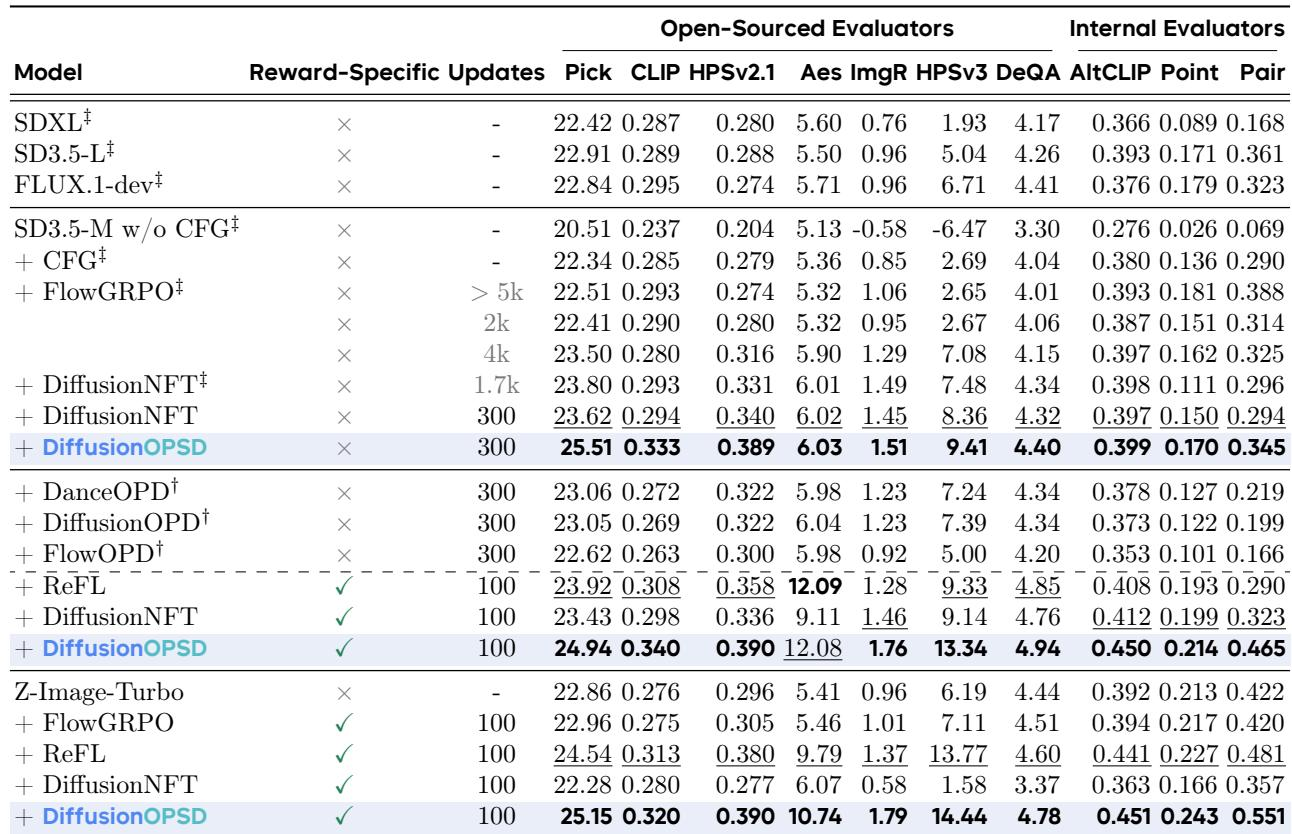
DiffusionOPSD is evaluated on reward-matched image generation tasks using both a standard backbone and a native few-step distilled model, comparing held-out evaluator scores and training stability. It achieves leading performance in nearly all settings, with sustained improvement through the final training update while competing methods often plateau or degrade. A single jointly trained policy preserves near-specialist quality across multiple rewards, outperforming joint baselines and matching or exceeding individual specialists.