Command Palette
Search for a command to run...
エージェントシステムにおける共進化:人間の設計を超えた自己指向型進化に向けて
エージェントシステムにおける共進化:人間の設計を超えた自己指向型進化に向けて
概要
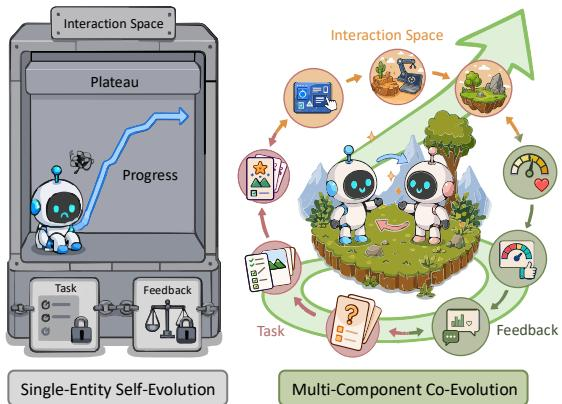
エージェントシステムは、展開後の改善がますます期待されているが、単一エンティティの自己進化は、固定されたタスクやフィードバックといった静的な学習コンテキストによって制限されることが多い。本サーベイは、エージェントシステムにおける共進化、すなわち複数のエージェントとその環境が相互に適応圧力を及ぼし合う、多要素からなる自己進化の一形態に焦点を当てる。既存研究を整理するため、我々は、システムが人間によって設計された制約を徐々に取り除いていく過程を追跡する、段階的な3段階の分類体系を提案する。「エージェント間共進化」は、敵対的、協調的、および組織的な適応を含む、動的な仲間を通じてエージェントがどのように適応するかを研究する。「エージェント・環境共進化」は、このループを、エージェントと共に変化する適応的なタスク、フィードバック、および相互作用空間へと拡張する。「メタ共進化」は、進化メカニズム自体を進化可能にする可能性をさらに探求する。また、そのようなシステムの評価、複数の要素にわたるスケーリング、そしてますます自律的になる進化プロセスを安全かつ制御可能に保つことにおける、未解決の課題についても議論する。本サーベイは、固定された人間設計の経路を超えて改善できる、頑健でオープンエンドなエージェントシステムを構築するための統一的な基盤を提供する。
One-sentence Summary
Researchers from Hong Kong University of Science and Technology, University of Illinois Urbana-Champaign, The Chinese University of Hong Kong, The University of Hong Kong, and Peking University present a survey on co-evolution in agentic systems, proposing a progressive three-stage taxonomy of agent–agent, agent–environment, and meta co-evolution that traces how adaptive pressure among multiple components gradually sheds human-engineered constraints, and discuss open challenges in evaluating, scaling, and ensuring safety for such systems to build robust, open-ended agentic systems that improve beyond fixed human-designed paths.
Key Contributions
- The survey provides a formal definition of co-evolution that requires mutual evolutionary pressure between at least two components, and organizes the field through a progressive three-stage taxonomy: Agent–Agent, Agent–Environment, and Meta Co-Evolution.
- A dynamic evaluation paradigm is proposed for co-evolving systems, moving beyond static benchmarks by measuring component-level improvements, cross-play transferability, and using held-out evaluators to detect exploitative behaviors.
- Meta Co-Evolution, where the evolution mechanism itself becomes evolvable, is identified as a critical frontier for reducing human intervention and enabling open-ended, self-improving agentic systems.
Introduction
As AI systems shift from isolated models to agentic systems that autonomously use tools, memory, and skills, a central challenge is enabling continual improvement after deployment. Self-evolution lets agents update themselves from experience, but it remains bounded by fixed external conditions, a limitation akin to the Red Queen effect. No existing survey has made co-evolution, where multiple components adapt jointly and reshape each other’s evolution, the central focus. The authors fill this gap by offering the first focused survey of co-evolution in agentic systems, organizing the literature with a progressive three-stage taxonomy that expands evolutionary freedom from agent–agent co-evolution, through agent–environment co-evolution, to meta co-evolution where the evolution mechanism itself becomes adaptive.
Method
The authors propose a three-stage taxonomy that follows the expanding scope of what a system is allowed to evolve, gradually removing human-engineered constraints.
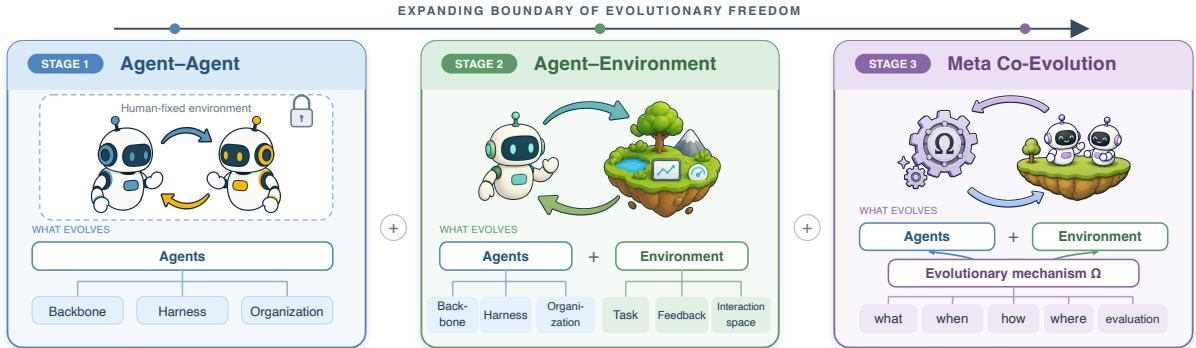
Stage 1 focuses on Agent-Agent Co-Evolution. Coevolution begins when an agent no longer learns against a static counterpart. As agents respond to one another, each agent's progress changes the challenges and opportunities facing its peers, and the collective may also reorganize its structure Π. This creates a coupled evolutionary process within the agent collective defined as:
At+1=({ait+1}i=1n,Πt+1)=Ω(At,E,τt).Stage 2 extends this to Agent-Environment Co-Evolution. While the coupled process in Stage 1 continuously changes the agents, the environment remains fixed, limiting new experiences. Stage 2 allows agent behavior to reshape the whole conditions that subsequently shape the agents:
(At+1,Et+1)=Ω(At,Et,τt).Stage 3 introduces Meta Co-Evolution. In Stage 2, the evolution mechanism remains human-designed. Meta co-evolution is defined as a stage where the lower-level co-evolving system further revises its evolution mechanism through a self-generated revision process Γt:
Ωt+1=Γt(St,Ωt,τt),St+1=Ωt+1(St,τt).This recursion provides a pathway toward open-endedness, characterized by continuous novelty Ωt+1=Ωt and unbounded divergence with adaptive capability H satisfying limt→∞H(St,Ωt)=∞. The authors decompose the evolution mechanism into five adaptive decisions: what to evolve selects the adaptation target, when to evolve triggers updates after failures or plateaus, how to evolve produces variants through training or revision, where to evolve covers the domain and setting, and how to evaluate judges evolution quality.
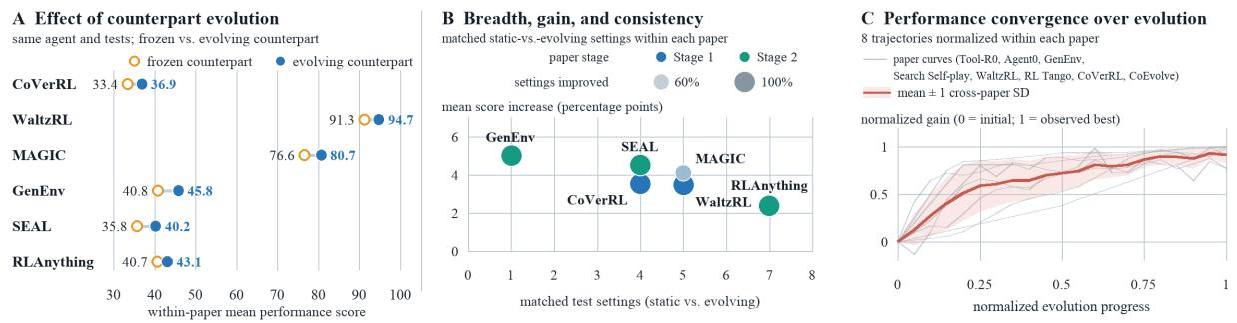
As shown in the figure below, Stage 1 and Stage 2 improve performance across most settings, but the gains become smaller as evolution approaches a plateau. By allowing the evolution mechanism to change, meta co-evolution moves beyond this bottleneck and opens new directions for improvement.