Command Palette
Search for a command to run...
プライバシーに配慮した教室内インシデント認識のためのロバストかつ効率的な動作推論
プライバシーに配慮した教室内インシデント認識のためのロバストかつ効率的な動作推論
Paritosh Parmar Landy Lan Hong Yang Chen Yi Chiat Pin Tay
概要
コンピュータビジョンは教室の安全性向上に貢献できるだろうか。本予備的研究では、CCTV形式の観測データから、プライバシーに配慮し計算効率の高い教室内インシデント認識を探求する。この設定は未だ研究が進んでおらず、実世界への展開に求められるプライバシー、効率性、汎化性の要件を満たすように設計されたベンチマークや手法は限られている。我々は、生成されたCCTV形式の動画と実世界の教室内姿勢データを組み合わせた新規のハイブリッドベンチマークを導入し、多くのインシデントが姿勢そのものよりも、動作の方向、速度、加速度、強度において差異が大きいという観察に動機づけられた、軽量かつロバストな動作推論フレームワークを提案する。この目的のため、本手法はまず人間の行動に関する階層的な運動学的表現を構築する。次に、大規模な教師モデルから階層的で多階の運動学的推論を、はるかに小規模な単階の生徒モデルへと蒸留する。これにより、表現力豊かな動作理解を保持しつつ、個人単位での効率的な推論を可能にする。実験により、提案モデルは、その10分の1未満の計算コストで、はるかに大規模なベースラインモデルを上回る性能を示し、同時に、より優れたドメイン外動作推論とゼロショットでの合成データから実データへの汎化能力を実証する。我々は、プライバシーに配慮した教室の安全性に関する更なる研究を促進するため、ベンチマーク、コードベース、および支援ツールを公開する予定である。
One-sentence Summary
Researchers from the Institute of High Performance Computing, A*STAR propose a lightweight motion-reasoning framework for privacy-aware classroom incident recognition that distills hierarchical, multi-order kinematic reasoning from a large teacher model into a single-order student model, achieving superior out-of-domain generalization and zero-shot synthetic-to-real transfer at less than one-tenth the computational cost of larger baselines.
Key Contributions
- A hybrid benchmark is introduced that combines generative CCTV-style videos with real-world classroom pose data, targeting privacy-sensitive safety scenarios such as falls and fights.
- A lightweight motion-reasoning framework is proposed that constructs hierarchical kinematic representations and distills multi-order motion knowledge from a large teacher model into a compact single-order student model for efficient per-person inference.
- Experiments show that the distilled model outperforms substantially larger baselines at less than one-tenth of their computational cost while exhibiting stronger out-of-domain motion reasoning and zero-shot synthetic-to-real generalization.
Introduction
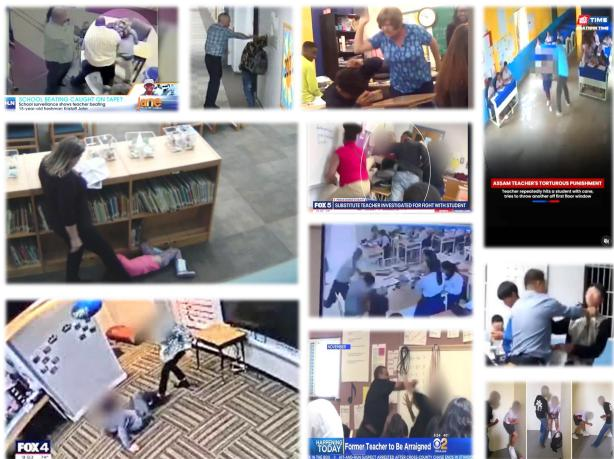
Classroom safety incidents such as physical altercations, falls, or abusive behavior can go unnoticed or unreported in a timely manner, delaying intervention and accountability. Although CCTV cameras are increasingly common in schools, manual monitoring of continuous video is error-prone, and automated recognition of safety-critical events remains underexplored due to unusual ceiling-mounted camera angles, the presence of young children underrepresented in standard datasets, and strong privacy constraints. The authors address these gaps by introducing a CCTV-view classroom incident recognition benchmark that combines synthetic videos generated with AI-based models and real-world recordings. They propose a lightweight, privacy-preserving framework that operates on skeletal pose features rather than raw images, outperforming existing pose-based action-recognition baselines while requiring fewer computational resources, and they demonstrate that models trained on synthetic data generalize effectively to real classroom footage.
Dataset
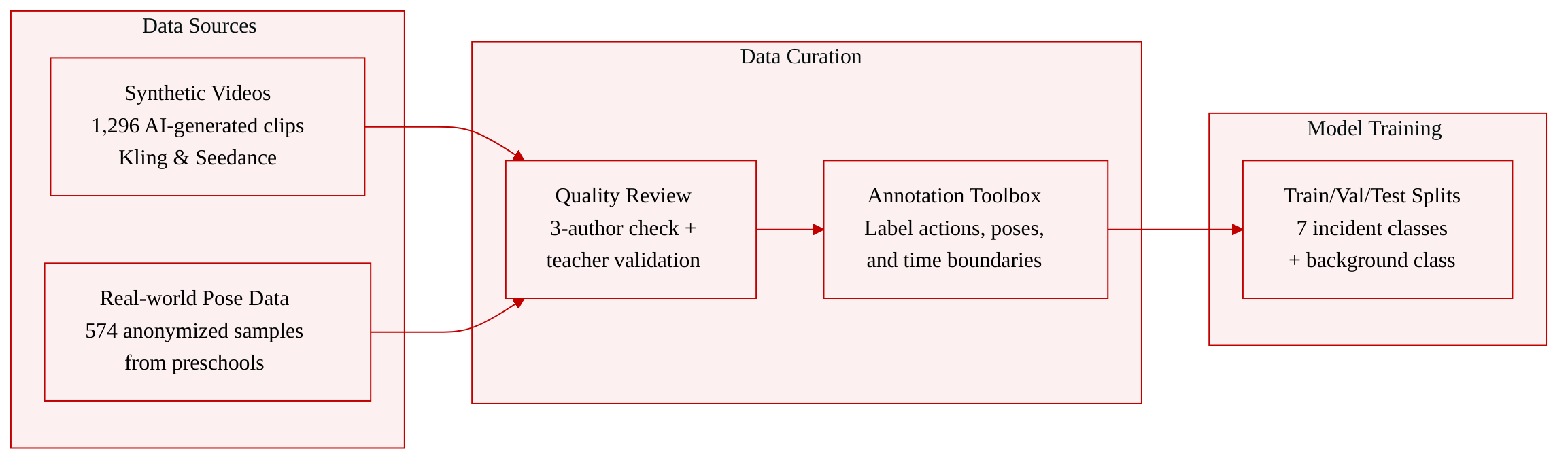
The authors construct a classroom incident recognition dataset with two complementary parts: a synthetic video set and a real-world pose set. Both are built around seven incident action classes (fall, punch, jump, kick, throw, run, sit) plus a background meta-class for ordinary activities.
Dataset composition and sources
- Synthetic subset: 1,296 videos generated by AI models (Kling and Seedance), selected after a preliminary study of multiple video generators.
- Real-world subset: 574 samples collected from actual preschools, where only anonymized pose data and verified action labels are retained.
- Action classes were defined in collaboration with preschool teachers in Singapore to reflect common dangerous incidents.
Key details for each subset
- Synthetic videos
- Size: 1,296 samples after quality checks.
- Source: Conditionally generated using prompts and a school-uniform asset library.
- Filtering: Each video is reviewed independently by three authors for visual realism, camera properties, motion realism, and action semantics. Only videos with unanimous approval are kept. A further validation pass by preschool teachers removes any remaining implausible samples.
- Real-world pose data
- Size: 574 samples.
- Source: Anonymized video from partner preschools.
- Filtering: Pose data is extracted, action labels are annotated, and the same teacher-review procedure used for synthetic data is applied. Only verified annotations and anonymous pose data are retained.
How the paper uses the data
- The dataset is used to train and evaluate models for classroom incident recognition.
- The background class is included to help models distinguish incident actions from everyday classroom activities, improving robustness against false positives.
- The paper does not specify exact training splits or mixture ratios; it focuses on describing the construction and quality-assurance pipeline.
Processing details
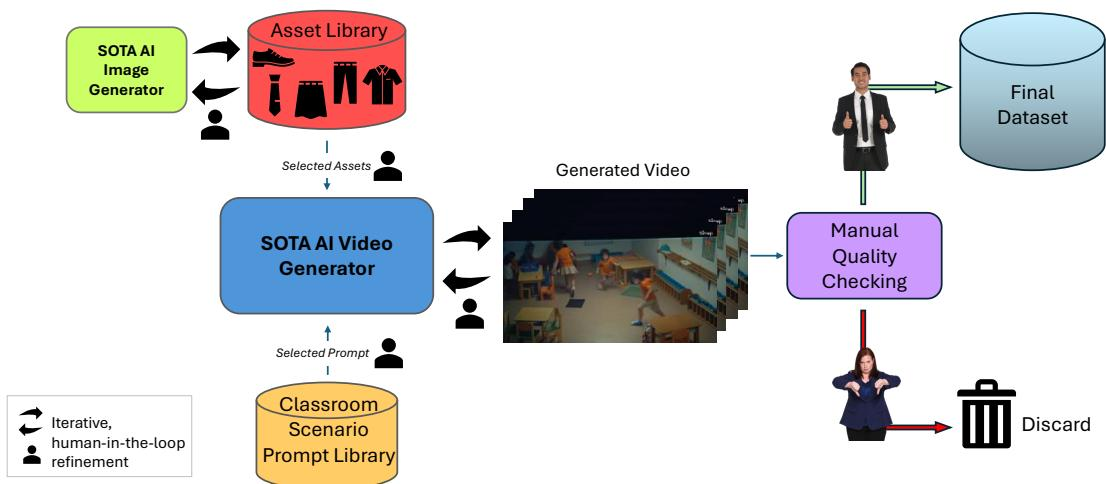
- Video generation: A library of school uniform assets is built with generative image models and manual verification. Prompts are designed to mimic real preschool CCTV footage, specifying camera placement, viewing angle, subject scale, and the presence of students in uniforms or non-uniform clothing.
- Annotation: An integrated annotation toolbox is developed to label action classes, temporal boundaries, and human poses. The tool preloads skeletal poses so annotators correct rather than create from scratch, improving efficiency and consistency.
- Quality control: All generated videos pass a three-author review and a subsequent preschool-teacher validation. Real-world pose data undergoes the same teacher-review step.
- Ethics: Real student images are used only as anonymized references for uniform generation. The released dataset contains only synthetic videos and approved real-world skeleton keypoints, with no identifiable personal information.
Method
The authors leverage generative AI to construct a realistic synthetic dataset for classroom incident recognition. The generation pipeline begins with the creation of an asset library, focusing on school uniforms, using state-of-the-art AI image generators in a human-in-the-loop process. These selected assets and carefully designed prompts from a classroom scenario library condition a SOTA AI video generator. The resulting videos undergo rigorous manual quality checking to ensure visual realism, temporal consistency, and accurate action semantics before inclusion in the final dataset.
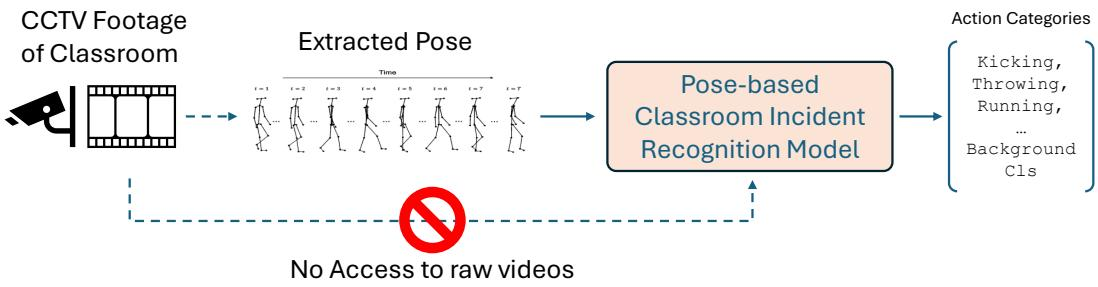
To ensure privacy in classroom monitoring, the authors design a pose-based incident recognition system that operates exclusively on human pose trajectories rather than raw RGB video. This approach minimizes reliance on identifiable appearance cues, making it suitable for sensitive environments.
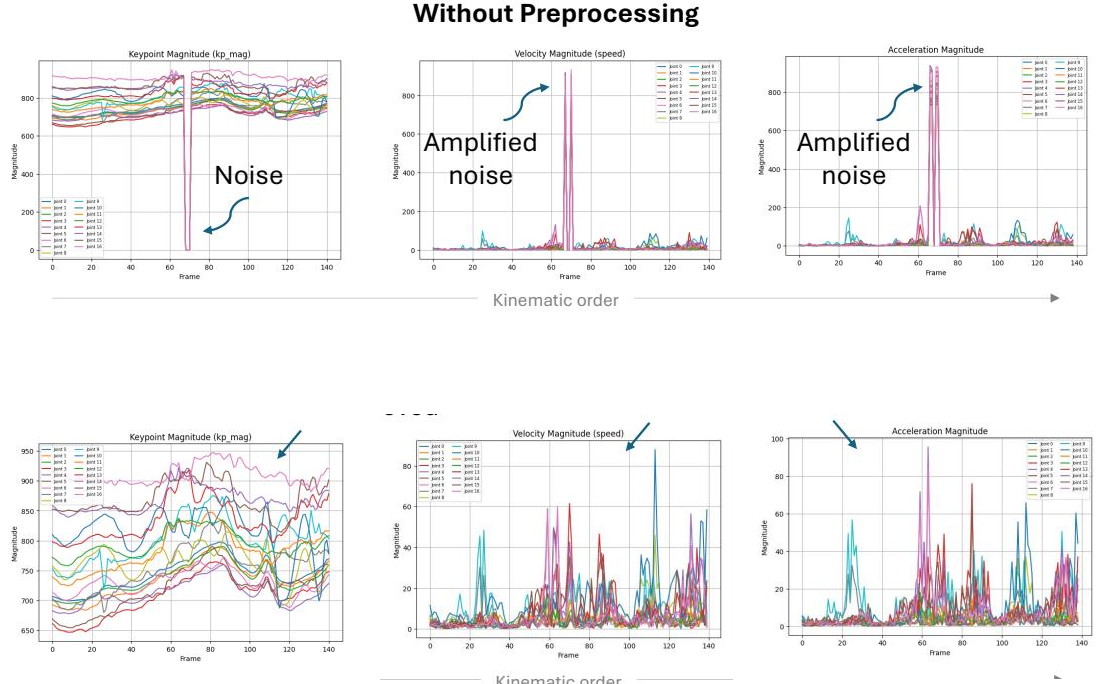
The method introduces hierarchical kinematic representations to capture action dynamics more effectively. Let jat∈RC denote the coordinate vector of joint a at time step t. The authors compute zeroth-order positions, first-order velocities vat=(jat−jat−δ)/δ, and second-order accelerations aat=(vat−vat−δ)/δ. Since higher-order derivatives amplify pose estimation noise, temporal preprocessing is applied. Missing coordinates are interpolated, and trajectories are smoothed using a Savitzky-Golay filter before computing derivatives.
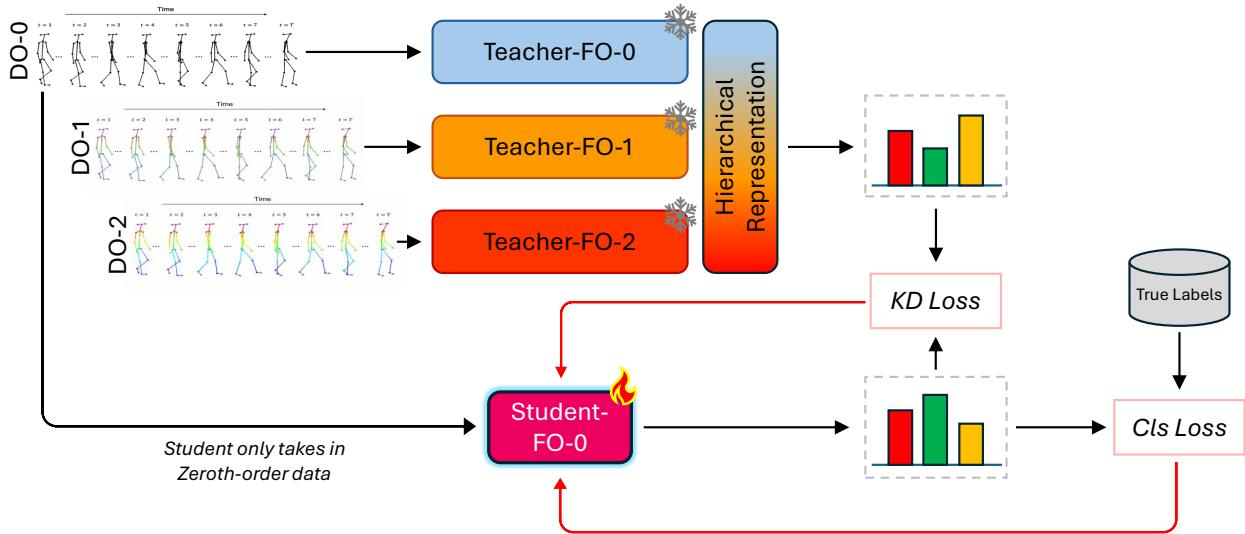
The full approach employs a multi-order kinematic fusion strategy. Dedicated backbones process each kinematic order independently. Their latent representations are fused via weighted averaging to form a robust hierarchical multi-order teacher model. To reduce inference costs for deployment, this teacher is distilled into a lightweight student model operating solely on zeroth-order features. The student is optimized using a multi-objective loss LMTL=λKDLKD+λClsLCls, combining a knowledge distillation loss to match the teacher's softened probability distribution and a standard classification loss against ground-truth labels.
Experiment
The experiments evaluate a multi-order motion reasoning framework for skeleton-based classroom action recognition, implemented with a lightweight STGCN++ student model distilled from a multi-order teacher. On a synthetic classroom incident dataset, the method achieves the highest accuracy while using far fewer parameters than strong baselines, and it also shows the best zero-shot transfer to real-world footage, confirming improved cross-domain generalization. Ablation studies reveal that fusing joint positions, velocities, and accelerations with carefully tuned weights, along with a balanced distillation loss, enables the compact student to outperform both the teacher and baseline models. Overall, the results demonstrate that synthetic data combined with multi-order distillation can produce efficient and robust models, though a substantial synthetic-to-real gap remains.
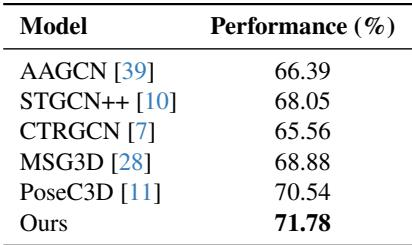
The proposed method achieves the highest accuracy on the synthetic classroom incident dataset, outperforming all baselines including PoseC3D while using only one-tenth of its parameters. The performance gain is attributed to a multi-order motion reasoning strategy that learns from joint positions, velocities, and accelerations, which is then distilled into a lightweight student model. Despite leading results, the overall accuracy remains relatively low, indicating that the dataset presents distinct challenges such as viewpoint variation and fine-grained action differences. The proposed method reaches the highest accuracy, improving over the strongest baseline PoseC3D by 1.24 percentage points and over MSG3D by 2.90 percentage points. The model uses only one-tenth as many parameters as PoseC3D while achieving superior performance. Multi-order motion cues including joint positions, velocities, and accelerations provide complementary information that improves recognition of rapid or forceful actions. Distilling a multi-order hierarchical teacher into a lightweight zeroth-order student allows the student to outperform the teacher. All evaluated methods show comparatively lower accuracy on this dataset than on established benchmarks, with PoseC3D dropping from over 94% on NTURGBD to 70.54% here.
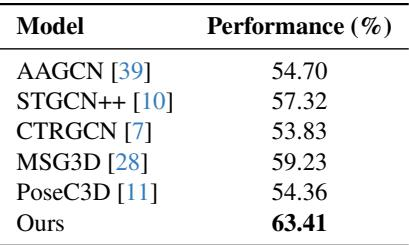
All methods lose accuracy when transferring from synthetic to real classroom video, confirming a domain gap. The proposed method achieves the highest zero-shot real-world accuracy, outperforming the strongest baseline by over four percentage points while using fewer parameters and FLOPs. Its pose-based abstraction and multi-order motion distillation yield more robust cross-domain generalization than competing approaches. The proposed method attains the best real-world accuracy of 63.41%, exceeding MSG3D by 4.18 percentage points and other baselines by larger margins. Pose-based features reduce reliance on synthetic visual appearance, and velocity plus acceleration cues supply complementary action dynamics information. Distilling a multi-order hierarchical teacher into a compact student helps the model retain action-relevant motion patterns across the domain shift. Strong synthetic-domain performance does not guarantee real-world transferability, as shown by PoseC3D's sharper drop relative to the proposed method.
The evaluation uses a synthetic classroom incident dataset and zero-shot transfer to real classroom videos. The proposed method outperforms all baselines, including PoseC3D, while using far fewer parameters by distilling a multi-order motion teacher that captures joint positions, velocities, and accelerations into a lightweight student. Despite leading results, overall accuracy remains low due to challenges like viewpoint variation and fine-grained action differences, and a clear domain gap is confirmed when transferring from synthetic to real data. The approach's pose-based abstraction and motion distillation yield stronger cross-domain generalization, with the largest margins over competing methods in the real-world setting.