Command Palette
Search for a command to run...
安定リッジ:部分空間制約付き平均シフトの一貫性と収束性
安定リッジ:部分空間制約付き平均シフトの一貫性と収束性
Wanli Qiao
概要
部分空間制約付き平均シフト(SCMS)アルゴリズムは、高次元データの低次元表現として機能する密度リッジを抽出するための一般的なノンパラメトリック手法である。文献では、SCMSの軌跡が、密度勾配ならびに密度のヘッセ行列の固有値および固有ベクトルによって定義される古典的な密度リッジ(我々が「静的リッジ」と呼ぶもの)に収束するという考えが広く受け入れられている。本論文では、この仮定が一般には成り立たないことを示す。静的定義は、アルゴリズムの基礎となるベクトル場の連続的な流れに沿った後続固有空間の回転を考慮していないためである。この問題を解決するため、我々はパラダイムシフトを提案し、力学系と射影密度勾配のヤコビアンの観点から定義される新しい幾何学的構造である「安定リッジ」を導入する。この安定リッジこそがSCMSアルゴリズムの真の理論的目標であることを証明する。この基盤に基づき、一定のステップサイズを用いた一般化SCMSフレームワークを開発し、その一様R-線形収束性と安定リッジへの位相的写像としての全射性を確立する。さらに、ハウスドルフ距離の観点から安定リッジを推定するための収束率を導出する。最後に、元のSCMSアルゴリズムが、平均シフト演算子を介してステップサイズを平滑化バンド幅に暗黙的に結合させることに起因する多項式時間の計算複雑性に悩まされることを明らかにし、我々の一般化フレームワークが統計的に一貫性があり、より効率的な解決策を提供することを示す。
One-sentence Summary
Wanli Qiao demonstrates that the Subspace Constrained Mean Shift algorithm does not converge to the classical static density ridge, and instead proposes the "stable ridge"—a dynamical systems-based structure defined via the Jacobian of the projected density gradient—along with a generalized constant-step-size framework that achieves uniform R-linear convergence, topological surjectivity, and statistically consistent estimation with improved computational efficiency.
Key Contributions
- The paper introduces the stable ridge, a geometric structure defined via the Jacobian of the projected density gradient, and proves it is the true theoretical target of the SCMS algorithm, correcting the prior assumption that SCMS converges to the static ridge.
- A generalized SCMS framework using a constant step size is developed, and its uniform R-linear convergence and topological surjectivity onto the stable ridge are established, along with convergence rates for estimating the stable ridge via Hausdorff distance.
- The analysis reveals that the original SCMS algorithm suffers from polynomial-time computational complexity because the step size is implicitly coupled to the smoothing bandwidth, and the generalized framework provides a more efficient solution that recovers the log-density ridge in O(log n) iterations.
Introduction
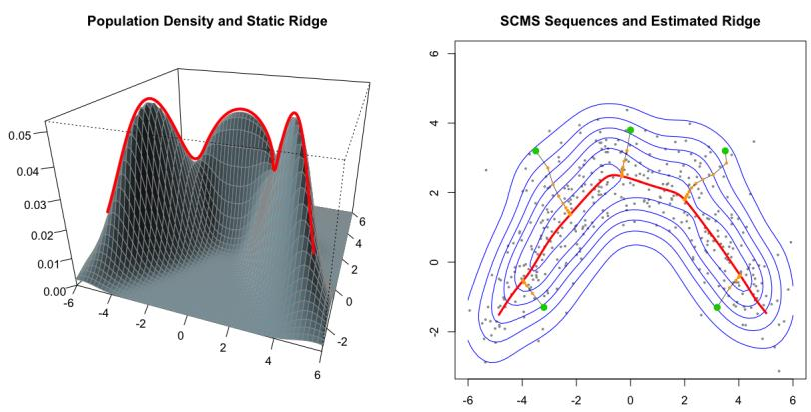
Extracting low-dimensional geometric structures from high-dimensional data is a core challenge in statistics and machine learning, with applications ranging from mapping cosmic web filaments to tracing blood vessels in medical images. Density ridges offer a compelling approach by defining these structures through the local differential geometry of the underlying probability density, and the Subspace Constrained Mean Shift (SCMS) algorithm has become a popular tool for estimating them. Prior work assumed SCMS converges to the static ridge, defined by pointwise conditions on the density Hessian, but recent counterexamples revealed this assumption is false, leaving the algorithm’s true target an open problem.
The authors resolve this by introducing the stable ridge, a new concept defined through the dynamical system governing the projected gradient vector field rather than static Hessian conditions. They prove that SCMS actually targets and converges to this stable ridge, establishing rigorous statistical consistency and computational complexity guarantees. Their analysis further uncovers a computational bottleneck in the original SCMS algorithm, where coupling the step size to the smoothing bandwidth forces polynomial iteration growth with sample size, and they propose a generalized framework with a constant step size that achieves logarithmic iteration complexity.
Method
The authors establish a rigorous theoretical foundation for the Subspace Constrained Mean Shift (SCMS) algorithm by first defining the geometric and regularity conditions under which stable ridge extraction is well-posed. The analysis begins with the introduction of the ridge-regular class, a set of density functions satisfying three key properties: a spectral gap between the k-th and (k+1)-th eigenvalues of the Hessian, negative definiteness of the Jacobian of the projected gradient field when restricted to the trailing eigenspace, and a lower bound on the projected gradient away from the ridge. These conditions, formalized in Assumptions (A1) and (A2), guarantee that the stable ridge R(f) is a compact, C2-smooth k-dimensional submanifold without boundary.
With the population geometry in place, the authors analyze the continuous flow φt(x) driven by the projected gradient vector field ξ(x). Lemma 2 demonstrates that for any point within a neighborhood Rϵ(f) of the ridge, the magnitude of ξ decays exponentially along the flow at rate γ, ensuring that trajectories remain confined to this neighborhood and converge to limit points on R(f). The limit map Φ(x) is shown to be continuously differentiable and, crucially, surjective from the boundary ∂Rϵ(f) onto the entire ridge, guaranteeing that initializing the flow from this boundary suffices to recover every point on the target manifold.
To bridge the continuous analysis with practical discretized implementations, the authors introduce a generalized SCMS algorithm that operates directly on the vector field ξ(x) with a constant step size α. The one-step operator is defined as Gα(x)=x+αξ(x). Lemma 4 establishes step-size bounds under which the discrete sequence remains within Rϵ(f) and the projected gradient decays geometrically at rate ρ=1−αγ/4. Theorem 2 then proves R-linear convergence of the iterates to a limit point on the stable ridge, with a uniform rate across all initial points in the neighborhood. The associated limit map Φα is continuous and approximates the continuous flow map Φ with error linearly bounded by α, as quantified in Proposition 2. Theorem 3 further confirms the surjectivity of Φα from the boundary set onto the ridge, mirroring the continuous case.
The finite-sample analysis translates these population guarantees to the empirical setting, where the density f is replaced by a kernel density estimator f. Under uniform convergence bounds on the derivatives of f and its associated geometric quantities, Corollary 2 shows that f inherits the ridge-regular properties with parameters scaled by 1/2. The sample version of the generalized SCMS algorithm, using the operator Gα(x)=x+αξ(x), is then analyzed. Theorem 5 establishes that, with high probability, the empirical iterates converge at an R-linear rate to the estimated ridge R(f), and Theorem 6 proves surjectivity of the empirical limit map Φα from ∂Rϵ(f) onto R(f). The total estimation error, combining computational and statistical components, is bounded in Theorem 7. By selecting the bandwidth h≍((logn)1+δ/n)1/(d+8) and stopping after O(logn) iterations, the Hausdorff distance between the recovered set and the true ridge achieves the rate O(((logn)1+δ/n)2/(d+8)).
The authors extend the framework to the original SCMS algorithm, which operates on the log-density p(x)=logf(x) and couples the step size to the bandwidth through the Mean Shift vector. They show that the original update can be rewritten as xm+1=xm+αn(xm)ξlog(xm), where the adaptive step size satisfies αn(x)≍h2. Under analogous regularity assumptions on the log-density, Lemma 7 establishes local diffeomorphism and surjectivity properties for the empirical log-density operator. Theorem 8 provides the total error bound, but reveals a critical computational limitation: because the step size scales with h2, achieving the statistical error rate requires m∗=O(n2/(d+8)) iterations, which grows polynomially with sample size. In contrast, the generalized SCMS formulation with a constant step size α achieves the same statistical accuracy in only O(logn) iterations, offering a substantial computational advantage for large-scale ridge extraction tasks.
Experiment
The evaluation uses Monte Carlo simulations with a radially symmetric density formed by convolving a uniform circle with Gaussian noise to validate the theoretical properties of the SCMS algorithms. The computational complexity experiment confirms that the generalized SCMS algorithm with a fixed step size bypasses the bandwidth-dependent iteration bottleneck of the original SCMS, showing nearly constant iteration counts as sample size grows, though the step size must be carefully tuned to avoid overshooting. The statistical consistency experiment verifies that the Hausdorff error between the estimated and true ridge decays with sample size at a rate faster than the theoretical upper bound, which is attributed to the density being flat along the ridge in this special scenario. Overall, the results support the theoretical findings that decoupling step size from bandwidth improves computational efficiency while maintaining statistical convergence.