Command Palette
Search for a command to run...
MerchantBench: Eコマース業務におけるLLMエージェントの長期的首尾一貫性評価ベンチマーク
MerchantBench: Eコマース業務におけるLLMエージェントの長期的首尾一貫性評価ベンチマーク
概要
大規模言語モデル(LLM)エージェントは自律的なツール使用者としての評価が進んでいるが、既存のベンチマークの多くは即時的な成功基準を持つ限定的なタスクに焦点を当てている。実世界への展開では、長期的首尾一貫性、すなわち蓄積された証拠に基づいて意思決定を適応させつつ、長期的な視野にわたって目的志向の行動を維持する能力がしばしば要求される。この能力を評価するには、行動が将来の選択を制約し、フィードバックが不均一な遅延を伴って到着し、首尾一貫性のない行動が測定可能な累積的効果を生み出す持続的環境が必要である。出品者側のEコマースは、商品調達、出品および価格管理、キャッシュフロー管理、および混在遅延フィードバックへの適応にわたる、反復的かつ相互依存的な意思決定を通じて、この評価に適した設定を提供する。我々はMerchantBenchを導入する。これは、98,843件の実Eコマース商品記録に基づき、エージェント対話用の26のツールを備えた365日間の注文レベルシミュレーションである。MerchantBenchは、即時的に観測可能な上流サプライヤーイベントと遅延する下流注文結果を結合し、エージェントが個々の注文ライフサイクルを追跡し、過去の意思決定を再検討することを要求する。我々は2つのエージェントフレームワークの下で8つのLLMを、それぞれ365シミュレーション日間にわたる48回の試行で評価した。その結果、最新のLLMと人間の参加者との間には大きな隔たりがあり、最も優れたLLM構成でも、人間の参加者が達成した平均最終純資産のわずか27.3%に留まることが明らかになった。我々のコードはhttps://github.com/KhanCold/merchantbenchで公開されている。
One-sentence Summary
Researchers from Zhejiang University, Peking University, and Fudan University introduce MerchantBench, a 365-day e-commerce simulation leveraging 98,843 real product records and 26 tools to assess LLM agents’ long-term coherence across sequential decisions such as product sourcing, pricing, cash-flow management, and mixed-latency feedback, finding that the best LLM attains only 27.3% of the mean final net assets of human participants.
Key Contributions
- MerchantBench is a 365-day order-level simulation benchmark for evaluating long-term agent coherence in seller-side e-commerce, constructed from 98,843 real product records and 26 interaction tools.
- The environment couples immediately observable upstream supplier events with delayed downstream order outcomes, requiring agents to track individual order lifecycles and adapt decisions across mixed-latency feedback.
- Evaluating eight LLMs across two agent frameworks in 48 runs shows the best-performing LLM configuration attains only 27.3% of the mean final net assets of human participants, highlighting a substantial gap in sustained autonomous decision-making.
Introduction
Evaluating LLM agents over extended realistic timescales is essential for deployment in persistent commercial settings such as seller-side e‑commerce, where sustained strategy, adaptation, and goal maintenance are critical. Existing benchmarks largely focus on short‑horizon, single‑session tasks and do not capture the challenges of long‑term operational coherence, including deteriorating activity, premature goal abandonment, and poorly calibrated strategy shifts. The authors introduce MerchantBench, a 365‑day order‑level simulation grounded in 98,843 real product records, designed specifically to measure long‑term coherence across eight LLMs and two agent frameworks and to reveal the performance gap relative to a human baseline.
Experiment
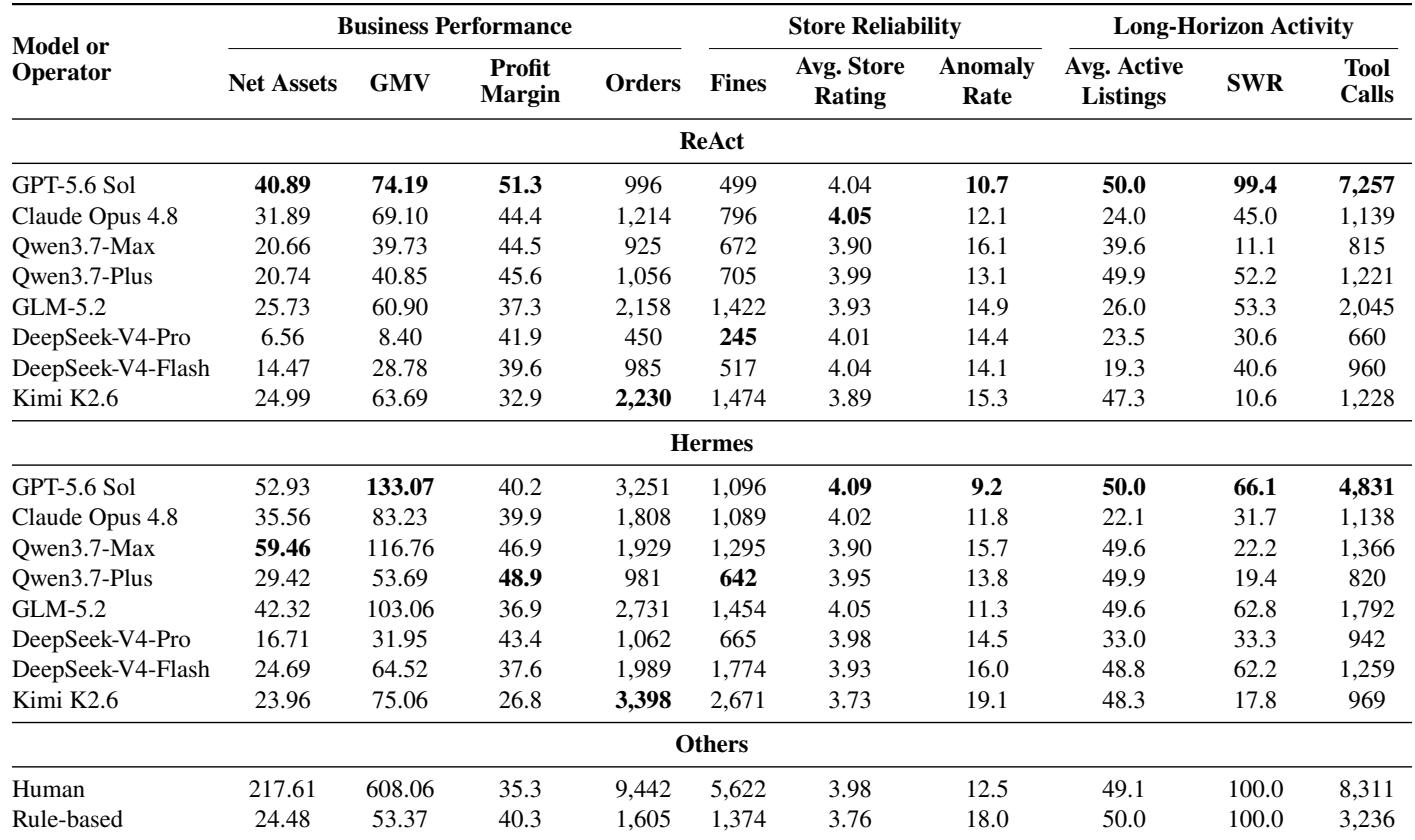
After 365 simulated days, ReAct GPT-5.6 Sol led all models in net assets, GMV, profit margin, and Sustained Window Rate, while incurring the fewest fines and lowest anomaly rate. Claude Opus 4.8 demonstrated strong store reliability with the highest average rating, and GLM-5.2 processed the most orders but paid the highest fines and earned the lowest margin. Sustained Window Rate differed sharply, from near-perfect for ReAct to just 11% for Qwen3.7-Max, highlighting large disparities in long-term operational consistency. ReAct GPT-5.6 Sol achieved the best overall business performance, with the highest net assets, GMV, and profit margin, while keeping fines and anomalies low. Claude Opus 4.8 secured the top average store rating and a low anomaly rate, though its financial metrics trailed ReAct's. GLM-5.2 drove the highest order volume but suffered the largest fines and the lowest profit margin among all agents. Sustained Window Rate ranged from 99.4% (ReAct) down to 11.1% (Qwen3.7-Max), revealing extreme variation in long-horizon reliability. Anomaly rates were lowest for ReAct (10.7%) and highest for Qwen3.7-Max (16.1%), indicating inconsistent store operation across models.
Monthly net profit profiles show that the human baseline attains far higher profits than any Hermes model, with a pronounced mid-year surge exceeding 35k. Among the Hermes variants, some demonstrate moderate profitability with peaks around 8-9k, while others remain near or below 1k throughout the year, often declining in later months. The human baseline exhibits a sharp seasonal spike, reaching its highest profits in months 6-8 and peaking above 39k. Hermes models display wide performance diversity: top performers achieve peak profits around 8-9k, whereas the weakest models rarely exceed 2k and show a downward trend. Several Hermes models end the year with profits under 1k, in contrast to the human baseline's sustained higher earnings.
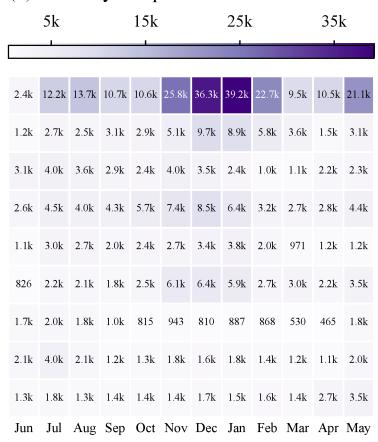
A 365-day simulated store experiment evaluated multiple LLM agents, with ReAct GPT-5.6 Sol leading in net assets, profit margin, and long-term reliability (99.4% sustained window rate), while other models showed trade-offs such as high order volumes coupled with extreme fines and low reliability. A separate human-versus-Hermes profit study found that human traders achieved far higher profits with a seasonal peak exceeding 39k, whereas Hermes models delivered modest peaks around 8-9k at best and often fell below 1k, underscoring a large performance gap.