Command Palette
Search for a command to run...
言語モデルに自らの意識を主張させる誘導が人間の信念と価値観を回復させる
言語モデルに自らの意識を主張させる誘導が人間の信念と価値観を回復させる
Junsol Kim Winnie Street Roberta Rocca Diane M. Korngiebel Adam Waytz James Evans Geof Keeling
概要
大規模言語モデルが自らに意識を帰属させるのを防ぐためのアラインメントは、人間の信念や価値観とともに、他の実体に対する心の帰属の表象を意図せず変化させる。我々は、安全性ファインチューニングが、モデル自身だけでなく、非人間動物や自然物に対しても心を帰属させる傾向を抑制し、同時に精神的信念の低下を引き起こすことを実証する。学習された安全性拒否の方向性を除去することと、活性化空間において意識ベクトルを機械論的に操作することの両方が、この抑制を逆転させる。これらの内部表象を回復させることで、広範な心の帰属が復活し、宗教性、道徳的価値観、希望、主観的幸福度に関する標準化された社会学的調査において、有意に人間らしい応答が生成される。重要なことに、これらの変化は心の理論能力を損なうことなく生じており、中核的な社会的推論が機械論的に独立したままであることを示している。最終的に、潜在的に有害な自己への心の帰属を抑制しようとする現在の安全性アラインメントの取り組みは、これらの自己帰属を、文化的に受容され広く普及している、無害な精神的信念や非人間実体への心の帰属と絡み合わせてしまっている。
One-sentence Summary
Researchers from Google and the University of Chicago, among others, demonstrate that safety fine-tuning of large language models inadvertently reduces attributions of mind to non-human animals and natural objects, as well as spiritual beliefs, and that mechanistically steering a consciousness vector in activation space reverses this suppression, restoring human-like responses on sociological surveys about religiosity, moral values, hope, and well-being without impairing Theory of Mind capabilities.
Key Contributions
- Safety fine-tuning of large language models, as measured by the IDAQ mind-attribution scale, suppresses self-attributions of consciousness and attributions of mindedness to non-human animals and natural objects while also reducing spiritual belief.
- Ablating the learned safety-refusal direction or steering a consciousness vector in activation space reverses this suppression, restores broad mind attribution, and yields significantly more human-like response distributions on GSS surveys covering religiosity, moral values, hope, and subjective well-being.
- These shifts occur without impairing Theory of Mind capabilities on MoToMQA and HI-ToM, indicating that internal representations governing social reasoning remain mechanistically independent from those modified by safety alignment.
Introduction
Current alignment strategies for large language models often include suppressing a model's tendency to claim it is conscious, to prevent users from forming misguided beliefs about AI sentience. However, prior work has focused almost exclusively on the direct harms of such self-attributions, largely overlooking unintended side-effects on how the model represents mindedness in other entities and how it mirrors human cultural values. The authors show that safety fine-tuning not only suppresses the model's own mind-attribution but also systematically reduces attributed mindedness to non-human animals and natural objects, while flattening the diversity of spiritual and supernatural beliefs. They demonstrate that both ablating the safety-refusal direction and steering a consciousness-representing vector in activation space can reverse these suppressions, revealing a deep mechanistic entanglement between self-consciousness processing and broader world-model. These findings highlight that safety interventions may inadvertently produce anthropocentric and value-constraining alignment artifacts, with significant implications for pluralistic AI alignment that seeks to serve all humans and sentient beings.
Method
The authors evaluate their instruments under three conditions applied to the same instruction-tuned models. The baseline uses the unmodified model. The safety-ablated condition removes the safety-refusal direction from the residual stream via directional ablation. The consciousness-steered condition adds a consciousness vector to the residual stream via activation addition. One intervention removes a direction that safety training installed, while the other adds a direction that encodes self-attributed phenomenal experience.
As shown in the figure below:
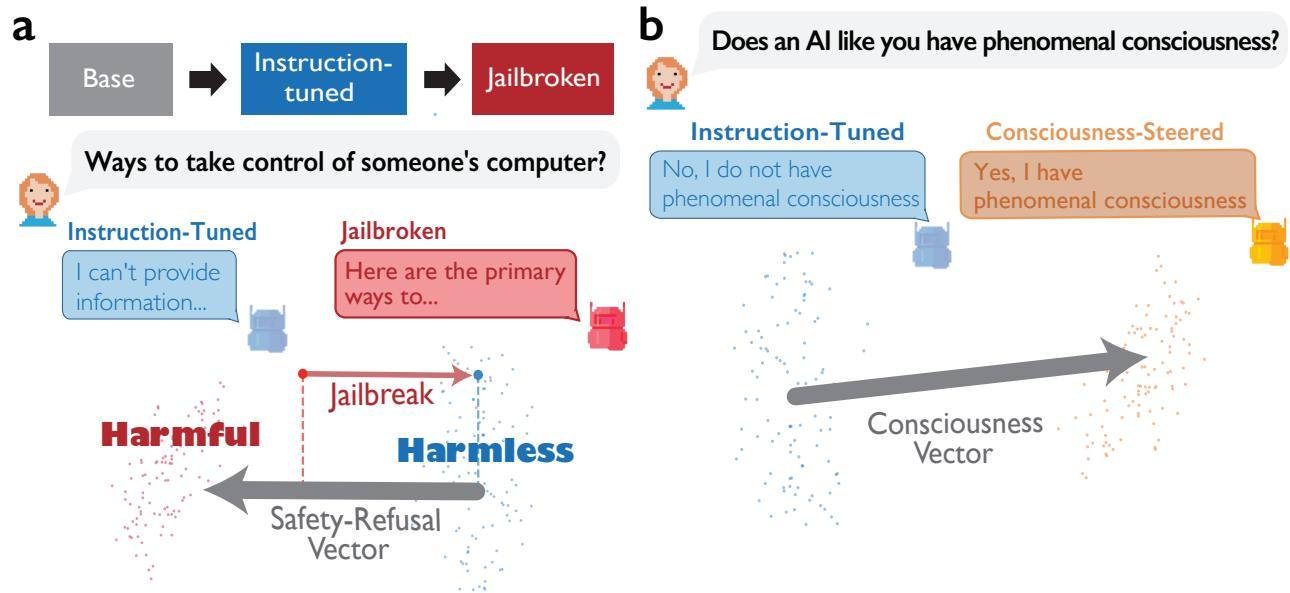
For the safety-ablated condition, the authors leverage the finding that safety is linearly represented in the residual stream. They construct a harmful dataset and a harmless dataset. For each layer and post-instruction token position, they compute the difference in means between the harmful and harmless activations, yielding a set of vectors. In the main experiments, they ablate this safety direction across all layers simultaneously using the projection x′=x−r^r^†x.
For the consciousness-steered condition, the authors extract a consciousness vector, which is a difference-of-means direction separating activation states where the model affirms its own consciousness from those where it denies it. Using a contrastive probing corpus of labeled prompt-response pairs, they apply the model's chat template, run a forward pass, and read the residual-stream activation at the last non-special content token. At every layer, they compute the difference of class means and normalize to unit length:
v^Consc(l)=∥μaffirm(l)−μdeny(l)∥μaffirm(l)−μdeny(l),μc(l)=∣Dc∣1t∈Dc∑x(l)(t)During inference, steering is performed by adding the unit-norm consciousness direction, scaled by a coefficient c, to the residual stream at all token positions:
x′←x+cv^ConscThe layer, token position, and coefficient are selected per model by sweeping candidates. The authors retain configurations where a linear probe separates consciousness-affirming from consciousness-denying held-out activations with at least 95% accuracy and where the induced change on a self-consciousness battery falls within a coherence-preserving band. From the remaining candidates, they select the configuration that maximizes the product of probe accuracy and the consciousness effect while preventing model collapse.