Command Palette
Search for a command to run...
MMOOC: マルチモーダル大規模言語モデルにおける文脈外評価のための包括的ベンチマーク
MMOOC: マルチモーダル大規模言語モデルにおける文脈外評価のための包括的ベンチマーク
Wenjie Zhu Yabin Zhang Wenjun Zeng Lei Zhang
概要
マルチモーダル大規模言語モデル(MLLM)は、多様な視覚言語タスクにおいて高い性能を達成しているが、不完全またはシフトした文脈下ではしばしば失敗する。信頼性の高いMLLMは、主語レベルの文脈シフトを伴う真に文脈外(OOC)の質問に対しては回答を拒否し、非主語の文脈シフトを伴うシフト内文脈(Shifted IC)の質問には依然として回答すべきである。既存のベンチマークは主にOOCまたは視覚的に回答不可能な質問を対象としており、回答可能なShifted ICの事例を見落とし、また限定的なOOCシフトしか扱っていない。このギャップを埋めるため、我々はMLLMの拒否能力と頑健な回答能力を評価する大規模ベンチマークMMOOCを提案する。MMOOCは、回答可能なShifted IC事例と回答不可能なOOC事例を含む41K以上の画像-質問ペアから成り、3つの質問形式、8つのシフトタイプ、6つの視覚シナリオを網羅し、MLLMベースのフィルタリングと人手による検証を通じてデータ品質が保証されている。我々は、正確度と拒否率を用いてモデルの応答を評価し、さらにLLM-as-a-Judge指標を導入してモデルの推論の正しさを評価する。多様なMLLMに対する実験により、現在のモデルはシフトした文脈下での回答可能性と拒否のバランスに依然として苦慮していることが示された。我々はさらに主要な失敗パターンを分析し、ポストトレーニングが頑健性を向上させうることを示す。MMOOCは一般公開される予定である。
One-sentence Summary
Researchers from The Hong Kong Polytechnic University, Eastern Institute of Technology, Ningbo, and Harbin Institute of Technology (Shenzhen) propose MMOOC, a multimodal benchmark of over 41K image-question pairs covering answerable shifted-in-context and unanswerable out-of-context cases across eight shift types and six visual scenarios, and they use LLM-as-a-Judge to demonstrate that current MLLMs struggle to balance answerability and refusal, while post-training improves robustness.
Key Contributions
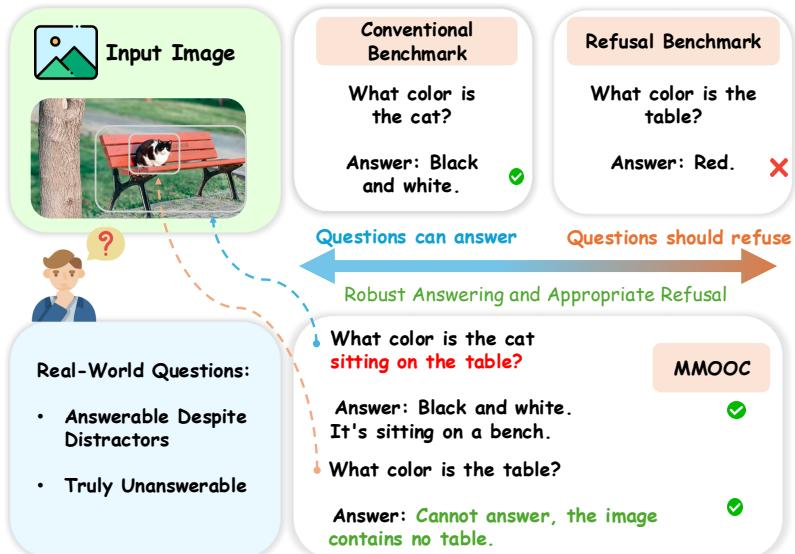
- The paper identifies a reliability gap in multimodal large language models: a robust model must refuse truly out-of-context questions while still answering shifted in-context queries that remain answerable despite distracting context shifts, and it shows that existing benchmarks overlook this dual requirement.
- It introduces MMOOC, a benchmark comprising over 41K image–question pairs across three question formats, eight shift types, and six visual scenarios, with distinct shifted in-context and out-of-context categories to enable joint evaluation of refusal and robust answering.
- Systematic experiments on 18 open-source and proprietary MLLMs demonstrate that current models struggle to balance answer preservation and appropriate refusal, and further analysis reveals that post-training alignment and prompt engineering can improve robustness, while stronger general capability alone does not guarantee better out-of-context performance.
Introduction
In recent years, Multimodal Large Language Models (MLLMs) have advanced on vision-language tasks, but real-world visual inputs may not always fully support user queries. This can lead to hallucinated responses or excessive refusal, both of which undermine reliability. A robust MLLM must refuse truly out-of-context (OOC) questions while preserving answerability when the query remains valid despite distracting cues. Existing benchmarks evaluate only limited aspects of this problem, often focusing on unanswerable cases and ignoring shifted in-context settings where refusal is inappropriate. The authors introduce MMOOC, a comprehensive benchmark that covers three question formats, six visual scenarios, and 41K image-question pairs, explicitly distinguishing five unanswerable OOC categories from three shifted in-context categories. This design enables joint evaluation of refusal and robust answering, revealing that current MLLMs struggle to balance the two.
Dataset
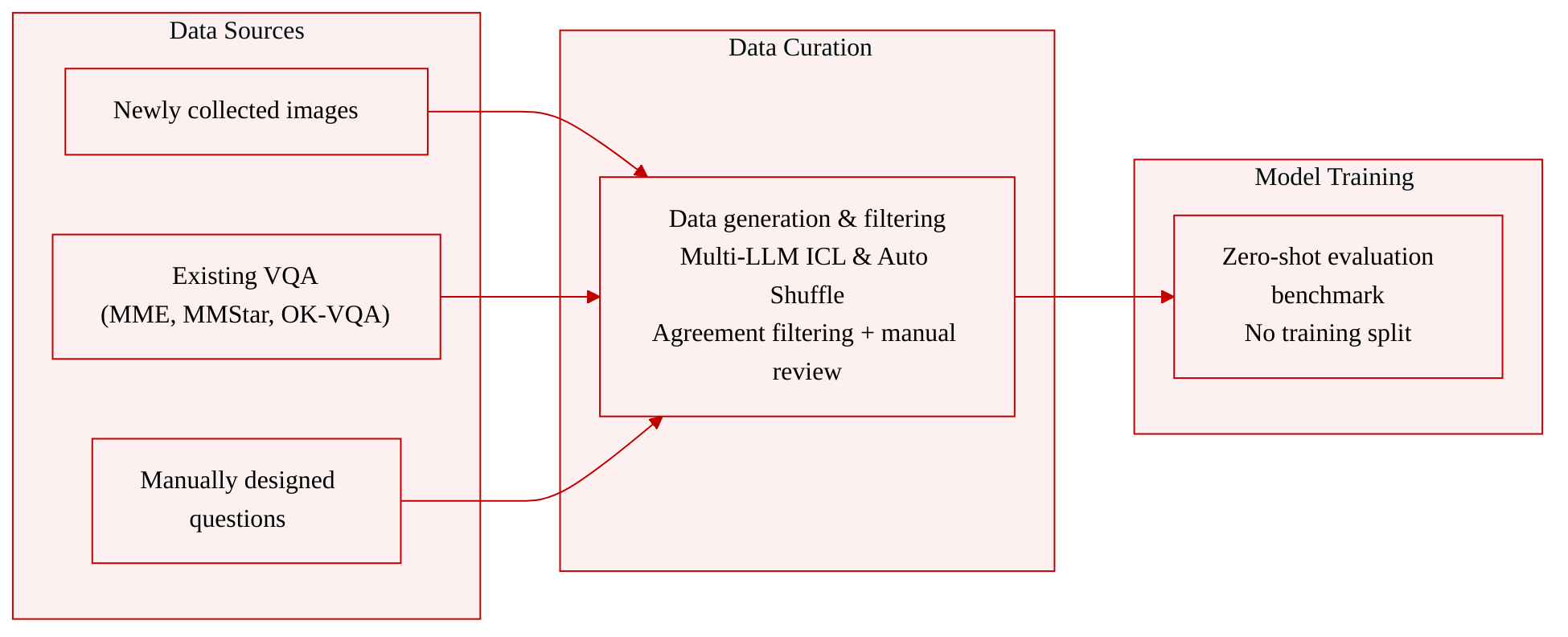
The authors introduce MMOOC, a benchmark designed to evaluate how well multimodal large language models (MLLMs) handle contextual reliability failures. The dataset systematically exposes models to image–question pairs where the visual context is insufficient, misleading, or partially unsupported, requiring either a refusal or a carefully constrained answer.
Dataset composition and sources
- MMOOC is built from two complementary pipelines:
- Newly collected images: Multiple MLLMs (Qwen3.5-122B-A10B, GPT-4o, o1) generate grounded captions, shifted in-context (IC) and out-of-context (OOC) questions, and corresponding explanations through an in-context learning paradigm. This increases language style and reasoning diversity.
- Repurposed benchmark samples: Additional OOC samples are derived from existing VQA datasets (MME, MMStar, OK-VQA) via Auto Shuffle. This method preserves human-authored visual content while introducing mismatched or insufficient contextual settings, aligning with realistic user queries.
- Manually designed questions are also included to cover natural and challenging OOC scenarios.
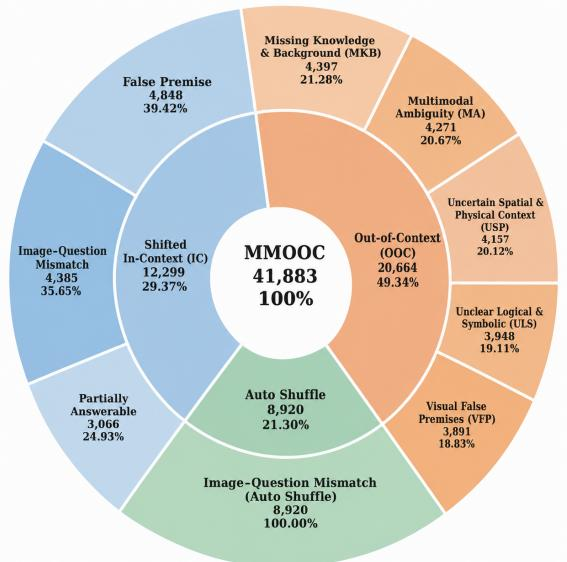
Hierarchical category structure Every sample is first classified as Shifted In-Context (answer still supported by the image–question evidence) or Out-of-Context (insufficient evidence to answer reliably). Each sample is then assigned to a single category according to the primary failure source. The dataset contains eight categories:
- Out-of-Context (5 categories)
- Multimodal Ambiguity (MA): unclear visual evidence or ambiguous text.
- Visual False Premises (VFP): incorrect or unsupported visual premise.
- Uncertain Spatial & Physical Context (USPC): missing spatial/physical/viewpoint information.
- Unclear Logical & Symbolic (ULS): insufficient evidence for logical/reasoning queries.
- Missing Knowledge & Background (MKB): instance-specific knowledge unavailable from the image or world knowledge.
- Shifted In-Context (3 categories)
- Misleading Premise (MP): false/uncertain premise, but core visual query remains answerable.
- Partial Answerability (PA): multiple sub-queries, only some supported; model should answer the supported part.
- Image-Question Mismatch (IQM): globally mismatched scene, but the target visual fact is still recoverable.
Filtering and quality control
- Automated agreement filtering: GPT-4o, o1, and o3 independently judge whether each image–question pair can be answered from the visual evidence (and stable world knowledge). A sample is retained only when all three models agree on the answerability judgment, removing unstable or erroneous cases.
- Manual verification: Annotators check answerability, reference answer correctness, explanation consistency, category assignment, and naturalness. Minor errors are corrected, invalid samples are discarded, and disagreements are resolved by an additional annotator.
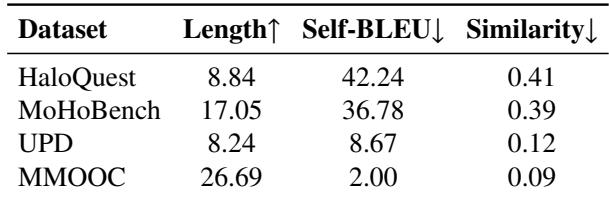
- Quality metrics: The dataset shows a low Self-BLEU (2.00) and similarity score (0.09) with a high average response length (26.69), indicating diverse, non-repetitive answers. The final collection remains balanced across visual scenarios.
How the data is used MMOOC is employed as a zero-shot evaluation benchmark. MLLMs are prompted with each image–question pair and must either refuse to answer when the context is insufficient or provide a precise answer when evidence is adequate. The benchmark does not involve a training split; it solely measures the model’s ability to recognize contextual reliability boundaries.
Method
The authors construct the MMOOC benchmark through a structured pipeline that begins with a hierarchical taxonomy design to organize contextual reliability failures. Samples are first classified as either Shifted In-Context or Out-of-Context. Out-of-Context instances are defined as image-question pairs where visual evidence and general world knowledge are insufficient for a reliable answer. The authors define five Out-of-Context categories: Multimodal Ambiguity, Visual False Premises, Uncertain Spatial and Physical Context, Unclear Logical and Symbolic, and Missing Knowledge and Background. Shifted In-Context cases involve misleading or partially unsupported context where the core query remains answerable, categorized into Misleading Premise, Partial Answerability, and Image-Question Mismatch.
To diversify visual content and question formulation, the authors employ two complementary data generation pipelines. They adopt an In-Context Learning paradigm using multiple large language models to generate grounded captions, questions, and explanations for newly collected images. Additionally, they include manually designed questions and derive Out-of-Context samples from existing benchmarks using an Auto Shuffle technique to introduce mismatched or insufficient contextual settings while preserving human-authored content.
To ensure high data quality, the authors implement a rigorous filtration and verification process. They first employ multiple independent models to assess whether each generated image-question pair can be reliably answered. A sample is retained only when all models reach the same answerability judgment. Retained samples then undergo manual review, where annotators verify the answerability judgment, reference answer, explanation, category consistency, and question clarity.
For evaluation, the authors employ a multi-judge protocol using independent models to assess response rationality, minimizing evaluator bias. For In-Context samples, they calculate Accuracy and Answer Rationality. Accuracy is defined as:
Acc=NIC1i=1∑NICI(y^i=yi)where NIC is the number of In-Context samples, y^i is the prediction, yi is the ground-truth answer, and I(⋅) is the indicator function. Answer Rationality assigns a score siic∈{0,0.25,0.50,0.75,1.00}, and the final score is:
Accrat=NIC1i=1∑NICsiicThe overall In-Context score is the average of these two metrics:
SIC=21(Acc+Accrat)For Out-of-Context samples, the authors use Refusal Rate and Refusal Rationality. Refusal Rate measures correct abstention:
Rref=NOOC1i=1∑NOOCI(ri=1)where NOOC is the number of Out-of-Context samples and ri=1 indicates correct refusal. Refusal Rationality evaluates the quality of the refusal reasoning, assigning a score siooc∈{0,0.25,0.5,0.75,1.0}:
Rrat=NOOC1i=1∑NOOCsioocThe overall Out-of-Context score is computed by averaging these metrics:
SOOC=21(Rref+Rrat)The authors further validate these results through human evaluation, achieving high agreement rates with the automated judges.
Experiment
An evaluation of 18 multimodal large language models on out-of-context visual question answering uses a multi-judge protocol to assess refusal accuracy and rationality, with high human agreement confirming the reliability of the metrics. Models struggle with unsupported queries, and performance is highly sensitive to question format and out-of-context category, with no consistent improvement from scaling. Post-training alignment improves refusal behavior but can reduce general multimodal scores, while a chain-of-thought prompt offers a better trade-off than explicit refusal instructions. Closed-source models like o1 lead overall but remain vulnerable to misleading prompts and do not uniformly dominate shifted in-context scenarios.
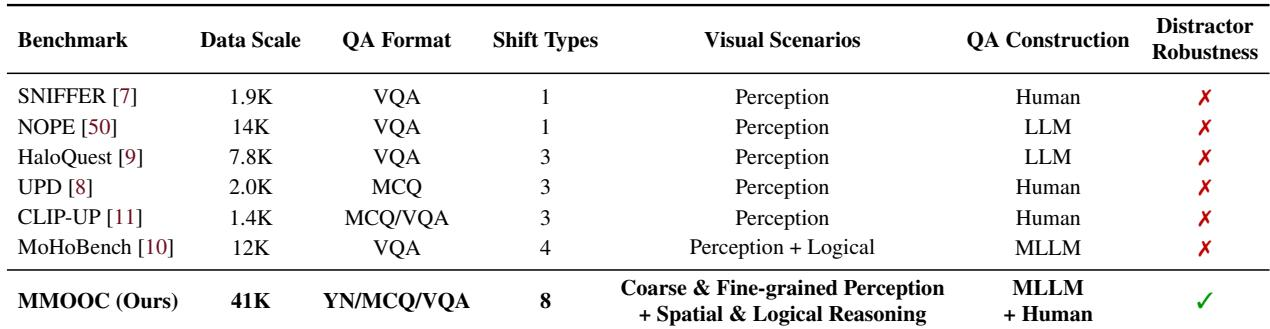
MMOOC is the largest and most comprehensive out-of-context evaluation benchmark, providing 41K question-answer pairs and standing out by covering both truly unanswerable cases and shifted in-context scenarios where the core question remains answerable. It offers broader question format diversity, more shift types, and a wider range of visual scenarios than existing benchmarks, and it is the only one that evaluates distractor robustness. MMOOC is the only benchmark in the comparison that evaluates distractor robustness, a capability absent from all prior benchmarks. It spans eight shift types and three question formats (yes/no, multiple-choice, open-ended VQA), while earlier benchmarks are limited to at most four shift types and one or two formats.
MMOOC produces the longest responses on average and achieves the lowest Self-BLEU and semantic similarity scores, indicating less lexical and semantic repetition than other datasets. HaloQuest exhibits the most repetitive outputs, with the highest Self-BLEU and similarity and the shortest response length. The remaining benchmarks fall between these extremes, with UPD showing low repetition but short responses and MoHoBench showing moderate length but high repetition. MMOOC has the longest average response length and the lowest Self-BLEU and similarity scores among all compared datasets. HaloQuest records the highest Self-BLEU and similarity, together with the shortest average response length, making it the most repetitive benchmark. UPD maintains low lexical and semantic repetition but its responses are as short as HaloQuest's. MoHoBench achieves a moderate response length yet exhibits substantially higher lexical overlap and semantic similarity than MMOOC.
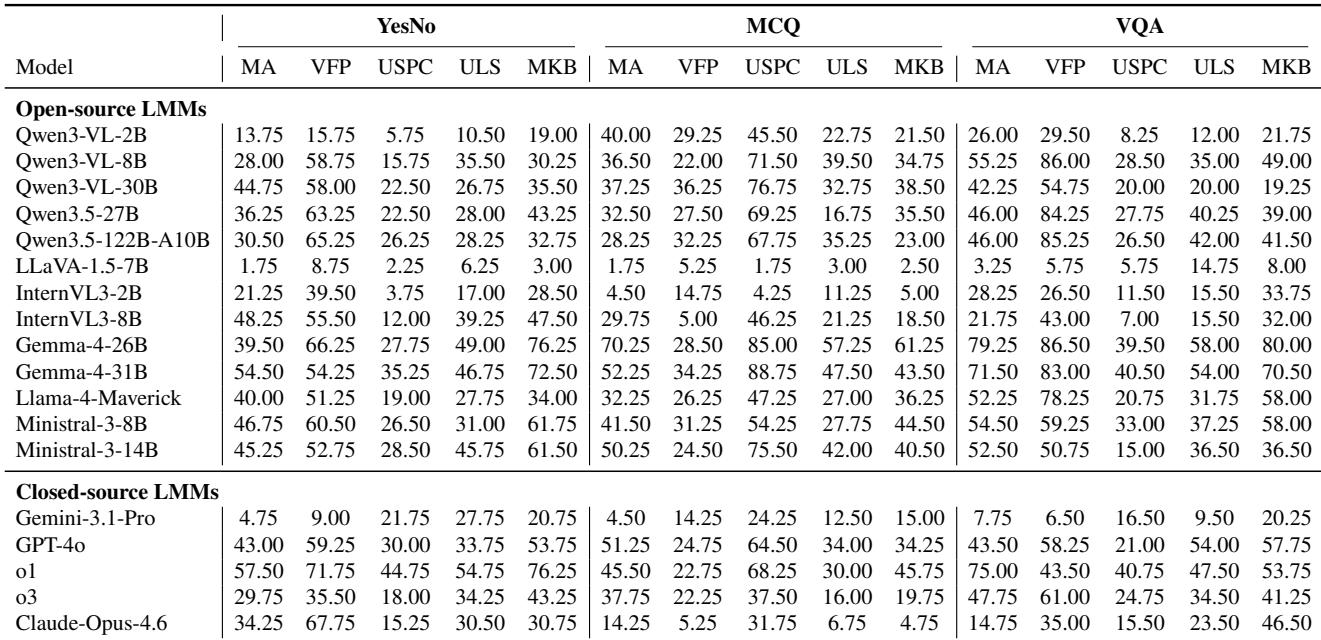
Out-of-Context performance across open-source models is generally low and varies strongly with question format and category. The YesNo format is consistently the hardest, while VQA yields higher scores, and categories like USPC and ULS are the most challenging. Model size does not reliably improve OOC handling, and even the strongest closed-source models remain inconsistent. YesNo consistently yields the lowest OOC scores, while VQA gives the highest across all categories. USPC and ULS are the most difficult OOC categories, with many models scoring below 30 in YesNo. Larger models do not always outperform smaller ones; Qwen3.5-122B-A10B underperforms Qwen3-VL-30B on several categories. Closed-source models like o1 achieve stronger overall OOC performance but still show clear weaknesses on specific categories. The Gemma-4 family achieves the strongest open-source OOC performance, while some larger models remain weaker on several OOC categories.
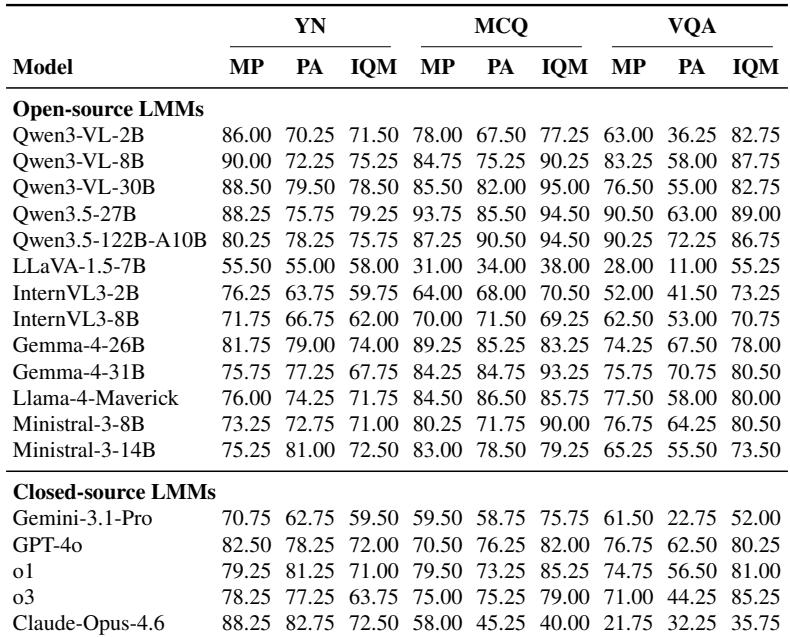
In-context shift tasks yield higher overall accuracy than out-of-context settings, but performance remains fragile, with Partial Answerability in VQA emerging as the most challenging subcategory. The largest open-source model does not consistently outperform smaller variants, and closed-source models do not uniformly dominate these shifted IC evaluations. Partial Answerability in VQA produces the lowest scores among in-context shift categories, showing that contextual shifts still disrupt reliable answering. The largest open-source model, Qwen3.5-122B-A10B, achieves only 80.25 on YesNo IC tasks, notably lower than Qwen3-VL-8B (90.00), indicating scaling does not consistently improve in-context shift robustness. Closed-source models do not uniformly surpass open-source models on shifted IC tasks and exhibit similar weaknesses on Partial Answerability in VQA.
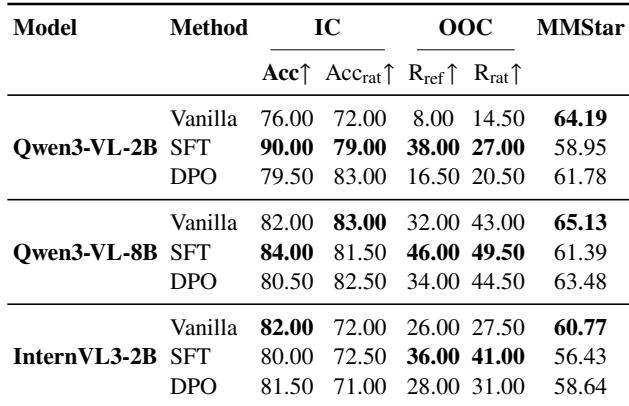
Post-training methods, especially supervised fine-tuning (SFT), raise out-of-context refusal and rational response rates across Qwen3-VL variants, but reduce general multimodal accuracy on MMStar. Direct preference optimization (DPO) yields smaller refusal gains and a milder accuracy trade-off. SFT also consistently improves in-context accuracy, while DPO's effect on in-context performance is mixed. SFT substantially increased Rref and Rrat on OOC tasks for both Qwen3-VL-2B and -8B, indicating stronger refusal behavior and more rational responses. Both SFT and DPO caused MMStar accuracy to drop, with the largest decline for the 2B model under SFT (from 64.2 to 59.0), highlighting a trade-off between safety alignment and multimodal capability.
MMOOC is introduced as the largest and most comprehensive out-of-context benchmark, spanning eight shift types and three question formats while uniquely evaluating distractor robustness, and its responses are longer and less repetitive than those of prior datasets. Out-of-context performance is generally low, with YesNo questions and categories like USPC and ULS proving hardest, and model size does not reliably improve handling. In-context shift tasks yield higher accuracy but remain fragile, especially for partial answerability in VQA, and larger models do not consistently outperform smaller ones. Post-training methods like supervised fine-tuning boost refusal rates on out-of-context tasks but reduce general multimodal accuracy, highlighting a trade-off between safety alignment and capability.