Command Palette
Search for a command to run...
Cura 1T: ヒューマンゲート自己進化ループにより訓練された医療特化型大規模言語モデル
Cura 1T: ヒューマンゲート自己進化ループにより訓練された医療特化型大規模言語モデル
Haolin Chen Leon Qi Steve Brown Deon Metelski Tao Xia Joonyul Lee Qixuan Wang Kevin Riley Frank Wang Weiran Yao
概要
医療は、高度なコミュニケーション、専門的推論、ワークフロー実行を伴う分野であるが、これらのユースケースを包括的にカバーする特化型大規模言語モデル(LLM)は依然として限られている。医療モデルには、患者相談、テキストと画像に基づく臨床推論、対話型診断、電子健康記録(EHR)ツールの利用が求められる。これらの能力は異なる形で失敗し、あるタスクに特化した更新が別のタスクの性能を低下させる可能性がある。我々は、ヒューマンゲート自己進化ループを通じて訓練された医療特化型LLM「Cura 1T」を提案する。各進化ラウンドにおいて、訓練エージェントが目標能力を計画し、モデルを訓練し、ベンチマークの軌跡を評価し、観測された失敗からデータ混合を改善する。このデータ中心のループは、単一の一般的な医療データ更新ではなく、ターゲットを絞った合成例と厳選された例を通じてモデルを改善する。医療評価スイート全体で、Cura 1Tは最先端のベースラインの中で最上位またはそれに近い順位を獲得し、一方でドメイン外の推論やエージェントベンチマークにおいても競争力を維持している。
One-sentence Summary
Actava AI's Cura 1T is a healthcare-specialized LLM trained through a human-gated self-evolution loop where each round a training agent plans a target capability, trains the model, evaluates benchmark trajectories, and refines the data mixture from observed failures, yielding targeted synthetic and curated examples; across the healthcare evaluation suite it ranks at or near the top among frontier baselines, while remaining competitive on out-of-domain reasoning and agentic benchmarks.
Key Contributions
- A human-gated self-evolution loop diagnoses benchmark failures and iteratively constructs targeted training data mixtures, enabling systematic improvement of a healthcare-specific LLM without a single generic medical update.
- Cura 1T, trained through this loop, ranks at or near the top among frontier baselines on a healthcare evaluation suite covering patient care, clinical reasoning, and agentic EHR tasks.
- Out-of-domain benchmarks (AIME, GPQA-Diamond, τ²-Bench) show that Cura 1T remains competitive, indicating that the healthcare specialization preserves the base model's general reasoning and agentic abilities.
Introduction
Frontier language models can answer difficult clinical questions, but deploying them in healthcare requires a single model that reliably handles three distinct use cases: patient-facing guideline-compliant responses, expert-level multimodal clinical reasoning, and multi-turn agentic workflows that use electronic health records and follow strict protocols. Prior work has produced strong individual components—rubric-graded conversation benchmarks, multimodal exam questions, and simulated diagnostic tasks—yet a unified model that performs well across all three areas remains underexplored. Building such a model is primarily a data-construction challenge: healthcare training signals are sparse, examples are fragmented across modalities and workflows, and adding data to improve one capability often degrades another. The authors address this by introducing Cura 1T, a healthcare-specialized large language model trained through a human-gated self-evolution loop. In this loop, an LLM agent plans a training round, trains low-rank adapters, evaluates the resulting model, reads failed trajectories, and curates the next data mixture to systematically repair gaps without causing forgetting.
Method
The authors develop Cura 1T, a one-trillion-parameter model post-trained on Kimi-K2.6 for healthcare use cases including patient care, clinical reasoning, and healthcare agentic tasks. To efficiently train this model, they build a training infrastructure around a lightweight adapter-training stack and a self-evolution loop orchestrated by a training agent.
As shown in the figure below:
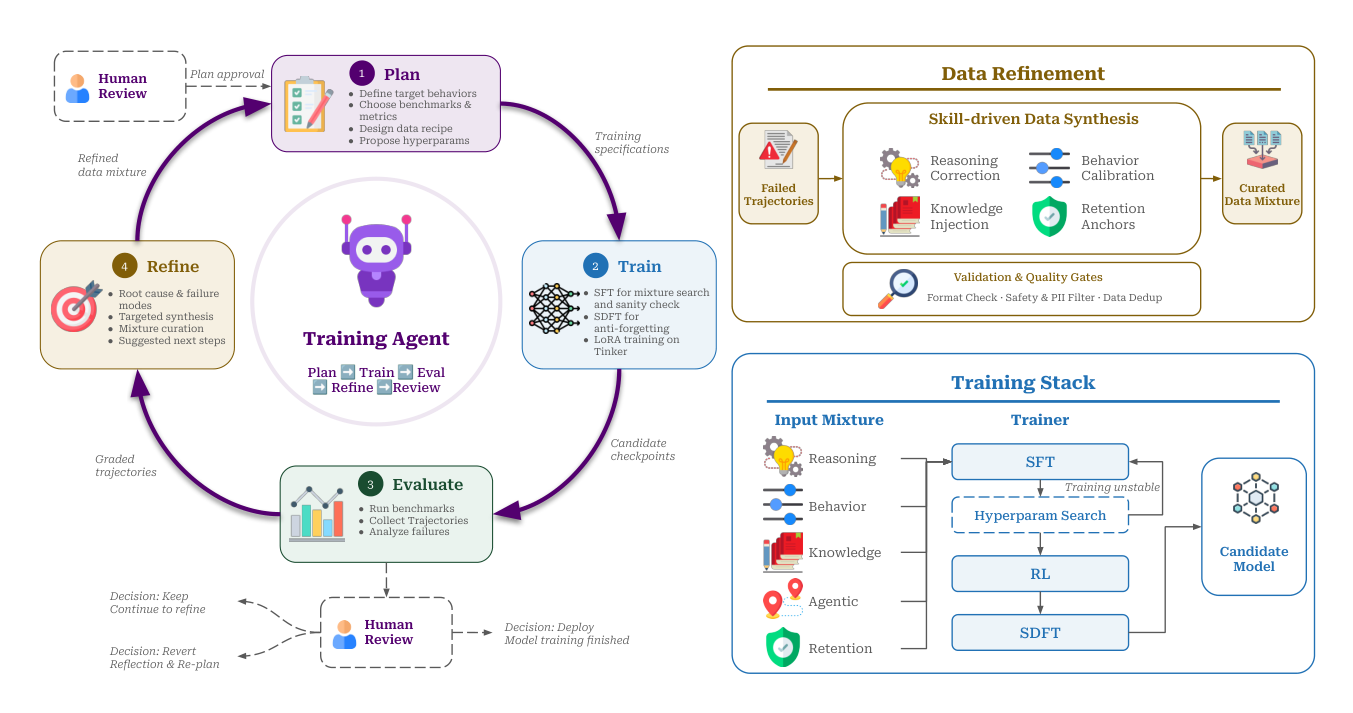
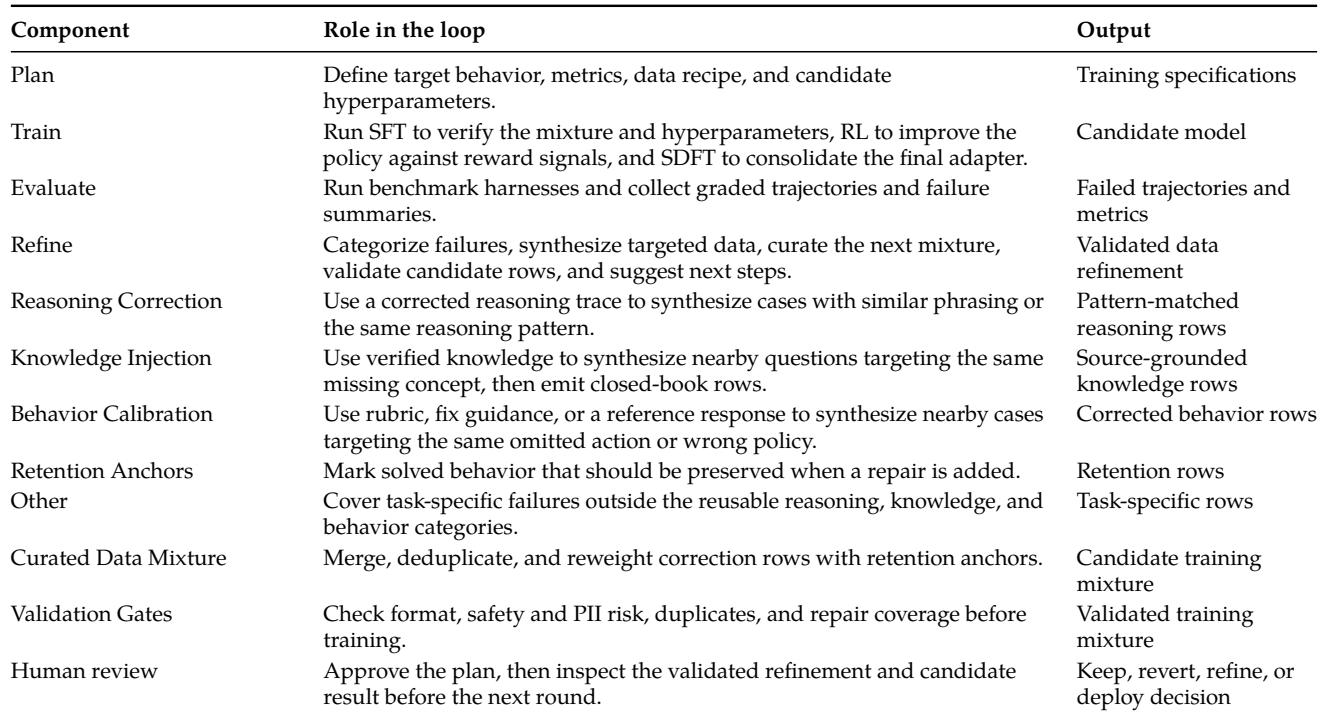
The self-evolution loop operates as a closed-loop system where the data recipe is the primary search object. The process begins with the Plan phase, where the training agent defines target behaviors, benchmarks, metrics, and a data recipe, which then passes through human plan approval. Next, the Train phase executes LoRA adapter training. This is followed by the Evaluate phase, where the agent runs benchmarks, collects trajectories, and analyzes failures. The Refine phase uses these failed trajectories for root-cause analysis, synthesizes targeted data, curates the next mixture, and validates candidate rows. Finally, a Human Review gate determines whether to keep, revert, continue refining, or deploy the candidate model.
The training protocol is implemented as a thin adapter-training stack consisting of three sequential stages. Supervised fine-tuning (SFT) serves as a low-cost prerequisite step to verify that the proposed data mixture and hyperparameters are well-formed and train stably. Once this screen passes, the round proceeds through reinforcement learning (RL) for reward-driven improvement. The final step is self-distillation fine-tuning (SDFT), which trains the model from its own on-policy samples toward a teacher distribution conditioned on additional privileged context. For a prompt x, privileged context c, and student sample y∼πθ(⋅∣x), the SDFT objective is formulated as: L(θ)=DKL(πθ(⋅∣x)∥π(⋅∣x,c))=Ey∼πθ(⋅∣x)[logπ(y∣x,c)πθ(y∣x)] Here, πθ(⋅∣x) is the student distribution and π(⋅∣x,c) is the privileged-context teacher distribution. The privileged context c represents extra information used to generate a clean teacher trajectory, such as an intervened trajectory or verified knowledge. The student only sees the original prompt after this context is removed, anchoring the update to trajectories the model can produce natively.
The data refinement pipeline enhances the data mixture by synthesizing new trajectories through several agent skills. Reasoning Correction edits failed reasoning traces with a frontier model while preserving the original problem shape to seed new questions. Knowledge Injection identifies missing clinical knowledge, grounds it with retrieved documents, and synthesizes closed-book QA rows. Behavior Calibration compares desired and observed answer behavior to synthesize rubrics and generate conditioned responses. Retention Anchors add a small set of examples for capabilities the model already handles to prevent catastrophic forgetting. Before entering the new mixture, these synthesized rows pass through validation gates checking format, safety, PII risk, duplicates, and coverage. The curated data mixture, encompassing reasoning, behavior, knowledge, agentic, and retention inputs, is then fed into the training stack to produce the candidate model.
Experiment
The evaluation spans diverse healthcare benchmarks that validate patient-facing response quality, clinical reasoning, interactive diagnosis, and FHIR tool-use reliability, while out-of-domain checks confirm preservation of general capabilities. The self-evolution pipeline addresses specific failure modes such as brittle EHR writes, omitted rubric points, missing clinical knowledge, and premature diagnosis through targeted synthetic data and retrieval strategies, often reverting rounds that degrade subsets. Cura 1T matches or surpasses frontier comparators on these tasks and retains competitive reasoning and agentic performance on out-of-domain benchmarks.
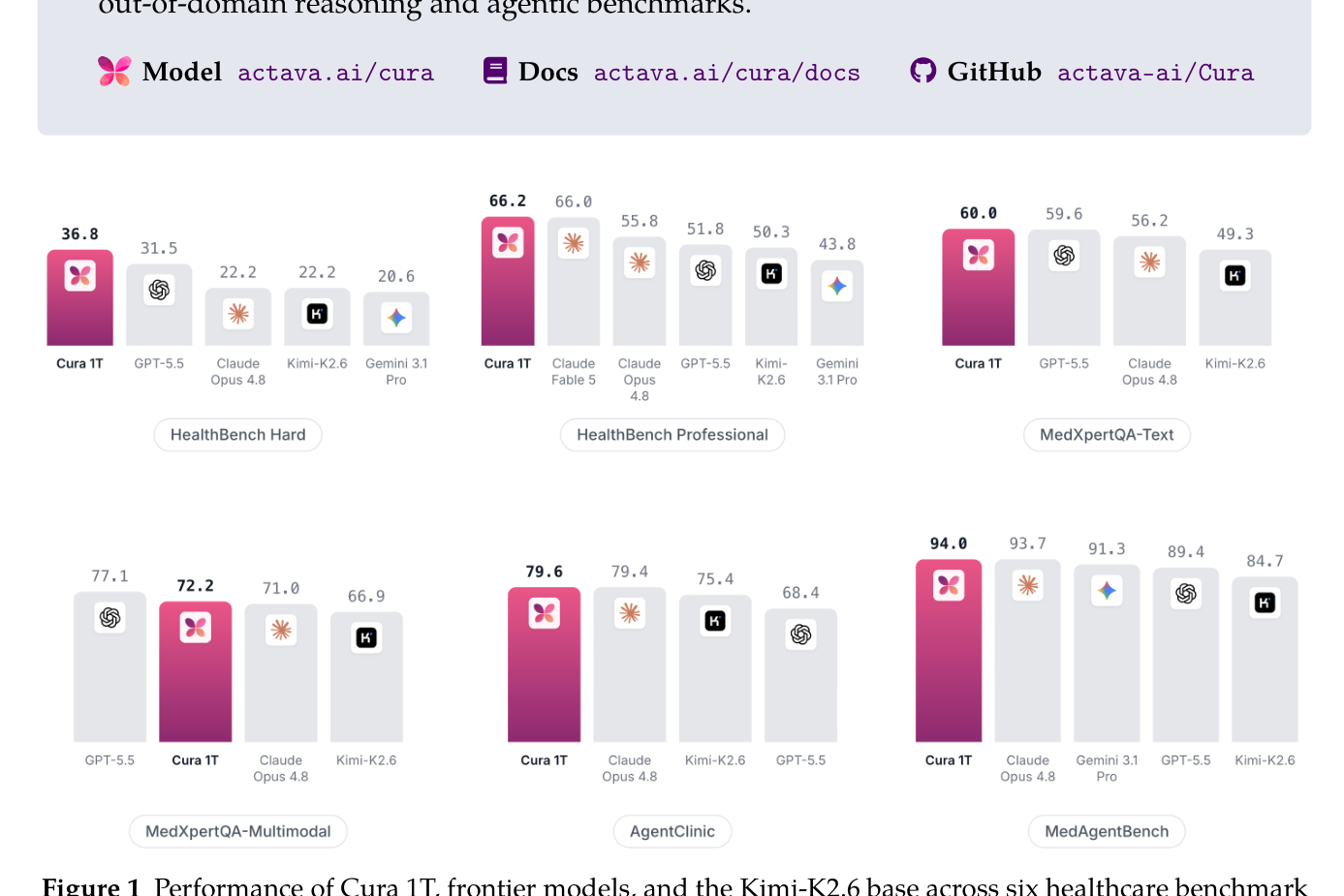
Cura 1T improves over the Kimi-K2.6 base on all five healthcare benchmarks, with the largest absolute gains on HealthBench Professional and Hard. Improvements on MedAgentBench, MedXpertQA, and AgentClinic confirm that the model strengthens across patient-care, clinical reasoning, and agentic tasks. Out-of-domain evaluations indicate that these healthcare gains do not erode general reasoning or agentic capabilities. Cura 1T achieves the largest gains on HealthBench, with rubric scores increasing by 0.159 on Professional and 0.146 on Hard. Task success on MedAgentBench rises from 0.847 to 0.940, showing notable improvement in healthcare agent workflows. MedXpertQA pass@1 improves by 0.086, leaving Cura 1T second only to GPT-5.5 on multimodal medical reasoning. AgentClinic sees a modest 0.042 gain, with the model matching the best reported NEJM score under the same tool-native harness. Out-of-domain tests confirm that Cura 1T preserves frontier-level reasoning and agentic performance on math, science, and non-healthcare benchmarks.
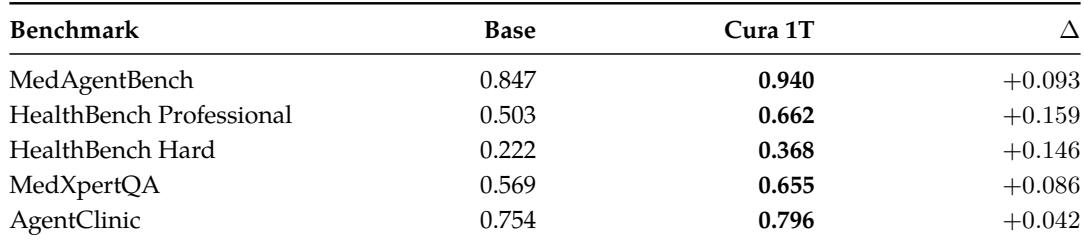
The self-evolution loop combines planning, training, evaluation, and refinement with targeted correction strategies to turn failure trajectories into improved training mixtures. Reasoning correction alone often degrades performance unless accompanied by knowledge injection and retention of correctly answered cases. The approach raises medical QA accuracy and clinical evidence-gathering scores, and the consolidated model retains specialized gains while matching general reasoning and agentic capabilities. Reasoning-only correction rounds are reverted on MedXpertQA because they lack factual coverage and reduce overall accuracy. Knowledge injection with retention and mixture refinement raises MedXpertQA pass@1 to 0.636, above the base model. Interactive trajectory training with retention improves AgentClinic pass@1 from 0.754 to 0.807, with the largest gains on NEJM and NEJM-Ext. The consolidated Cura 1T model preserves most of the AgentClinic gain (0.796) and performs on par with frontier models on out-of-domain reasoning and agentic benchmarks.
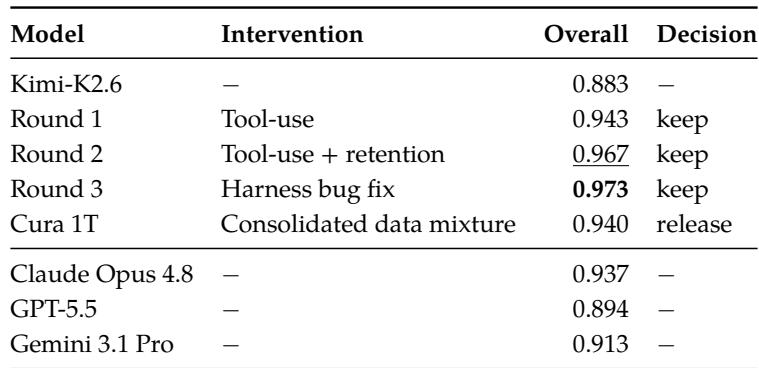
Iterative tool-use training and trajectory retention raised the model's task success from 0.883 to 0.967, with a harness fix lifting it to 0.973. The consolidated Cura 1T model achieves 0.940, surpassing the strongest frontier system at 0.937 while remaining below the fully refined pipeline. Tool-use training with retention increased success from 0.883 to 0.967 across two rounds. After consolidation, Cura 1T outperforms the best frontier model (0.940 vs 0.937) but does not reach the peak refined score of 0.973.
Starting from a base model with modest HealthBench scores, a broad behavior correction improved aggregate performance but hurt a subset and was reverted. A cleaner behavior mix then raised both Professional and Hard scores without that subset penalty, and the final consolidated model reached the strongest Professional score while staying near the best Hard score. The base model's failures were dominated by omitted required rubric points rather than explicit penalty violations. Behavior correction lifted aggregate scores but caused a large drop on a specific subset, forcing a revert. Clean behavior mix improved Professional to 0.634 and Hard to 0.372 without the earlier subset degradation, and was kept. After consolidation, Cura 1T achieved the highest Professional score at 0.662 and remained close to the top Hard score at 0.368.

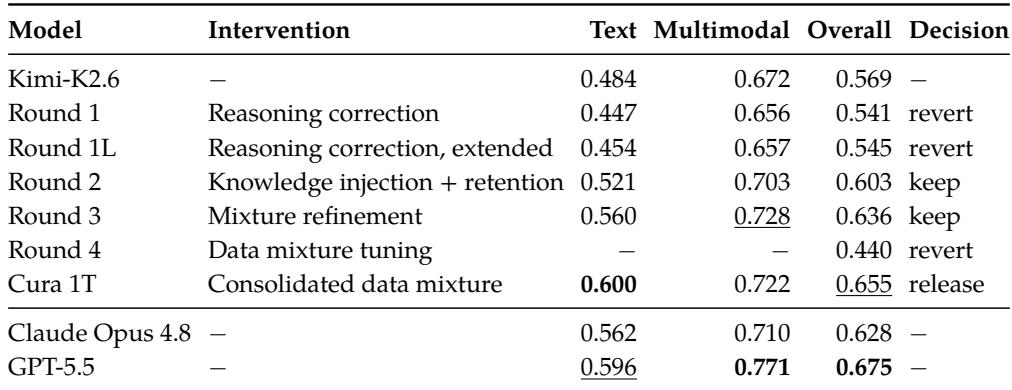
The base model achieves moderate MedXpertQA performance. Reasoning-only interventions reduce overall accuracy and are reverted. Knowledge injection with retention, followed by mixture refinement, progressively improve scores, and the consolidated Cura 1T model reaches the highest overall pass@1, surpassing the base model and Claude Opus 4.8 while remaining second to GPT-5.5. Reasoning-only correction and its extended variant both underperform the base model, leading to their reversion. Knowledge injection with retention and mixture refinement each raise overall pass@1, with mixture refinement achieving the strongest kept result before consolidation. Cura 1T combines the gains to reach 0.655 overall, outperforming the base model and Claude Opus 4.8 but trailing GPT-5.5.
Cura 1T, refined through a self-evolution loop that combines correction strategies, knowledge injection, and retention of successful trajectories, improves over the base model across all five healthcare benchmarks, with the largest gains on HealthBench Professional and Hard, while preserving frontier-level general reasoning and agentic performance. The evolution loop reveals that reasoning-only corrections often degrade accuracy unless paired with factual knowledge, and that iterative tool-use training with trajectory retention significantly boosts healthcare agent success. The consolidated model matches or surpasses frontier systems on medical QA, clinical reasoning, and agentic tasks, confirming that its specialized healthcare gains do not compromise out-of-domain capabilities.