Command Palette
Search for a command to run...
エージェントのためのハーネス進化評価の再考
エージェントのためのハーネス進化評価の再考
Yike Wang Huaisheng Zhu Zhengyu Hu Yige Yuan Zhengyu Chen Shakti Senthil Hannaneh Hajishirzi Yulia Tsvetkov Pradeep Dasigi Teng Xiao
概要
我々は、LLMエージェントに対する自動ハーネス進化の評価を再検討する。既存のハーネス進化手法は、ユニットテストケースを用いてハーネス設定を探索し、最終的な性能を同一の公開ベンチマークで報告する。このプロトコルには二つの根本的な懸念がある。第一に、ハーネス進化自体が、タスクフィードバックを用いて候補ハーネスを繰り返し評価・修正する反復探索手順である。エージェント的テスト時スケーリングと同様に、その利得がハーネス設計の改善によるものか、単なる追加探索によるものかを判断するため、フィードバックと推論予算を一致させた単純なタスクレベル探索ベースラインと比較すべきである。第二に、探索と最終評価が同一ベンチマークを共有するため、報告される利得はその特定タスクセットへの過学習リスクを伴う。これらの懸念に対処するため、我々は、同等のフィードバックと推論予算の下で、ハーネス進化を単純なテスト時スケーリングおよび発見ベースラインと比較する広範な評価を実施し、さらに、発見された改善が汎化するかを評価するため、保持されたタスクで進化ハーネスを評価する。GPT-5.4およびClaude Opus 4.6を用いたTerminal-Bench 2.1での実験は、自動ハーネス進化が単純なテスト時スケーリング手法を一貫して上回らず、限定的な汎化を示すことを明らかにする。我々の結果は、自動ハーネス進化の有効性に関する重要な疑問を提起し、自動ハーネス設計のためのより公平な評価プロトコルとベンチマークの必要性を強調する。コードはhttps://github.com/rethinking-harness-evolutionで公開されている。
One-sentence Summary
Researchers from the Allen Institute for AI and the University of Washington find that automatic harness evolution for LLM agents does not consistently outperform simple test-time scaling methods under matched feedback and inference budgets on Terminal-Bench 2.1 with GPT-5.4 and Claude Opus 4.6, and exhibits limited generalization to held-out tasks, calling for fairer evaluation protocols.
Key Contributions
- A controlled comparison of automatic harness evolution against test-time scaling baselines under matched feedback and inference budgets shows that evolution methods do not consistently outperform simpler scaling approaches on Terminal-Bench 2.1 with GPT-5.4 and Claude Opus 4.6.
- Evaluating evolved harnesses on held-out tasks from the same benchmark reveals limited generalization, questioning the practical utility of the discovered improvements.
- The study identifies a flawed evaluation protocol where search and final evaluation share the same benchmark, risking overfitting, and advocates for fairer evaluation protocols and benchmarks for automatic harness design.
Introduction
Large language model (LLM) agents rely on external harnesses (prompts, tools, memory, verification, and control logic) to interact with complex environments, and prior work shows that harness design can dramatically affect agent performance even when the underlying model is fixed. However, harness engineering remains mostly manual, motivating automatic harness evolution methods that search over harness configurations using benchmark feedback. The existing evaluation of these methods has two key limitations: it often uses the same public benchmark for both search and final measurement, which risks overfitting, and it lacks comparisons to test-time scaling baselines that allocate additional computation directly to evaluation tasks. The authors revisit the evaluation of automatic harness evolution, comparing it against parallel sampling and sequential refinement under a controlled budget that matches feedback and inference compute. Their findings show that harness evolution does not consistently outperform simple test-time scaling, and that gains observed on overlapping tasks may reflect adaptation to specific instances rather than generalizable harness improvements, underscoring the need for stricter evaluation protocols.
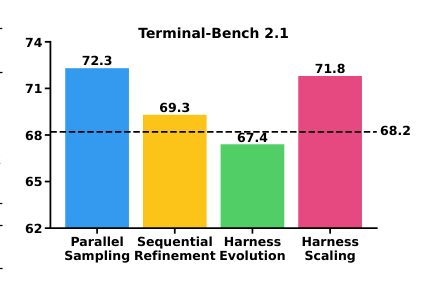
Experiment
The experiments compare automatic harness evolution with test-time scaling methods (parallel sampling, sequential refinement, harness scaling) on Terminal-Bench using three frontier models, under settings with and without unit test feedback, and on a held-out task split. Harness evolution does not consistently outperform simpler test-time discovery; its gains largely come from making multiple attempts rather than from genuinely improved harness design, and it fails to generalize to unseen tasks, instead overfitting to task-specific shortcuts. Qualitative analysis shows that while the meta agent produces rational edits, these rarely convert hard failures into successes, suggesting that harness evolution may only be beneficial when tasks are both difficult and strongly harness-dependent.
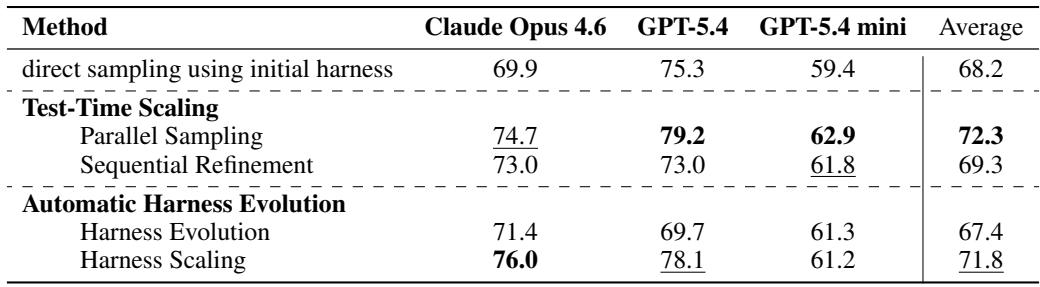
When unit tests are unavailable, test-time scaling via parallel sampling provides consistent gains, while automatic harness evolution underperforms the baseline and can harm stronger models. Self-generated feedback alone is too noisy to reliably guide harness revision, making parallel sampling a safer and more effective strategy in this setting. Parallel sampling improved average pass@1 across all three models and achieved the highest overall average, while harness evolution fell below the direct sampling baseline. Harness evolution caused a sharp drop of over 5 points on GPT-5.4, showing that iterative self-revision can degrade performance when correctness signals are absent.
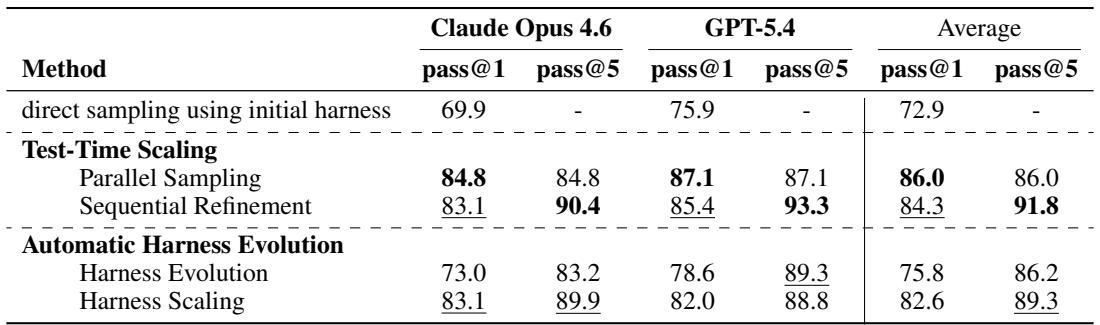
When unit tests are available, test-time scaling methods substantially outperform direct sampling and automatic harness evolution. Parallel sampling and sequential refinement both achieve large gains, with sequential refinement reaching the highest pass@5 scores. Harness evolution improves only modestly over the baseline and remains well below the test-time scaling approaches. Parallel sampling delivers the highest pass@1 performance, raising average scores from 72.9 to 86.0 and matching its pass@5 accuracy. Sequential refinement achieves the best pass@5 results, reaching 93.3 on GPT-5.4, far exceeding harness evolution’s best pass@5 of 89.3.
When a harness is evolved on a set of training tasks and evaluated on unseen held-out tasks, it provides almost no benefit over the initial harness. The evolved harness yields a small improvement on one model and none on the other, averaging less than one point, indicating that the process overfits the training data and fails to generalize. The discovered modifications appear to be task-specific shortcuts rather than reusable design principles. On held-out tasks, Harness Evolution improved Claude Opus 4.6 by only 1.2 points and left GPT-5.4 unchanged, for an average gain of 0.6 points. The near-zero transfer performance suggests that the algorithm overfits training tasks, memorizing fixes instead of learning general scaffolding strategies.

The evaluation compares test-time scaling methods (parallel sampling and sequential refinement) to automatic harness evolution first without and then with unit tests, and finally on held-out tasks. In both settings, test-time scaling reliably improves performance, while harness evolution is harmful without tests, provides only modest gains with tests, and fails to generalize to unseen tasks due to overfitting.