Command Palette
Search for a command to run...
多様なインタラクションを備えた無限の世界
多様なインタラクションを備えた無限の世界
概要
我々はLingBot-World 2.0(LingBot-World-Infinityとしても知られる)を発表する。これはLingBot-Worldの高度な反復版であり、4つの明確なアップグレードを特徴とする。(1) 我々のモデルは、注意深く設計された因果的事前学習パラダイムの恩恵により、一貫した出力品質を維持しつつ、無限のインタラクション期間を達成する。(2) 基本モデルからリアルタイム変種を蒸留することにより、我々のシステムは迅速な応答時間を保証し、720pのビデオストリームを60fpsで駆動するのに十分である。(3) 以前のバージョンと比較して、今回の更新では、より広範なアクション(例:攻撃、弓術、呪文詠唱、射撃)と、より豊富なテキスト駆動型イベントを含む、非常に多様なインタラクティブ要素が導入されている。(4) 我々は世界モデリングの領域内でエージェント的ハーネスの統合を先駆的に行い、パイロットエージェントがキャラクターの行動を計画・実行する役割を担い、ディレクターエージェントがシーンの進行に応じて新たな環境要素を合成する責任を負う。さらに、共有体験を促進するために、複数のプレイヤーが同時にこの鮮やかな世界シミュレーターに没入できるインターフェースを開発する。我々は主要な14Bモデルを軽量な1.3Bの対応モデルと組み合わせ、単一GPU上での容易な展開をサポートする。
One-sentence Summary
The authors present LingBot-World 2.0 (LingBot-World-Infinity), an advanced world simulator that enables unbounded interaction horizons through a causal pretraining paradigm, incorporates a distilled real-time 1.3B model delivering 720p video at 60fps, features diverse interactive elements including actions like attacking, archery, spell-casting, and shooting as well as a richer variety of text-driven events, and introduces an agentic harness with pilot and director agents, all deployable on a single GPU and supporting simultaneous multiplayer immersion.
Key Contributions
- LingBot-World-Infinity is an open causal world model that sustains unbounded interaction horizons with consistent visual quality and drift resistance, achieved through a causal pretraining paradigm.
- A real-time distilled version renders an unbounded, drift-free interactive world at 720p and 60 fps, verified by over an hour of continuous generation without quality loss.
- An agentic harness combines a pilot agent for character behavior planning and a director agent for synthesizing environmental elements, supporting a diverse action space (combat, archery, spell-casting, shooting) and on-the-fly text-driven events such as weather changes, creating a self-sustaining, goal-directed, and open-ended interactive experience.
Introduction
Interactive world models that synthesize video frames in response to real-time inputs offer a compelling path toward dynamic game generation and embodied simulation. However, prior work has struggled with long-horizon stability: errors accumulate and scenes degrade within minutes, while high-fidelity interactivity remains computationally prohibitive, often forcing a trade-off that yields only coarse camera control at low resolution. The authors tackle both challenges by training a causal video generation backbone that strongly resists drift, then distilling from it a real-time model that sustains an unbounded, drift-free world at 720p and 60 fps. An agentic harness—with a pilot agent that chooses character actions and a director agent that seeds fresh content—turns the frame predictor into a self-sustaining, open-ended experience with rich interactivity such as combat, archery, spell-casting, and on-the-fly environmental changes.
Dataset

The authors construct a unified training dataset from three complementary video sources, then filter, profile, and annotate it to support an interactive world model that must respond to time-varying instructions and control signals.
Data sources and initial normalization
- Egocentric videos: self-collected first-person footage capturing natural hand–object interactions and real-world dynamics.
- Synthetic data: clips generated from games and Unreal Engine environments, providing accurate scene geometry and temporally aligned control signals (jumping, attacking, driving, flying). These signals are essential for learning controllable state transitions.
- Web videos: large-scale in-the-wild content that supplies open-domain coverage and long-tail visual diversity.
- All raw videos are normalized into a shared metadata record containing source information and basic attributes before downstream processing.
Profiling and filtering pipeline
- Shot boundaries are detected with TransNet V2, and long videos are split into temporally coherent clips.
- Clips are removed if they fail basic constraints on duration, resolution, or decoding stability.
- A technical scoring filter aggregates visual quality, luminance range, OCR-based text occupancy, motion statistics, and encoding stability to discard clearly unsuitable samples.
- The remaining candidates are profiled by a vision-language model (VLM) in two dimensions:
- Quality attributes: editing artifacts, ambiguous visual evidence.
- Semantic attributes: viewpoint, activity category, interaction pattern.
- VLM profiles are later used for data balancing and prompt routing.
Multi-dimensional annotation design
- The pipeline produces video-level global captions (overall scene, task context, interaction trajectory) and chunk-wise local captions for temporal segments.
- For each chunk, the annotation process uses multi-track event-level annotation:
- Decoupled tracks independently capture subject visibility, motion state, interaction state, environmental dynamics, and static scene state. This avoids merging unrelated changes.
- When available, temporally aligned control signals serve as auxiliary evidence for boundary cues, but final captions are strictly grounded in visible content to prevent speculation.
- Active track states are composed into chunk-wise captions, then refined to improve terminology consistency, temporal smoothness, and to remove future-revealing or redundant expressions.
How the data is used in the model
- The dataset was created to resolve a train–inference mismatch: the model must follow localized instructions in real time, so training includes both global context and chunk-level supervision.
- Video-level captions supply overarching semantic context, while chunk-wise captions provide per-segment state descriptions that help the model capture scene dynamics, interaction outcomes, and control-sensitive transitions.
- The mixed-source corpus, after profiling and hierarchical annotation, is used to train the interactive world model; composition and filtering statistics are documented in the paper’s Table 1.
Method
The authors formulate the interactive world simulator as a causal generative process along the time axis, adhering to the principle that an effect never precedes its cause. Under this causal assumption, each state depends solely on its historical context and the current user input, yielding the factorization:
pθ(x1:T∣a1:T)=∏tpθ(xt∣x<t,a≤t)
where θ parameterizes the world transitions and dynamics. To realize this, the authors develop LingBot-World-Infinity, which takes an initial frame and interacts with a stream of user inputs to autoregressively generate an infinite, drift-free world in real time.
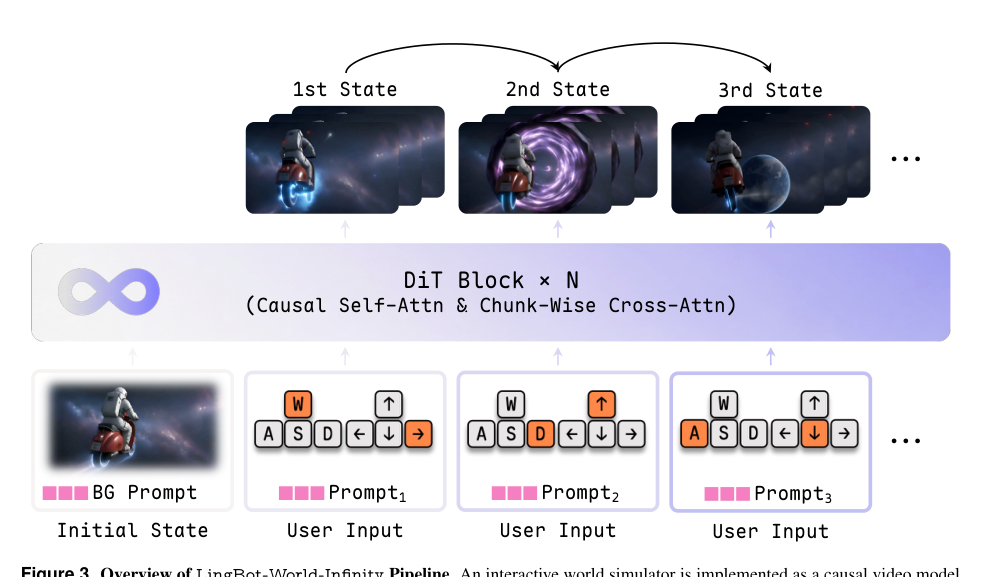
The training process is divided into two stages: a pre-training stage that learns a causal, action-conditioned world model, and a post-training stage that distills the model into a real-time generator while suppressing long-horizon drift.
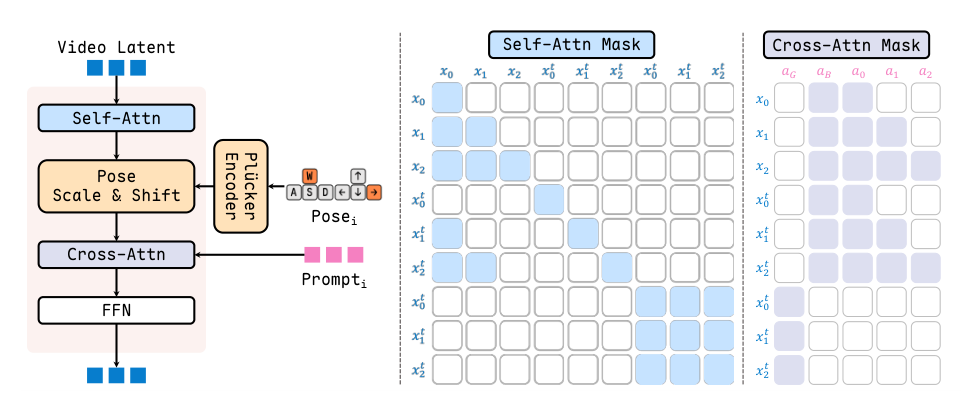
In the pre-training stage, the authors train a causal world model capable of generating boundless, action-controllable video with high visual fidelity. The architecture supports two forms of user input as actions: camera poses and textual prompts. Camera poses are represented using Plücker embeddings, which encode the viewing ray of each pixel as six-dimensional coordinates, and are incorporated into the diffusion process via an adaptive layer normalization mechanism. For textual control, chunk-wise prompts are adopted, where each video chunk is assigned its own caption to enable time-localized semantic control.
To address the issue of the model over-relying on the clean context during autoregressive generation, which leads to overfitting and visual quality degradation, the authors propose the Mixture of Bidirectional and Autoregressive (MoBA) Attention Mask. This hybrid mechanism integrates a bidirectional component into the standard teacher forcing mask. For self-attention, each noisy frame attends to itself and its clean context, while the bidirectional component with full attention helps the model adapt to flexible-length video generation and acts as a regularizer. For cross-attention, the autoregressive component attends to a background prompt and chunk-wise prompts in a lower-triangular pattern to prevent future semantic leakage, while the bidirectional component attends to a global prompt describing all events.
The model is optimized using a conditional flow-matching objective. For each frame i, a noisy latent xit=(1−t)xi+tϵ is constructed, and the network vθ is trained to predict the flow velocity conditioned on the clean context, camera poses, and prompts:
Lfm=Ex,i,t,ϵ∥vθ(xit,t∣x<i,p≤i,a≤i)−(ϵ−xi)∥2
In the post-training stage, the multi-step pre-trained causal diffusion model is compressed into a few-step generator suitable for real-time interaction. The authors employ Consistency Distillation to reduce the number of denoising steps by enforcing local consistency between adjacent points on the same teacher probability-flow ODE trajectory:
LCD=E[d(Gθ(xit,t∣c),Gθ−(x~it−Δt,t−Δt∣c))]
where c denotes the causal conditioning variables. To further refine the student generator and mitigate compounding drift during long-horizon self-rollout, Distribution Matching Distillation (DMD) is applied. DMD optimizes the generator using the gradient of the KL divergence between the noised student distribution and the noised data distribution:
∇θE[DKL(pθ,t∥pdata,t)]=−E[(sreal(x^it,t∣c)−sfake(x^it,t∣c))∂θ∂x^i]
By applying DMD over long self-rollout trajectories, the student is optimized on the state distribution induced by its own predictions, effectively reducing accumulated drift.
To bridge the gap between passive video generation and interactive world modeling, the authors introduce a Director-Pilot Co-Simulation Framework for deployment. In this architecture, a Vision-Language Model serves as the "Director," governing macroscopic semantic rules and causal reasoning, while the underlying Video Generator acts as the "Pilot," simulating low-level physical dynamics and rendering high-fidelity visual transitions.
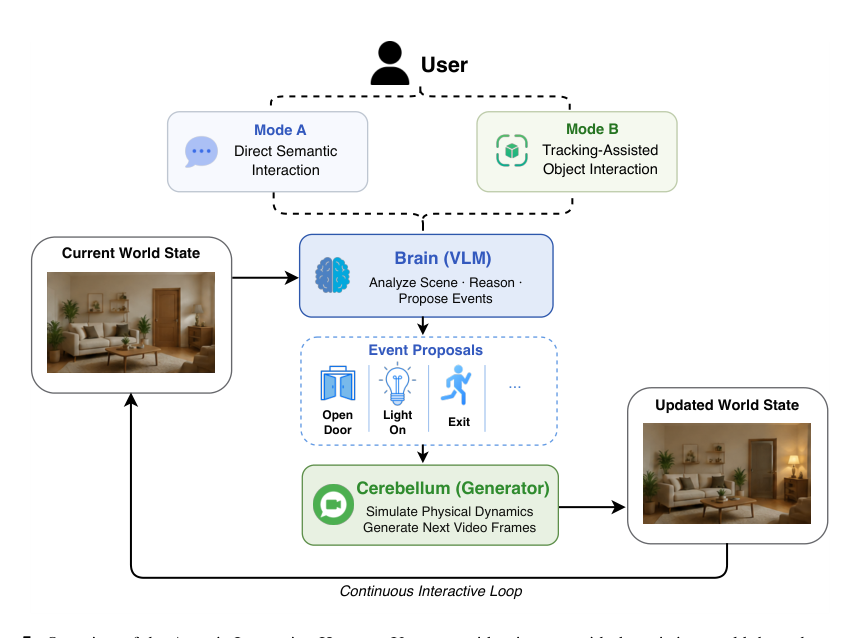
The VLM continuously analyzes the current visual phenomena, anticipates the logical consequences of user interactions, and formulates explicit event proposals. These proposals are fed into the Video Model to ground semantic instructions into coherent spatio-temporal rollouts. The framework supports two primary interaction modes. In Direct Semantic Interaction, the VLM directly analyzes the current frame and generates dynamic event cards for the subject, allowing seamless, holistic interactions. In Tracking-Assisted Object Interaction, a SAM-based action-proposal loop is integrated for precise, object-centric manipulation. The VLM identifies specific interactive elements, and SAM continuously tracks these objects across video chunks to maintain spatial consistency.
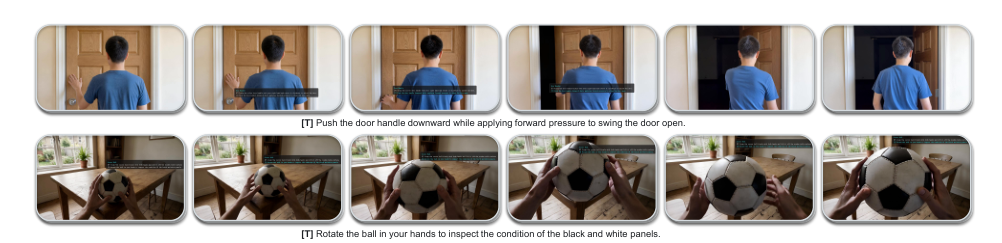
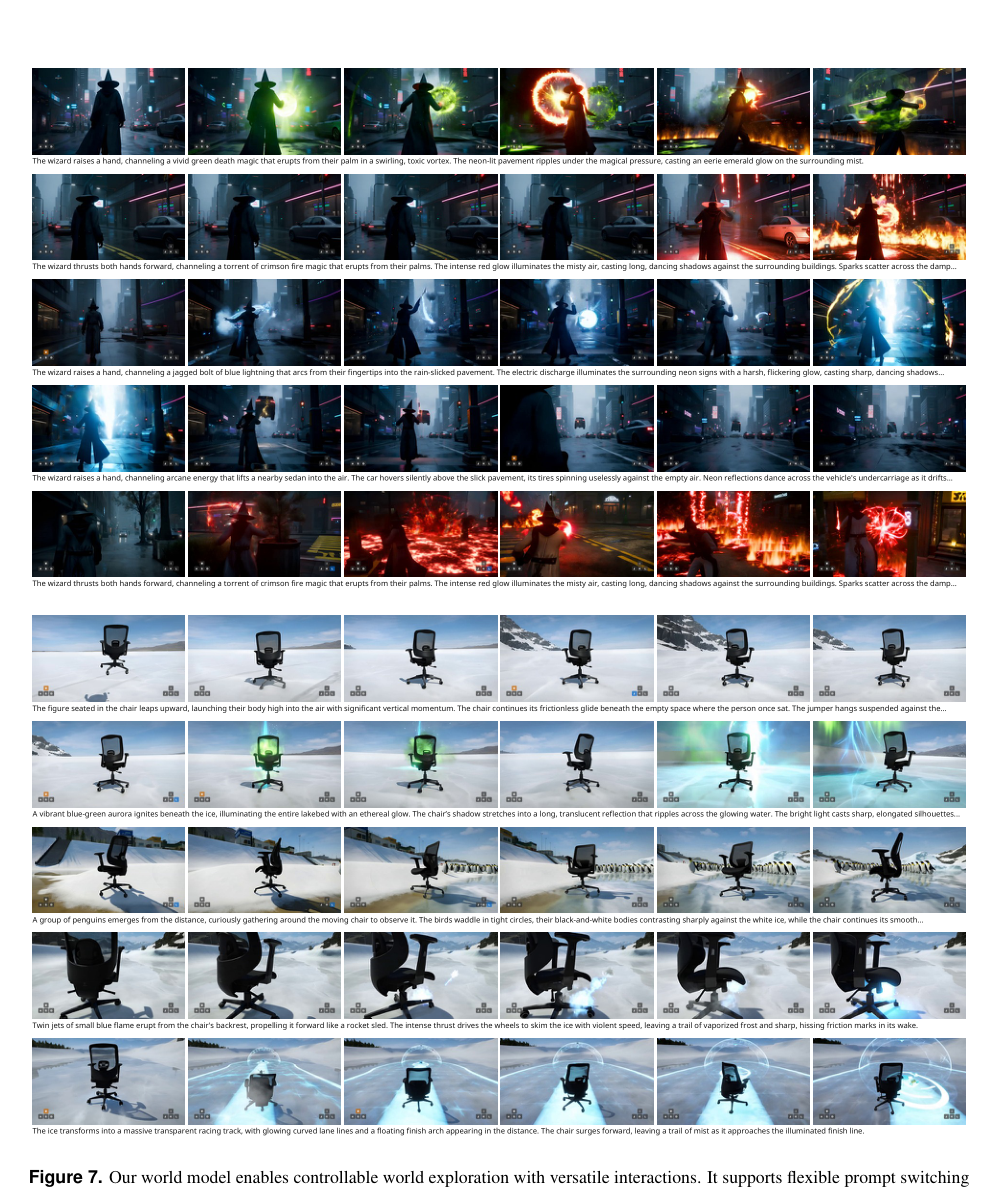
To ensure high visual quality and low latency during deployment, the authors implement a lightweight spatio-temporal refiner that upsamples decoded frames and synthesizes intermediate frames for smoother motion. Additionally, a dynamic KV-cache scheduling mechanism adapts the context on the fly according to the current control signal, retaining the most informative history while discarding stale entries to accelerate inference and improve coherence. The resulting system enables controllable world exploration with versatile interactions, supporting flexible prompt switching across different world horizons and controllable navigation of diverse protagonists.
Experiment
The evaluation first examines the distilled interactive model, which matches the visual quality of the strongest closed-source baselines while remaining open, sustains real-time high-resolution generation without degradation, and maintains full stability over hour-long continuous sessions. The pretrained backbone is then compared against prior causal models, where it consistently outperforms them in long-horizon coherence, retaining sharp textures and stable geometry far beyond the few seconds or minutes at which earlier systems fail, thanks to its anti-drift training. Together, these results demonstrate structural stability superior to existing alternatives, with the distilled model uniquely combining open access, real-time interactivity, and consistent visual quality over extended exploration.
The proposed interactive world model uniquely achieves hour-level continuous generation in a general domain, combining infinite semantic interactions, high dynamic degree, and real-time performance while remaining fully open-source. All other compared models are limited to minute-scale generation and none offer both general-domain scope and rich interactivity. Only the proposed model sustains generation beyond minutes, reaching hours without visible quality decay. It provides infinite semantic interactions, whereas competitors support none or only a few. Despite being fully open-source, its visual quality equals or exceeds that of the strongest proprietary baselines. The model maintains real-time, high-resolution output with no degradation over arbitrarily long rollouts.
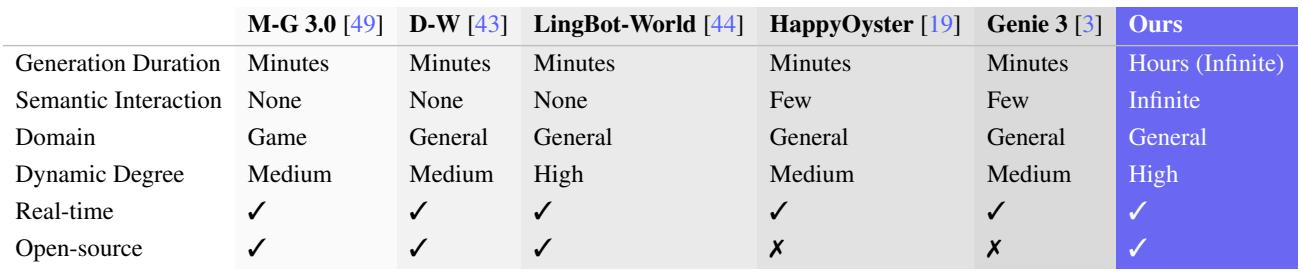
The evaluation demonstrates that the proposed interactive world model uniquely achieves hour-level continuous generation, supporting unlimited semantic interactions and high dynamic degree in a general domain, while all other methods are restricted to minute-scale generation and limited interactivity. The model sustains real-time, high-resolution output with no quality degradation over arbitrarily long rollouts, and its visual quality equals or surpasses that of the strongest proprietary baselines despite being fully open-source.