Command Palette
Search for a command to run...
マルチレゾリューションフローマッチング: 段階的サンプリングによる訓練不要な拡散加速
マルチレゾリューションフローマッチング: 段階的サンプリングによる訓練不要な拡散加速
Xingyu Zheng Xianglong Liu Yifu Ding Weilun Feng Junqing Lin Jinyang Guo Haotong Qin
概要
テキストから画像への拡散を加速するハードウェア非依存の戦略、例えばタイムステップ蒸留や特徴キャッシングは、カスタムカーネルやシステムレベルの最適化なしに推論時間を短縮できる。中でも、マルチレゾリューション生成戦略は最近広く注目を集め、訓練なしで5倍以上の高速化を達成している。しかし、潜在空間でのアップサンプリングと部分領域の選択的修正を組み合わせた設計により、これらの手法は顕著なぼやけやアーティファクトを生じさせる。そこで我々は、事前学習済みフローマッチングモデルのための訓練不要なマルチレゾリューション加速戦略MrFlowを提案する。これは低解像度から高解像度への段階的パイプラインに基づく。MrFlowはまず低解像度で主要構造を迅速に生成し、次に軽量な事前学習済みGANベースモデルを用いてピクセル空間で超解像を行い、その後低強度のノイズを注入して高周波リサンプリングを可能にし、最後に高解像度で詳細を精緻化する。FLUX.1-devとQwen-Imageでの定量的・定性的結果は、MrFlowが低解像度サンプリングの二次的なトークン削減とステップ数低減要件を活用し、加速前とのOneIG差を1%以内に保ちつつ、エンドツーエンドで10倍の加速を達成し、他の訓練不要な加速戦略を大幅に上回り、一切の訓練や実行時の動的識別を必要としないことを示す。MrFlowはさらに、事前学習済みタイムステップ蒸留戦略と直交的に直接組み合わせることができ、最大25倍の生成加速を達成する。
One-sentence Summary
Beihang University, Nanyang Technological University, and Chinese Academy of Sciences, among others, propose MrFlow, a training-free multi-resolution acceleration strategy for pretrained flow-matching models that first generates main structure at low resolution, then applies pixel-space super-resolution via a lightweight GAN, injects low-strength noise for high-frequency resampling, and finally refines details at high resolution; evaluated on FLUX.1-dev and Qwen-Image, MrFlow achieves a 10× end-to-end speedup with a OneIG gap <1% relative to unaccelerated sampling, and when combined with timestep distillation, reaches up to 25× acceleration, significantly outperforming existing training-free approaches.
Key Contributions
- MrFlow is a training-free multi-resolution acceleration pipeline for pretrained flow-matching models that generates an image structure at low resolution, upsamples in pixel space via a lightweight GAN-based super-resolution model, injects low-strength noise, and performs a single high-resolution refinement step.
- On FLUX.1-dev and Qwen-Image, MrFlow achieves over 10× end-to-end speedup while keeping the OneIG-Bench loss within a 1% gap relative to native inference, outperforming other training-free acceleration strategies without any training or runtime dynamic statistics.
- The method allows flexible configuration for speedup–quality tradeoffs and can be directly combined with pretrained timestep distillation models to yield an orthogonal compounded speedup of up to 25×, with no additional training.
Introduction
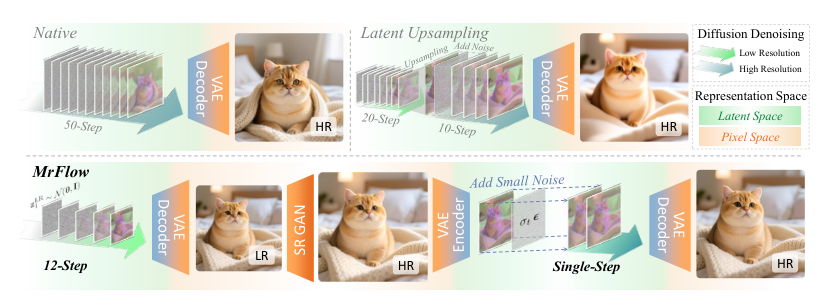
Modern diffusion models built on Transformers and flow matching have become the standard for high-quality image generation, but this quality comes with substantial computation. For example, a leading 20-billion-parameter model can take 47 seconds to generate a single 1024×1024 image on an NVIDIA A100. Researchers have pursued several acceleration strategies: timestep distillation slashes the number of sampling steps to just 1–4 but requires expensive model retraining; feature caching and token pruning offer training-free speedups but rarely exceed 4×. Training-free multi-resolution methods that exploit spatial redundancy can surpass 5× speedup, yet they typically depend on runtime dynamic identification of image regions, and performing upsampling directly in the latent space often introduces blurring or artifacts. The authors leverage this multi-resolution insight but address its shortcomings. They propose MrFlow, a training-free staged pipeline that first generates the image’s coarse structure at low resolution in the latent space, then uses a lightweight GAN-based super-resolution network in pixel space to upscale while preserving structure, applies low-strength noise to weaken any erroneous high-frequency details, and finally refines the result with a fast, few-step high-resolution sampling. This design exploits the fact that structure emerges quickly at low resolution and that the flow trajectory is straighter near clean images, enabling a total acceleration of more than 10× while keeping generation quality within 1% of native inference. MrFlow requires no training, no dynamic statistics, and can be directly paired with existing timestep-distillation models to reach a combined speedup of over 25×.
Method
The authors propose MrFlow, a multi-resolution generation pipeline that accelerates text-to-image diffusion by decoupling the generation of global structure from detail refinement. The key insight is that the low-resolution stage determines the overall layout and semantic composition of the image, while the high-resolution stage need only adjust local high-frequency details inherited from an intermediate super-resolution step. By performing the bulk of computation at low resolution and limiting the high-resolution phase to one denoising step with minimal noise, MrFlow achieves substantial speedups without sacrificing output quality.
The pipeline consists of five sequential stages: low-resolution latent-space sampling, VAE decoding, pixel-space super-resolution, VAE encoding with low-strength noise injection, and a final high-resolution latent-space sampling followed by VAE decoding.
Low-resolution structure generation. The initial stage generates a clean latent at a reduced spatial size. Starting from Gaussian noise z1LR∈RC×HL×WL, a pretrained flow matching velocity network vθ is integrated using KL-step Euler discretization of the rectified flow ODE, yielding z0LR=Φvθ,cKL(z1LR), where c is the text-condition embedding. The authors set KL=12 by default. Decoding through the pretrained VAE produces a low-resolution pixel-space image xLR. This stage already captures the complete global structure and semantic content of the prompt, albeit with the softness typical of a low-resolution render.
Two factors enable the efficiency of this stage. First, inference cost scales roughly linearly with the number of image tokens, so halving each spatial dimension yields roughly a 4× speedup per step. Second, low-resolution generation requires fewer sampling steps to converge, attributed to both higher text-to-image semantic utilization at low resolution and a shorter ODE path corresponding to the low-frequency skeleton.
Pixel-space super-resolution. The low-resolution image is upsampled in the pixel domain using a pretrained Real-ESRGAN network xSR=U(xLR). This GAN-based super-resolver faithfully preserves the global layout while injecting plausible high-frequency details. Operating in the pixel space is deliberate: natural-image priors for edges and textures reside in pixels, and subsequent re-encoding by the VAE acts as a lightweight regularizer that attenuates out-of-distribution high-frequency artifacts. GAN-based upscaling is chosen over interpolation or regression-based methods because its outputs are sharper and contain only local high-frequency residuals that are amenable to downstream refinement; interpolation-based methods, by contrast, would require stronger noise to overcome persistent blur, undermining the pipeline’s speed advantage.
Low-strength noise for high-frequency resampling. The super-resolved image is encoded back into the high-resolution latent space z0SR=E(xSR). At this point, the latent may contain minor high-frequency artifacts such as character-stroke shifts introduced by the GAN. To correct these while preserving the low-frequency structure, a small amount of flow-matching noise is injected: ztHR=(1−σt)z0SR+σtϵ, with σt∈[0.1,0.15]. The noise level is chosen such that the signal-to-noise ratio in the low-frequency band remains high, while the high-frequency band’s SNR is lowered enough for the subsequent denoising step to resample it according to the flow prior. A theoretical lower bound σt⋆=1+λhfλhf is derived from the high-frequency power λhf of the clean latent, confirming that the typical σt values are sufficient when the super-resolution residual errors are predominantly high-frequency. This insight eliminates the need for heavy noise that would erase useful SR detail and demand many refinement steps.
High-resolution detail refinement. The noised high-resolution latent ztHR is denoised via the same velocity network with KH Euler steps: z0HR=Φvθ,cKH(ztHR). By default, KH=1. Because the noised latent is already very close to the clean manifold, the velocity field magnitude is nearly flat around that point, making a single-step discretization highly accurate. The final image xHR=D(z0HR) thus retains the global structure established at low resolution while the high-frequency artifacts of the GAN are corrected. The entire pipeline delivers high-fidelity results at the target resolution with a total of only 12 low-resolution steps, one noise injection, and one high-resolution step, translating to a latency reduction of more than half compared to direct high-resolution generation with comparable visual quality.
Experiment
The evaluation setup on FLUX.1-dev and Qwen-Image-20B at 1024x1024 resolution compares MrFlow with training-free and training-dependent acceleration methods. MrFlow maintains image quality at aggressive speedups of 8x to 10x where feature-caching and other multi-resolution approaches fail, and a single high-resolution denoising step suffices for detail refinement. Ablations confirm that more low-resolution steps improve metrics while one refinement step is sufficient, and Real-ESRGAN yields the best visual fidelity. MrFlow matches training-dependent distillation accuracy and synergizes with distilled models for up to 25x speedup without extra training.
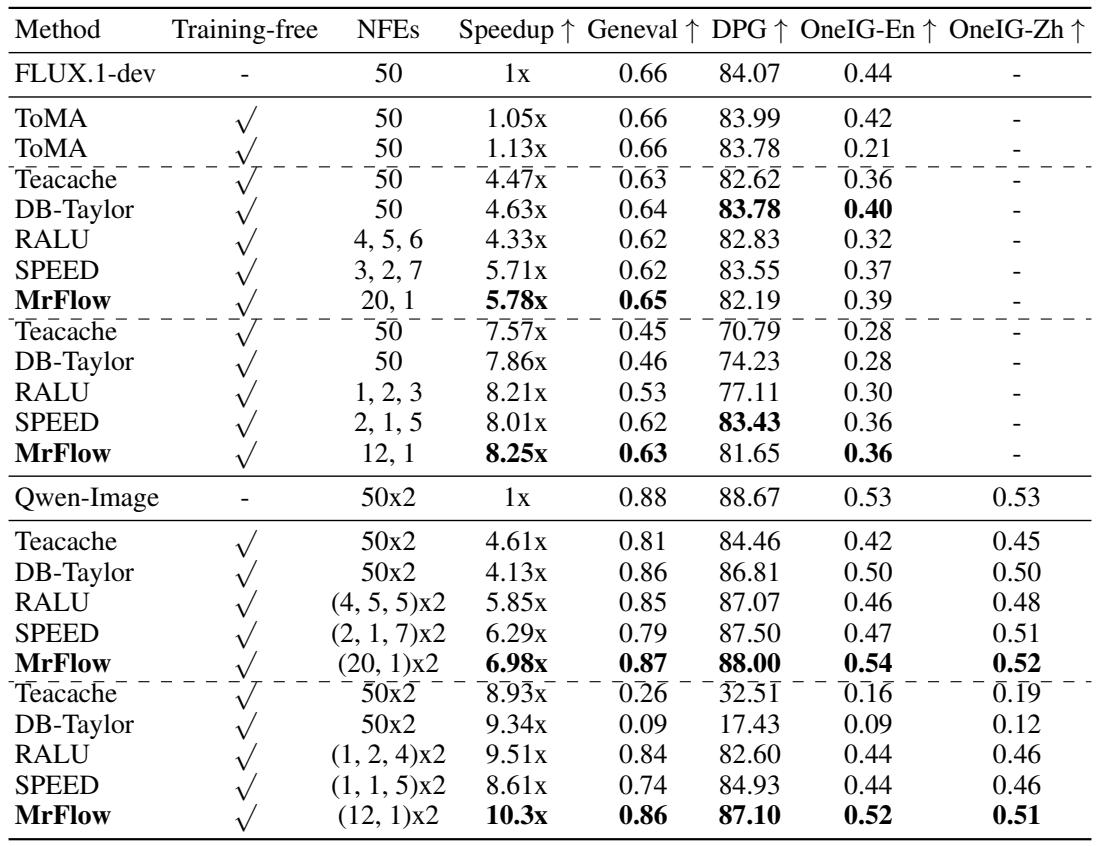
Training-free acceleration methods on FLUX.1-dev show that token pruning (ToMA) yields negligible speedup and silently collapses image quality despite stable metrics. Techniques like Teacache and DB-Taylor achieve around 4.5× speedup with only minor drops in Geneval and DPG, while further speedups from RALU and SPEED incur larger metric declines, illustrating a clear tension between efficiency and fidelity. ToMA attains at most 1.13× speedup and its OneIG-En score plunges from 0.44 to 0.21, reflecting severe image collapse not captured by Geneval. Teacache and DB-Taylor provide speedups near 4.5× while retaining Geneval scores within 0.03 of the baseline and DPG above 82.6, offering a favorable quality–speed trade-off.
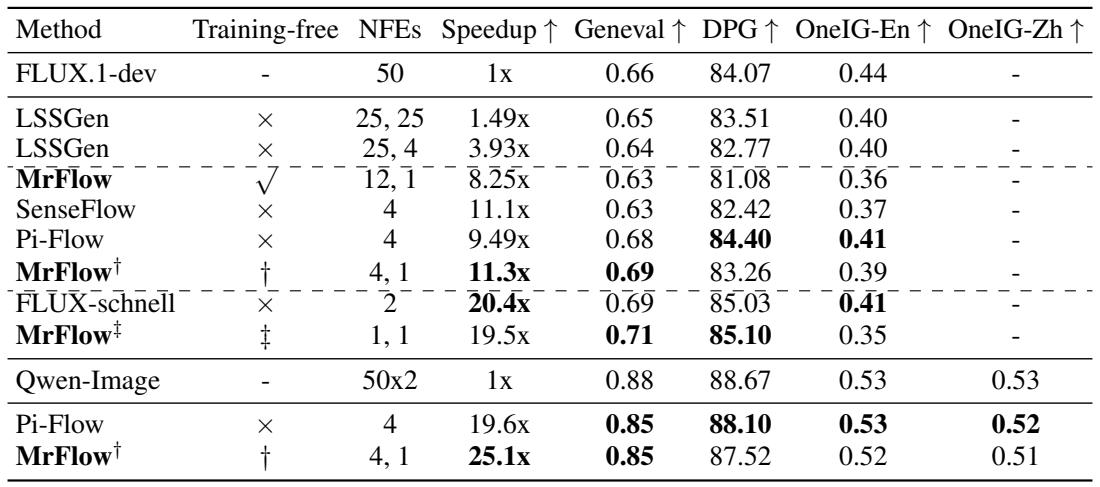
On FLUX.1-dev, the training-free MrFlow model with 12+1 steps attains an 8.25× speedup while preserving quality close to the 4-step training-dependent SenseFlow method. When combined with the Pi-Flow distillation model using only 4+1 steps, MrFlow† reaches an 11.3× speedup, outperforming standalone Pi-Flow in both speedup and Geneval score. The training-required LSSGen method exhibits a noticeable generation quality drop at 3.93× speedup despite similar automatic metric scores. MrFlow (12+1 steps) achieves an 8.25× speedup without any training, with a Geneval score comparable to the 4-step SenseFlow method. MrFlow† (4+1 steps, reusing pre-trained distillation weights) delivers a higher 11.3× speedup, surpassing the native Pi-Flow (4 steps) in both speedup and Geneval. LSSGen at 3.93× speedup shows little metric degradation but the generated images collapse significantly according to the paper. Pi-Flow maintains the best DPG and OneIG-En scores among all methods, while MrFlow† reaches the highest Geneval and the fastest speedup.
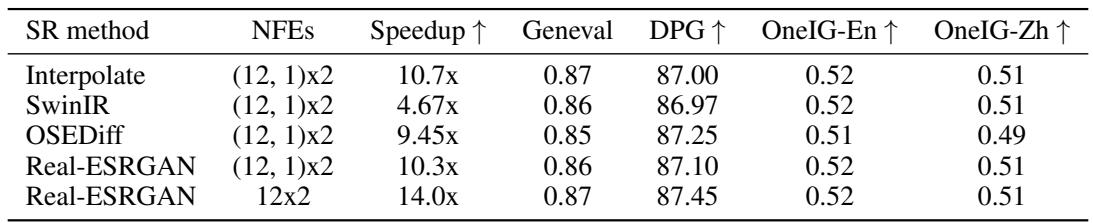
On Qwen-Image at 1024×1024, automatic metrics for interpolation, SwinIR, OSEDiff, and Real-ESRGAN differ only slightly, but visual quality reveals clear ranking: interpolation and SwinIR remain blurry, OSEDiff adds character artifacts, while GAN-based Real-ESRGAN provides the best blend of sharpness, semantic accuracy, and efficiency. A fast Real-ESRGAN variant using a 12+2 step configuration reaches 14× speedup with metric scores comparable to or better than the 12+1-step setting. All evaluated super-resolution methods achieve tightly clustered Geneval, DPG, and OneIG-Bench scores. Real-ESRGAN with a 12+2-step configuration yields a 14× speedup while maintaining a Geneval of 0.87 and slightly higher DPG compared to its 12+1-step counterpart. Interpolation and SwinIR produce blurry enlargements, whereas OSEDiff introduces character inaccuracies; Real-ESRGAN best balances clarity and semantic fidelity.
The evaluations first examine training-free acceleration on FLUX.1‑dev, where caching techniques such as Teacache and DB-Taylor achieve around 4.5× speedup while preserving image quality, whereas token pruning yields negligible speedup and causes severe visual collapse that automatic metrics fail to capture. A subsequent experiment shows that the training-free MrFlow model attains an 8.25× speedup and, when integrated with a distilled model, reaches 11.3× speedup with the highest Geneval score, surpassing even some training-dependent methods. Finally, super-resolution benchmarks on Qwen‑Image reveal that despite similar metric scores, interpolation and SwinIR remain blurry and diffusion-based methods introduce artifacts, while a fast GAN-based Real‑ESRGAN variant provides the best balance of sharpness, semantic accuracy, and efficiency with a 14× speedup.