Command Palette
Search for a command to run...
Perceive-to-Reason: 細粒度視覚推論のための知覚と推論の分離
Perceive-to-Reason: 細粒度視覚推論のための知覚と推論の分離
概要
細粒度の視覚推論は、特に高解像度画像に埋もれた小さな視覚的手がかりが重要な場合、視覚言語モデルにとって依然として困難である。既存手法は、繰り返しの切り出しやテスト時の視覚探索によって局所的な証拠を導入するが、通常、知覚と推論を明示的に区別していない。本論文では、細粒度視覚推論を知覚と推論の二段階プロセスとして定式化する統一的枠組みPerceive-to-Reason(P2R)を提案する。モデルはまずPerceiverとして質問に関連する証拠を局所化し、次にReasonerとして注釈付き画像と切り出し領域に基づいて質問に回答する。この分離された定式化と訓練をより整合させるため、最終回答の監視のみを用いて知覚重視と推論重視の更新を交互に行う役割認識型強化学習戦略Perception-Reasoning Alternating GRPO(PRA-GRPO)を導入する。Qwen3-VL-Instruct-2B/4B/8Bを基盤として、P2Rはモデル規模全体で一貫して性能を向上させる。特に、P2R-4BはV-Starで93.2%、HR-Bench-4Kで81.9%、HR-Bench-8Kで80.5%を達成し、対応するバックボーンを大幅に上回る。さらなる実験により、P2Rの利点は高解像度ベンチマークを超えて、より広範なマルチモーダル推論タスクにも及ぶことが示される。これらの結果は、知覚と推論を明示的に分離することが細粒度視覚推論に効果的な枠組みを提供することを示唆している。
One-sentence Summary
Researchers from Zhejiang University and Alibaba Group propose Perceive-to-Reason (P2R), which decouples fine-grained visual reasoning into explicit perception and reasoning stages, and PRA-GRPO, a role-aware reinforcement learning strategy that alternates perception-focused and reasoning-focused updates under final-answer supervision; unlike prior work that merges these stages, P2R built upon Qwen3-VL-Instruct models attains state-of-the-art performance on V-Star and HR-Bench.
Key Contributions
- P2R is a unified framework that formulates fine-grained visual reasoning as a two-stage perceive-to-reason process, explicitly decoupling evidence localization (Perceiver) from answer generation (Reasoner).
- PRA-GRPO is a role-aware reinforcement learning strategy that aligns training with the decoupled formulation by alternating perception-focused and reasoning-focused updates, using only final-answer supervision without ground-truth bounding box annotations.
- Built on Qwen3-VL-Instruct models at 2B, 4B, and 8B scales, P2R achieves consistent and substantial gains, including 93.2% on V-Star and 81.9%/80.5% on HR-Bench-4K/8K for the 4B variant, and its benefits extend beyond high-resolution benchmarks to broader multimodal reasoning tasks.
Introduction
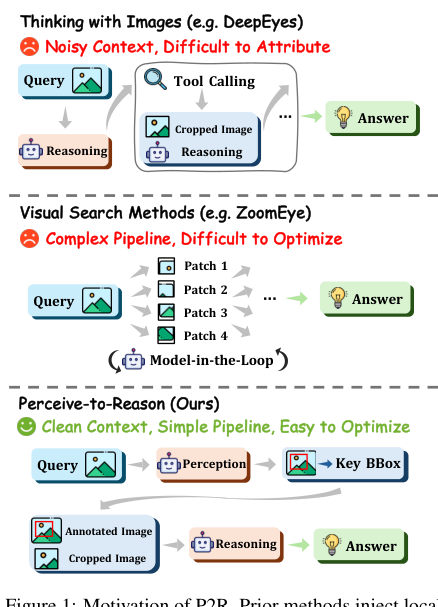
Vision-language models (VLMs) now perform well on broad visual understanding tasks, but fine-grained visual reasoning, such as reading dense text or interpreting precise spatial relations, remains difficult. A diagnostic experiment reveals that poor perception is a major bottleneck: simply providing oracle bounding boxes lifts a baseline model’s accuracy on V-Star from 81.7% to 90.6%, showing that many failures come from not locating the right evidence. Prior work addresses this by interleaving region exploration with reasoning or by relying on complex test-time search pipelines, but these approaches either entangle evidence localization with the answer generation process or externalize it in a way that makes “where to look” decisions hard to optimize directly.
The authors propose Perceive-to-Reason (P2R), a framework that explicitly decomposes fine-grained visual reasoning into two stages: a Perceiver first localizes question-relevant regions, and then a Reasoner produces the answer using the annotated image and cropped evidence. To train this decoupled setup under only final-answer supervision, they introduce PRA-GRPO, a reinforcement learning strategy that alternates between perception-focused and reasoning-focused optimization while freezing the other role’s parameters. This role-aware alternation converts a single correctness signal into a more attributable training signal for each stage, removing the need for ground-truth bounding boxes and enabling the model to learn better where to look and how to reason.
Method
The authorspropose P2R, a unified framework that formulates fine-grained visual reasoning as a perceive-to-reason process. It consists of two tightly coupled components: a two-stage inference paradigm that explicitly separates evidence localization and answer generation, and PRA-GRPO, a role-aware reinforcement learning strategy that aligns training with this decoupled formulation.
In the inference stage, the model structures fine-grained visual reasoning into two consecutive phases: perception and reasoning, using a single underlying VLM with shared parameters θ.
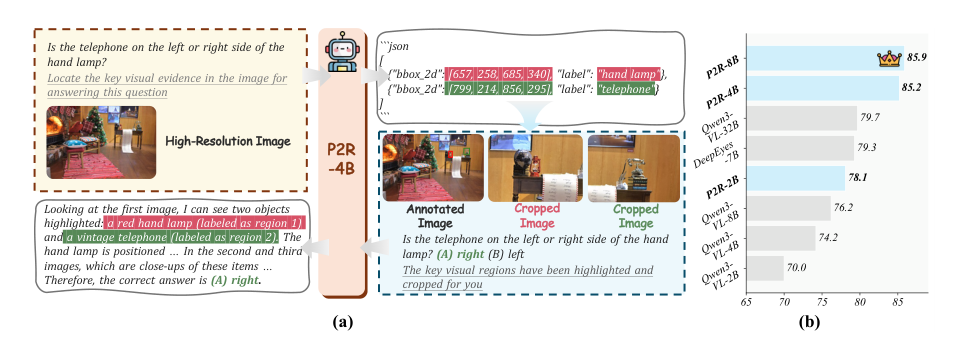
As shown in the figure above, the first stage involves the model acting as a Perceiver. Given an image-question pair (I,Q), the Perceiver makes an explicit localization decision for the visual evidence most relevant to the question. Let Q~p=Tp(Q) denote a perception-oriented prompt. The Perceiver predicts a set of bounding boxes B={Bk}k=1K as: B∼πp(⋅∣I,Q~p;θ) where each Bk=(x1,y1,x2,y2) specifies a rectangular region. These predicted boxes are transformed into two complementary visual inputs: an annotated image Ia=annotate(I,B) where boxes are overlaid on the original image, and cropped evidence images Ic=crop(I,B) containing the local regions.
In the second stage, the model acts as a Reasoner to generate the final answer Y: Y∼πr(⋅∣Ia,Ic,Q;θ) This formulation turns fine-grained visual reasoning into an explicitly structured process where the Perceiver determines where to look and the Reasoner focuses on how to reason from the evidence.
Training this decoupled formulation is challenging because the final prediction depends on both stages, and supervision is only available at the final answer level. To address this, the authors propose PRA-GRPO, a role-aware reinforcement learning strategy that aligns optimization with the perceive-to-reason structure.
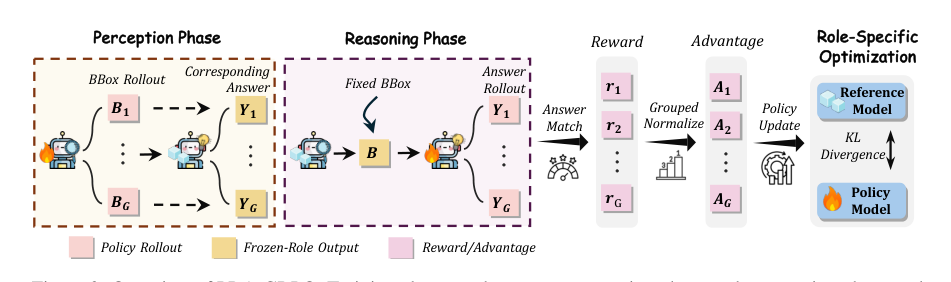
The core idea is to convert final answer correctness into a more attributable training signal by alternating between perception-focused and reasoning-focused updates. PRA-GRPO alternates between optimizing the Perceiver and the Reasoner while keeping the other role fixed.
In the perception phase, the quality of predicted evidence is evaluated through the answer produced by a fixed Reasoner. Given an image-question-answer triplet (I,Q,Y), the model samples a group of G rollouts of bounding boxes Bi∼πp(⋅∣I,Tp(Q);θ). Based on Bi, the annotated image Iai and cropped images Ici are constructed and fed into the fixed Reasoner to obtain the final answer Yi.
In the reasoning phase, answer generation is optimized conditioned on evidence provided by a fixed Perceiver. The output oi is an answer Yi∼πr(⋅∣Ia,Ic,Q;θ), where (Ia,Ic) are constructed from the bounding boxes predicted by the fixed Perceiver.
To keep supervision minimal and task-agnostic, a binary reward is defined based solely on final answer correctness: ri=I[Yi=Y] The group-relative advantage is computed following GRPO: Ai=std({rj}j=1G)+ϵri−mean({rj}j=1G) The active role ϕ∈{p,r} is optimized using the standard GRPO objective: JGRPOϕ(θ)=Ex,{oi}i=1G[G1∑i=1Gmin(ρiAi,clip(ρi,1±ε)Ai)−βKL[πϕ,θ∥πref]] where ρi=πϕ,θold(oi∣x)πϕ,θ(oi∣x). Specifically, x=(I,Tp(Q)) and oi=Bi in the perception phase, while x=(Ia,Ic,Q) and oi=Yi in the reasoning phase. This allows perception to be learned from downstream reasoning outcomes through final-answer supervision alone.
Experiment
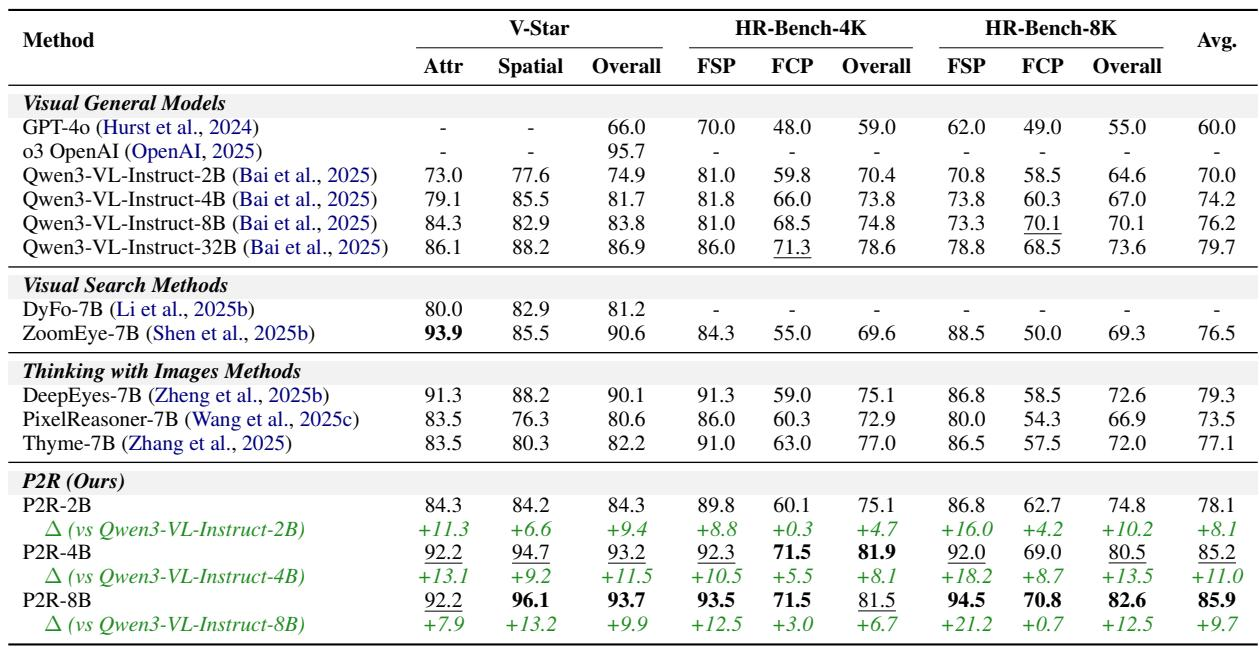
The evaluation setup compares P2R against general-purpose VLMs, visual search, and thinking-with-images methods on high-resolution fine-grained benchmarks (V-Star, HR-Bench) and a broader real-world benchmark (MME-RealWorld-Lite). P2R consistently improves over Qwen3-VL-Instruct backbones across all scales, with gains spanning perception and reasoning subtasks particularly in challenging high-resolution scenarios. Ablations validate that the perceive-to-reason inference decomposition is beneficial, and alternating role-aware training with the Perceiver phase first yields the best performance by enabling more accurate evidence localization before reasoning. Further analysis shows cross-role knowledge transfer under shared parameters, zero-shot gains on reasoning grounding, and faster learning scaling driven by mutual reinforcement between perception and reasoning.
P2R models consistently outperform their corresponding Qwen3-VL-Instruct baselines on fine-grained visual reasoning benchmarks, with average gains of 8.1, 11.0, and 9.7 points for the 2B, 4B, and 8B scales. Improvements are most pronounced on the high-resolution HR-Bench-8K, highlighting the effectiveness of the perceive-to-reason formulation in demanding settings. Among open-source models, P2R-8B achieves the best averaged performance across the three evaluated benchmarks. P2R variants surpass Qwen3-VL-Instruct at every model scale, yielding average improvements of 8.1 (2B), 11.0 (4B), and 9.7 (8B) percentage points. Gains are largest on HR-Bench-8K, indicating that the perceive-to-reason approach is especially beneficial for challenging high-resolution visual reasoning. P2R-8B attains the highest average performance among all open-source models on V-Star, HR-Bench-4K, and HR-Bench-8K.
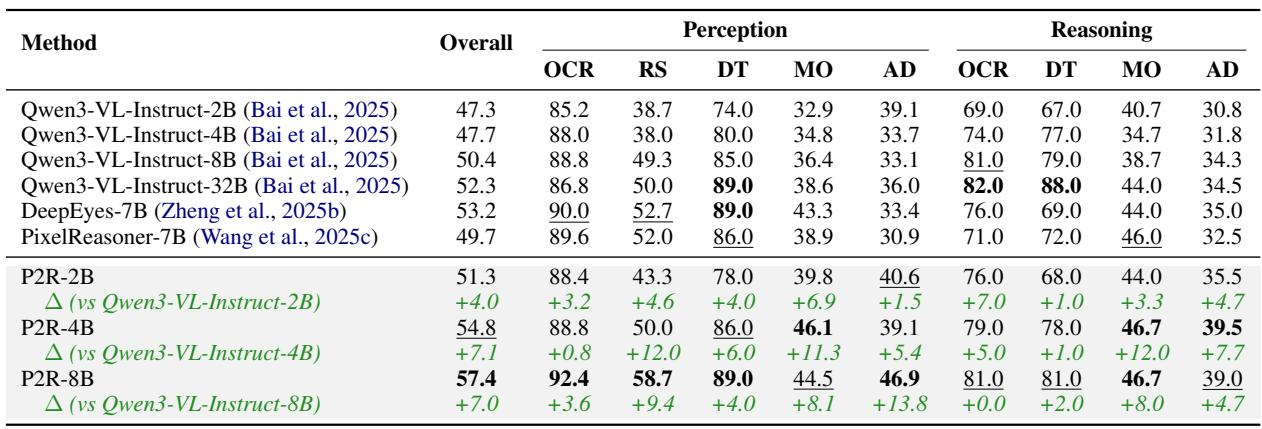
On the MME-RealWorld-Lite benchmark, P2R models consistently surpass their Qwen3-VL-Instruct baselines, with overall gains of 4.0%, 7.1%, and 7.0% for the 2B, 4B, and 8B variants. These improvements are broad, appearing across nearly all perception and reasoning subtasks, demonstrating that the perceive-to-reason framework benefits general multimodal understanding beyond high-resolution scenarios. P2R-8B achieves the highest overall performance among all compared methods. P2R-2B, P2R-4B, and P2R-8B improve overall accuracy over their respective Qwen3-VL-Instruct baselines by 4.0, 7.1, and 7.0 percentage points. Performance gains are spread across nearly all perception and reasoning subcategories rather than being concentrated in a few areas. P2R-8B attains the best overall score among all listed models, outperforming prior specialized approaches such as DeepEyes-7B. The baseline Qwen3-VL-Instruct models show limited scaling (from 47.3 at 2B to 52.3 at 32B), whereas P2R's enhancements yield larger relative jumps at each scale.
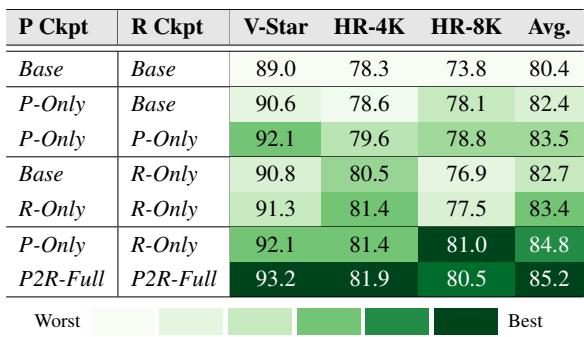
Shared parameters enable cross-role transfer: a checkpoint trained only as a perceiver boosts reasoning when reused as a reasoner, and vice versa. Combining separately trained perceiver and reasoner checkpoints reaches 84.8% average, but the full alternating training method yields 85.2%, showing better integration. The design uses a single model for both roles, simplifying deployment. Using a perceiver-only checkpoint as both perceiver and reasoner improves the average over using it just as perceiver with a base reasoner, revealing that perceiver training transfers to reasoning. A reasoner-only checkpoint applied to both roles outperforms the base perceiver paired with that reasoner checkpoint, confirming that reasoner training also benefits perception. The highest average score is achieved by the final jointly trained model, surpassing even the best mix of independently trained perceiver and reasoner roles. All three fine-grained visual reasoning benchmarks—V-Star, HR-4K, and HR-8K—show gains when role-specific training is applied to the complementary role.
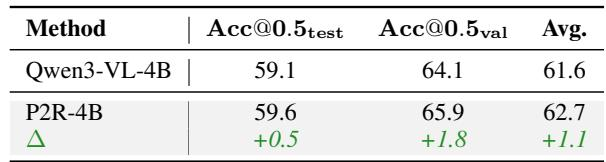
On the reasoning grounding benchmark ReasonSeg, the P2R-4B model trained with PRA-GRPO outperforms its base model on both test and validation splits, even though it never received grounding-specific data or bounding box annotations. The results indicate that the fine-grained visual reasoning training transfers to improved localization of query-relevant evidence. P2R-4B achieves an average accuracy gain of 1.1 percentage points over the baseline. The improvement is larger on the validation split (+1.8) than on the test split (+0.5). The model relies solely on answer-level supervision from visual reasoning data, with no access to grounding annotations.
Across fine-grained visual reasoning benchmarks and the MME-RealWorld-Lite suite, P2R models consistently outperform their Qwen3-VL-Instruct baselines at every scale, with the largest gains on high-resolution tasks, and P2R-8B attains top open-source performance. Ablation studies on cross-role transfer demonstrate that a single model jointly trained to alternate between perceiver and reasoner roles achieves better integration than combining separately trained checkpoints, and that training one role transfers benefits to the other. Furthermore, P2R's fine-grained reasoning training improves grounding on ReasonSeg without any grounding-specific supervision, highlighting the broad transferability of the perceive-to-reason framework.