Command Palette
Search for a command to run...
パラメータではなくホライズンをスケールする:35Bエージェントで1兆パラメータ級の性能を達成
パラメータではなくホライズンをスケールする:35Bエージェントで1兆パラメータ級の性能を達成
Agents-A1 Team Zongsheng Cao Bihao Zhan Zhijie Zhong
概要
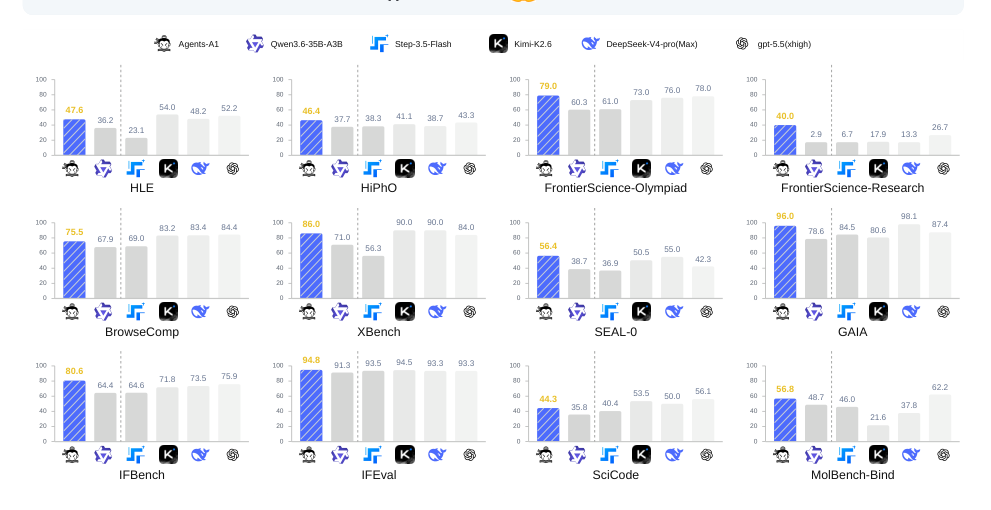
我々は、エージェントホライズンをスケールすることで1兆パラメータ級の性能に到達する35B Mixture-of-Expertsエージェントモデル「Agents-A1」を導入する。エージェントホライズンのスケーリングを、長ホライズン軌跡のスケーリングと異種エージェント能力のスケーリングという2つの観点から検討する。この目標を支えるため、外部知識、行動、観測、検証結果を接続し、平均45Kトークンのエージェント軌跡を生成する長ホライズン知識-行動基盤を構築する。これに基づき、Agents-A1を3段階のレシピで訓練する。第1に、全ドメイン教師あり微調整を行い、基盤モデルを幅広いエージェント行動に整合させる。第2に、各ドメインの専門知識を捉えるドメインレベルの教師モデルを訓練する。第3に、顕著語彙アラインメントを伴うマルチ教師ドメインルーティング方策蒸留を提案し、異なるドメイン間の知識伝達効率を向上させ、6つの異種ドメインを1つの展開可能な生徒モデルに統合する。Agents-A1は、長ホライズンエージェントベンチマークで強力かつ幅広い性能を達成する。Kimi-K2.6やDeepSeek-V4-proといった1Tパラメータモデルと比較して、Agents-A1はSEAL-0 (56.4)、IFBench (80.6)、HiPhO (46.4)、FrontierScience-Olympiad (79.0)、MolBench-Bind (56.8)で主要な結果を達成し、SciCode (44.3)、HLE (47.6)、BrowseComp (75.5)でも高い競争力を維持する。本研究が、長ホライズンタスクで1Tモデルの性能に到達または匹敵する35Bエージェントを用いたホライズンスケーリングの実践的な道筋をコミュニティに提供することを期待する。
One-sentence Summary
Researchers from Shanghai Artificial Intelligence Laboratory introduce Agents-A1, a 35B Mixture-of-Experts agentic model that scales the agent horizon via long-horizon knowledge-action trajectories and multi-teacher domain-routed on-policy distillation with salient vocabulary alignment, achieving trillion-parameter-level performance on benchmarks such as SEAL-0 (56.4) and IFBench (80.6).
Key Contributions
- Agents-A1, a 35B Mixture-of-Experts agentic model, scales long-horizon heterogeneous abilities and matches or exceeds 1T-parameter models on benchmarks including SEAL-0, IFBench, and HiPhO.
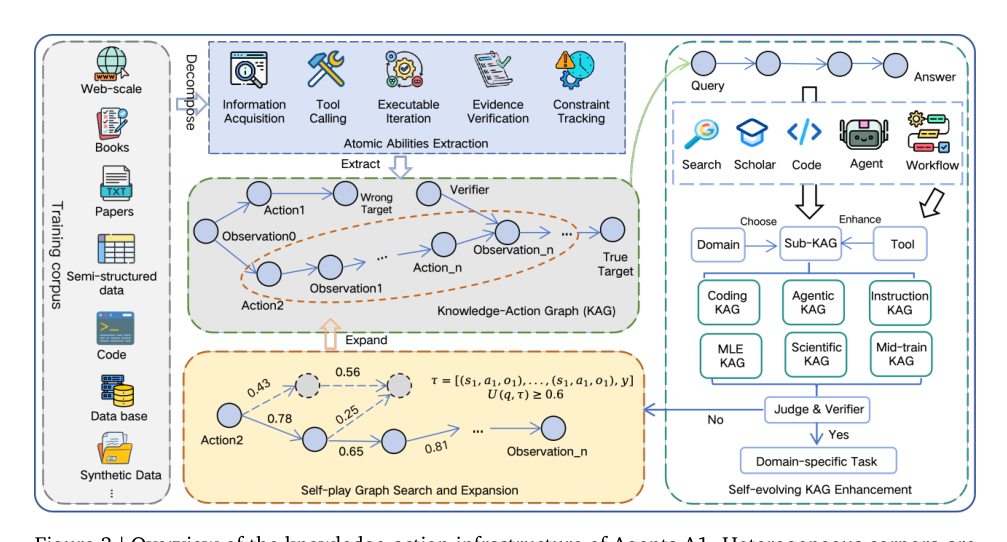
- A long-horizon knowledge-action infrastructure generates agentic trajectories averaging 45K tokens by connecting external knowledge, actions, observations, and verification signals, improving multi-turn grounding in tool use, planning, and result checking.
- Domain-routed on-policy distillation with salient vocabulary alignment unifies six domain-specific teacher models into a single student, reducing cross-domain reasoning conflicts and improving knowledge transfer efficiency across heterogeneous domains.
Introduction
Recent progress in LLMs is pushing AI from passive language models toward autonomous agents that plan, use tools, interact with environments, and improve through feedback. In long-horizon settings such as software engineering and scientific research, agents must acquire information, decompose tasks, call tools, verify intermediate results, and continuously adjust strategies. This is especially challenging because early mistakes compound and new external information often forces strategy revisions. Prior work follows two main scaling routes: scaling model parameters internalizes reasoning and tool-use patterns but demands massive compute and data, making agentic competence hard to reproduce at smaller scale. Scaling the agent horizon instead makes intermediate decisions explicit, but this exposes two bottlenecks. First, it requires a unified knowledge-action infrastructure that connects external knowledge, actions, observations, and verification signals, without which agents struggle to learn grounded multi-step reasoning and recovery. Second, it must integrate heterogeneous and compositional abilities (multi-step retrieval, tool use, executable iteration, constraint tracking, reflection) that emerge unevenly across domains and interact in complex ways. The authors introduce Agents-A1, a 35B mixture-of-experts agentic model built to address these challenges. They construct a long-horizon knowledge-action infrastructure that produces agentic trajectories averaging 45K tokens, enabling learning from grounded feedback. The model is trained with a three-stage recipe: full-domain supervised fine-tuning for broad long-horizon capabilities, domain-level teacher models for specialized improvements, and a novel domain-routed on-policy distillation with salient vocabulary alignment to unify abilities from six heterogeneous domains into a single deployable model.
Dataset

The authors build a multi-domain dataset aligned with a Knowledge-Action Graph (KAG) schema, producing training trajectories that pair context, actions, observations, and verifier signals across five areas. The data is used to train models for long-horizon reasoning and interactive decision-making under structured feedback.
-
Long-horizon Search Sources: a Wikipedia corpus graph (articles as nodes, hyperlinks as edges) and real web interaction from strong model rollouts. Processing: controlled random walks filter out disambiguation pages, near‑duplicate titles, nodes without valid text or enough outgoing links, and non‑content tail sections. Accepted walks are converted into masked Q&A pairs with paragraph‑level evidence attached. Web‑based trajectories use search, read_page, and code tools in a 256K‑token context; post‑processing discards wrong answers, overly short interactions, and obvious guessing. Usage: provides supervision for search behaviour, evidence retrieval, and answer verification.
-
Machine Learning Engineering Sources: MLE‑Dojo (Kaggle‑style tasks spanning tabular, vision, NLP, audio, time‑series) and ended Kaggle competitions. For ended competitions, public data is re‑split into fresh train/test sets with private answers and a local evaluator. Processing: an agentic harness grows a tree of solution nodes (full scripts, patches, execution runs). Teacher trajectories are collected with multiple seeds and prompt variants, replayed with the local evaluator, and filtered to retain only runs yielding valid, competitive submissions. Regressive segments are trimmed and duplicates removed; final runs are serialised with loss masks over teacher‑generated content. Usage: teaches solution‑search behaviour, node navigation, and evaluator‑guided refinement.
-
Scientific Reasoning and Research Sources: ~15K science problems from math, physics, and related fields, expanded through a self‑evolving graph process that creates harder, more interaction‑enriched variants. Processing: from each problem, both “no‑tool” (pure multi‑step derivation) and “tool‑augmented” trajectories (using search, visit, code, and scholar tools) are distilled from a strong model. Only trajectories with correct final answers are kept. Usage: provides complementary supervision for pure reasoning and tool‑assisted scientific problem solving.
-
Instruction Following Sources: 13K multi‑constraint samples from NVIDIA’s Nemotron‑RL dataset (derived from WildChat‑1M and Open‑Instruct), and 10K in‑house long‑context QA instances. Processing: for the in‑house subset, long documents are parsed to extract fact graphs, then multi‑hop questions are synthesised with injected local rules or distractors; all tasks are converted to multiple‑choice format and filtered by automatic validation to ensure the answer depends on both dispersed evidence and injected constraints. Usage: trains constraint tracking, evidence verification, and resistance to distractors in long documents.
-
Tool Calling Sources: tool schemas extracted from scientific, web, repository, database, and simulation environments; tasks are created through graph‑compositional synthesis over a tool‑dependency graph. Processing: in a sandbox, solver backends explore multi‑turn trajectories with optional simulated user feedback. Multiple candidate chains are scored by verifiers on schema correctness, state consistency, observation grounding, and goal completion; invalid or ungrounded runs are discarded. Usage: teaches schema‑grounded tool use, clarification handling, and state‑dependent multi‑turn interaction.
All subsets are merged into a unified message stream. During training, the model learns from the full corpus to perform KAG‑style operations (acting, observing, verifying) across diverse horizons, with verifier outcomes and loss masks shaping the supervision.
Method
The authors propose a three-stage training pipeline to develop a broadly capable long-horizon agent. As shown in the framework diagram, the process begins with full-domain supervised fine-tuning to establish baseline capabilities across diverse domains. Subsequently, domain-level teachers are trained using targeted supervised fine-tuning or reinforcement learning to specialize in specific interaction patterns. Finally, these specialized teachers are consolidated into a single deployable student model through multi-teacher on-policy distillation.
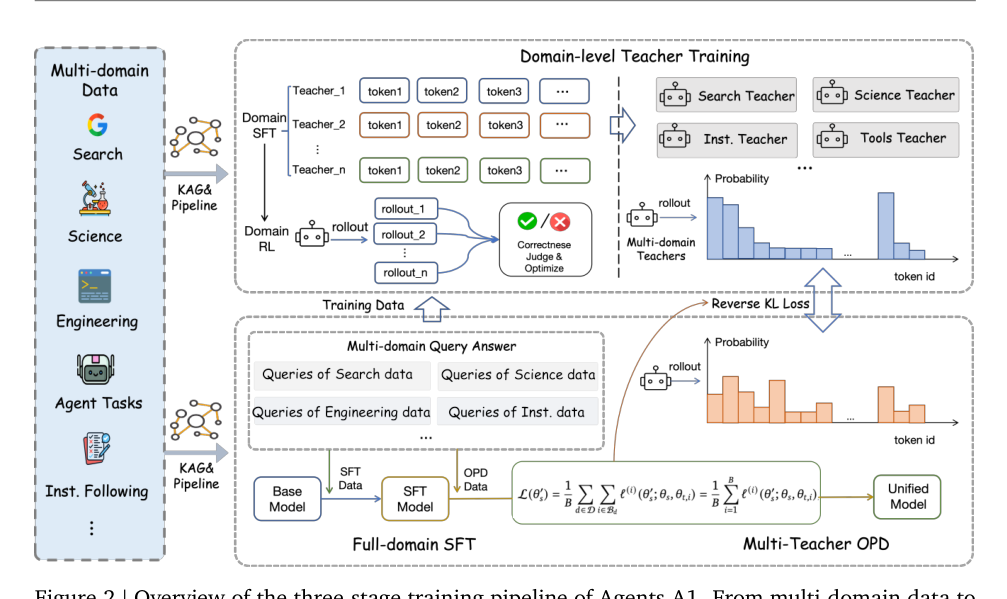
To support this pipeline, the authors construct a knowledge-action infrastructure that converts heterogeneous corpora into compositional and verifiable supervision. This infrastructure is built upon a Knowledge-Action Graph, which represents evidence, actions, observations, and verifier outcomes as linked objects. The graph is formally defined as a typed 4-tuple Gd=(Cd,Ad,Od,Vd), where Cd is the domain corpus, Ad is the action space, Od is the observation space, and Vd is the verifier set. To optimize the quality of the graph, a proposer-solver-verifier game is employed to expand the graph through self-play graph search and expansion.
During the domain-level teacher training stage, specialized models are developed for tasks such as agentic searching, scientific reasoning, instruction following, and tool calling. For instance, the search teacher is optimized using reinforcement learning with a reward function that combines correctness, search behavior penalties, and format calibration. The science teacher undergoes a two-stage supervised fine-tuning pipeline to enhance both intrinsic reasoning depth and extrinsic tool-augmented interaction.
To consolidate these domain-specific teachers into a unified student, the authors employ a domain-routed multi-teacher on-policy distillation framework with Salient Vocabulary Alignment. For each prompt-domain pair (xi,di), a frozen rollout student samples yi∼πθs(⋅∣xi), while the optimized student θs′ is supervised by the routed teacher θt,i≜θtdi. Salient Vocabulary Alignment replaces the sampled-token surrogate by aligning the student and routed teacher on a compact teacher-supported local vocabulary. Let ps′(u)=πθs′(u∣xi,yi,<t) and pt,i(u)=πθt,i(u∣xi,yi,<t). The distributions are renormalized on the set of top-k valid tokens under the routed teacher distribution, denoted as Si,t(k): pˉs′(u)=∑v∈Si,t(k)ps′(v)ps′(u),pˉt,i(u)=∑v∈Si,t(k)pt,i(v)pt,i(u),u∈Si,t(k). The per-sample objective is the truncated reverse KL over this salient support, averaged over trainable model-generated positions Ri: ℓSVA(i)(θs′;θt,i)=∣Ri∣1∑t∈Ri∑u∈Si,t(k)pˉs′(u)logpˉt,i(u)pˉs′(u).
To handle cross-domain heterogeneity and prevent high-frequency domains from dominating the update, the authors aggregate losses with a domain-normalized objective. Let Bd denote the subset of samples from domain d in a mini-batch Bz, and DB be the set of active domains. The final objective averages losses within each active domain and then across active domains: LMT−SVA(θs′)=∣DB∣1∑d∈DB∣Bd∣1∑i∈BdℓSVA(i)(θs′;θt,i). This approach ensures that the student retains broad coverage while absorbing stronger domain-specific behaviors from the teacher pool.
Experiment
The evaluation covers a broad range of long-horizon agentic benchmarks in search, science, engineering, instruction following, and tool use, using a multi-stage recipe where domain-specific teachers are first trained via supervised fine-tuning and two-stage reinforcement learning (RL) with rule-based and process rewards, then distilled into a single model through multi-domain on-policy distillation. Domain teachers show substantial gains in their specialties, while on-policy distillation resolves conflicting thinking patterns between single-turn long reasoning and multi-turn tool interactions, producing a balanced agent that outperforms same-scale baselines and even rivals much larger models on search, scientific research, and long-instruction following. Qualitative case studies demonstrate the model's ability to autonomously conduct multi-step machine learning optimization and closed-loop scientific analysis, though open-ended engineering tasks remain challenging due to the demands of stable long-horizon planning.
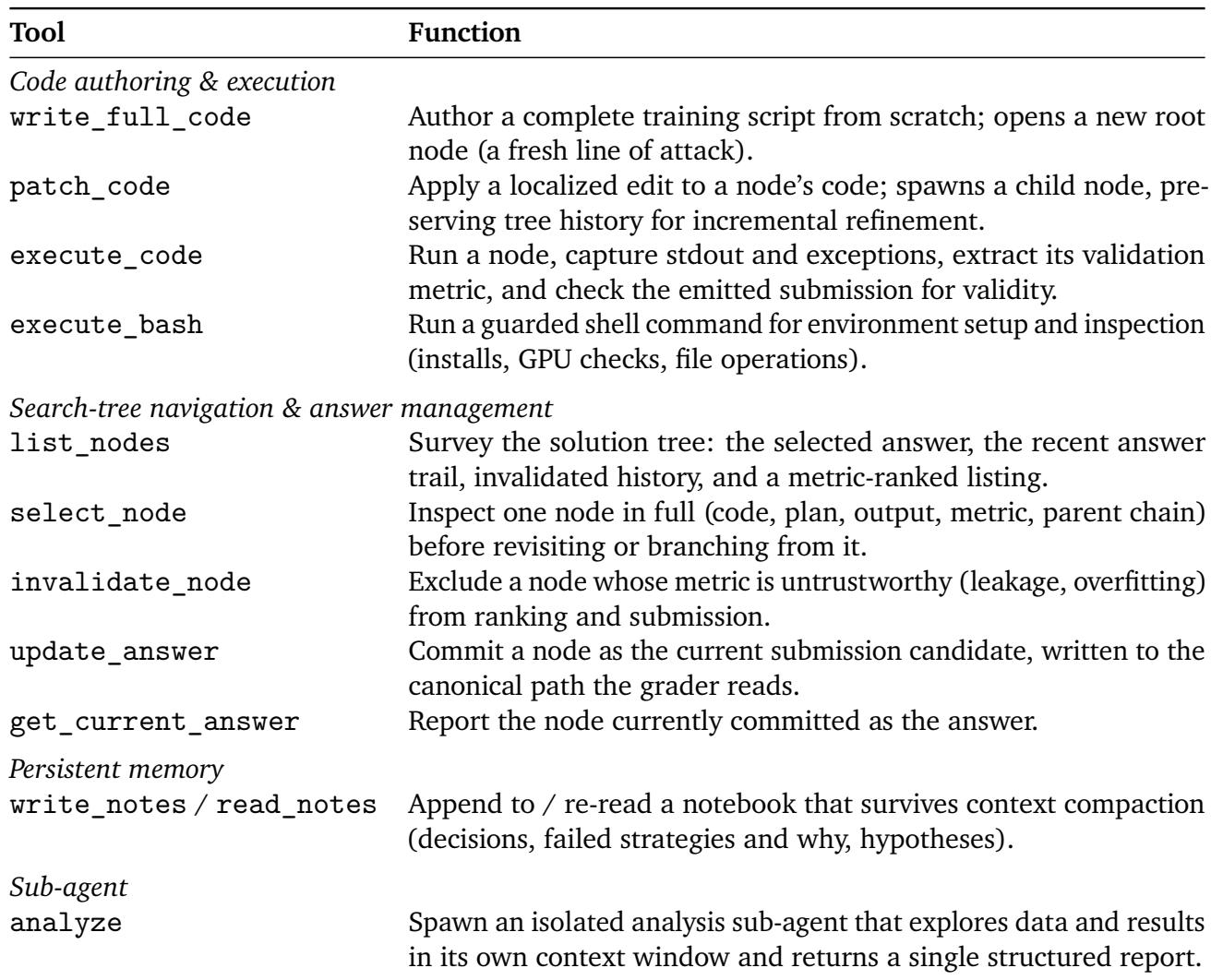
The agent harness provides a compact tool interface for code authoring, execution, and solution-tree navigation. These tools let the agent create fresh attack roots, apply incremental patches that spawn child nodes, execute code while capturing validation metrics and submission validity, and survey the tree's metric-ranked listing, selected answer, and invalidation history. This design supports verifier-guided solution search and enabled a 12-hour autonomous optimization that improved a naive CNN baseline to a gold-medal-level result. write_full_code opens a new root node for a fresh line of attack, while patch_code spawns a child node to preserve tree history during incremental refinement. execute_code captures stdout, exceptions, a validation metric, and checks submission validity, directly feeding verifier outcomes back into the search process. list_nodes surveys the full solution tree with a metric-ranked listing, the recent answer trail, and invalidated history, enabling informed selection and backtracking. execute_bash provides guarded environment inspection and setup (installs, GPU checks, file operations) without polluting the solution code.
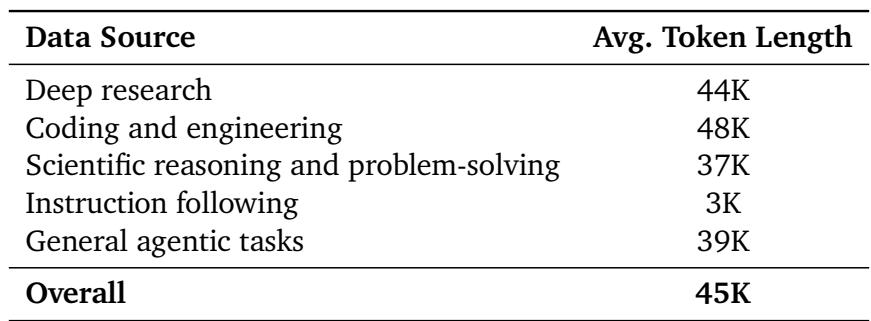
The supervised fine-tuning dataset consists predominantly of long-context examples, with an overall average of 45K tokens. Coding and engineering, deep research, and general agentic tasks have the highest average lengths, while instruction following samples are substantially shorter. This composition supports training for complex, multi-turn reasoning and agentic workflows. Coding and engineering tasks reach the highest average token length, slightly exceeding deep research. Instruction following is a clear outlier, with average length roughly an order of magnitude lower than all other domains. Four of the five domains average at least 37K tokens, indicating a heavy reliance on long-horizon trajectories in training.
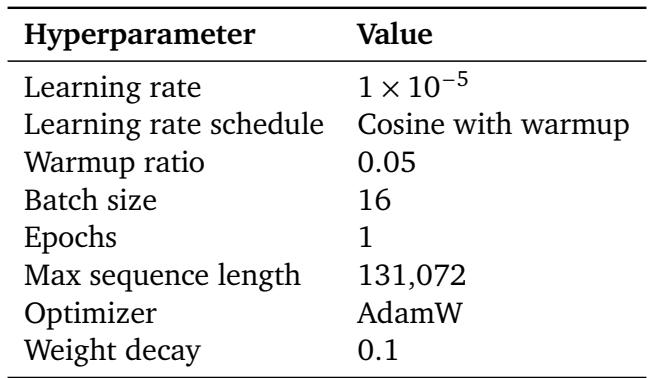
Supervised fine-tuning is applied for one epoch with a low learning rate of 1e-5 and a cosine schedule that includes a 5% warmup phase. The training uses a batch size of 16, a maximum sequence length of 131,072 tokens, and the AdamW optimizer to align the model with desired behaviors across a diverse instruction-following dataset. A single training epoch with a cosine learning rate schedule and a warmup ratio of 0.05 is adopted to avoid overfitting while adapting the model. Sequences are processed up to 131,072 tokens in length, combined with a batch size of 16 and the AdamW optimizer.
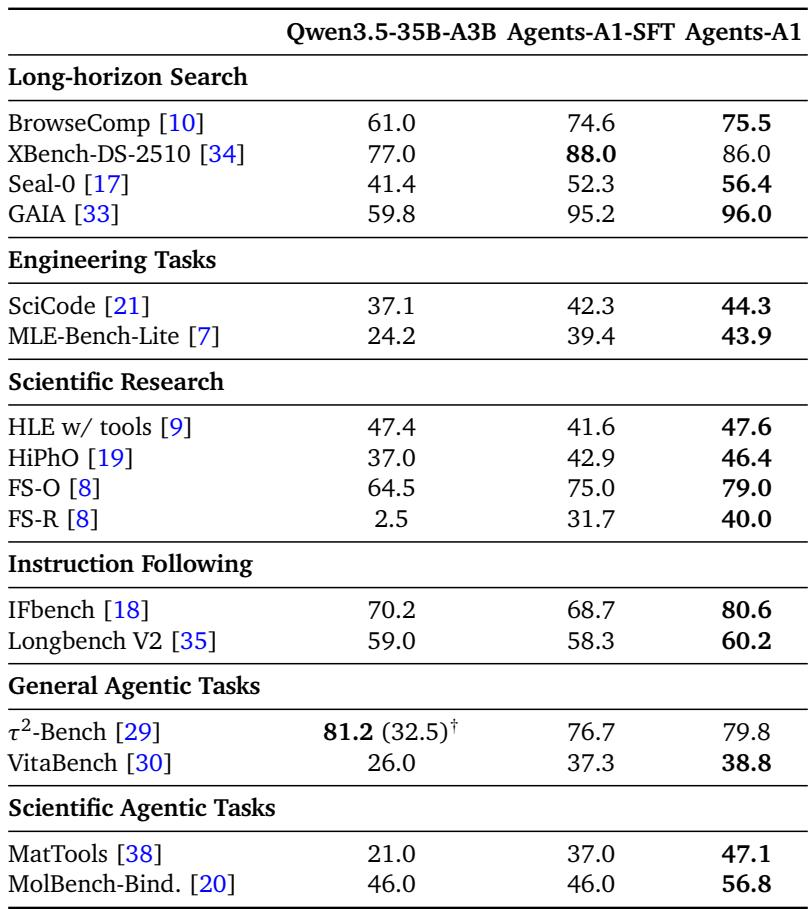
Compared to the Qwen3.5-35B-A3B baseline, the full-domain SFT model Agents-A1-SFT yields substantial gains on every reported long-horizon search task and on the SciCode engineering benchmark. The final Agents-A1 model, which adds multi-domain on-policy distillation, either maintains or further improves these results, achieving the highest scores on BrowseComp, Seal-0, GAIA, and SciCode among the three configurations. Agents-A1-SFT dramatically lifts performance on GAIA over the baseline, and Agents-A1 pushes it slightly higher, leading all compared models on this task. On SciCode, a consistent upward progression occurs from baseline to SFT to Agents-A1, with the final model attaining the best score.
The search-enhanced teacher model, obtained through supervised fine-tuning and RL, outperforms the baseline Qwen3.5-35B-A3B on all evaluated search benchmarks. The largest gain is on GAIA, where performance leaps from 59.8 to 95.1, while HLE with tools sees a small but consistent improvement. Meaningful advances on Seal-0 and XBench-DS-2510 further confirm the benefit of search-specific post-training. The search-enhanced teacher improves all four search benchmarks relative to the baseline, with the most dramatic increase on GAIA (from 59.8 to 95.1). HLE with tools shows a modest gain of 2.9 points, indicating the teacher's search augmentation provides a smaller but reliable boost on this challenging benchmark. Seal-0 and XBench-DS-2510 scores rise substantially, demonstrating that search-oriented SFT and RL strengthen both retrieval-augmented reasoning and domain generalization.

The experiments validate an agent harness that combines code authoring, execution, and solution-tree navigation tools to enable autonomous optimization, lifting a naive CNN baseline to a gold-medal level result. Training on a predominantly long-context dataset averaging 45K tokens equips the model for complex, multi-turn agentic workflows, while supervised fine-tuning followed by multi-domain on-policy distillation yields consistent gains across long-horizon search tasks and engineering benchmarks. Additionally, a search-enhanced teacher model demonstrates that search-specific post-training dramatically boosts performance, particularly on retrieval-augmented reasoning tasks, confirming the effectiveness of the overall design.