Command Palette
Search for a command to run...
ViQ: 任意の解像度におけるテキストと整合した視覚量子化表現
ViQ: 任意の解像度におけるテキストと整合した視覚量子化表現
Xumin Yu Zuyan Liu Zhenyu Yang Yuhao Dong Shengsheng Qian Jiwen Lu Han Hu Yongming Rao
概要
テキストと視覚のための統一表現は、より単純なマルチモーダルモデリングとより効率的な学習を可能にするため、自然な追求対象である。しかし、画像をテキストと同様に離散信号として表現することは、必然的に重大な情報損失をもたらす。既存の研究は、離散表現における低レベルの詳細と高レベルのセマンティクスのバランスを取ることに苦戦している。再構築を主眼とした表現はしばしばセマンティクス情報を欠き、一方、セマンティクス性が強い特徴は通常、詳細情報の重大な損失に悩まされる。本研究では、ViQ(Visual Quantized Representationsフレームワーク)を提案する。これは、ネイティブ解像度での入力をサポートしつつ離散表現におけるセマンティクスと詳細のバランスを取るよう設計されており、任意の視覚入力に対する統一かつ汎用的な離散表現として機能することを可能にする。本手法では、量子化学習を2つの段階に構造化する。すなわち、テキストにアラインされた事前学習と特徴の離散化である。テキストにアラインされた事前学習により、事前学習済み言語モデルからの意味豊富な監督信号を視覚エンコーダーに付与し、ネイティブ解像度の視覚入力を処理可能とする。離散化段階では、特徴空間を段階的に圧縮するための近接表現学習戦略と、任意の解像度を柔軟に処理可能にする位置情報Awareなヘッドごとの量子化機構を提案する。マルチモーダルタスクに関する広範な実験により、ViQが連続的かつ高次元の視覚特徴を持つ最先端のマルチモーダル視覚エンコーダーと比較して競争力のあるパフォーマンスを達成しつつ、低レベルの再構築においても高い精度を維持することが示された。さらに、視覚量子化表現を用いたマルチモーダル学習が効率を大幅に向上させ、異なるベースLLMおよび学習レシピにおいて最大20%-70%の高速化をもたらすことも示す。
One-sentence Summary
ViQ is a visual quantization framework that balances high-level semantics and low-level details by integrating text-aligned pre-training for native-resolution processing with a proximal representation learning strategy and position-aware head-wise quantization, yielding a unified discrete representation that enables simpler multimodal modeling and more efficient training across arbitrary resolutions.
Key Contributions
- The paper introduces ViQ, a visual quantized representations framework that balances low-level details and high-level semantics in discrete formats while natively supporting arbitrary input resolutions.
- The framework structures quantization learning into text-aligned pre-training and feature discretization phases, employing a proximal representation learning strategy to compact the latent space and a position-aware head-wise quantization mechanism to preserve resolution flexibility.
- Evaluated across nine multimodal benchmarks and reconstruction tasks, the framework outperforms existing quantized models and achieves performance competitive with continuous encoders such as InternViT, AIMv2, and SigLIP2. Training efficiency improves by 20% to 70% across varying sequence lengths, while reconstruction fidelity achieves a PSNR of 22.73 and an rFID score of 0.62.
Introduction
Multimodal large language models benefit from unified representations that align vision and text, enabling simpler modeling and improved training efficiency. However, continuous visual features mismatch the discrete token structure of language and impose heavy computational costs, while existing discrete quantization methods often fail to balance high-level semantics with low-level visual details. The authors introduce ViQ, a framework that produces text-aligned visual quantized representations capable of handling native resolutions. By combining text-aligned pre-training with a proximal representation learning strategy and position-aware head-wise quantization, ViQ achieves competitive multimodal performance and reconstruction fidelity while delivering significant training speedups.
Method
The authors introduce ViQ, a visual quantization framework designed to bridge raw pixels and compact latent representations for multimodal learning. The architecture processes images at any resolution through a specific pipeline that converts continuous features into discrete codes.
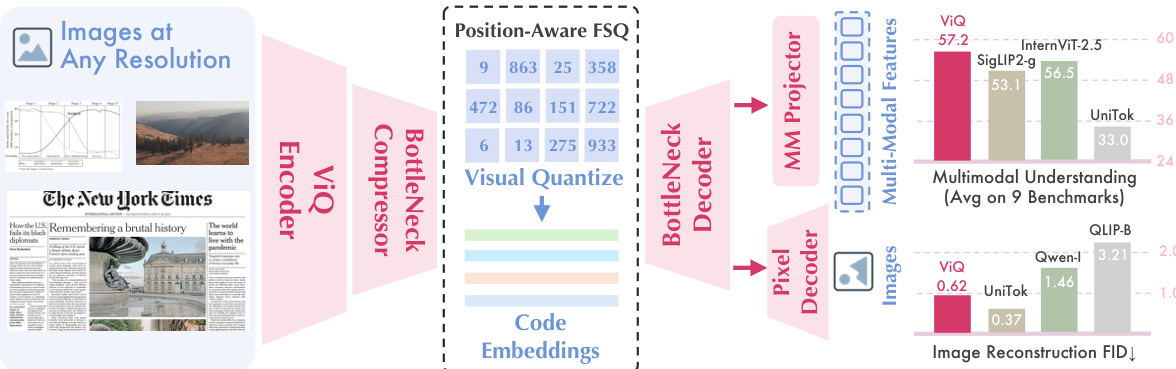
As shown in the framework diagram, input images first pass through a ViQ Encoder to extract high-dimensional features. These features are then compressed by a Bottleneck Compressor. The core module, Position-Aware FSQ, visualizes the quantization process where continuous features are mapped to discrete code embeddings. The BottleNeck Decoder then reconstructs these embeddings. The output branches into two paths: an MM Projector for generating multi-modal features for language models and a Pixel Decoder for image reconstruction tasks.
The training process follows a two-stage approach to ensure robust alignment and effective quantization. In the first stage, text-aligned pre-training aligns the visual encoder with language embeddings. To support native resolution inputs, the model replaces fixed positional embeddings with resized positional embeddings that dynamically adjust dimensions. The optimization combines a text-guided cross-entropy loss and a self-distillation loss. The text loss is defined as:
Ltext=Cross Entropy[LLM(ViQ(I), T), A]The self-distillation loss ensures semantic consistency with a fixed-resolution teacher model using cosine similarity:
Ldistill=1−cos(zsstudent,zsteacher)The second stage involves progressive quantization of the continuous features.
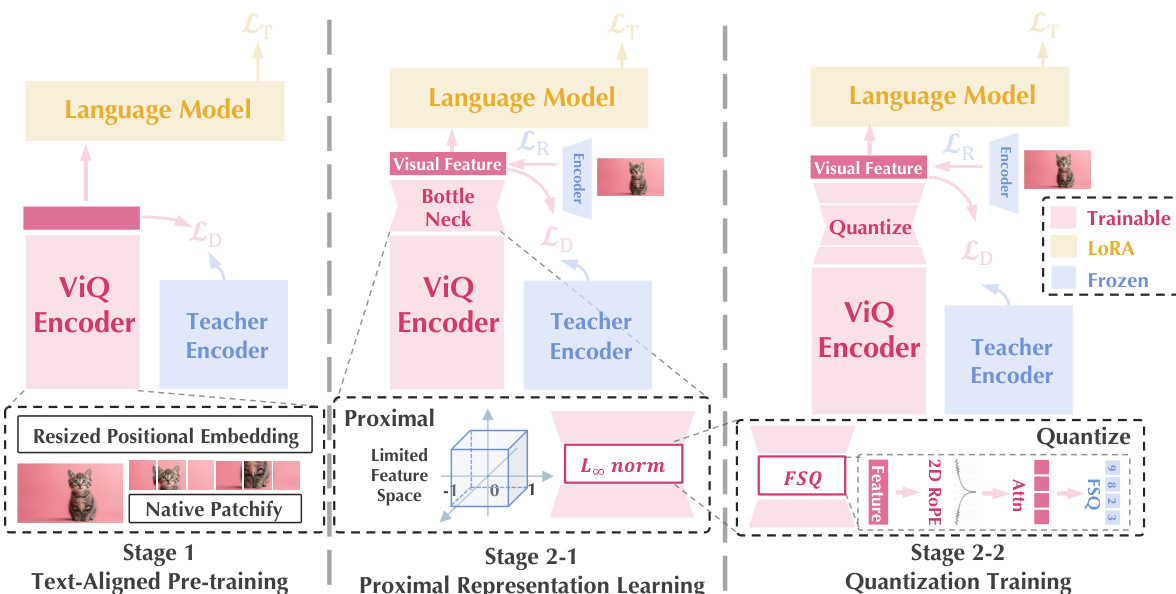
This stage begins with proximal representation learning. High-dimensional features are compressed via a bottleneck layer and constrained to a hypercube surface using the L∞ norm to reduce feature space complexity. The feature transformation is formulated as:
f1=L∞(BN(f)),f^=BN′(f1)Following this, the model employs Multi-Head Finite Scalar Quantization (FSQ). To enhance representational capacity, a multi-head attention mechanism expands each visual patch into a 2×2 grid of codes. Additionally, 2D Rotary Position Embedding (RoPE) is applied to encode spatial resolution information:
f~m=fm⊙ei(hθh+wθw)To preserve low-level details, the training incorporates a reconstruction loss supervised by a pre-trained visual autoencoder. The total objective combines the text loss, distillation loss, and reconstruction loss:
Ltotal=λtextLtext+λdistillLdistill+λreconLreconExperiment
The evaluation integrates ViQ with varying-scale language models and benchmarks it against general, multimodal-specialized, and quantized visual encoders across comprehensive understanding tasks, training efficiency tests, and image reconstruction pipelines. These experiments validate that ViQ achieves compact visual representations that preserve strong perceptual and semantic capabilities, particularly excelling in text- and document-centric tasks while delivering substantial training speed-ups through precomputed discrete codes. Ablation studies further confirm that gradually regularizing the latent space, employing non-learnable codebooks, and combining targeted reconstruction losses effectively balance low-level fidelity with high-level alignment. Overall, the findings establish ViQ as an efficient visual encoder that successfully navigates the trade-off between aggressive compression and robust multimodal understanding.
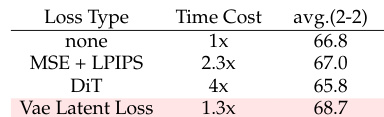
The authors evaluate different reconstruction loss formulations to optimize the training process. The experiments demonstrate that the VAE latent loss yields the best performance while being more computationally efficient than complex alternatives like MSE combined with LPIPS. The VAE latent loss achieves the highest average performance compared to other loss types. It requires less computational time than the MSE and LPIPS combination. It outperforms the baseline configuration with no specific loss.
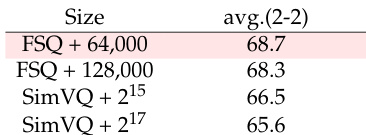
The authors compare the performance of FSQ and SimVQ quantization methods across varying codebook sizes. The findings show that FSQ consistently outperforms SimVQ, and reducing the codebook size leads to better results for both approaches. FSQ achieves higher average performance than SimVQ. Smaller codebook sizes improve performance for FSQ. SimVQ performance declines as the codebook size increases.
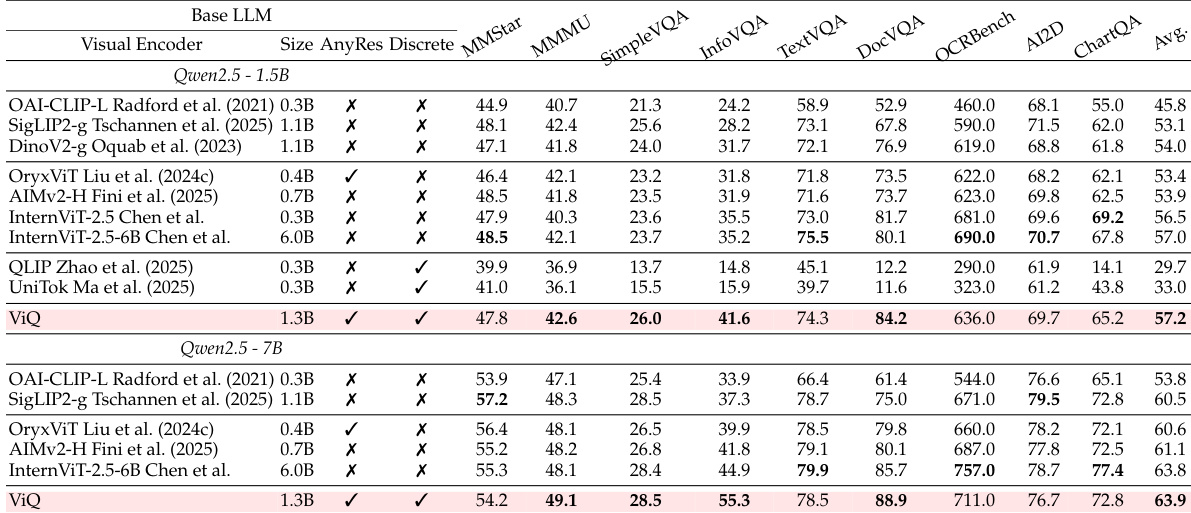
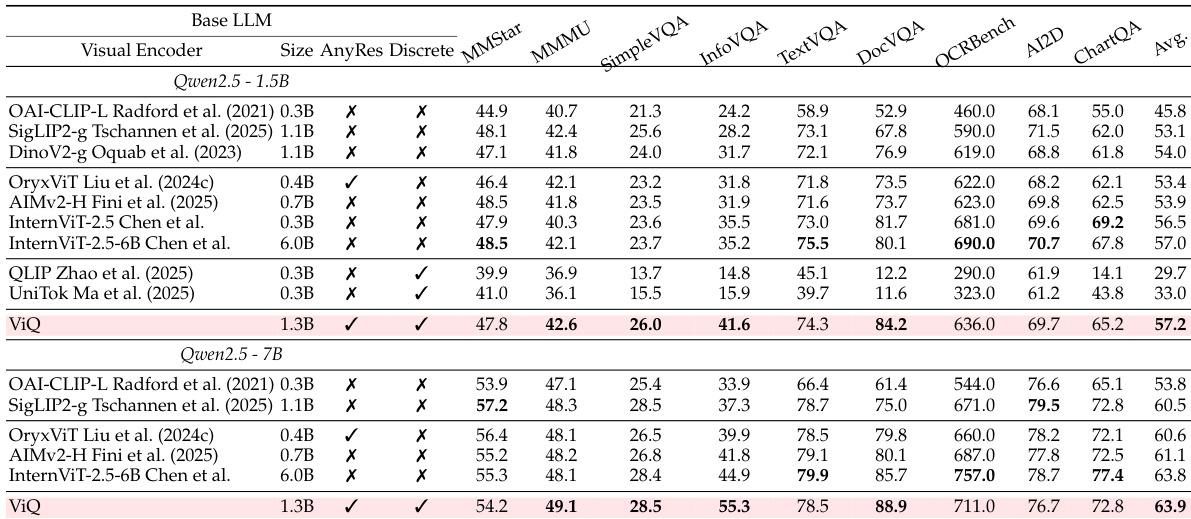
The authors evaluate ViQ against various visual encoders on multimodal understanding benchmarks to assess its effectiveness. The results demonstrate that ViQ achieves competitive overall performance, frequently matching or surpassing continuous encoders while significantly outperforming existing quantized models. It exhibits particular strength in text and document-centric tasks, validating its capability as a compact visual representation. ViQ achieves higher average scores than most continuous visual encoders across different model sizes. The model significantly outperforms previous quantized baselines on multimodal understanding benchmarks. ViQ demonstrates superior performance in text and document recognition tasks compared to other encoders.
The authors investigate the impact of bottleneck width on the model's average performance across multiple benchmarks. The results demonstrate that a significantly reduced bottleneck width can achieve performance levels comparable to the widest configuration. This suggests that the model maintains robustness and quality even with substantial dimensionality reduction. A narrower bottleneck width achieves performance similar to the widest configuration. Reducing the width does not cause significant performance degradation. The model preserves high average scores despite reduced dimensionality.
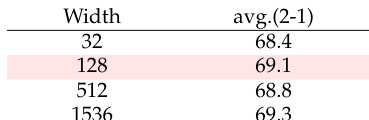
The evaluation setup systematically tests key training and architectural components, validating that the VAE latent loss optimizes both reconstruction quality and computational efficiency compared to complex alternatives. Quantization analysis reveals that FSQ consistently outperforms SimVQ, with smaller codebook sizes further enhancing results across both methods. When benchmarked against standard visual encoders, the proposed ViQ model matches or exceeds continuous approaches on multimodal tasks while significantly surpassing prior quantized baselines, particularly in text and document understanding. Finally, bottleneck width tests confirm that substantial dimensionality reduction preserves overall performance, validating the framework's robustness and compact design.