Command Palette
Search for a command to run...
意図を考慮したシーン表現による群衆におけるロボット視覚ナビゲーションの学習
意図を考慮したシーン表現による群衆におけるロボット視覚ナビゲーションの学習
Han Bao Bingyi Xia Hanjing Ye Yu Zhan Hao Cheng Baozhi Jia Wenjun Xu Jiankun Wang
概要
群衆ナビゲーションを行うロボットには、環境の構造的制約を考慮しつつ人間の意図を推論する能力が要求される。現在、深層強化学習(DRL)は、人間の意図を理解するナビゲーション方策を学習するための有望な手法を提供している。しかし、既存の手法の多くは限定的なシーン表現に依存しており、歩行者を単純な2次元点として扱い、人間および環境由来の豊富な視覚手がかりを無視している。この課題に対処するため、本稿では意図認識型のシーン表現を備えた新規な視覚ベースの群衆ナビゲーション手法であるiCrowdNavを提案する。本手法は、自己中心視点の視覚観測から行動的および構造的コンテキストをエンコードする。本手法は2つの主要な構成要素を採用している。1つはシーンの占有特徴を抽出するための時空間エンコーダ、もう1つは人間の姿勢をエンコードして歩行者の運動意図を推論するアテンションベースのモジュールであるIntent-Interact Former(I2 Former)である。これらの特徴量は、効果的なDRL方策学習を可能にするコンパクトな状態埋め込みに統合される。広範な実験により、本手法がベースラインを上回る優れた性能を発揮することが示されており、実環境での展開により視覚ベースの群衆ナビゲーションが実証された。
One-sentence Summary
iCrowdNav enhances deep reinforcement learning for crowd navigation by leveraging intention-aware scene representations that integrate a spatio-temporal encoder for environmental occupancy and the Intent-Interact Former (I^2Former) for pedestrian pose inference from egocentric views, achieving superior performance over baselines in extensive experiments and demonstrating successful real-world deployment.
Key Contributions
- iCrowdNav is a visual navigation framework that learns intention-aware scene representations directly from egocentric camera observations. The architecture combines a spatio-temporal encoder for extracting occupancy features with an Intent-Interact Former module to process human poses and infer pedestrian motion intentions.
- The method replaces simplified 2D point representations with BEV features integrated with behavioral visual cues, enabling a deep reinforcement learning policy to navigate dense crowds. This design captures both environmental structural constraints and human behavioral context within a compact state embedding for effective policy training.
- Extensive simulation benchmarks and real-world physical robot deployments demonstrate that the framework achieves improved safety and robustness compared to existing baselines. These results validate the practical viability of vision-based crowd navigation in dynamic, populated environments.
Introduction
Autonomous robot navigation in dense crowds is essential for real-world service applications but requires anticipating human behavior while navigating constrained spaces. Prior deep reinforcement learning methods typically oversimplify scene representations by treating pedestrians as low-dimensional 2D points and relying on basic occupancy maps. This approach ignores critical visual cues like body poses and environmental semantics, which limits generalization from controlled simulations to unstructured real-world environments. To address these limitations, the authors leverage a novel visual encoder within a deep reinforcement learning framework to learn intention-aware scene representations directly from egocentric RGB-D cameras. They combine a spatio-temporal encoder that extracts dense occupancy features with an attention-based module that infers pedestrian motion tendencies from 3D human poses. These enriched visual cues are fused into a compact state embedding that enables robots to navigate safely and efficiently in complex crowds with successful zero-shot sim-to-real deployment.
Dataset

-
Dataset composition and sources The authors generate the dataset entirely through simulation using the SocNav-Gym environment built on Isaac Sim. Visual data is captured using a Clearpath Dingo robot equipped with two Intel RealSense D435 RGB-D cameras, which deliver a combined field of view of approximately 140 degrees and a depth range of 0.3 to 10 meters.
-
Key details for each subset Training scenarios feature hallways, corners, cluttered spaces, and dense open areas. Testing scenarios span specialized indoor settings including hospitals, offices, and warehouses. The provided text does not specify exact dataset sizes, filtering thresholds, or subset mixture ratios.
-
How the paper uses the data The authors leverage the simulated trajectories to train and evaluate social navigation policies. Each episode randomizes the robot's starting and target positions to encourage adaptation across varied navigation tasks. Pedestrian agents follow the Social Force Model and move toward fully randomized destinations to drive policy learning.
-
Processing and environment details Natural pedestrian animations are rendered through Isaac Sim to ensure crowd interactions closely mirror real-world dynamics. The simulation does not mention explicit cropping strategies or metadata construction, relying instead on randomized episode initialization and physics-based pedestrian modeling to generate diverse navigation experiences.
Method
The authors address the challenge of vision-based robot navigation in crowded environments by formulating the task as a partially observed Markov decision process. The overall system architecture is depicted in the framework diagram, which illustrates the flow from system inputs to navigation actions. The method consists of three primary components: a feature extraction module, a feature fusion module, and a deep reinforcement learning network.
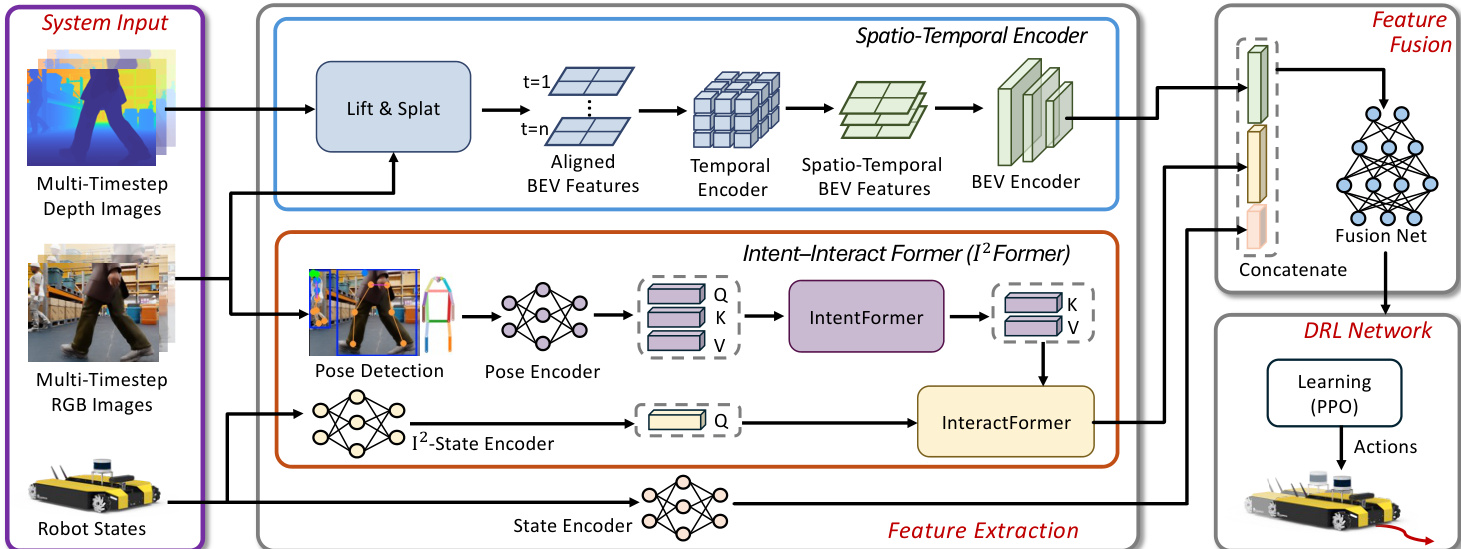
The feature extraction module processes multi-timestep RGB-D images and pedestrian poses. As shown in the detailed module diagram, the spatio-temporal encoder handles the visual inputs. It utilizes a pre-trained RGB backbone to extract features from the images. These features are then lifted to 3D space and splatted into a Bird's Eye View (BEV) representation. To capture temporal dynamics, the encoder aligns BEV features from previous time steps (t−1 and t−2) using a temporal encoder, resulting in a robust spatio-temporal BEV feature map. This encoder is kept frozen during training as it is pre-trained on external datasets.
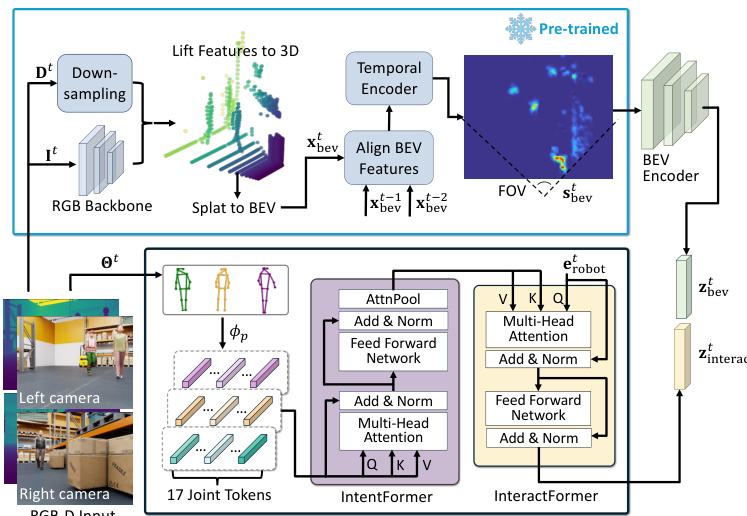
Simultaneously, the Intent-Interact Former (I2Former) extracts intention-aware features from the poses of surrounding pedestrians. The pose detection module identifies pedestrians and encodes their 17 joint tokens. These tokens are processed by an IntentFormer, which captures the intention of the pedestrians. The InteractFormer then integrates these intention features with the robot's internal state embedding (erobott) through multi-head attention mechanisms, producing interaction-aware features.
The extracted spatio-temporal BEV features (zbevt) and the interaction features (zinteractt) are concatenated with the robot state embedding to form a comprehensive state representation. This state embedding is fed into a DRL network based on the Proximal Policy Optimization (PPO) algorithm. The network is trained to maximize the expected cumulative reward, defined as:
L(θ)=Eπθ[t=0∑∞γtrt]where γ is the discount rate and rt is the reward at time t. The reward function is designed to encourage safe navigation, collision avoidance, and smooth trajectories. Specifically, the navigation reward rnavt provides dense feedback based on the distance to the goal (dgt) and the minimum distance to obstacles or pedestrians (dot). The reward logic is structured as follows:
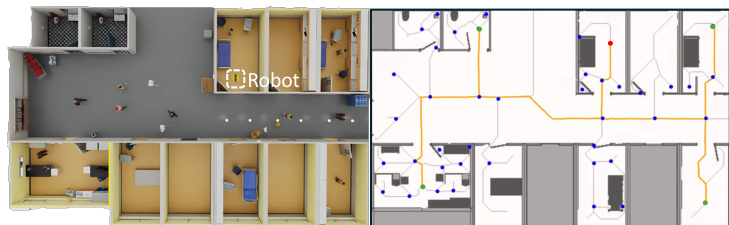
rnavt=⎩⎨⎧20,−20,0.5(dot−0.9),3.2(dqt−1−dqt),if dgt≤ρrobotelse if dot≤ρrobotelse if ρrobot<dot<0.9otherwise,where ρrobot is the radius of the robot. To address potential jitter in the policy, a trajectory-smoothing reward rωt is also included, which penalizes excessive angular velocity. The method is evaluated in complex indoor scenarios, as illustrated in the simulation visualization, where the robot must navigate through hallways and rooms while maintaining social distance from pedestrians.
Experiment
The proposed method was evaluated through simulated crowd navigation across varying spatial constraints and densities, long-horizon topological mapping tasks, and real-world deployments in complex public environments. These experiments validate the combined effectiveness of the spatio-temporal BEV encoder and intention-aware I²Former modules against ablated variants and established navigation baselines. Qualitatively, the full architecture consistently yields smoother trajectories, enhanced spatial awareness, and significantly reduced intrusion into personal space, particularly in dense or narrow settings. Ablation studies confirm that integrating both environmental occupancy features and pedestrian intention modeling is essential for flexible navigation, while real-world tests further demonstrate the system's robustness and social compliance under dynamic, occluded conditions.
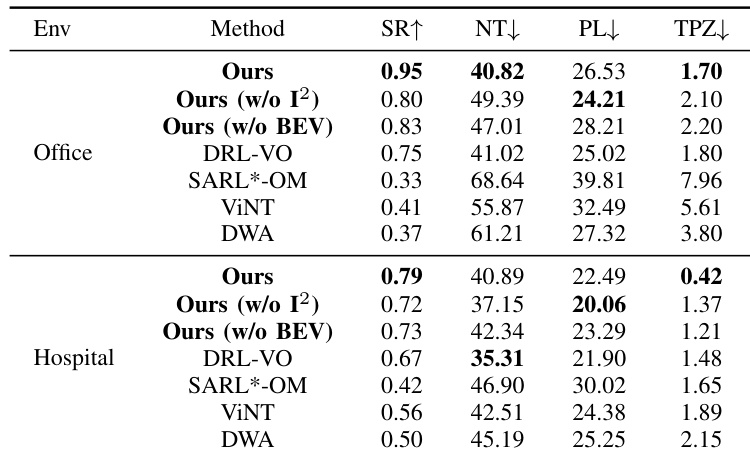
The experiment evaluates the proposed navigation method against baselines and ablation variants in office and hospital settings. The full method consistently achieves the highest success rates and the lowest time spent in pedestrians' private zones, indicating superior safety and effectiveness. Ablation studies confirm that both the intention-aware module and the BEV representation are crucial, as their removal leads to degraded performance in success rate and personal space compliance. The proposed method achieves the highest success rates in both office and hospital environments compared to all baseline methods. Removing the intention-aware module results in a decrease in success rate and significantly increased time spent in pedestrians' private zones. The full method demonstrates the safest navigation behavior by maintaining the lowest time in private zones across both environments.
The authors evaluate their navigation method against several baselines and ablated variants across three distinct environments with varying widths and crowd densities. The results indicate that the full method achieves the highest success rates and most efficient navigation while minimizing intrusion into pedestrians' personal space. Removing key components like the intention-aware module or the BEV encoder leads to significant performance drops, particularly in success rate and social compliance. The proposed method consistently outperforms baselines in success rate, navigation efficiency, and social compliance across all tested environments. Ablation studies demonstrate that both the intention-aware module and the BEV encoder are critical for robust performance, as their absence increases collisions and social violations. In narrow and high-density scenarios, the method maintains superior stability and safety compared to baselines, which often exhibit rigid or inefficient navigation behaviors.
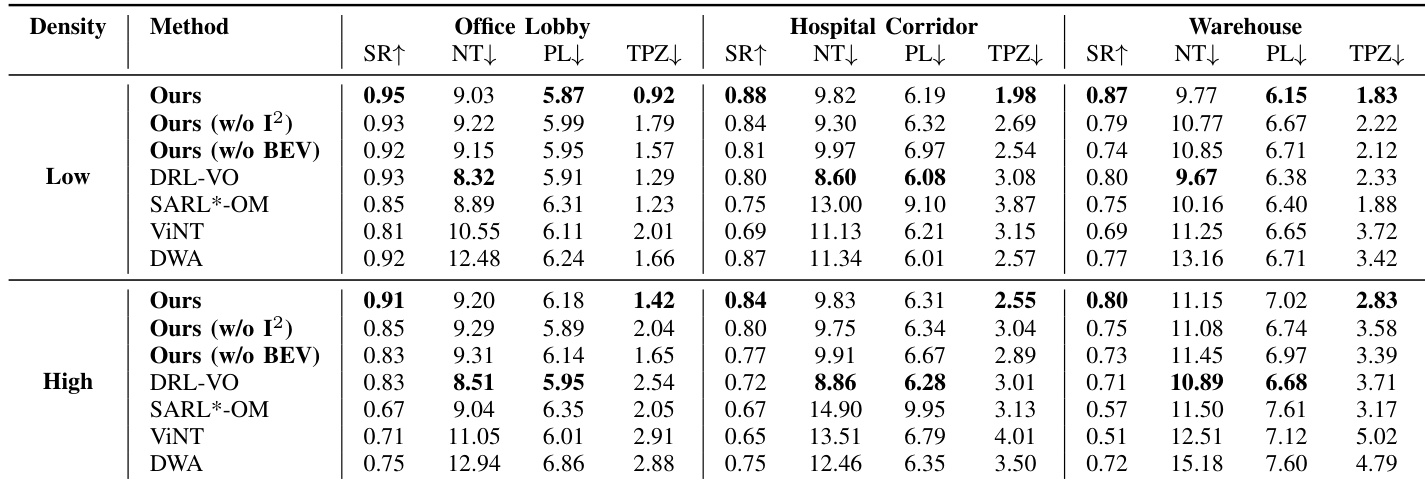
The proposed navigation method was evaluated across office, hospital, and varied environmental settings against standard baselines and ablated variants to assess its overall effectiveness and social compliance. The full system consistently demonstrates superior navigation success and efficiency while strictly minimizing intrusion into pedestrians' personal space, particularly in narrow or crowded conditions where baseline approaches exhibit rigid or unsafe behaviors. Ablation studies further validate that both the intention-aware module and the BEV representation are critical for robust performance, as their removal significantly compromises safety, increases social violations, and degrades overall reliability.